
Quick Summary
An investor first complained about unauthorised commodity trading in her Angel One account in 2011. She finally recovered ₹18,20,982 plus 8% interest running from 2011, in December 2024, after her case survived a rejection, a High Court appeal, and a second arbitration from scratch. Along the way, Angel One’s own audio recording of the disputed order, produced only after the broker had earlier told the exchange no recording existed, was found suspicious enough that the final tribunal disregarded it entirely. This page tells the story in order: what happened, what she argued, what Angel One argued, and how the case was finally decided.
Most disputes resolve or die within a year or two.
This one took thirteen years, two arbitral tribunals, and a High Court appeal before an Angel One client finally recovered her money.
Angel One 13-Year Arbitration Case: What Happened
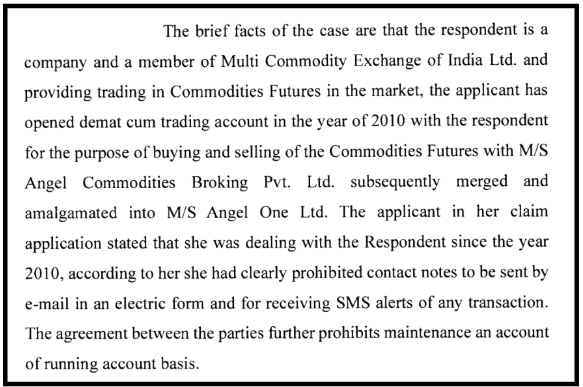
In September 2011, the investor discovered a large number of commodity trades had been executed in her Angel One account that she says she never authorised.
Under pressure, and holding scrips worth roughly ₹40 lakh in her demat account that the broker threatened to sell, she paid Angel One ₹18.40 lakh by cheque to protect her holdings.
Her husband, an advocate, had undergone major surgery around this time and was hospitalised for several days.
She says this is why she did not review the emails and SMS alerts Angel One sent about the disputed trades in time to object before the damage was done.
She complained to SEBI in February 2012, then filed her first arbitration application the same year, the start of a process that would stretch across two tribunals and a High Court appeal, longer than almost anything else among Angel One complaints on record.
What She Argued
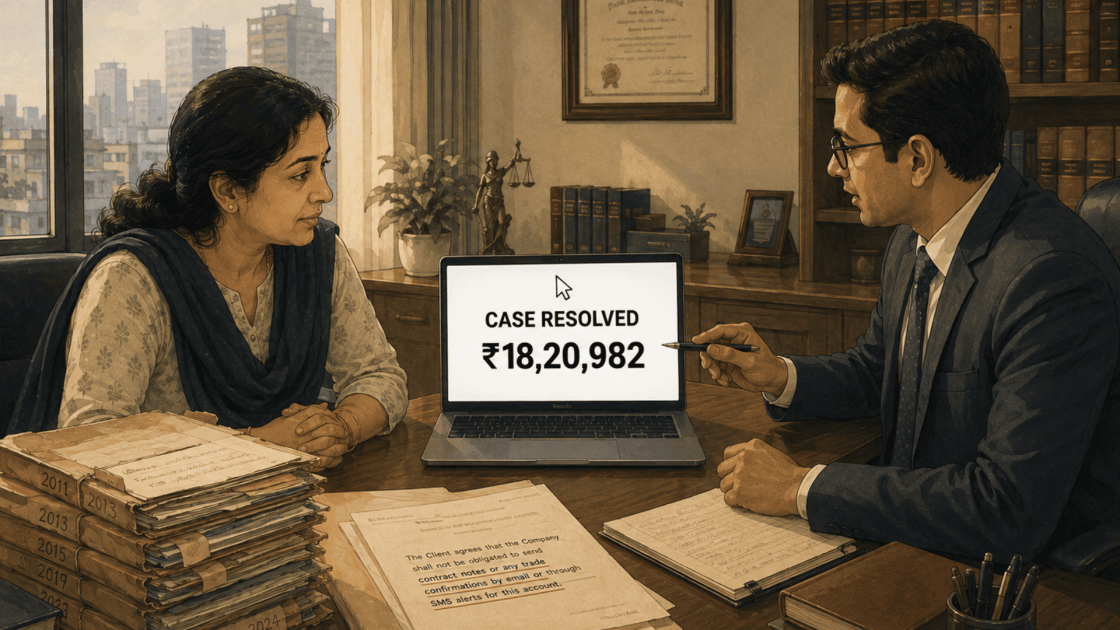
Her central argument, repeated at every stage over the next thirteen years, rested on one document: her 2010 client agreement, which she said expressly prohibited contract notes being sent to her by email and expressly prohibited SMS alerts for that specific account.
If she had validly opted out of receiving these communications electronically, then Angel One’s claim that she had “seen and ignored” the trade confirmations could not be used against her, because she was never supposed to be receiving them that way in the first place.
She also argued Angel One could not produce a single order she had actually placed, even though it was required to keep that record.
What Angel One Argued
Angel One’s position was that it had properly notified her of every disputed trade through email and SMS alerts sent to the address and number she had provided, and that her failure to object within a reasonable time meant she had effectively accepted the trades.
At one stage, it relied on an audio recording it said supported its case that the trades were authorised.
Round One: The First Arbitration Rejects Her Claim
The first arbitral tribunal, in 2012, sided with Angel One.
It reasoned that she had been trading in the stock market since 2007, had not denied receiving the contract notes, SMS alerts, and emails documenting the disputed trades, and dismissed her claim outright.
Round Two: The High Court Single Judge Rules for Her
She did not stop there. She challenged that award in the Delhi High Court under Section 34 of the Arbitration and Conciliation Act.
In March 2018, a single judge ruled in her favour, ordering Angel One to pay the full ₹18,20,982 with 6% interest from November 2011.
The single judge’s reasoning turned on the same document she had argued from the start: her 2010 client agreement, which prohibited email contract notes and SMS alerts for this account.
Angel One could not produce a single order she had actually placed.
The judge also examined Angel One’s audio recording closely and found it deeply suspicious.
The broker had earlier acknowledged, in writing, that it had no such recording.
The audio surfaced only later, after the fact, and did not even relate to the actual placing of the disputed orders.
Round Three: The Division Bench Sends It Back
Angel One appealed the single judge’s ruling to the Division Bench of the Delhi High Court.
In 2019, the Division Bench set the award aside, not on the facts of the dispute, but on a narrower legal point: that the single judge had gone further into re-examining the evidence than Section 34 of the Arbitration Act allows a court to do.
The underlying facts of who was right remained unresolved, and the matter was sent back for a fresh arbitration.
Round Four: A Fresh Arbitration Reaches the Same Answer
She filed again in 2023, and after one procedural detour to get the case in front of a properly constituted three-member panel rather than a sole arbitrator, that panel finally heard the case afresh, going through the entire record built up over more than a decade.
The final tribunal reached the same conclusion the High Court single judge had reached back in 2018.
The client agreement expressly barred email contract notes and SMS alerts for this account. That being so, it was Angel One’s burden to prove she had separately agreed to receive them, and the broker could not do it.
Merely showing she had agreed to receive electronic contract notes for a different, related account did not prove she had agreed to it for this one, since each was a separate legal agreement.
The tribunal also noted that MCX’s own record-keeping circulars required Angel One to keep evidence, ideally a sound recording, of the client actually placing each disputed order.
No such contemporaneous record existed. The recording produced later, after the broker had already told the exchange no recording existed, could not be relied upon.
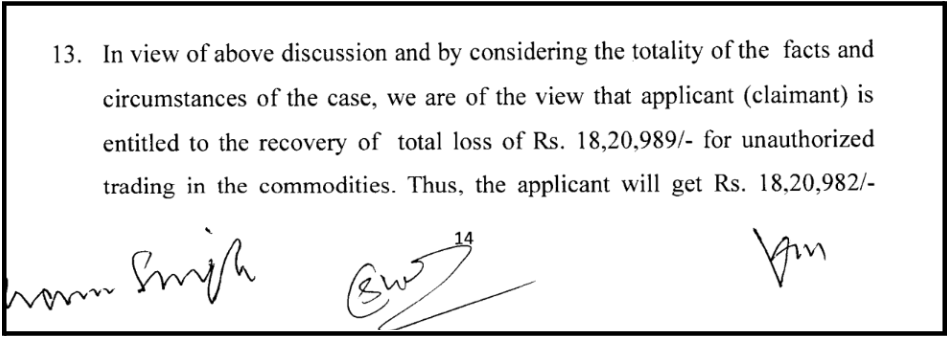
In December 2024, the tribunal awarded the investor ₹18,20,982, with 8% simple interest running all the way back to 21 November 2011, the date of her original claim, rising to 12% penal interest if not paid within three months.
What Kept This Case Alive for Thirteen Years
Three things, each ordinary on their own, combined to make a case this durable.
- She read her own client agreement closely enough to spot the one clause that mattered: The prohibition on email contract notes and SMS alerts, buried in a 2010 document, became the single fact that decided the case twice, in 2018 and again in 2024.
- She pursued every available escalation rather than accepting the first rejection: SEBI complaint, first arbitration, High Court single judge, High Court Division Bench, second arbitration. Each stage that failed led to the next available route rather than the end of the matter.
- She kept the paper trail intact across more than a decade: A case this old only survives if the original documents, contract terms, and correspondence remain available and are re-presented consistently at every stage.
What This Means for Your Own Dispute
Very few cases will take this long, and this one is included here because of what it reveals about the mechanics of a strong claim, not as a typical timeline to expect.
Gather now:
- Your original client agreement or KYC document, read closely for any clause about how you are meant to receive contract notes and alerts
- Every piece of correspondence with the broker about the disputed activity, kept indefinitely, not just for the first year or two
- Any recording, log, or record the broker claims to have, and when it was first produced or mentioned
Read your own agreement for what it actually says, not what you assume it says. The clause that ultimately won this case was sitting in the client’s own file for thirteen years before it decided the outcome.
Our page on how to file complaint against Angel One covers where to start, from the first written complaint to the broker through to escalating with SEBI.
For the full picture of how these disputes typically resolve, including timelines and outcomes across many cases, see Angel One arbitration cases.
Unauthorised trading disputes tend to hinge on the same handful of documents and arguments, no matter how long the case ultimately takes to resolve.
For a related unauthorised trading case, Angel One unauthorized share sale arbitration.
Facing unauthorised trading in your account that the broker is trying to explain away?
Our team goes through your original account agreement clause by clause, checks it against what the broker actually did, and builds the claim to last as long as it needs to. Register with us for a free consultation.
An Honest View of the Odds
Most disputes should not, and do not, need thirteen years. This case took that long because it was appealed at nearly every stage, which is unusual.
What it does show clearly is that a well-documented claim, grounded in the broker’s own paperwork rather than a verbal dispute, can survive setbacks that would end a weaker case.
The clause that won it was there from day one. It just took thirteen years of persistence to reach a tribunal willing to apply it properly.
Conclusion
Thirteen years after an unauthorised trading complaint began, an Angel One client recovered ₹18,20,982 with interest running the entire time, because one clause in her original agreement never stopped being true, and she never stopped pursuing it.
Most cases resolve far faster. But this one is a reminder that a claim grounded in the broker’s own documents does not expire just because the first, second, or even third attempt does not succeed.
Report. Recover. Stay Fraud Free.
Frequently Asked Questions
It went through a first arbitration that rejected the claim, a High Court appeal that won it, a further appeal that sent it back on procedural grounds, and a second arbitration that finally confirmed the original finding. Each stage added years, which is unusual even for a contested case.
The client's 2010 agreement, which expressly prohibited contract notes being sent by email and SMS alerts for that specific account. Because Angel One could not prove she had separately consented to receive them, the broker could not rely on those communications as proof she knew about the disputed trades.
Angel One had earlier told the exchange it had no recording of the disputed order being placed. A recording surfaced only later in the process, did not relate to the actual placing of the orders, and was found too doubtful to rely on.
The tribunal awarded ₹18,20,982 with 8% simple interest running from 21 November 2011, the date of the original claim, rising to 12% penal interest if the amount was not paid within three months of the December 2024 award.


 Add us as a preferred source on Google »

