

Quick Summary
Initial Claim: ₹1,00,000 Core Violation: A firm registered as a Research Analyst charged a 30 percent cut of every profitable trade, an arrangement SEBI prohibits outright, then layered a separate recovery fee on top once losses began mounting. Forum Used: Direct negotiation with the firm, following a formal legal notice. Recovery Secured: ₹80,000. Manav Trivedi (name changed) is from Ujjain, Madhya Pradesh. He paid this firm when he won. He paid this firm again, differently, when he lost. Either way, the firm collected.
A representative of a firm registered with SEBI as a Research Analyst approached Manav, offering advisory services for Nifty trades.
The terms were stated plainly from the start: a thirty percent cut of any profit made on his trades.
His first trade under this arrangement showed a small profit, and he paid ₹2,000 as the agreed profit share. That single successful trade set the pattern for everything that followed.
A profit-sharing arrangement of this kind is not a minor disclosure gap.
SEBI regulations prohibit research analysts from entering into profit sharing arrangements with clients at all, regardless of the percentage or how transparently it is stated upfront.
From Winning Cuts to Loss Demands: How the Scheme Transformed
As Manav continued following the firm’s recommendations, profits gave way to consistent losses. His total trading losses eventually reached ₹1,05,000.
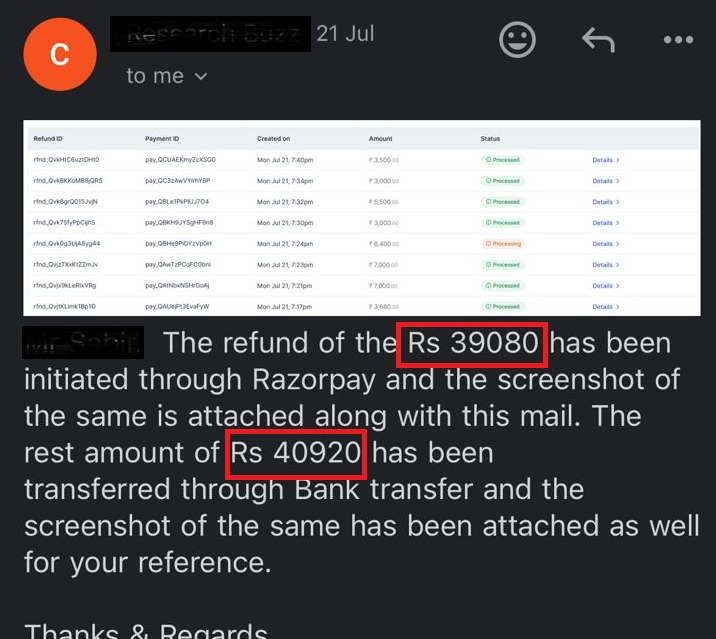
Rather than pausing or adjusting the approach, the firm introduced an entirely new charge at this stage: a recovery fee of ₹39,080, framed as the path back to profitability.
This was a different fee entirely from the profit share he had paid earlier, layered on top of losses the original arrangement had already contributed to.
Anyone charged under a similar layered fee structure can learn how to complaint against research analyst firms operating this way, since profit sharing combined with a separate recovery fee compounds two distinct violations into one relationship.
Repeating the Pattern: Exploiting Losses to Extract More Money
At one point, following a loss of ₹6,400, Manav was again told that paying additional fees would help recover what had gone wrong. No recovery followed.
The pattern simply repeated, each loss met not with caution but with another request for money.
By the time Manav stepped back to assess the full picture, it was clear the structure itself was designed to extract payment regardless of outcome, a cut when he won, a fee when he lost.
How We Built a Case Around Two Separate, Stacked Violations?
This case needed the profit sharing arrangement and the recovery fee treated as two distinct violations, since folding them together would have understated the extent of what had actually happened.
Step One: We Documented The Profit Share Terms From The First Trade
The thirty percent arrangement, stated plainly from the outset, was recorded as a standalone violation, since SEBI’s prohibition on profit sharing applies regardless of how openly the terms were communicated.
Step Two: We Separated The Recovery Fee As A Distinct Charge
The ₹39,080 recovery fee was documented independently from the original profit share, showing it as a second, separate extraction layered on top of losses rather than a natural extension of the original fee structure.
Step Three: We Traced The Pattern Across Every Payment
Each payment, the initial profit share, the recovery fee, and the smaller additional payment following a further loss, was placed on a single timeline to show a consistent pattern rather than isolated incidents.
Step Four: We Matched Both Fee Types To Specific SEBI Violations
The profit sharing arrangement and the recovery fee were each tied to their own specific regulatory basis, giving the complaint two independently strong grounds rather than one blended claim.
Step Five: We Sent A Legal Notice Covering Both Violations Together
Our notice set out the full payment history alongside both violations, giving the firm a clear deadline to respond to the complete picture rather than a partial version of events.
Step Six: We Pushed Through Direct Negotiation With The Firm
With both fee structures clearly documented and independently grounded in specific regulations, our team moved the matter toward resolution through direct engagement.
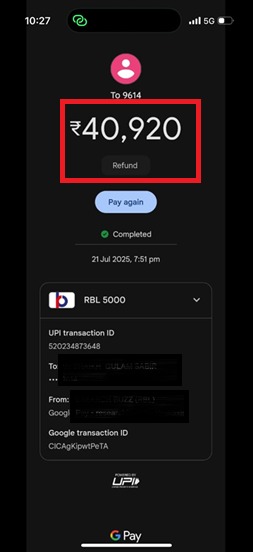
Through this direct negotiation, the matter resolved with a recovery of ₹80,000.
Charged A Cut Of Your Profits And Then A Fee For Your Losses? Our Team Can Help
Manav’s case worked because we treated the profit share and the recovery fee as two separate violations, not one blurred complaint. If you have paid a firm both ways, list every payment out separately today.
Register with us and we will take it from there.
Conclusion
A firm that profits whether a client wins or loses has built a structure that works against the client by design, not by accident.
Manav’s case shows why a profit share and a later recovery fee should never be treated as one combined dispute, since each rests on its own violation and deserves its own documented weight in the complaint.
Watching for a fee structure that changes shape once losses begin, moving from a cut of your winnings to a charge for fixing your losses, is often the clearest sign that a relationship has moved from advisory into extraction.
Report. Recover. Stay Fraud Free.
Frequently Asked Questions
No. SEBI regulations prohibit research analysts from entering into any profit sharing arrangement with clients, regardless of the specific percentage agreed or how clearly it was stated.
Yes. It represents a separate charge layered on top of an already problematic fee structure, and should be documented and challenged as its own distinct violation.
Agreement to a prohibited structure does not make it lawful. The regulation exists specifically to prevent this kind of arrangement from being offered to clients at all.
Treat it as a warning sign rather than a genuine solution, and preserve every message describing the new charge before deciding how to respond.
Yes. Payments made at different points, even under different labels like profit share or recovery fee, can be documented together to show the full pattern of a single scheme.





 Add us as a preferred source on Google »

