

Quick Summary
When the government’s 2020 Yes Bank restructuring scheme locked in 75% of existing shareholdings, Angel One mishandled the transition for multiple clients. Two arbitration cases show strikingly different results from the same underlying failure. In one, the client and Angel One split a ₹33,100 loss equally, each bearing part of the blame. In the other, the client recovered the full ₹1,51,238 plus interest and 500 undelivered shares, because Angel One’s failure to warn the client was the sole cause of loss. This page tells both stories side by side and explains what separated a shared loss from a full recovery.
Not every Yes Bank lock-in dispute against Angel One ended the same way. One client split the loss. Another recovered it in full.
Here is what happened in each, and why the outcomes diverged.
Angel One Arbitration Case One: What Happened
The government’s reconstruction scheme for Yes Bank, effective 13 March 2020, locked in 75% of each shareholder’s existing holdings for three years.
A client held 3,000 Yes Bank shares as of that date and sold all of them in two tranches, 2,250 shares on 16 March and 750 on 18 March, before realising the lock-in applied to most of that holding.
Angel One was required to reverse the sale of the locked-in portion, 2,250 shares, but reversed only 1,750 by mistake.
It also never told her the lock-in existed at all.
What The Client Argued
She said Angel One had failed her twice: first by not telling her about the lock-in before she sold, and second by botching the reversal it was required to carry out.
She had no way of knowing about a regulatory scheme her broker never mentioned, and the resulting loss should fall entirely on Angel One.
What Angel One Argued
Angel One did not seriously dispute that it had made an error in the reversal count.
Its broader position was that the restructuring scheme was public knowledge, and that as a shareholder she carried some responsibility for knowing the terms affecting her own holdings, independent of anything the broker specifically told her.
Final Conclusion By the Tribunal
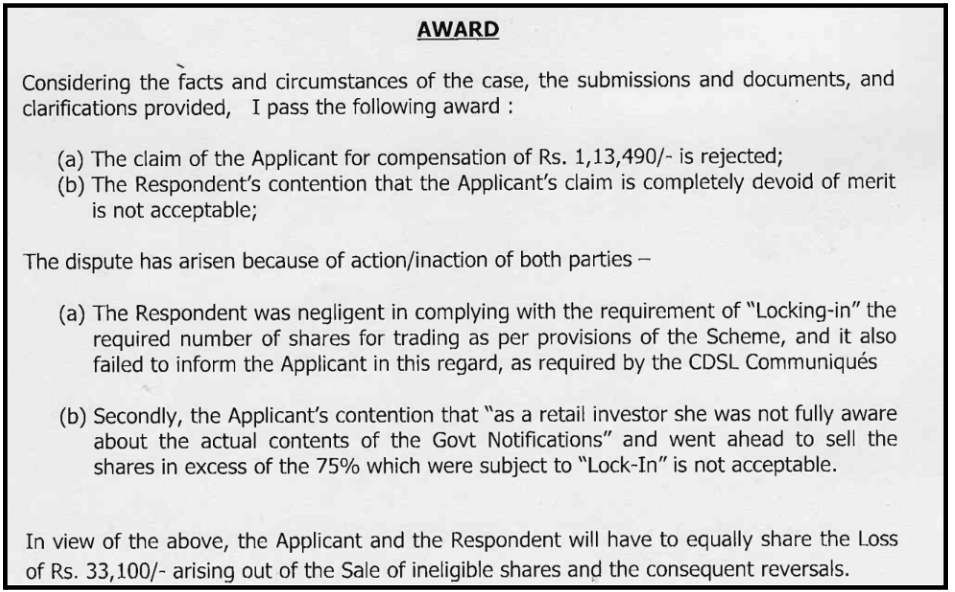
The tribunal found fault on both sides. Angel One had clearly failed to lock in the correct number of shares and never informed the client, a real lapse.
But the tribunal also held that the restructuring was public knowledge, and the client had gone ahead and sold shares without checking the terms herself.
Both parties shared responsibility, and the tribunal split the resulting ₹33,100 loss equally, awarding her ₹16,550.
Angel One Arbitration Case Two: What Made It Happen
A different client bought 8,000 Yes Bank shares on 16 and 17 March 2020 and sold 7,500 of them.
Because of the restructuring, Yes Bank shares briefly existed under two parallel ISIN codes, an old one and a new one.
Some of what he had purchased came through in the old, soon-to-be-suspended ISIN.
When he tried to settle his sales, part of the delivery failed, triggering a forced auction close-out at unfavourable prices.
What He Argued
He argued this was entirely different from a case where a client should have known the public rules.
He had no way of knowing which of his own purchased shares carried the old ISIN versus the new one.
Only Angel One, processing the trades on the back end, could have known that split.
He should not bear any loss from a technical detail he had no visibility into.
What Angel One Argued In This Case
Angel One’s position was that the ISIN split arose from regulatory and depository actions outside its control.
That the failed settlements were an inevitable consequence of market-wide conditions during the restructuring, not something specific to how it had handled his account.
What the Tribunal Concluded For This Case
The tribunal agreed with the client on the key point.
Unlike the first case, where the client could have checked publicly available lock-in terms, this client had no reasonable way to know which ISIN his own shares carried.
That information existed only on Angel One’s side of the transaction.
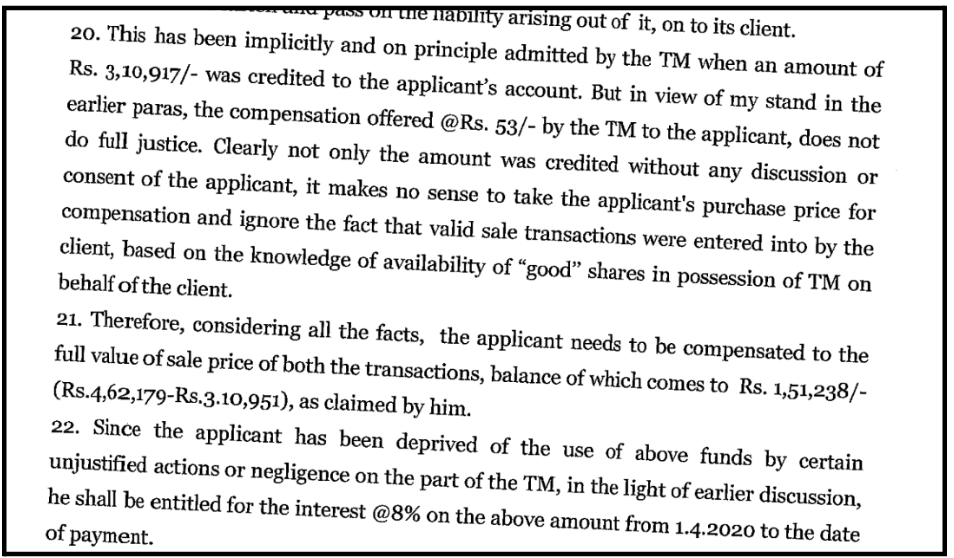
The tribunal found this was entirely a due diligence failure on Angel One’s part.
Angel One had already, without discussion, credited a partial compensation of ₹3,10,951, but the tribunal found this insufficient and awarded the full outstanding balance of ₹1,51,238 plus 8% interest, along with delivery of the 500 shares still pending, plus interest on those too.
Why the Two Cases Ended So Differently
The distinction the tribunals drew was consistent across both of these Angel One arbitration cases: where the client could have checked something and did not, liability is shared.
Where the client had no way to check, the broker bears it alone. Public knowledge of a restructuring scheme is one thing.
Private, broker-side information about which ISIN a specific batch of shares carries is another.
What to Do With a Similar Corporate Action Dispute?
Corporate action mishandling, whether from a restructuring, a demerger, or an ISIN change, follows a similar pattern of dispute.
The key question is always whether you had any way to know what the broker failed to tell you.
Gather now:
- Every communiqué the depository or exchange issued about the corporate action, and whether your broker forwarded it to you.
- Your transaction and reversal history for the affected period, with exact dates and prices.
- Any partial compensation the broker credited unilaterally, and how it was calculated.
- Public market data for the correct settlement dates, to check whether the broker used a fair price.
Ask whether the information was knowable to you.
If the broker had specific technical knowledge, like which ISIN your shares carried, that you had no way of checking yourself, that shifts responsibility more fully onto the broker.
Our page on how to file complaint against Angel One covers the complaint process before arbitration.
If the information was public and you simply did not check, expect the tribunal to split the loss.
For related cases from the same period, see Angel One unauthorized share sale arbitration.
Did a corporate action get mishandled in your account, leaving you with an unexplained loss?
Our team reconstructs the timeline against the exchange’s own communiqués, identifies whether the broker or the investor bore the informational gap, and builds the claim accordingly. Register with us for a free consultation.
An Honest View of the Odds
Corporate action disputes are rarely all-or-nothing.
Tribunals look closely at what each side could reasonably have known, and split liability where both sides share some responsibility.
Your best outcome depends on showing the tribunal exactly what information only the broker had access to, versus what was publicly available and simply went unchecked.
That distinction, more than the size of your loss, tends to decide these cases.
Conclusion
Two Yes Bank lock-in disputes against Angel One, two different results.
One client recovered half her loss because both sides shared the blame. The other recovered his loss in full, plus his undelivered shares, because the broker alone held the information that mattered.
If a corporate action went wrong in your account, the outcome depends less on how much you lost and more on who actually had the information to prevent it.
Report. Recover. Stay Fraud Free.
Frequently Asked Questions
Yes, if you can show the broker failed to inform you of something it was required to communicate, such as a lock-in or an ISIN change. Whether you recover the full loss or a shared portion depends on whether you also had a reasonable way to know the risk.
The client who recovered in full could not have known which shares carried a suspended ISIN, since only the broker had that information. The client who recovered half had a way to check the public lock-in notification herself and did not, so the tribunal split the fault.
One case resulted in ₹16,550, being half of a ₹33,100 loss shared between the client and the broker. The other resulted in ₹1,51,238 plus 8% interest and delivery of 500 pending shares, the full amount claimed.
Check whether the exchange or depository issued a public notification your broker should have forwarded to you, and whether the information involved something only the broker could have known, like which ISIN your specific shares carried. That distinction shapes how much of the loss you can recover.


 Add us as a preferred source on Google »

