

Quick Summary
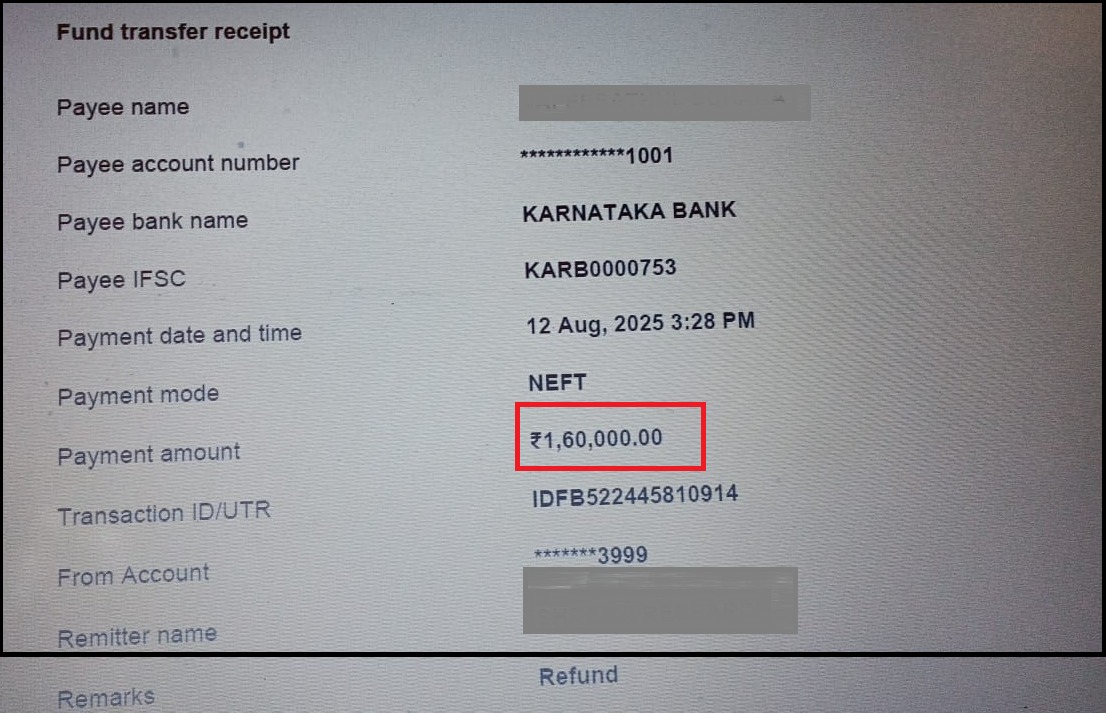
Initial Claim: ₹2,50,000 (₹2,30,000 in trading losses plus ₹20,000 in fees) Core Violation: A firm registered as a Research Analyst promised guaranteed returns, used a small early profit to build trust, then pressured the client into increasing her investment well beyond what she had agreed to, leading to a devastating single day loss. Forum Used: Direct negotiation with the firm, following a formal legal notice. Recovery Secured: ₹1,60,000. Nafeesa Iqbal (name changed) is from Udupi, Karnataka. Her first trade earned her six thousand rupees. That single number was enough to convince her to trust an analyst who would go on to push her capital far past where she was ever comfortable.
Nafeesa was contacted by a representative claiming to be a SEBI-registered research analyst, offering advisory services with an assurance of guaranteed high returns.
Her very first trade under his guidance produced a profit of ₹6,000.
That early, genuine result did more work than any sales pitch could have. It converted a stranger’s promise of guaranteed returns into something that felt proven.
How Analysts Push Clients to Over-Leverage Capital?
Once that trust was established, Nafeesa was pushed to increase her investment well beyond her original comfort level.
This was not a suggestion offered once and left for her to consider.
It was sustained pressure applied directly.
A single trading day under this increased exposure produced a loss of ₹1.2 lakh, a figure that dwarfed the small profit that had started the relationship in the first place.
Advice That Kept Coming After The Damage Was Done
Rather than pausing after that single devastating day, further trades were advised, adding still more to her losses.
By the time the full picture came together, her total trading losses had climbed to ₹2,30,000.
Throughout this entire period, no risk associated with these trades was disclosed to her, and no stop-loss strategy was ever discussed as part of the advisory relationship.
Anyone pushed to increase their investment after a small early win can complaint against sebi registered research analyst using this exact sequence, since the pattern of a small proven profit followed by pressure to risk far more is a recognised inducement tactic.
Fees Paid For A Relationship Built On A False Guarantee
Alongside the trading losses, Nafeesa paid ₹20,000 in fees for services that had been sold to her on the promise of guaranteed profits, a promise SEBI’s rules for research analysts explicitly prohibit.
How We Analyzed the SEBI Research Analyst’s Tactics
The genuine early profit made this case slightly more complex to frame, since it required showing how a real result had been weaponised rather than pretending the whole relationship was fabricated from the start.
Step One: We Established The Small Profit As The Trust-Building Moment
The ₹6,000 early profit was documented specifically as the inducement point, the moment that made everything which followed possible, rather than treated as an incidental detail.
Step Two: We Isolated The Single Catastrophic Trading Day
The ₹1.2 lakh loss from the single day of increased exposure was pulled out and examined on its own, showing exactly how far the position size had grown from where Nafeesa had started.
Step Three: We Documented The Continued Advisory After The Loss
Trades advised after that devastating day were compiled separately, showing a pattern of continued pressure rather than any pause or reassessment following the loss.
Step Four: We Matched The Guaranteed Return Promise To The Specific Regulation
The explicit assurance of guaranteed high returns made at the very first contact was tied directly to SEBI’s prohibition on such promises, anchoring the fee claim in a clear violation.
Step Five: We Sent A Legal Notice Covering The Full Financial Picture
Our notice combined the fee claim and the trading loss claim into one complete demand, supported by the documented sequence from the first profitable trade through to the final loss.
Step Six: We Pushed Through Direct Negotiation With The Firm
With the full sequence laid out clearly, from trust-building profit to pressured escalation to eventual silence, our team engaged the firm directly to move toward resolution.
Through this direct negotiation, the matter was resolved with a
Pushed To Invest More After An Early Win? Our Team Can Help
Nafeesa’s case turned on documenting the exact sequence, one small profit, then pressure to risk far more. If that sounds familiar, write down the timeline yourself while it is still fresh.
Register with us and we will take it from there.
Conclusion
A genuine early profit is not proof that an advisory relationship is trustworthy; it is often the exact mechanism used to make everything that follows feel safe.
Nafeesa’s case shows why a small proven win followed by pressure to risk significantly more deserves scrutiny rather than confidence, since the size of the eventual loss is rarely proportional to the size of the trust-building trade that came before it.
Documenting that specific sequence: the win, the pressure, and the single day the losses arrived, gave this case a clarity that a general complaint about bad advice would not have had on its own.
Report. Recover. Stay Fraud Free.
Frequently Asked Questions
Not necessarily. A real early win can be used deliberately to build trust before a client is pushed toward much larger, riskier positions.
Yes. Advice must be suitable to a client's own risk appetite and financial situation, not driven by pressure to deploy more capital regardless of comfort level.
It shows clearly how far a position had grown from where the client started, making the scale of the escalation and its consequences easy to demonstrate.
Yes. A profitable start does not offset a guaranteed return promise made at onboarding or losses caused by advice that followed later.
Save every message where the increase was suggested or pushed, along with the dates, so the sequence from trust building to pressure to loss is clear.





 Add us as a preferred source on Google »

