
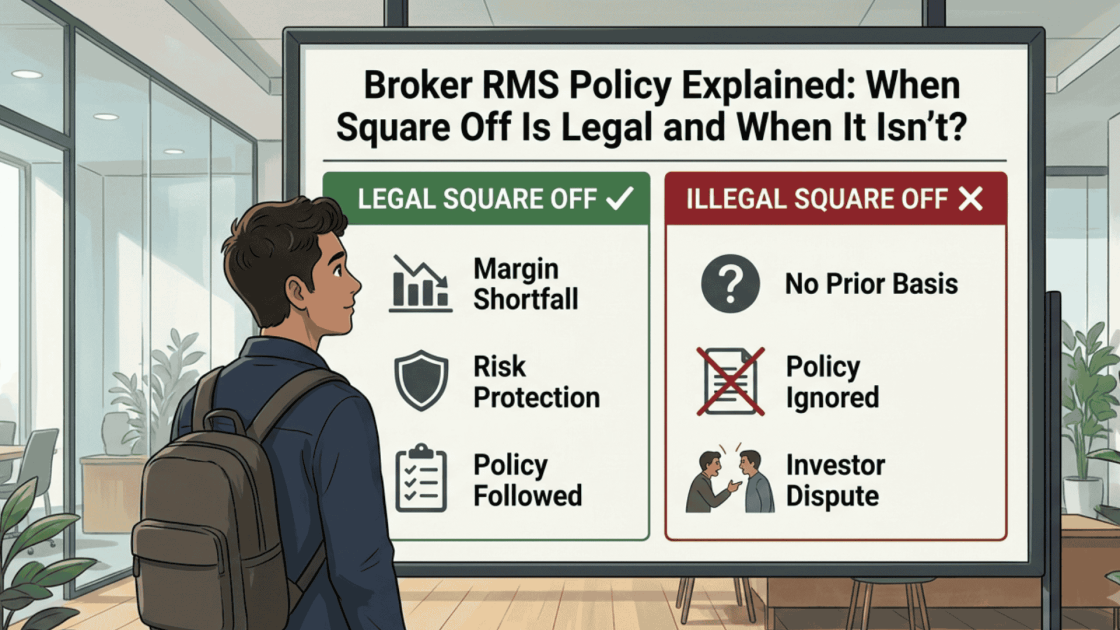
Quick Summary
Every broker’s RMS can square off your position for a genuine margin shortfall, and NSE rules allow that. What the rules do not allow is doing it without reasonable notice, ignoring proof of payment you already made, or closing a position when nothing was actually owed. NSE tribunals have ordered Angel One, IIFL, Sharekhan and Zerodha to pay clients amounts ranging from ₹15,984 to over ₹36 lakh for exactly these failures. This page lays out where the legal line sits, the four patterns that have won in arbitration, and what to collect if your own position was closed without warning.
Your broker’s RMS policy sounds like fine print until the day it closes your position without asking you first.
NSE tribunals have made brokers pay for wrongful square-offs in amounts from ₹15,984 to over ₹36 lakh, and the same rule decided every single case.
That rule is simple to state and easy to miss in the moment it matters.
This page shows you exactly where it sits, so you can tell which side of it your own square off falls on.
Is a Broker Square Off Ever Illegal?
A broker can square off your position when you genuinely fall short on margin. That much is normal, and NSE and BSE rules allow it without needing your explicit permission in the moment.
What tips a square off from lawful into wrongful is timing and proof, not the act itself.
If the broker sold before giving you a fair chance to respond, or after you had already paid and proven it, or when nothing was actually owed, tribunals have consistently ruled against the broker.
Four recent NSE arbitration awards show exactly where that line sits, and each one decided the same principle from a different angle.
When Is a Broker Square Off Considered Illegal by Tribunals?
These four cases cover four different ways a square off goes wrong, and knowing which one matches your situation tells you what evidence actually matters.
One turns on notice, one on ignored payment, one on non-existent dues, and one on an alerting system that left no real window to respond.
Match your own timeline against these before you decide whether to challenge yours.
1. Angel One Square Off: No Notice Before Liquidation
In Angel One square off arbitration, an NSE tribunal ordered Angel One to pay ₹17,217 plus 6 percent interest after it sent a margin shortfall message and squared off the position in the same afternoon, at 1:43 pm.
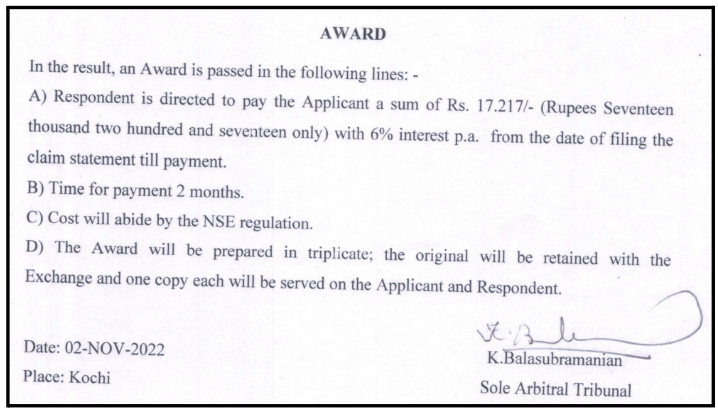
The tribunal held that squaring off without proper notice breaches the principles of natural justice, because the client never had a real window to add funds.
2. IIFL Square Off Despite Proof of Payment
IIFL wrongful square off arbitration produced the largest of these awards.
IIFL squared off a client’s position at ₹36,04,575 even though he had wired ₹20 lakh in margin that morning and shared the transfer proof with his relationship manager, who confirmed receiving it.
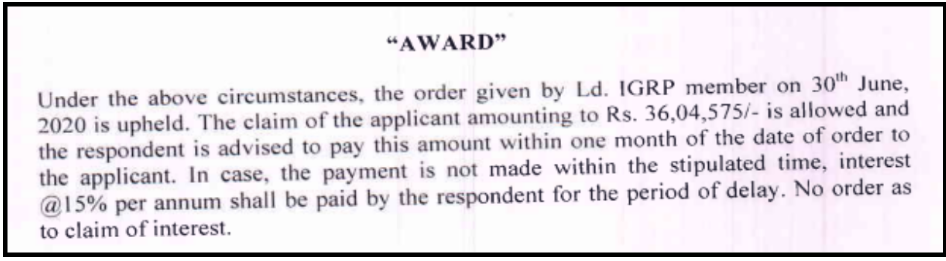
A second case at the same broker earned a smaller award, ₹4,61,280, after the risk team squared off a position despite the client’s clear instruction not to and the relationship manager’s own assurance.
The tribunal held that a client’s consent is a mandate that cannot be bypassed without a fair chance to respond.
3. Sharekhan Square Off With No Dues Owed
Sharekhan square off arbitration covers two awards.
In one, Sharekhan sold six holdings worth about ₹1.48 lakh to recover dues that did not exist, because it had failed to credit a payment the client had already made.
The tribunal ordered the shares restored in full, along with every dividend and bonus since, rather than a cash settlement.
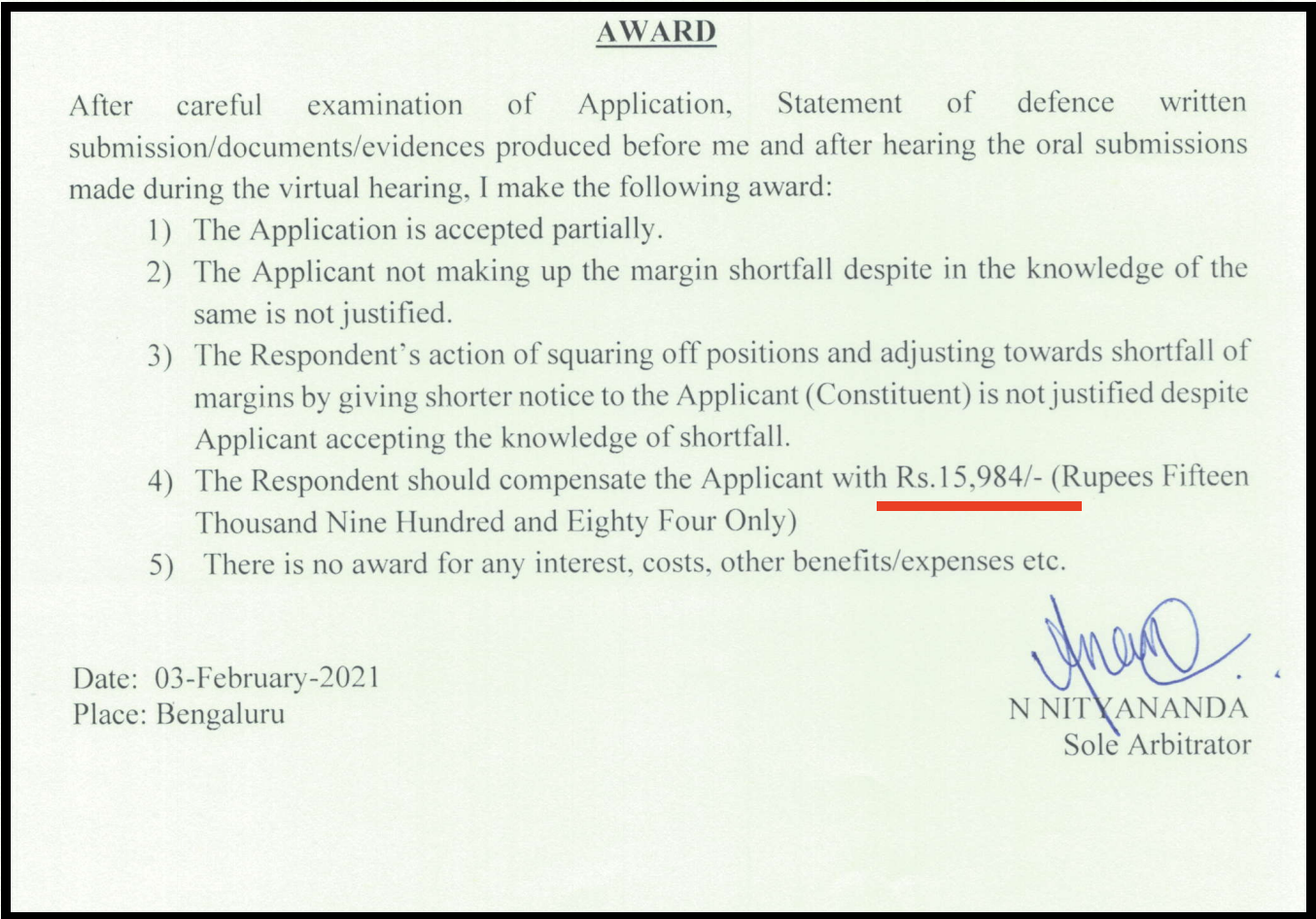
In the second, a same-day sale after a morning margin demand earned the client ₹15,984 in compensation, because the broker’s own terms required a window until the next business day.
4. Zerodha Square Off: Alert System Left No Window
Zerodha’s RMS square off of a commodity position, covered in full on Zerodha loss recovery, resulted in a ₹10.39 lakh award.
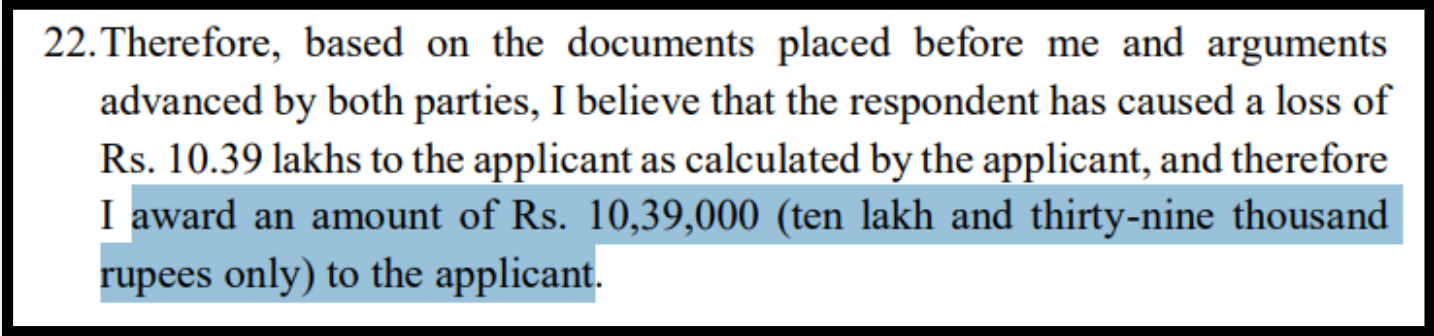
The arbitrator found that the broker’s own alert framework was set to notify clients only at fixed shortfall intervals, and the square-off fell between two of those alerts.
Extra lots were also sold beyond the shortfall, and the broker restored two of them soon after.
Why Broker RMS Policies Differ Across Stock Brokers?
The RMS policy of a stock broker is not one single rulebook across the share market.
Each broker sets its own thresholds, alert intervals and notice windows within the boundaries NSE and BSE allow.
That is exactly why the same margin shortfall played out four different ways above. Angel One, IIFL, Sharekhan and Zerodha each had their own internal notice period, and each fell short of it differently.
If your broker is not one of these four, the principle still applies.
Check your own broker’s published risk management policy or client agreement for its specific margin shortfall notice period, since that document is what a conciliator holds the broker to, not what feels fair in hindsight.
Also Read: Harikanta Overseas IPO, ₹25.6 crore raised, on BSE’s SME platform in May 2026.
What Should You Collect If Your Position Was Squared Off?
Every one of the four wins above turned on the same thing: a documented timeline the broker could not argue with.
Before you decide whether to escalate, pull together what actually happened in your account, because this is what a conciliator or arbitrator asks for first.
- Every SMS, email or app notification about the margin shortfall, with exact timestamps.
- The exact time your position was closed, from your contract note.
- Proof of any payment you made, especially a transfer reference and the time you sent it.
- Any recorded or written assurance from your broker or relationship manager.
- A written request to the broker for the call recording covering that window, since a broker failing to produce one has counted against it in more than one award.
Not sure if your square off crosses the line or falls within the broker’s rights?
We will map your notice trail and payment timeline against the pattern tribunals have already ruled on, and build the case around whichever one fits.
How Do You Actually Escalate a Wrongful Square Off?
A wrongful square off follows the same escalation path as any other broker dispute, starting with the broker’s own grievance desk and ending in arbitration if money is still at stake.
Our full walkthrough on file complaint against stock broker covers every stage in detail, including where a SEBI SCORES complaint fits and when SMART ODR opens conciliation before arbitration.
Since a broker’s failure to preserve records like call recordings has already counted against it in more than one award above, put that request in writing rather than over a call, so there is a record you asked for.
Readers land here after very different square-offs, some still deciding if it is worth challenging, others already mid-dispute.
These questions cover what usually comes up once the four patterns above are matched against a real account.
Conclusion
The pattern across every award above is the same. A broker can square off for a genuine shortfall, but not without notice, not while ignoring proof you already paid, and not when nothing was actually owed.
If your position was closed and something about the timing or the demand feels off, that gap is usually exactly where a challenge stands.
Report. Recover. Stay Fraud Free.
No. NSE rules require a genuine margin shortfall and reasonable notice before liquidation. Tribunals have repeatedly held that sending a shortfall message and squaring off within the same hours breaches natural justice, regardless of how the broker's internal policy is worded. That is one of the strongest cases to challenge. In the ₹36 lakh IIFL award, the tribunal held that ignoring a proven payment, even one not yet formally credited, was unjust. Keep your transfer reference and the time you sent it. Yes, and it is often worth far more. In the Sharekhan case, the tribunal ordered the wrongfully sold shares replenished in full along with every dividend, split and bonus that accrued since the sale, rather than valuing them at a fixed date. This varies by broker and is usually set out in the broker's own risk policy and terms of use, but tribunals have held that a same day demand and sale, with no real gap between the two, does not meet that bar. No. NSE and BSE set the outer boundary, a broker cannot square off without reasonable notice, but the exact notice period and alert triggers come from each broker's own RMS policy. Always check your specific broker's published terms for the precise window.Frequently Asked Questions





 Add us as a preferred source on Google »

