
Quick Summary
Extended bidding windows and floor pricing in Indian SME IPOs often signal weak organic demand, while informal arrangements artificially push subscription figures past the mandatory 90% threshold to the detriment of retail applicants. Using the Harikanta Overseas issue as a case study, this analysis highlights key indicators applicants should evaluate before committing funds. This page will help retail investors understand hidden SME IPO bidding risks before applying.
The issue extended its bidding window and priced at the floor of its band. Both facts are public. Neither was widely noticed, and together they point to a gap in what SME applicants are able to see.
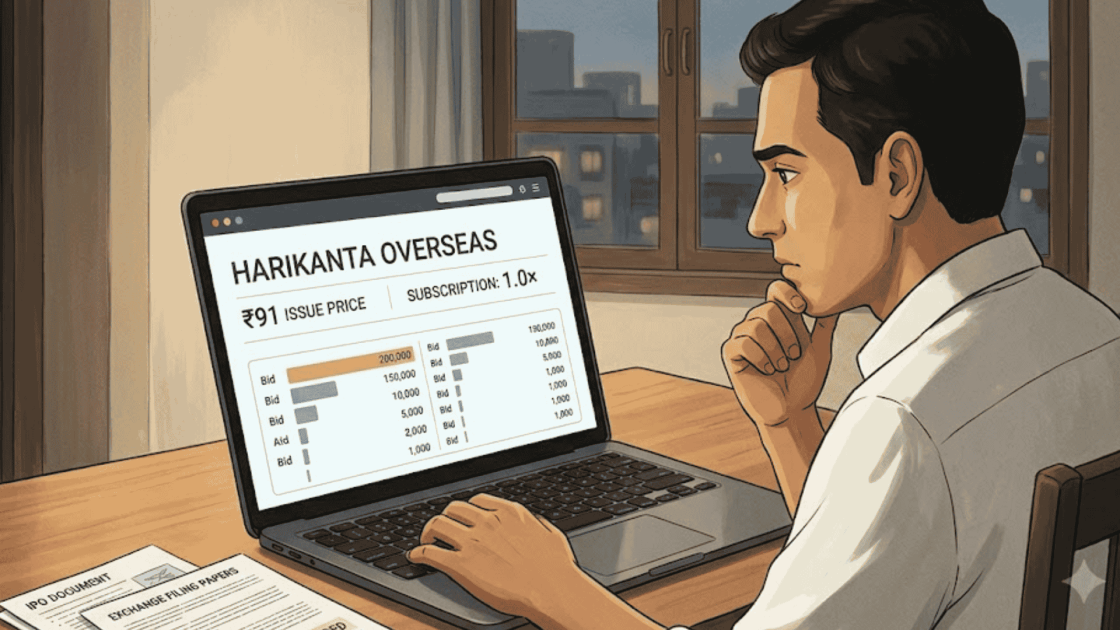
Harikanta Overseas Limited, a Surat-based manufacturer of synthetic textile fabrics, raised approximately Rs 25.6 crore on the SME platform of BSE Limited in May 2026.
The issue price was Rs 91. The stock currently trades near Rs 65.
The post-listing decline has drawn as much attention as the company has received. The record of the issue itself has drawn very little.
That record shows two things. The issue was announced with a three-day bidding window opening on 20 May and a price band of Rs 91 to Rs 96.
Bidding ran beyond the announced window, and the final price was fixed at Rs 91, the floor of the band.
Neither fact is unusual in isolation. Issues are extended for a range of reasons and priced at the floor of a band routinely. Both were disclosed. Both were available before allotment.
What they indicate, read together, is that the issue did not fill on the terms or the timetable it had set for itself. For a retail applicant deciding whether to commit funds, that is material information.
It is also information that sits some distance from where most applicants look.
What Does Harikanta Overseas’ Subscription Data Really Tell Retail Investors?
For an SME issue, the subscription percentage functions as the principal signal of demand available to a retail applicant.
Main-board issues carry analyst coverage, institutional scrutiny and substantially heavier disclosure.
SME issues carry none of that by design. What remains is a percentage published on the exchange page and updated through the bidding window.
Applicants treat that percentage as a proxy for judgement exercised by better-informed participants. A book that fills is read as evidence that somebody with greater access and more time examined the company and committed capital to it.
The inference is reasonable.
It is also, for the overwhelming majority of retail applications to SME issues, the substance of the decision. Few applicants read a draft red herring prospectus running to several hundred pages for an issue of this size.
The reliability of that inference therefore depends entirely on the composition of the number, which is not disclosed.
The 90% Minimum Subscription Rule, and Where Harikanta Overseas Stood Against It
An issue cannot proceed on whatever subscription it happens to attract. The regulations governing public issues require minimum subscription of 90 per cent of the offer.
Where that level is not reached, allotment cannot be made, and application monies must be returned in full.
A second requirement sits alongside it.
Closure of an issue may be announced only after the lead manager has satisfied itself that the threshold has been met and has obtained a certificate from the registrar to the issue confirming it.
Both provisions rest on a single assumption: that every bid counted toward the threshold was placed by an applicant who wanted the shares.
Nothing published during a bidding window indicates whether that assumption holds in a given issue.
Merchant Bankers & Issuers: The Pressure on Harikanta Overseas to Cross 100%
The economics of a failed SME issue fall on every participant in the chain except the retail applicant.
An issuer that does not complete has already incurred merchant banking fees, legal and audit costs, and printing and marketing expenditure across several months.
A failed attempt is also public, which makes a second attempt materially harder. Lead managers carry a track record. Underwriters carry commitments.
Market makers hold arrangements contingent on listing. Compensation across the chain is generally contingent on completion.
The arithmetic at the margin is the relevant point. On an issue of roughly Rs 25 crore, the distance between 0.8 times subscription and 1.0 times is in the region of Rs 5 crore.
In the non-institutional category, that is two or three applications.
This is a structural feature of the process rather than a defect in any particular issue. It recurs wherever a book approaches its final day short of the threshold.
The Risk of ‘Assured Exit’ Schemes in SME IPO Bidding
Market participants describe a recognised practice at that point in a bidding window. Intermediaries with access to applicants capable of writing large cheques are approached and asked to bring bids in.
The request is typically specific as to amount, category and deadline.
Because an applicant committing several crore to an undersubscribed SME issue shortly before listing is unlikely to be doing so on a view of the business, an inducement is generally attached.
That inducement takes the form of an assured exit: a stated price or percentage within a defined window after listing, presented either as an undertaking from the issuer’s promoters or as an arrangement the intermediary will manage.
No such entitlement exists under the framework governing public issues. There is no mechanism by which an applicant to an IPO acquires a right to a defined return over a defined period.
Where an assurance of that nature is extended, it sits outside the offer document and is available to some applicants and not to others.
The consequence is that applicants to the same issue on the same day may be participating on materially different terms, with only one side aware of the difference.
Hidden Bidding Patterns: What the Harikanta Overseas BSE SME Page Doesn’t Reveal
Solicitations of this kind occur on telephone calls and in closed messaging groups between participants who transact across multiple issues.
They are not visible on any public page.
What is visible is the resulting movement in the subscription figure, which is indistinguishable from genuine late demand. The exchange page carries no indication of the basis on which any bid was placed.
The composition of that movement is equally opaque.
A book that moves from 0.8 to 1.1 times may have done so through several hundred applications of a few lakh rupees each, or through three applications of Rs 2 crore.
The percentage is identical. The implication is not.
What Harikanta’s Record Indicates?
Applied to the public record of the Harikanta issue, the position is as follows.
The issue announced a three-day bidding window and bid beyond it. It announced a band of Rs 91 to Rs 96 and priced at Rs 91.
An extension indicates an issue that did not fill on schedule. Pricing at the floor indicates an absence of demand at the upper end of the band. Those are the limits of what the two facts establish.
The shares subsequently listed below the issue price and have traded below it since.
Extension, floor pricing, a listing discount and a sustained decline together describe a recognisable sequence. The sequence is not evidence of how the book was filled.
It is the pattern as it appears from outside the process, which is the only vantage available to a retail applicant.
Why Harikanta Overseas Crashed After Listing: Reading the Post-Listing Selling Pressure
Where an issue is carried across the threshold by arranged bids, the effect is generally visible after listing.
Applicants participating on an assured-exit basis are counterparties to a short-term arrangement rather than investors in any conventional sense.
Selling from that quarter arrives early, in size, and within the window agreed.
Retail applicants who subscribed on the strength of the subscription figure hold the stock against that selling.
How Retail Investors Can Spot SME IPO Red Flags Before Applying
Certain features of a book are disclosed and can be examined before an application is made.
The category-wise breakdown is published alongside the headline figure. An issue showing 1.1 times overall may be heavily subscribed in a small institutional portion and substantially undersubscribed in the non-institutional and retail categories.
The headline does not disclose that distribution; the table does.
Application counts, read against subscription value, indicate whether a book has filled through a large number of small bids or a small number of large ones.
Extensions and revisions to a price band are recorded in exchange filings and indicate that an issue did not fill on its original terms.
Movement in the closing hours of the final day, particularly where a book crosses the threshold late, is observable in the live subscription data.
None of these is conclusive. Each is more informative than the headline percentage alone.
Proposed SEBI & Exchange Regulations for SME IPO Transparency
Several straightforward changes would narrow the gap.
Publication of the composition of the book alongside the percentage, showing applications by size band and category on a live basis, would indicate whether a threshold was crossed by many participants or by a handful.
Prominent disclosure of extensions and price band revisions on the exchange’s own issue page, rather than in addenda, would bring material timetable changes to the attention of applicants.
Requiring the lead manager’s minimum subscription verification to be filed as a document rather than held as an internal satisfaction would create a record.
A reporting channel for assured-exit solicitations would give intermediaries approached in this manner somewhere to take the request.
At present, there is no established route and no consequence attached to silence.
The Future of SME IPO Frameworks: Balancing Capital Access & Investor Safety
Lighter regulation of SME issues is a deliberate policy choice, intended to give smaller companies access to public capital without the compliance burden of a main-board listing.
That framework depends on the reliability of the limited signals it leaves in place.
Where analyst coverage, institutional scrutiny and disclosure volume have been removed, the subscription figure carries a disproportionate share of the informational load.
If the final portion of that figure can be assembled through a small number of solicited applications, the figure ceases to perform the function it exists to perform, and applicants relying on it are the only participants unaware of that.
Harikanta Overseas represents one issue on one platform in one month. Whether its public record is atypical or routine is not a question that can be resolved from outside the process.
It is a question for the entities with visibility over every book as it fills.
How to File a Grievance Regarding SME IPO Irregularities?
Retail investors who suspect irregularities, fraudulent practices, or non-disclosures in an SME IPO can escalate their concerns directly through regulatory and exchange mechanisms.
Filing a grievance ensures that market regulators investigate potential violations, such as false subscription claims or unapproved exit schemes.
Here is a simple, step-by-step guide to filing your complaint:
- Submit your complaint to SEBI: You can file an official grievance against the issuer, merchant banker, or registrar through the SEBI SCORES complaint portal.
- Escalate online dispute resolution: If your grievance remains unresolved after reaching out to the intermediary, you can escalate the matter online via the SMART ODR portal.
- Report to the National Stock Exchange: If the issue involves an SME listing on NSE, submit a formal NSE complaint to their investor service cell.
- Contact the Bombay Stock Exchange: If you encounter bidding issues or irregularities on BSE SME, reach out via the official BSE complaint number or helpline.
- Initiate formal dispute resolution: If financial claims or trade execution disputes cannot be settled directly, investors can initiate arbitration in stock market proceedings under exchange rules.
Do you need help filing a complaint regarding SME IPO irregularities?
Our expert team can assist you in navigating the recovery and grievance process step-by-step.
Register with us today to get started.
Disclaimer: Based on publicly available subscription, pricing, and issue-timetable data. No assertion is made regarding the conduct of any company, intermediary or individual.
Conclusion
SME IPO subscription numbers often obscure true market demand, leaving retail investors vulnerable to post-listing declines.
Evaluating extended bidding windows, floor pricing, and bid distribution helps spot artificial demand driven by short-term arrangements.
Greater disclosure around book composition and timetable revisions is essential to protect applicants.
Retail investors must look beyond headline numbers, analyze category breakdowns, and use official grievance channels like SEBI SCORES or exchange portals when encountering irregularities to safeguard their capital.
Frequently Asked Questions
Under SEBI guidelines, an IPO cannot proceed if it fails to achieve at least 90% subscription across the overall offer. If this threshold is not met within the bidding window, the issue is aborted, and all application money must be refunded to applicants in full.
An "assured exit" is an informal arrangement where large participants are offered guaranteed returns or liquidity shortly after listing to encourage late bidding. These arrangements are not recognized under public offer regulations, and all investors participate under the standard terms outlined in the prospectus.
Bidding windows are extended when an issue does not receive sufficient bids within its initial timetable. Issuers may also lower the price band during an extension to attract additional participation and meet the required subscription levels.
Investors can review category-wise breakdowns (Retail vs. NII/QIB), check total application counts relative to overall bid value, monitor late-bidding surges on the final day, and track exchange filings for extensions or price band revisions.





 Add us as a preferred source on Google »