
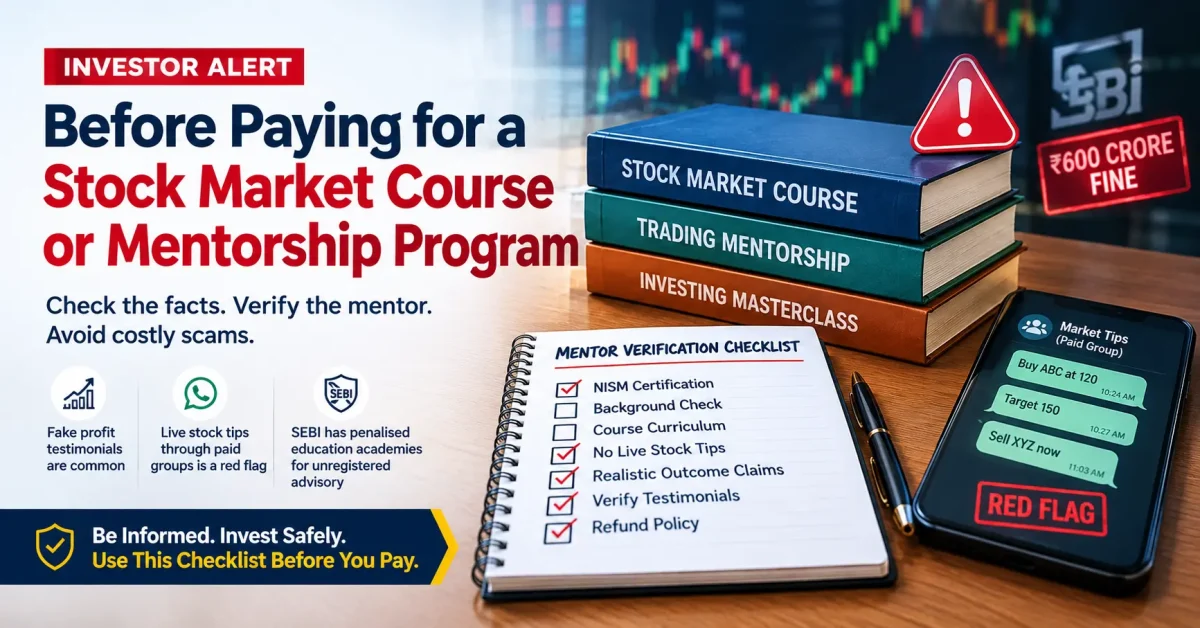
Quick Summary
Course testimonials showing huge student profits are sometimes staged, not reflections of actual trades.
A genuine trading educator does not give live, stock specific tips through a paid WhatsApp group.
SEBI has penalised education academies for exactly this pattern, including one fine reaching Rs 600 crore.
This checklist covers what to verify about a mentor before you pay for any course or program.
The videos showed students celebrating massive profits after joining the course.
SEBI checked the same students’ actual trades and found most of them were sitting in losses.
That gap between the marketing and the reality cost one academy a Rs 600 crore penalty.
Before you pay for the next “mentorship,” run this checklist on the person behind it.
Education vs Disguised Advisory: Where the Line Sits
| Signal | Genuine Broker App | Clone App |
| Download source | Official Play Store or App Store only | Shared link via WhatsApp or Telegram |
| Fund transfer | Routed through registered payment gateway | Requested to a personal bank account |
| Withdrawal experience | Processes normally, standard timelines | Blocked with rotating excuses |
| Developer listing | Matches the broker’s registered name | Generic, mismatched, or unverifiable |
| IPO allotment claims | Verifiable through your actual broker | Suspiciously large, unverifiable gains shown |
The Mentor Verification Checklist
Go through each point below before paying any course or mentorship fee.
- NISM certification: A genuine market educator should hold relevant NISM certification, not just a large following.
- Background check: Search the mentor’s name alongside words like complaint, fraud, or SEBI action before enrolling.
- Curriculum clarity: Ask for the exact course structure and topics covered, not vague promises of “secrets.”
- No live stock tips: A course teaching concepts is different from a WhatsApp group giving live buy or sell calls.
- Realistic outcome claims: Be wary of any promise tying course completion to a specific daily or monthly income figure.
- Verify testimonials independently: Reach out to past students outside the mentor’s own channels if possible.
- Refund policy in writing: A legitimate course provider states refund terms clearly before you pay.
The Gap Between the Pitch and the Trades
In this enforcement case, SEBI found that testimonial videos of profitable students didn’t match their actual trading records, as detailed in Avadhut Sathe penalty.
This blurred line between teaching and unregistered advisory is exactly what SEBI penalised.
1. Testimonials collected: hand picked student success stories were featured prominently in marketing videos.
2. New enrolments pitched: prospective students, impressed by these stories, signed up for more expensive programs.
3. Live tip groups formed: paid WhatsApp groups attached to the course began giving live trade calls.
4. SEBI investigation: SEBI’s inspection found testimonial claims didn’t match actual student trading records.
A Smaller, More Common Version of the Same Trap
Not every case involves crores in penalties. One trader paid Rs 60,000 for a course after seeing fake profit screenshots, a story documented in are you actually buying stock market course or tips.
He never validated the mentor’s background or asked for the actual curriculum before paying.
Bottom Line
A five minute background check on the mentor costs nothing, unlike the course fee you’d lose without it.
You can report financial fraud india and browse checklists for every entity and scam type through Fraud Free.
If a course or mentorship crossed into unregistered advisory, you can report unregistered advisory activity through the correct channel.
Report. Recover. Stay Fraud Free.
Frequently Asked Questions
Pure education does not require SEBI registration, but giving specific buy or sell tips for a fee does. Many mentors blur this line by pairing courses with live tip groups, which crosses into unregistered advisory.
Try to independently reach past students outside the mentor's own promotional channels. SEBI has found cases where testimonial videos of profitable students didn't match their actual trading records.
Look for relevant NISM certification, which confirms baseline knowledge and regulatory awareness. A large social media following is not a substitute for verifiable qualification.
This is a common pattern, but it's also where many courses cross into unregistered advisory territory. A course should teach concepts, not deliver ongoing stock specific recommendations through a chat group.
Ask for the exact curriculum, the mentor's certification, and a written refund policy. Avoid any program promising a specific daily or monthly income figure as a guaranteed outcome of the course.
Often with fake profit screenshots shared to build trust, followed by a course sold with vague promises. A quick background check on the mentor before paying can prevent this pattern entirely.


 Add us as a preferred source on Google »

