

Quick Summary
In two reviewed awards, NSE tribunals held Sharekhan’s forced sales improper. In one, the broker sold a client’s shares to recover dues that did not exist, because it had failed to credit money she had already paid. The tribunal ordered the shares replenished in full, along with every dividend, split and bonus since, rather than settling for a cash figure. In the other, the broker sent a margin demand and squared off the same day. The tribunal held a client is entitled to until the next business day, and awarded compensation.
Picture waking up to find your shares sold overnight, without warning, for dues you never actually owed.
That exact scenario sits at the heart of every Sharekhan square-off arbitration we have studied closely. Two clients faced forced sales they never expected, and both walked away with the tribunal firmly on their side. Their stories reveal what a fair window really means.
Let’s understand what their case was and how they successfully recovered money.
Understanding Sharekhan Square Off Arbitration
A broker can sell your holdings if you genuinely fall short on margin. That is normal, and the rules allow it, often governed by the RMS policy of stock broker firms across the market.
What the rules do not allow is selling when nothing is owed, or selling before you have had the time you are entitled to. Both happened here, and each produced a different and instructive remedy.
Interestingly, Sharekhan complaints involving forced sales rarely start at arbitration itself; they usually begin with a client emailing the broker directly, getting brushed off, and only escalating once that channel fails.
The first is the more startling of the two, because the debt itself was imaginary from the start.
When There Were No Dues at All
The client bought stock worth about ₹2.03 lakh and transferred ₹2.04 lakh to the broker the same day. The transfer failed due to a technical error, and the money bounced back to her bank account. On the broker’s own advice, she sent it again a few days later.
Sharekhan did not credit that second payment to her account for six days.
During those six days, she received demands for payment of dues she did not owe. Her broker emailed Sharekhan with her bank statement proving the transfer, and was told a resolution would come within 24 hours. It never did. Instead, the broker sold six of her holdings, IOC, GAIL, IRCON, BPCL, NALCO and Motherson Sumi, for about ₹1.48 lakh, right in the middle of the March 2020 crash.
The messages demanding payment by 5 pm that day arrived at 11:29 and 11:40 in the morning. The shares had already been sold at 9:30, well before either warning reached her.
Why the Remedy Mattered More Than the Money
The grievance committee had already accepted that Sharekhan was at fault and that returning her shares was reasonable. But it converted her claim into a cash figure based on share prices on an arbitrary date, arriving at ₹93,464. It also directed her to pay the broker 24% interest on the sale proceeds credited to her.
It held that the broker lacked internal coordination and supervision. The sale was unauthorised because no dues existed, and the broker had accepted its own error.
On the remedy, it found it arbitrary to value the shares using prices from a random date. The shares were actively traded and had risen since then.
So it ordered Sharekhan to restore the shares with all dividends, splits, and bonuses accruing from the date of the wrongful sale until replenishment. She returns the ₹1,71,694 credited to her, with interest at 12% instead of the 24% the committee had imposed because a client cannot be made to pay a penalty rate for the broker’s own mistake.
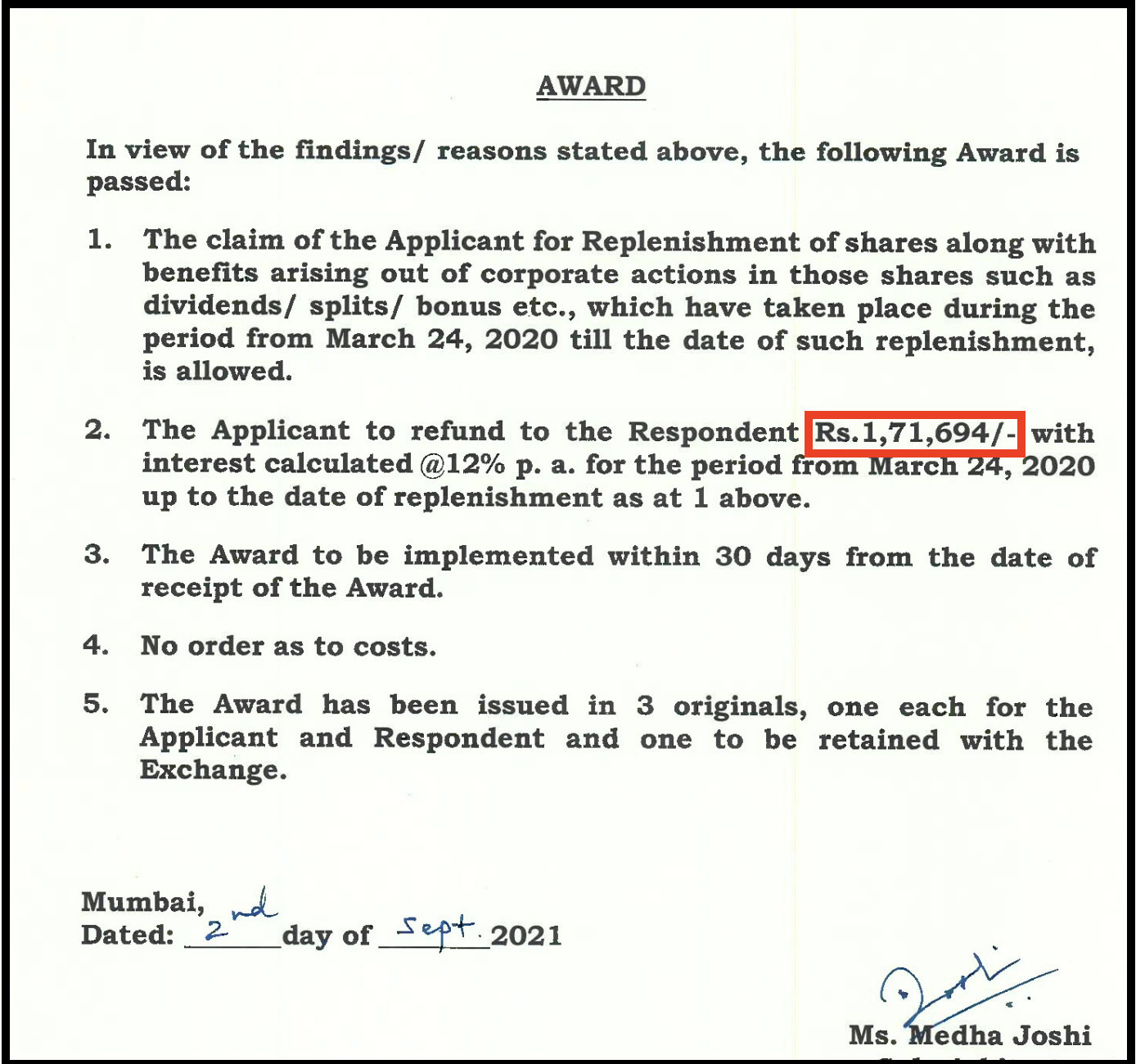
Getting the shares back rather than a fixed sum was worth far more. Few clients ask for this remedy on their own.
Did Sharekhan sell your holdings before you had a fair chance to respond?
We map the demand against the sale timestamp, test whether anything was genuinely owed, and press for the remedy that actually restores your position rather than a discounted cash figure.
Register with us for a free consultation.
Sharekhan NSE Arbitration Awards on Timing and Notice
The second case turns on timing rather than error.
The client held a derivatives position and fell short on margin. Sharekhan sent an SMS at 7:47 in the morning flagging a shortfall and naming the stocks that would be sold. It squared off the same day, hours after that message went out.
The tribunal examined the broker’s own terms, which require the client to pay a margin shortfall on the immediately succeeding business day after the demand, and the risk policy, which gives until 11 pm on the day following the margin call. Selling on the same morning the demand was issued gave the client no such window at all.
There was a second failure sitting beneath the first. The broker was asked to produce the call recording for the relevant period, and confirmed in writing that it could not find it. Among the Sharekhan NSE arbitration awards we reviewed, this absence of records came up repeatedly, and the tribunal noted that SEBI’s circular of 22 March 2018 requires trading members to keep exactly this kind of evidence.
The award was measured, not sweeping. The client had known about the shortfall and had not cured it, so the tribunal did not award his full claim. But it found that the broker had no justification for squaring off his positions on shorter notice than the rules allowed.
So it compensated him for the difference between the prices at which the broker sold his positions and the closing prices the next day, when he should have been allowed to bring in the margin. That came to ₹15,984.
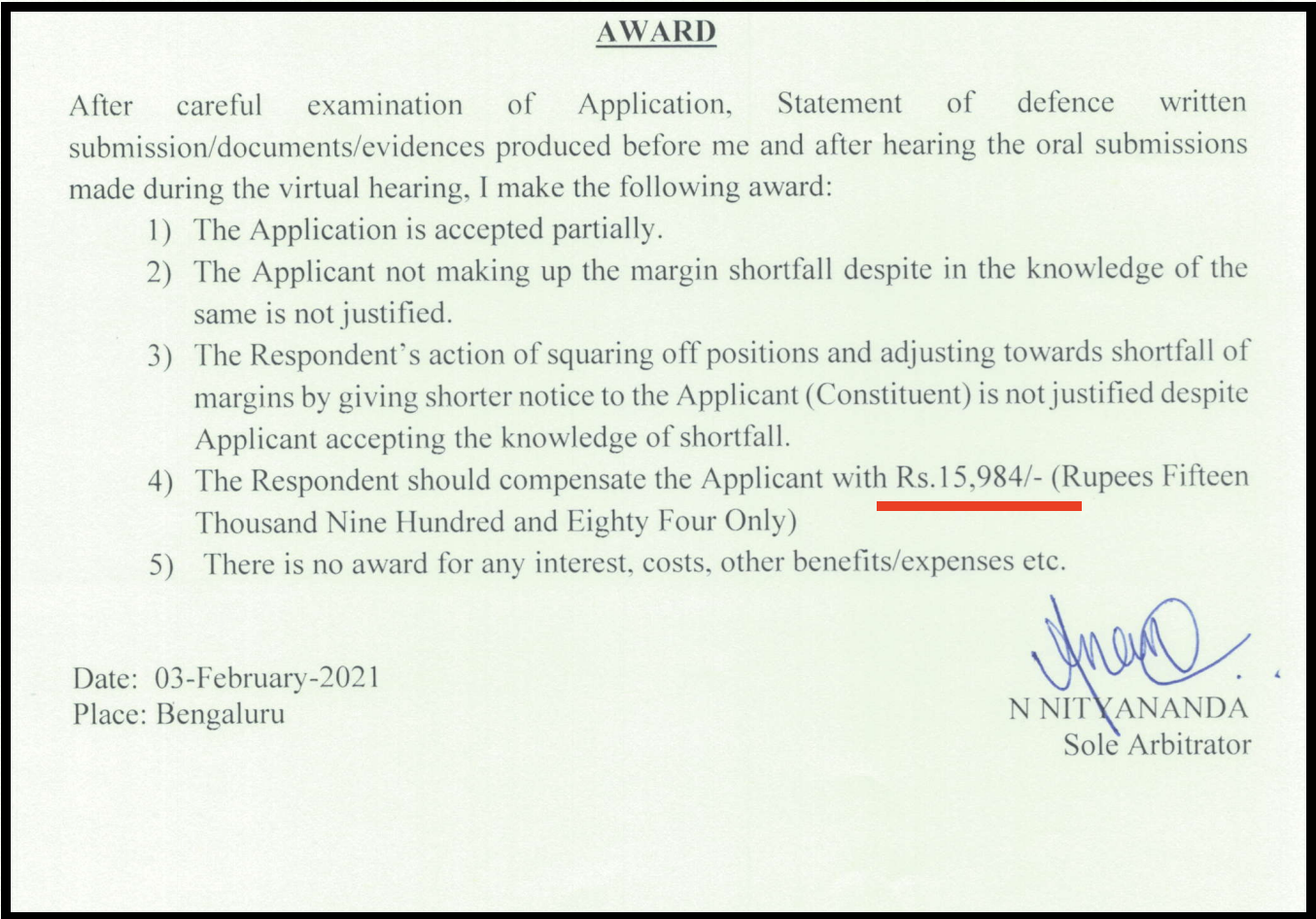
The amount is modest. The principle is not, and it is the one to hold onto: notice is not a formality; it is the client’s right to a fair chance to respond properly.
Square Off, Excess Charges, and Where Complaints Fit In
Forced sales rarely travel alone. Several clients who raised square off disputes also discovered Sharekhan excess charges sitting quietly in the same account, from brokerage slabs applied incorrectly to dormant accounts reactivated without fresh review.
If you suspect both issues together, treat them as two separate complaints rather than folding one into the other.
Before any of this reaches arbitration, you are expected to raise the issue formally first. These complaints follow a defined path, and skipping it can cost you time later.
Our page on Sharekhan unauthorised trading arbitration covers the related situation where someone at the broker traded your account without asking you, which runs on a different rule entirely from a margin sale.
Ever Had Sharekhan Sell Your Holdings Without Warning?
Maybe you are reading this because something similar happened to you last month, or maybe last year, and it still bothers you. Perhaps a demand landed, and the sale followed almost instantly, leaving no real room to respond. If that sounds like your account, arbitration is open to you too, but a proper sequence needs to come first.
Before that stage, it also helps to know how to file a complaint in Sharekhan the right way, since a documented complaint trail strengthens everything that follows.
- List out every margin demand you received, along with the exact time each one landed.
- Match that against your contract note to find the precise moment the sale happened.
- Keep proof of any payment you made, including transfer references and dates.
- Request your complete ledger to check what was actually owed and when it was cleared.
- Write to Sharekhan asking specifically for the call recording covering that window.
- Take the matter to the exchange grievance cell once the broker’s own response falls short.
Lining up these timestamps side by side is usually what turns a vague grievance into a case worth filing.
Conclusion
The replenishment order sets the stronger principle: When a broker sells shares to recover dues created by its own error, it must restore what it took, along with everything that accrued after the sale.
The ₹15,984 award sets a narrower principle. A margin demand does not justify a same-day sale, and brokers must give clients the time the rules actually provide.
If a broker sold your holdings when you owed nothing, or before you had a chance to respond, you may have grounds to challenge the sale.
Report. Recover. Stay Fraud Free.
Frequently Asked Questions
No. In the reviewed case the broker sold six holdings to recover dues that did not exist, because it had failed to credit a payment the client had already made. The tribunal held the sale unauthorised and ordered the shares restored.
Yes, and it is often worth far more. The tribunal rejected the grievance committee's approach of valuing the shares at a random date and ordered replenishment of the shares themselves, along with all dividends, splits and bonuses that had accrued since the wrongful sale.
Under the broker's own terms in the reviewed case, the client was required to pay a shortfall on the immediately succeeding business day, and the risk policy allowed until 11 pm the day after the margin call. The tribunal held that sending the demand and squaring off the same morning did not give the client the window he was entitled to.
It counts against the broker. SEBI's circular of 22 March 2018 requires trading members to preserve such evidence, and in the reviewed case the broker confirmed in writing that it could not locate the recording. The tribunal treated that absence, alongside delayed email responses, as raising doubts about its conduct.


 Add us as a preferred source on Google »

