
If you trade with Sharekhan and something about your brokerage charges has felt off, you are not imagining it. Excess charges complaints now make up 72.7% of all grievances filed against Sharekhan, and most investors only discover the mismatch after the money is already gone.
Many investors only discover the mismatch when they carefully compare their contract notes with their original tariff sheet. By then, the extra deductions have already accumulated over multiple trades.
This blog covers the official complaint data, real investor experiences, and your rights as a client, so you know exactly where you stand.
Sharekhan Excess Charges Complaints
SEBI mandates that brokers charge only what appears in the agreed tariff sheet. When a broker collects anything beyond that, it qualifies as an excess charge.
Sharekhan excess charges complaints have risen consistently over the past few years, and the numbers tell a clear story.
Some investors discover excess charges alongside forced liquidation of their holdings. If your dispute also involves a margin sale, our guide on Sharekhan Square Off Arbitration cases explains how NSE tribunals have dealt with such situations.
Regulatory data from SEBI and BSE reveals that Sharekhan receives a notable volume of complaints every financial year. Excess charges form a significant portion of those complaints.
Here is a year-by-year breakdown of the excess charges complaint data:
Excess Charges Complaints Data
| Financial Year | No. of Complaints | Excess Charges Complaints | % of Excess Charges Complaints w.r.t. Total Complaints |
| 2026-27 | 22 | Around 16 | 72.7% |
| 2025-26 | 235 | Around 99 | 42.1% |
| 2024-25 | 316 | Around 137 | 43.4% |
| 2023-24 | 207 | Around 108 | 52.2% |
| 2022-23 | 178 | Around 23 | 12.9% |
In 2024-25, excess charges complaints alone crossed 137, the highest absolute number across all five years.
Furthermore, the proportion jumped sharply from just 12.9% in 2022-23 to 72.7% in 2026-27, meaning excess charges now dominate Sharekhan’s complaint landscape.
Note: 2026-27 data is mid-year and will be updated as the financial year progresses.
But are you the only one facing this, or are thousands of others dealing with the same problem in different ways? Let’s find out.
Also Read: JM Financial account handling, why “market risk” isn’t an answer to an unexplained charge.
Sharekhan User Complaints
Real clients across platforms share their experiences with Sharekhan, and a recurring theme stands out. Unexpected brokerage charges can eat into profits or even turn winning trades into losses.
Here are three representative cases drawn from verified reviews:
1. Brokerage Revised Without Any Prior Notice
A trader who operated in the Futures & Options segment for years noticed that his zero-brokerage agreement suddenly changed.
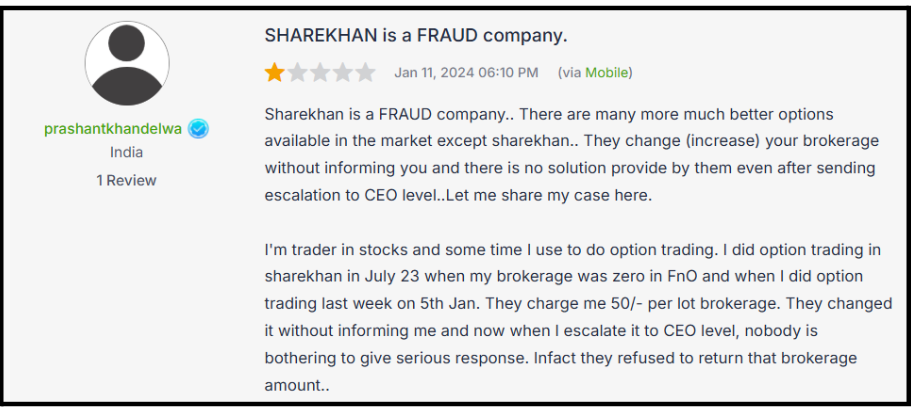 He placed trades expecting the same terms as before. Instead, the broker deducted ₹50 per lot without giving any prior written communication.
He escalated the complaint to the highest level within the company. Even after multiple follow-ups, the company declined to reverse the charge.
2. Per-Lot Brokerage in F&O Turns Profits Into Losses
A client trading Sensex F&O contracts experienced a shocking mismatch between expected and actual charges.
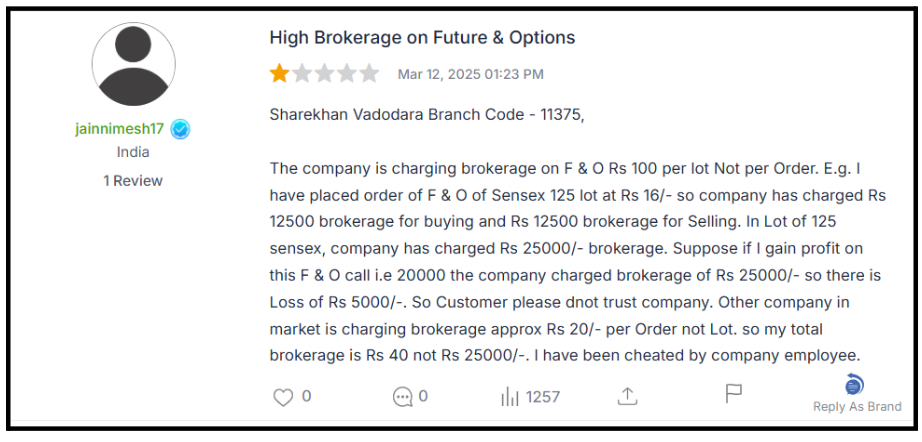
The broker charged brokerage on a per-lot basis rather than per order. On a trade involving 125 lots, the total brokerage on buying and selling combined reached ₹25,000.
The actual profit on the trade was only ₹20,000, resulting in a net loss of ₹5,000 despite being right on the market call.
3. Advisory Services Used to Justify Higher Brokerage Extraction
One client enrolled in Sharekhan’s advisory services expecting guidance that would improve returns.
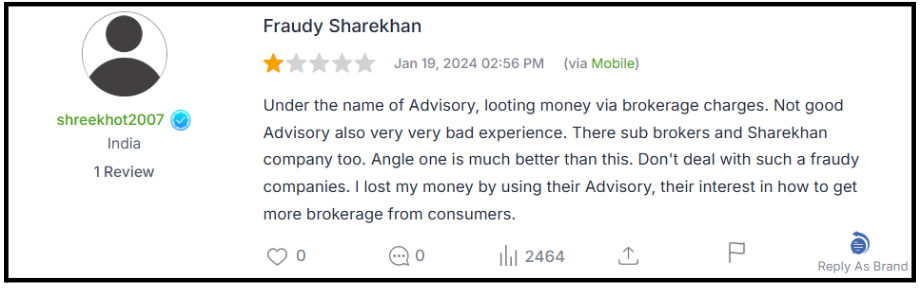
Instead, the charges kept mounting through brokerage fees tied to the advisory trades.
The advisory recommendations generated consistent churn and consistent brokerage revenue for the broker, while the client’s returns deteriorated.
Also Read: PhonePe Excess charges, fewer clients, fewer complaints, the same proportion regardless.
What Should Every Overcharged Sharekhan Investor Know?
Sharekhan levies several charges beyond basic brokerage, including DP charges, AMC fees, call-and-trade surcharges, and margin interest.
Many of these appear without clear upfront communication, leaving traders shocked when they read their contract notes.
Spotting them is easier than you think. Here’s where to look:
- Compare your contract note with your signed tariff sheet.
- Check your ledger statement for recurring unexplained deductions.
- Cross-verify the brokerage rate applied per trade against your agreed plan.
If the numbers don’t match, that is a documented overcharge, not a grey area. You have grounds to file a complaint and pursue recovery of the difference
Also Read: Choice Broking excess charges, fabricated reports, showing profit while the account actually bled.
Can You Report Against Your Broker?
Yes. If you are looking to file official brokerage complaints, experiencing unannounced excess charges gives you one of the strongest grounds to do so.
Any charge collected beyond your agreed tariff sheet is a documented, provable violation, not a grey area.
If your contract notes consistently reflect more than what you signed up for, you are not overreacting; you have a legitimate case that regulators and arbitration panels recognise and act on.
You may not have checked it before. Check it now; it is the single document that proves your case
Now that you know what is happening and why, it is time to stop reading and start acting.
How to File a Complaint Against Excessive Brokerage Charges?
If Sharekhan excess charges have impacted your trading account, you need to act in a structured, documented manner.
Emotional escalations rarely produce results; a step-by-step approach does.
If you are wondering how can I raise my complaint in Sharekhan, the process is straightforward when done through the right regulatory channels.
Here are the steps to report a stock broker in India:
Step 1: Collect All Evidence
Pull out every contract note, account statement, and trade confirmation from the relevant period. Compare the actual charges with what your tariff sheet specifies.
Note every discrepancy with the exact date, amount, and trade reference number.
Step 2: File a Written Complaint With the Broker
Submit a formal written complaint to Sharekhan’s grievance redressal team. Keep a copy of everything you send.
Give the broker a reasonable deadline, typically 15 to 30 days, to respond.
Step 3: Register a Complaint with SCORES
If the broker fails to resolve your complaint within the stipulated time, register your complaint on the SEBI SCORES portal.
SCORES requires the broker to respond within a defined timeframe under regulatory oversight.
Step 4: Lodge a Complaint with Smart ODR
If the broker fails to resolve your complaint satisfactorily, take your case to Smart ODR, SEBI’s official Online Dispute Resolution platform.
Smart ODR connects investors directly with a neutral conciliator or arbitrator.
Register your case on the portal, upload all supporting documents, and track the entire process online without physically visiting any exchange or tribunal.
Step 5: Share Market Arbitration
If the disputed amount is significant and other channels have not worked, arbitration is a legally recognised option.
Stock exchanges administer the arbitration process, and the outcome is binding on both parties. Many investors have successfully pursued their claims through Sharekhan NSE arbitrations.
Need Help?
Every rupee charged beyond your agreed tariff is recoverable, but only if your complaint is properly documented and filed through the right channels.
That is exactly what we do.
We help investors identify, document, and pursue legitimate claims against brokers.
Our services include:
- Case assessment: We review your complaint, contract notes, and trade history to identify valid grounds for a claim.
- Documentation support: We help you organise evidence in the format that regulatory bodies and arbitration panels require.
- Complaint drafting: We prepare legally sound written complaints for SEBI SCORES, exchange cells, and arbitration filings.
- End-to-end follow-up: We track your complaint at every stage and guide you through each escalation step.
If Sharekhan has charged you beyond your agreed tariff, the paper trail already exists in your contract notes. Register with us today, and we will tell you exactly what your case is worth and how to pursue it.
Conclusion
Sharekhan excess charges complaints form a significant and growing portion of the broker’s overall grievance data, peaking at 72.7% of all complaints in 2026-27.
User reviews across platforms confirm the same pattern: brokerage revised without notice, per-lot charges that eliminate profits, and advisory services that cost more than they return.
Every investor has the right to pay only what they agreed to. If Sharekhan charged you beyond that, document it, escalate it, and pursue it through the right channels.
Your tariff sheet is the proof. Your contract notes are the evidence. The only thing left is the decision to act.
Frequently Asked Questions
1. Sharekhan charged me brokerage at a different rate than what I signed up for; is that legal?
No (if not properly communicated). Brokerage must follow the agreed tariff sheet; any change should be informed and applied going forward.
2. I traded F&O and the brokerage wiped out my entire profit; what can I do?
Yes, you can raise a complaint. Compare contract notes with agreed charges and escalate via exchange or SEBI SCORES if there is excess billing.
3. Sharekhan’s advisory service kept recommending trades and charged heavy brokerage on each; is this allowed?
Not necessarily. Advisory should be in the client’s interest; if it mainly drives brokerage, it can be escalated to the exchange or SEBI.
4. Can I get my excess brokerage refunded after filing a complaint?
Yes, if proven. Refunds can be directed through exchange arbitration or complaint redressal with proper documents.
5. Sharekhan resolved my complaint on paper but never actually refunded the money. What now?
No, that is not a valid closure. You can re-escalate via SEBI SCORES or the exchange with proof of non-refund.


 Add us as a preferred source on Google »

