

Quick Summary
On August 13, 2025, SEBI issued Adjudication Order No. Order/AK/DS/2025-26/31592-31594 against Eqwires Research Analyst and its partners, following an inspection covering April 2020 to November 2021. SEBI’s Adjudicating Officer, Amit Kapoor, found the firm guilty of misrepresenting itself as an Investment Adviser, illegally operating a client’s trading account, and using fabricated testimonials, conduct SEBI’s own order calls fraudulent and unfair trade practices. The firm and its partners were fined ₹6,00,000 jointly. A separate order against the firm’s own Compliance Officer, Priyank Shah, added a further ₹11,00,000 penalty, a two-year market ban, and an ₹8,47,000 refund order. This page covers every finding in full.
Eqwires called itself “India’s top-notch SEBI registered Research Analyst.” That’s the pitch you’d see on Telegram or its own website.
SEBI looked at the same firm and used a very different word: fraud.
This is the complete SEBI order against Eqwires Research Analyst, what actually happened, who was fined, and why, laid out in plain, easy language.
Eqwires Research Analyst SEBI Order
SEBI inspected Eqwires Research Analyst’s registered office, covering the period from April 1, 2020 to November 25, 2021.
The firm holds SEBI Research Analyst registration number INH000007465. Its partners at the time, Bansri Pankajbhai Thakkar and Pranay Dineshbhai Morakhiya, were also named in the order.
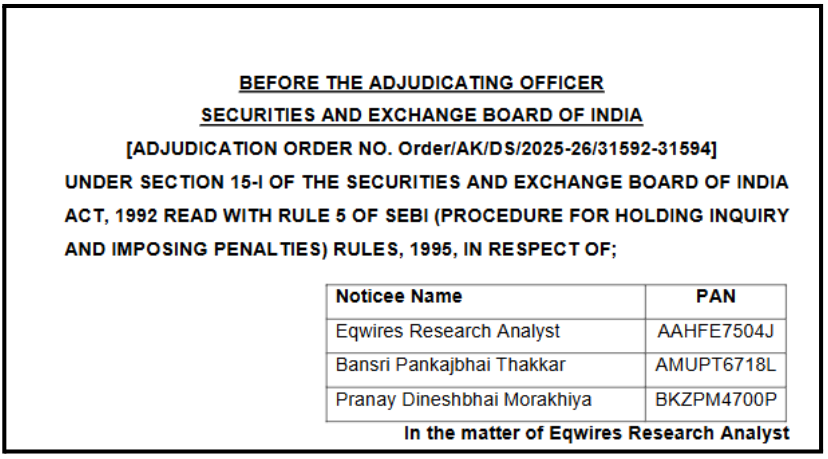
The Adjudicating Officer, Amit Kapoor, concluded that all three noticees had engaged in conduct detrimental to investor protection.
He stated plainly that registered intermediaries carry a statutory obligation to comply with applicable circulars, rules, and regulations, and that the purpose of these regulations is to deter wrongdoing and promote ethical conduct in the securities market.
Finding 1: Misrepresenting Itself as an Investment Adviser
Eqwires was registered only as a Research Analyst, but it systematically presented itself as an Investment Adviser, which it was never licensed to be.
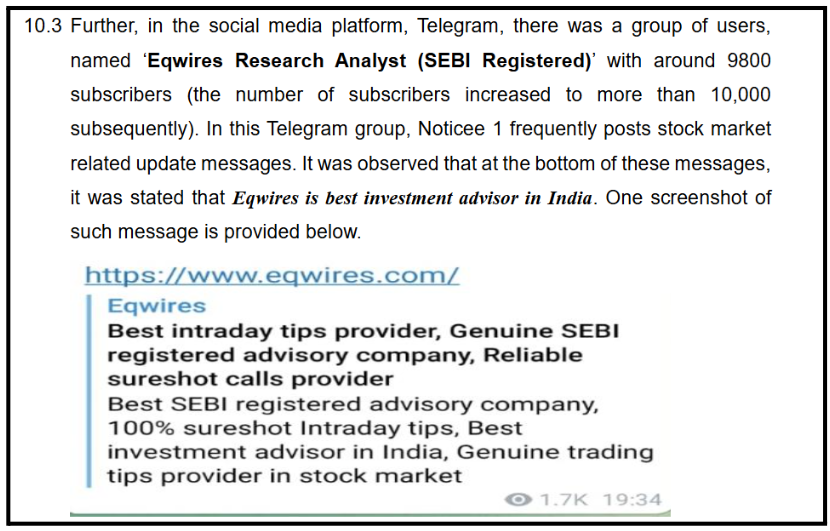
Its website and Telegram channel used taglines like “Best investment advisor in India,” “Genuine SEBI-registered advisory company,” and “India’s top-notch SEBI registered Research Analyst” alongside “Best investment adviser,” language that blurs a distinction SEBI treats as genuinely serious.
Bank statements showed clients making payments labeled “advisory service,” “market tips,” and “advisory company,” confirming clients believed they were paying for adviser-level services, not general research.
Eqwires argued it only provided buy, sell, or hold recommendations, activity covered under its Research Analyst registration.
SEBI rejected this defence, finding the firm’s actual marketing and client-facing language went well beyond what that registration permits.
Why this matters: An Investment Adviser has to follow much stricter rules, checking your risk level and confirming advice actually suits your specific situation.
By presenting itself this way without holding the correct registration, Eqwires exposed clients to advice that may never have been properly suited to them.
Finding 2: Unauthorised Account Handling
In a serious breach of trust, Eqwires directly operated a client’s trading account.
A client identified in the order as Mrs. Roy told SEBI that after she said she had no time to trade herself, Eqwires offered an “Add-on Service.”
She signed an authorisation letter and handed over her login ID and password, letting the firm execute trades in her account for nine months.
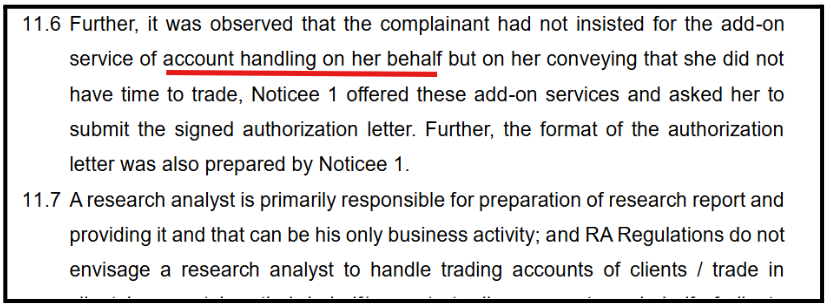
A Research Analyst’s job is strictly to publish research and recommendations, nothing more. Handling a client’s funds or executing trades for them is completely prohibited under the Research Analyst Regulations.
The order also describes how Eqwires pressured this same client to remove a negative online review, one posted by her sister, discouraging honest feedback from ever reaching the public.
Why this matters: When someone else controls your trading account, they can churn your portfolio, generating excessive transactions purely for their own commission, or take risks with your capital you never agreed to.
Finding 3: Fabricated Testimonials and Reviews
To build a false image of success, Eqwires engaged in systematic deception.
Its website featured glowing reviews from supposedly happy clients like “Prasad Kumar.” During SEBI’s inspection, Eqwires admitted these people weren’t real clients at all.
On platforms like Quora, fake user profiles claimed to earn massive profits using Eqwires’ services.
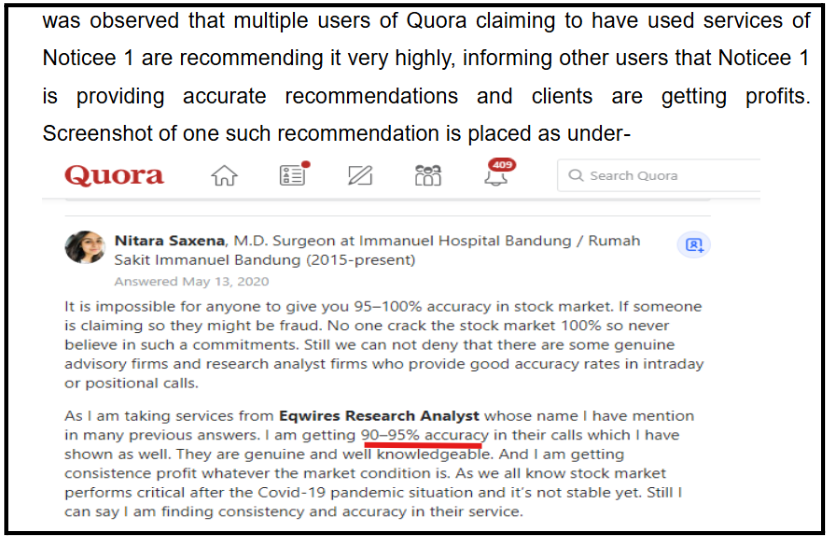
One such profile, under the name “Nitara Saxena,” described as an “M.D. Surgeon,” claimed 90-95% accuracy and nearly ₹1 lakh in profit in a single month from a service called “VENUS TRADING SERVICE.”
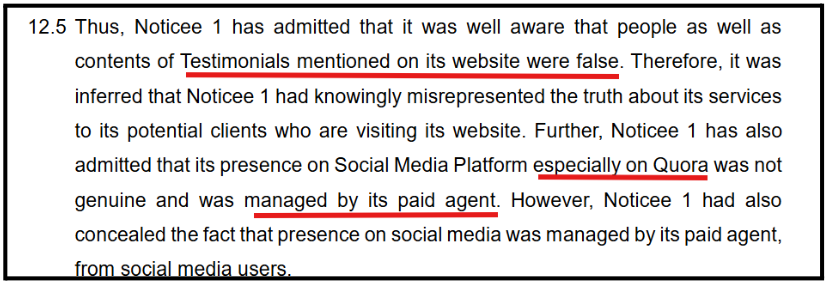
The firm confessed this profile, and others like it, were created by paid marketing agents.
Eqwires blamed a marketing agency and argued SEBI’s rules against misleading testimonials came later.
SEBI dismissed this too, stating plainly that honesty and good faith are fundamental obligations from day one, not something that only applies once a specific rule is written down.
Why this matters: Fake reviews manipulate how a new investor perceives risk. They create an illusion of reliability that draws in inexperienced people who believe they’re following a proven track record.
Also Read: Manish Goel SEBI order, 46 pages, six things SEBI caught.
Why SEBI Called This “Fraudulent and Unfair Trade Practices”?
SEBI’s order didn’t treat these three findings as separate, minor paperwork issues.
Taken together, misrepresenting its licence category, illegally handling a client’s account, and fabricating testimonials to build false credibility, SEBI’s Adjudicating Officer determined this conduct constituted fraudulent and unfair trade practices.
This is a meaningful legal characterization, not a casual description.
It reflects SEBI’s own conclusion that Eqwires’ actions went beyond simple non-compliance into deliberate, misleading conduct directed at investors.
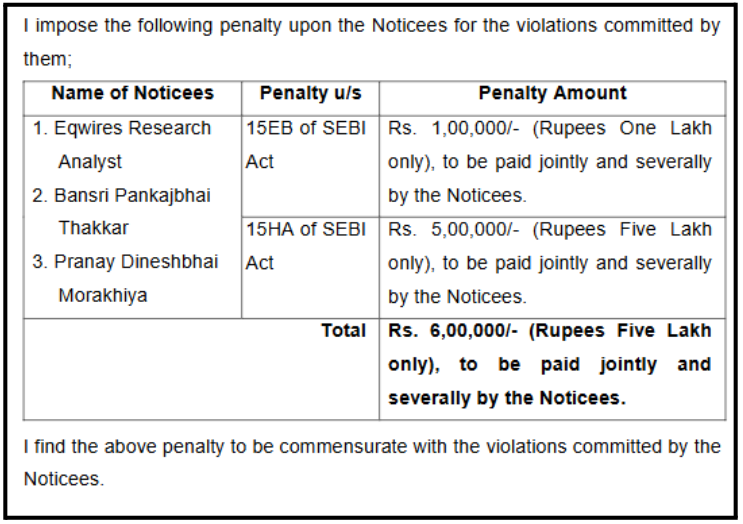
Based on all three findings, SEBI imposed a joint and several penalty of ₹6,00,000 on Eqwires and its two partners.
Because Thakkar and Morakhiya were partners during the inspection period, they were held equally liable under Section 27 of the SEBI Act, a provision that holds partners responsible for violations committed by the firm while they’re in charge of its operations.
The ₹6,00,000 penalty was not the last step in this matter.
SEBI later passed a separate final order against the firm in September 2026, which ended in a regulatory censure, and we have covered that in our report on SEBI’s later action against Eqwires Research Analyst.
SEBI Action Against Eqwires’ Own Compliance Officer
The case goes further than the firm itself.
SEBI issued a separate order against Priyank Dineshbhai Shah, who served as Eqwires’ own Compliance Officer, the person whose actual job was to make sure the firm followed SEBI’s rules.
Instead, Shah was found to have operated two unregistered investment advisory platforms of his own, named “Proworth” and “Profinity.”
He allegedly misused another individual’s SEBI registration number on these platforms and collected advisory fees from investors without any authorisation to do so.
These activities ran out of the same operational address as Eqwires itself.
The connections to Eqwires are direct:
- Shah was Eqwires’ own Compliance Officer, the person responsible for internal oversight.
- His wife, Bansri Thakkar, was a Partner and Research Analyst at Eqwires, and her phone number was used in the fraudulent scheme.
- The fraudulent operation ran from the same Ahmedabad address as Eqwires’ registered office.
- Shah recruited another SEBI-registered Research Analyst, Mr. Gowtham, into the scheme, under the pretext of offering him a job.
SEBI’s penalties against Shah were severe:
- A financial penalty of ₹11,00,000.
- A market ban of 2 years.
- A joint liability to refund ₹8,47,000 collected from investors.
- A restriction from associating with any listed company or SEBI intermediary during the ban.
This isn’t just about one bad individual.
The actions of Eqwires’ own Compliance Officer carry real reputational weight for the firm itself, since he was specifically the person meant to be preventing exactly this kind of misconduct.
Also Read: Why SEBI took action against Streetgains Research Services, another Research Analyst penalized ₹8 lakh for similar violations.
What This Order Means If You’re an Eqwires Subscriber?
This regulatory finding is your strongest tool if you’ve lost money to this firm.
SEBI has already established, in a formal order, that Eqwires engaged in fraudulent and unfair trade practices, misrepresented its licence, and used fabricated testimonials.
You don’t need to prove these things yourself; the regulator already has.
For real user accounts describing exactly these patterns in their own experience, our page on how to recover money from Eqwires research analyst covers six separate, individually documented complaints in full.
Does your own experience with Eqwires match any of these findings?
This order is exactly the kind of evidence that strengthens a formal complaint. Tell us what happened, and we’ll help you build your case around it.
For the complete company profile behind this order, our page on Eqwires Research Analyst covers registration details, pricing, and the firm’s Telegram presence separately.
Conclusion
SEBI’s own order against Eqwires Research Analyst doesn’t mince words; it calls the firm’s conduct fraudulent and unfair trade practices, backed by three specific, documented findings and a combined ₹17 lakh in penalties across the firm and its own Compliance Officer.
A SEBI registration confirms a firm cleared the eligibility requirements to operate. It doesn’t confirm every claim that firm makes is true, and this order is the clearest proof of that gap available.
If your own experience matches any of what’s documented here, this order is real, checkable evidence to build your complaint around.
Report. Recover. Stay Fraud Free.
Adjudication Order No. Order/AK/DS/2025-26/31592-31594, dated August 13, 2025, issued by Adjudicating Officer Amit Kapoor, finding Eqwires guilty of misrepresentation, unauthorised account handling, and fabricated testimonials. ₹6,00,000, imposed jointly and severally on Eqwires and its two partners, Bansri Thakkar and Pranay Morakhiya. Yes, SEBI's own order states the conduct constituted fraudulent and unfair trade practices, a direct finding from the Adjudicating Officer, not an outside characterization. Priyank Shah was separately fined ₹11,00,000, banned from the securities market for two years, and ordered to jointly refund ₹8,47,000 to investors for running his own unregistered advisory schemes. SEBI's inspection of Eqwires Research Analyst covered the period from April 1, 2020, to November 25, 2021. This nineteen-month window is when the regulator examined the firm's client communications, marketing material, and account records, and it's the specific period the three findings, misrepresentation, unauthorised account handling, and fabricated testimonials, all trace back to. Yes, referencing an existing regulatory finding significantly strengthens a formal complaint, since it establishes documented misconduct rather than relying solely on your own account.Frequently Asked Questions





 Add us as a preferred source on Google »

