

Rakesh received a call that sounded convincing.
The representative claimed to have market expertise, showed examples of successful trades, and explained how a premium subscription could help him recover previous losses.
Before making any payment, however, Rakesh searched online: “Supreme Investrade real or fake?” If you are asking the same question, you are probably trying to decide whether the service deserves your trust.
This blog examines publicly available information, regulatory actions, investor complaints, and a real dispute case to help you make a more informed decision.
Is Supreme Investrade Real or Fake?
Yes, Supreme Investrade is an existing, SEBI-registered entity, holding registration number INH000008747, granted on September 9, 2021.
So the question isn’t really “real or fake.” The better question is whether you, as an investor, have enough verified information to make an informed decision.
Based on publicly available information, Supreme Investrade has faced regulatory action and investor complaints over how certain services were promoted and delivered.
SEBI took action against the firm for guaranteeing returns and violating advisory regulations, and it has also faced allegations of misleading advisory practices.
Before subscribing or transferring any money, here are the red flags worth knowing about, drawn from SEBI’s December 2024 adjudication order:
1. Profit Screenshots Used to Attract Clients
SEBI found that representatives shared other clients’ profit screenshots with prospects to suggest consistent, guaranteed returns, a direct violation of Research Analyst regulations and a misleading picture of typical results.
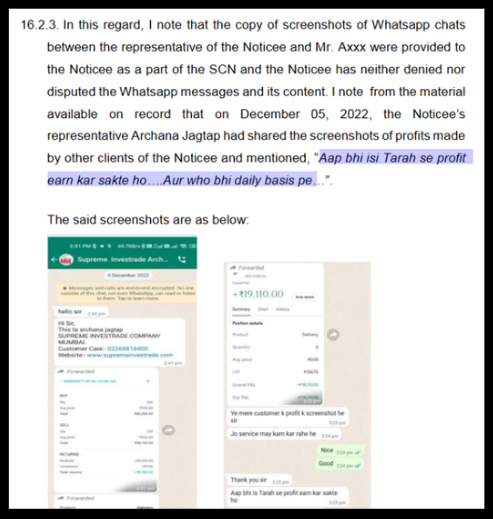
If a firm shows you someone else’s profits to win your business, treat it as red flag number one.
2. Clients Pushed to Add More Capital After Losses
Instead of urging caution after losses, representatives reportedly pushed clients to deposit more money to “recover” through future calls, including one case where a client was told to arrange extra capital after already losing money.
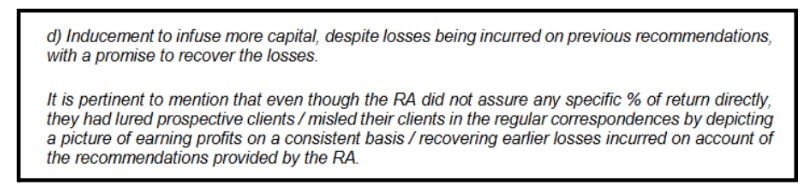
This recovery-trading pressure falls under SEBI’s PFUTP Regulations and is banned outright.
3. Real-Time Trading Instructions Crossing the Research Line
Research analysts can give buy/sell calls with targets and stop-losses, but not real-time execution instructions, telling you exactly when and how much to buy, with urgency.
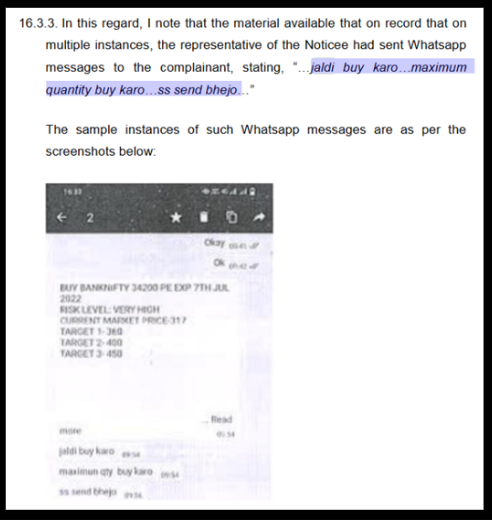
Crossing this line amounts to mis-selling under SEBI’s framework.
4. Tampered SEBI Complaint Resolution
Most seriously, an employee allegedly drafted a fake satisfaction statement, including lines like “I am very happy…” and asked a client to send it to SEBI to close their complaint.
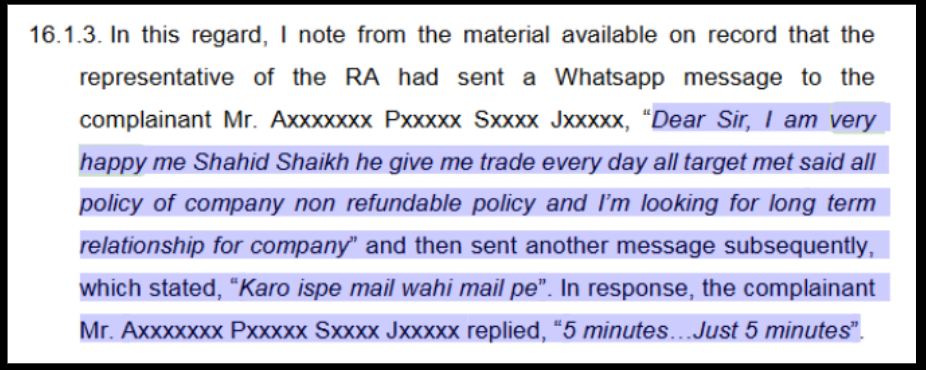
SEBI flagged this as a deliberate attempt to undermine its grievance system and treated it as a major aggravating factor.
So before transferring money, ask yourself:
- Have I verified the registration status?
- Do I understand exactly what service I am buying?
- Have I read the refund policy?
- Are the risks clearly explained?
- Is everything being communicated in writing?
If the answer to any of these is “no,” it’s worth pausing before you proceed.
What Did SEBI’s Order Against Supreme Investrade Actually Find?
Going beyond “who, “ let’s see what SEBI’s adjudication order against Abhishek Kumar Singh or Supreme Investrade actually revealed after going through investor complaints, WhatsApp chats, and call recordings.
1. Guaranteed Profit Order (December 2024)
SEBI observed that the entity had exploited the profit screenshots of other clients for enticing new subscribers, a move that was strictly misleading and was flagged under the Research Analyst Regulations.
While a research analyst is permitted to release buy/sell recommendations accompanied by target prices and stop losses, he/she cannot extend beyond this scope.
A penalty of ₹5,00,000 was imposed.
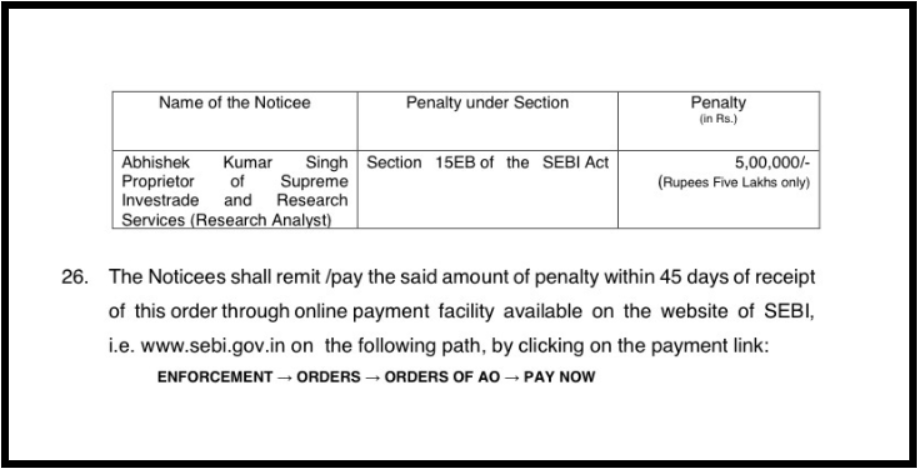
This SEBI action against Supreme Investrade for guaranteed returns highlights an important lesson for investors: profit screenshots are not proof of future performance.
A screenshot usually shows only a successful outcome, not the losing trades, risks, stop-loss hits, or the overall performance record behind it.
2. Order on Misleading Advisory Services (May 2026)
This order was focused on promises of returns and the fee structure.
The company allegedly assured clients of daily returns ranging from 15 to 20 per cent and sought 50 to 70 per cent of clients’ profits as fees.
These two practices are far from what a SEBI-registered RA is allowed to charge or claim.
SEBI rejected the firm’s defence.
SEBI clarified that influencing investor decisions through misleading statements falls within the scope of fraud under the regulations, even without directly executing trades.
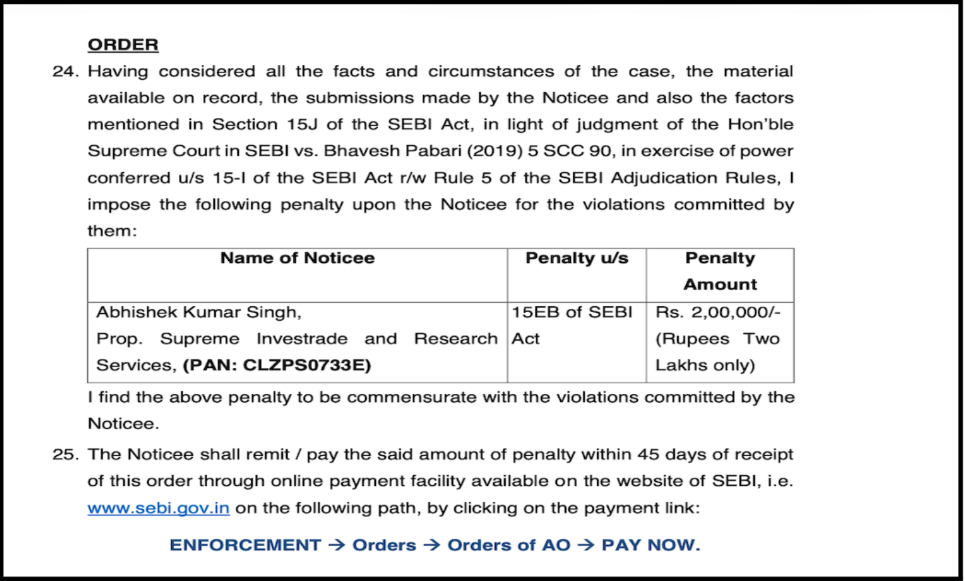
A penalty of ₹2,00,000 was imposed here, with SEBI noting the conduct was repetitive, and the advisor had been penalised before.
This case is an acute example of how research analysts in India mislead investors.
Caught in the Cycle? The Pattern Hundreds of Traders Face
Imagine this. An investor joins after seeing positive market discussions and examples of profitable trades.
Initially, the communication feels professional.
Then comes the subscription upgrade.
Next comes the promise of better opportunities for premium clients.
Soon, additional payments are requested for higher-level services.
When losses occur, the explanation often becomes, “The market was unpredictable.”
This pattern does not automatically indicate wrongdoing, but it highlights why investors should document every communication and understand the service before paying.
And this is exactly why the regulatory developments surrounding Supreme Investrade became important.
For investors, the lesson is straightforward: Any investment-related service that creates the impression of guaranteed market success deserves additional scrutiny.
Markets are uncertain by nature.
No legitimate market participant can eliminate risk.
What You Must Verify Before Paying Any Advisor?
Many disputes with research and advisory firms arise because investors fail to verify important details before making a payment.
Taking a few minutes to check the following points can help you avoid unnecessary problems later.
- Verify the SEBI Registration: Never rely solely on a registration number shared by the firm. Visit the official SEBI website and confirm that the registration is valid and currently active.
- Understand the Fees and Refund Policy: Before paying any amount, make sure you know exactly what you are being charged for. Ask for the fee structure and refund policy in writing so there is no confusion later.
- Get a Written Service Agreement: Do not depend on verbal assurances given over phone calls or WhatsApp messages. Request a formal agreement that clearly explains the services you will receive and the responsibilities of both parties.
- Check Whether Risks Are Properly Explained: A genuine advisor will always discuss the risks associated with investing and provide the required risk disclosure documents. If these are ignored or downplayed, proceed with caution.
- Confirm the Complaint Resolution Process: Before signing up, find out how the firm handles customer grievances. A professional organisation should have a clear and established process for resolving disputes if any issues arise.
How to Report Against a Research Analyst?
If you believe there is a genuine issue regarding the service you received, it is important to follow the proper complaint process rather than relying only on phone calls or informal discussions.
The sooner you organise your documents, the stronger your position may become.
Follow these steps:
Step 1: Collect All Your Evidence
Start by gathering payment receipts, bank statements, WhatsApp chats, emails, invoices, research reports, call recordings (if available), and screenshots of any representations made before you subscribed.
These records help establish what was communicated and what service was actually provided.
Step 2: Raise a Written Complaint Directly
Before escalating the matter, send a detailed written complaint to Supreme Investrade through its official grievance channel.
Clearly explain your concerns, attach supporting documents, and request a written response.
Step 3: Escalate Through SCORES
If the issue remains unresolved and the matter falls within SEBI’s jurisdiction, investors may file a complaint through the SEBI SCORES platform.
SCORES provides a formal mechanism for lodging and tracking complaints against regulated entities.
Step 4: Lodge a complaint in SMART ODR
Where applicable, investors may use the SMART Online Dispute Resolution (ODR) platform to seek structured dispute resolution.
This step may help resolve disputes before moving to formal proceedings.
Step 5: Consider Stock Market Arbitration
If the dispute still remains unresolved, investors may explore stock market arbitration depending on the facts of the case and the applicable legal framework.
Arbitration allows an independent authority to review evidence and pass a decision based on the records presented.
Need help?
Many investors wait too long before raising concerns.
By the time they act, important messages, call records, and supporting documents may no longer be available.
Have you had a similar experience with an advisory firm? Register your case with us for a free initial review.
Our team will assess your situation and walk you through the right complaint pathway, step by step.
Conclusion
The question “Supreme Investrade Real or Fake?” cannot be answered with a simple yes or no.
What can be said with certainty is that investors should carefully review publicly available information, verify all claims independently, and never rely solely on verbal assurances.
For many investors, the concern is no longer whether the service worked as expected.
The real question becomes whether a Supreme Investrade refund is possible after paying substantial advisory fees and feeling dissatisfied with the experience.
Regulatory actions, investor complaints, and arbitration matters demonstrate why documentation, due diligence, and caution are essential before subscribing to any market-related service.
The smartest decision is not the fastest decision. The smartest decision is the most informed one.
Frequently Asked Questions
1. Is Supreme Investrade SEBI registered?
Yes, Supreme Investrade and Research Services is registered with SEBI as a research analyst entity under proprietor Abhishek Kumar Singh.
However, registration confirms regulatory status, not that day-to-day practices comply with SEBI norms
2. Can a research analyst guarantee profits or recovery of losses?
No. SEBI regulations clearly prohibit any RA from promising fixed returns or guaranteeing recovery of past losses.
3. What should I do if I’ve already paid money to Supreme Investrade?
Stop making further payments, preserve every chat, call recording, and payment receipt, and file a written complaint with the firm.
4. Can I get my money back if I was misled by an advisory firm?
Possibly. As seen in the Shikha Sharma arbitration case, fee refunds are achievable when misrepresentation is proven, though compensation for actual trading losses is harder to obtain.





 Add us as a preferred source on Google »

