

Quick Summary
SEBI passed a formal adjudication order against Abhishek Kumar Singh, proprietor of Supreme Investrade and Research Services, after examining WhatsApp chats, investor complaints filed on SCORES, and profit screenshots shared with clients. The order found seven distinct violations, including guaranteed loss-recovery promises, misleading profit screenshots, pressure to invest more after losses, and giving exact entry, exit, and quantity instructions over informal channels. SEBI imposed a penalty of ₹5,00,000 under Section 15EB of the SEBI Act, with 45 days to pay before recovery proceedings begin. This page explains every violation in plain language and what it means for you as an investor.
What if the advice you trust in the stock market is quietly shaping your decisions in ways you don’t even realise?
The recent SEBI action against Supreme Investrade for guaranteed returns exposes how investor communication, when handled irresponsibly, can cross into serious regulatory violations.
This case is not just about one research analyst. It is about how persuasive messages, profit screenshots, and confident assurances can influence investor behaviour.
SEBI took a deep dive into complaints, chats, and conduct, and what it uncovered is something every investor should understand before acting on any advisory service.
Let’s decode this order in simple language so you can see exactly what went wrong and how it affects you.
What was SEBI Action Against Supreme Investrade for Guaranteed Returns?
SEBI passed an adjudication order against Abhishek Kumar Singh Research Analyst, proprietor of Supreme Investrade and Research Services.
The order came after an examination of multiple investor complaints filed through SCORES and a review of WhatsApp chats, screenshots, and other evidence.
SEBI analysed whether the advisory practices followed by the noticee were compliant with securities laws and ethical standards expected from a research analyst.
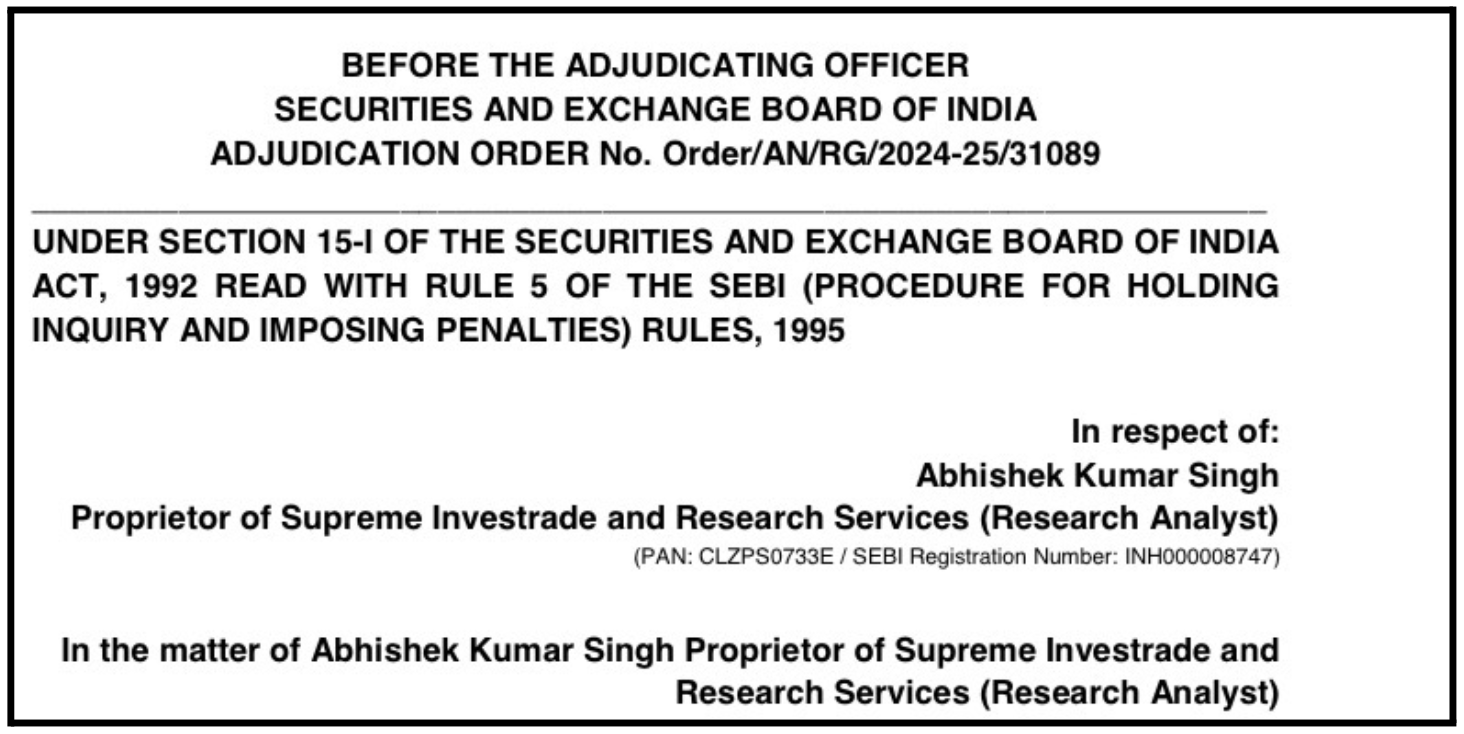
After detailed examination, SEBI concluded that several actions of the noticee were misleading, non-compliant, and in violation of regulatory provisions.
Why was the Order Imposed?
This is where things get interesting. SEBI did not rely on assumptions.
It relied on actual conversations, investor complaints, and patterns of conduct.
Here are the key violations explained simply:
1. Assurance of profits and recovery of losses
The noticee, through its representatives, assured clients that losses could be recovered through future trades.
In one instance, a client was told that by following a senior’s trades, the existing loss could be recovered in a single trade.
SEBI clearly held that such assurances are meant to influence investor decisions and are not acceptable in the securities market.
2. Depicting a misleading picture through profit screenshots
The firm shared screenshots of profits allegedly earned by other clients. These were shown without clearly highlighting the risks involved.
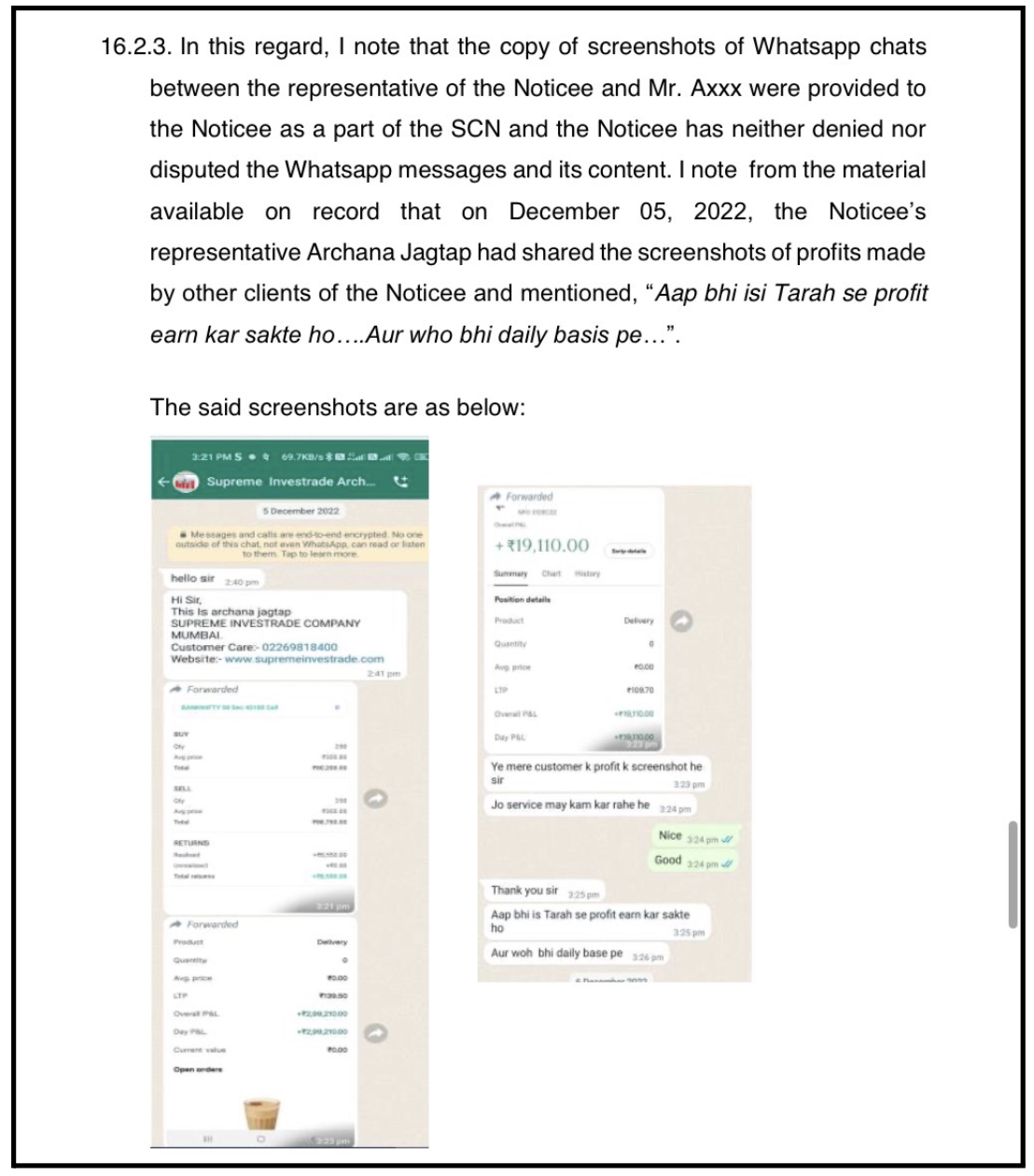
Even though in one instance SEBI gave the benefit of the doubt due to a lack of complete evidence, overall conduct showed a pattern of creating a misleading impression to attract clients.
3. Inducing investors to invest more money despite losses
Clients were encouraged to add more funds even after suffering losses, with the promise that losses would be recovered.
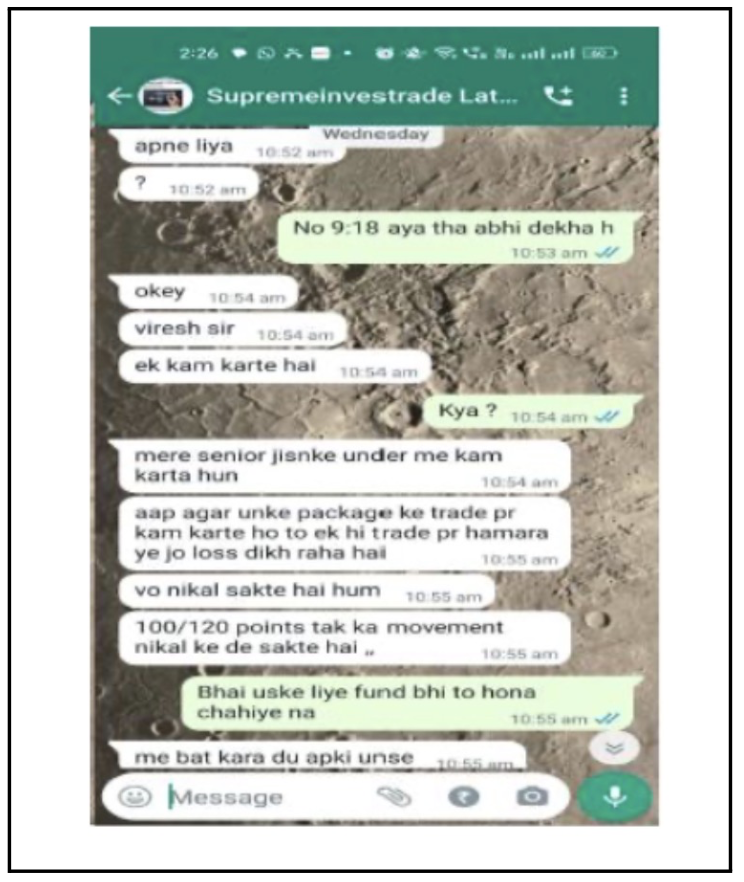
This kind of advice can push investors into deeper risk, and SEBI considered this a serious violation.
4. Providing exact entry, exit, and position sizing guidance
The research analyst was not just giving general advice. They were guiding clients on when to enter, when to exit, and how much quantity to trade.
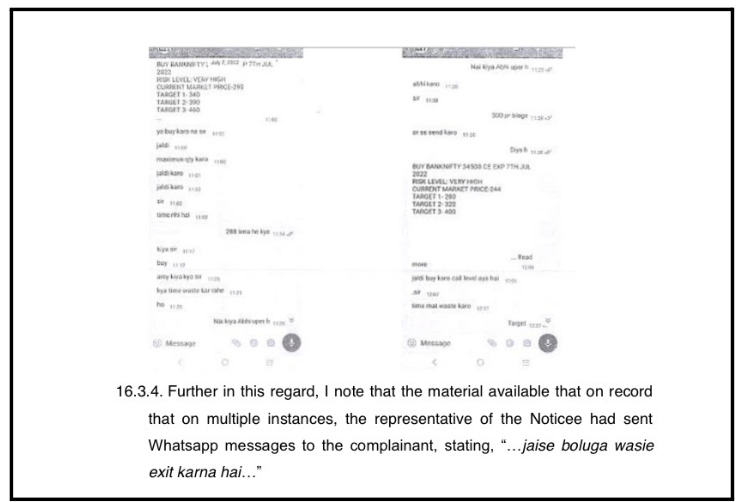
SEBI found that such detailed control over trades, especially through informal channels like WhatsApp, crossed regulatory boundaries.
5. Contradiction between disclaimers and actual conduct
While the firm’s website and onboarding documents mentioned market risks, their actual communication with clients told a different story.
SEBI observed that giving risk disclaimers on paper but making contrary promises in chats is not acceptable.
6. Misleading communication influencing investor decisions
SEBI clarified an important point here. Even if the advisor is not directly executing trades, influencing investor decisions through misleading statements still counts as “dealing in securities” under regulations.
7. Violation of PFUTP Regulations and Code of Conduct
The actions were held to be fraudulent and unfair trade practices because they were designed to induce investors to trade.
The noticee also failed to act with honesty, diligence, and good faith, which are basic requirements under the Research Analyst Regulations.
The noticee tried to defend itself by arguing that there was no direct fraud in “dealing in securities” and relied on past legal cases.
However, SEBI rejected this argument, explaining that influencing investor decisions itself falls within the scope of fraud under the regulations.
What Penalty was Imposed?
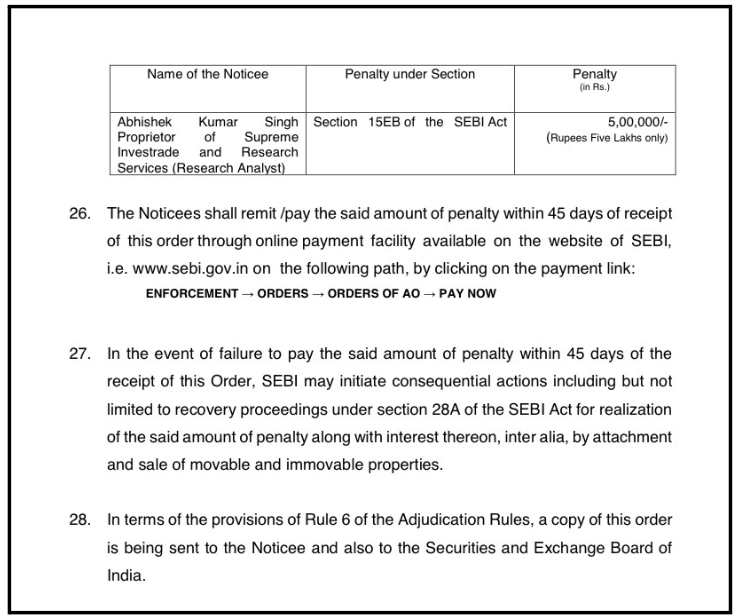
After evaluating all factors, SEBI imposed a penalty of ₹5,00,000 under Section 15EB of the SEBI Act.
While deciding the penalty, SEBI considered:
- No exact calculation of investor losses or gains was available.
- Violations were serious in nature.
- The conduct affected investor trust and market integrity.
SEBI also made it clear that once a violation of regulations is established, a penalty becomes applicable, even if the exact financial impact is not measurable.
The noticee was directed to pay the penalty within 45 days, failing which recovery proceedings could be initiated, including attachment of assets.
Ever felt like an advisor was steering your decisions more than actually informing them?
We will review your case, identify which specific SEBI violation applies, draft your SCORES complaint, and represent you through SMART ODR and arbitration.
What Can You Learn From This Case?
This case is full of lessons that every investor should keep in mind:
- Be cautious of loss recovery promises: No advisor can guarantee recovery of losses. Such statements are often used to keep investors engaged and investing more money.
- Do not rely on screenshots of profits: These can be selective and do not show the complete picture, especially the risks or losses involved.
- Watch how the advisor communicates, not just what they claim on paper: Disclaimers on websites mean nothing if actual communication tells a different story.
- Avoid advisors who push you to invest more after losses: This is a common tactic that increases your risk exposure instead of protecting your capital.
How to File a Complaint Against Supreme Investrade?
If you ever face a situation like this, acting smartly is more important than acting quickly.
Most complaints against Supreme Investrade don’t get resolved in one step.
They move through stages, each one giving you a stronger position if the one before it didn’t work. Here’s what’s actually available at each stage.
- File a SEBI SCORES complaint for direct escalation to the regulator.
- Register through the SMART ODR portal for structured mediation.
- If it comes to that, stock market arbitration delivers a final, binding decision.
For the complete step-by-step process, exactly how to use each of these and in what order, see our full guide: Supreme Investrade refund.
Conclusion
The SEBI action against Supreme Investrade for guaranteed returns highlights how easily investor trust can be misused.
It shows that even subtle communication can influence major financial decisions. SEBI has made it clear that misleading investors will not be tolerated.
Before trusting any advisory service, investors should know the answer to a critical question: can research analysts guarantee returns?
The clear answer is: NO.
For investors, awareness is your strongest defence. Always question what you are told and verify before you act.
Avoid decisions driven by pressure or promises. Because in the market, informed choices are the only real protection you have.
Report. Recover. Stay Fraud Free.
Frequently Asked Questions
₹5,00,000 under Section 15EB of the SEBI Act, with 45 days to pay before recovery proceedings, including possible asset attachment, could begin.
No. SEBI's order confirms that any assurance of loss recovery through future trades is a serious violation, regardless of how the promise is worded or delivered.
No. SEBI found that screenshots shared without showing the full picture, including losses and risks, create a misleading impression, even when some individual screenshots couldn't be fully verified.
No. SEBI specifically held that written risk disclaimers mean nothing if the advisor's real communication, over chat or calls, makes contrary promises to clients.
No. SEBI found that this level of detailed trade control, especially through informal channels, crosses the boundary of what a Research Analyst registration permits.
Yes. SEBI clarified that influencing investor decisions through misleading statements counts as "dealing in securities" under the regulations, even without direct trade execution.





 Add us as a preferred source on Google »

