
Quick Summary
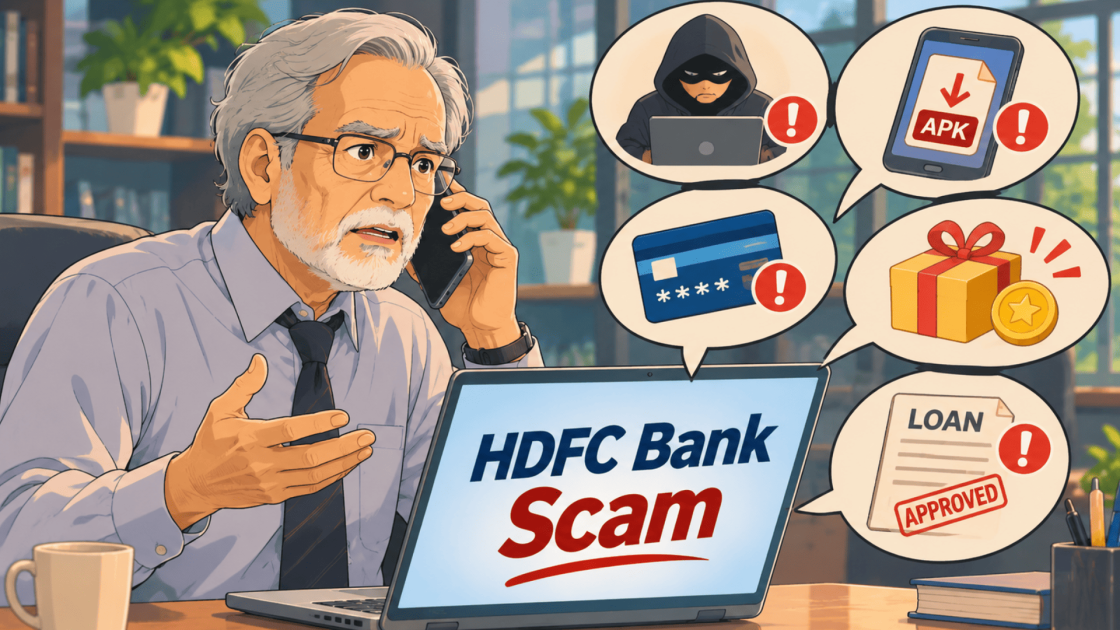
The HDFC Bank scam is not run by the bank. Criminals use its name, logo and calling style to push fake KYC updates, credit card limit offers and customer care numbers, then get victims to install an APK or share card details. Reported losses in this blog range from ₹1 lakh to ₹12.75 lakh. This blog explains how the impersonation works, five real cases, red flags, protection steps, the reporting order and when a refund claim may apply.
Your phone rings and the caller says he is from HDFC Bank. He may even know your name, tells you your card is about to be blocked, and sounds so calm that you start to believe him.
That is how the HDFC Bank scam usually begins. Within minutes it can end with a shared OTP, a file you never meant to install or a loan you never applied for.
The bank is real, but the caller is not.
Here is how the impersonation works, what it has cost real people and what to do in the first hour.
HDFC Bank
HDFC Bank is India’s largest private sector bank by assets and market value. It is headquartered in Mumbai.
It was incorporated in August 1994 as a subsidiary of HDFC Ltd and began operations in January 1995.
HDFC Ltd merged into the bank on 1 July 2023. Shareholders received 42 HDFC Bank shares for every 25 they held.
As of 30 June 2026 the bank had about 9,694 branches and 20,958 ATMs. The merged customer base is roughly 12 crore.
It is listed on the BSE and NSE, with ADRs on the NYSE, and is one of three Domestic Systemically Important Banks, alongside SBI and ICICI Bank.
Is HDFC Bank Real or Fake?
Yes, HDFC Bank is real. It is a private sector bank approved by the Reserve Bank of India, and it has been operating since January 1995.
This is not a fly by night name. The bank is listed on the BSE and NSE, and its branches and ATMs are spread across the country.
If you ever doubt a call, you can walk into your own branch or open the official app and check there. A genuine bank will not mind being verified.
The trouble starts because the name is so well known that fraudsters borrow it. The bank is real, but the person on your phone may not be.
HDFC Bank has said so itself. Its advisory of 5 August 2025 warns that fraudsters pose as bank employees or government officials and send an APK file, citing re-KYC, pending e-challan fines or income tax refunds.
The bank also has an official calling series, the 1600 and 140 numbers. A WhatsApp call from a personal mobile number is not the bank.
Its advice is simple. Never share KYC details, user ID, password, card details, CVV, OTP or PIN with anyone.
It also points customers to the Department of Telecommunications Chakshu portal to report suspicious calls and messages.
That brings us to what the HDFC Bank scam actually is.
What Is the HDFC Bank Scam?
It is a classic impersonation scam, where the criminal borrows a trusted name instead of breaking into anything.
The fraud is not done by HDFC Bank. It is not a bank policy, a bank KYC drive or an official bank app.
Fraudsters make it look real in a few ways:
- A WhatsApp profile that shows the bank’s logo.
- An APK file disguised as a PDF, a KYC form or a PayZapp download.
- A fake helpline number that appears at the top of Google results.
- Urgent talk of a blocked card, expiring reward points or a new beneficiary on your account.
The caller is not the bank. A customer who did nothing wrong may still have rights against the bank in some situations, and the reporting section below explains how that has played out in court.
How the HDFC Bank Scam Works?
The story changes, but the steps do not. There is a call or message in the bank’s name, an urgent reason and then a file or number that gives the fraudster control.
1. Fake KYC Update APK
The most common version starts with a message saying your KYC is pending or your account will be closed.
You are told to install an APK to “update” it. The file can arrive on WhatsApp, SMS or email, often with a bank logo on it.
Once installed, the malware can read OTPs and take control of the phone. Victims usually find out only when debit alerts arrive.
In one Hyderabad case the caller sent an APK presented as a PDF and told the victim it was not an APK.
2. Credit Card Limit and Reward Points Calls
Here the caller offers a higher credit card limit, or says your reward points are about to expire.
To “help”, he asks for card details or asks you to install a PayZapp style app. In a Delhi case reported in August 2026, a WhatsApp caller offering a higher limit led to ₹1,00,629 in card spends and gold coins bought with the card.
3. Fake Customer Care Number From Google
Sometimes you make the call yourself. Your card payment fails, you search for the helpline and call the first number you see.
Hyderabad Cyber Crime Police warn that fraudsters pay for top search placements for fake numbers.
The person who answers asks you to install a remote access app such as AnyDesk or TeamViewer, or to send a small test payment. Money then leaves in repeated transactions.
4. Loan or New Beneficiary Added to Your Account
In the worst version the fraudster does not only empty your savings. A loan you never applied for shows up in your account, and it goes out the same way.
If a loan credit or a new payee appears that you did not set up, someone else has access. You should report loan scams to your bank and to the cybercrime helpline on the same day.
HDFC Bank Scam Cases That Cost Lakhs
Most of the people below were doing something very ordinary, like fixing a failed card payment or redeeming reward points. None of them were looking for trouble.
Here is what happened to five of them, starting with the biggest loss.
1. ₹12.75 Lakh Lost After a Fake HDFC Officer Call in Secunderabad
A 41 year old man began getting OTPs, WhatsApp alerts and calls from people posing as HDFC Bank officials, who talked of a new beneficiary being added. He told his local branch and asked for precautionary action.
A malicious APK he had installed without knowing it compromised his net banking on 26 August. The fraudsters added an unauthorised payee.
A loan of ₹12,75,204 was then credited to his account without his consent. The loan and his savings were moved out in five debits.
Hyderabad’s Cyber Crime Wing registered a case.
2. ₹6.02 Lakh Lost After Calling a Fake HDFC Helpline
A sitting Bombay High Court judge tried to redeem credit card reward points and could not reach official customer service. On 28 February 2026 she searched online and called a number that turned out to be a fraudster’s line.
The caller sent an 18 MB file on WhatsApp. When it did not work on her iPhone, he suggested an Android phone.
She borrowed a helper’s phone, downloaded the file and entered her card details in a linked form. Alerts for ₹6.02 lakh followed. She blocked the card and reported it to cybercrime authorities and the police.
3. ₹3.39 Lakh Lost to a Fake HDFC Credit Card Executive in Hyderabad
On 2 February 2026 a 26 year old chartered accountant got a call from someone posing as HDFC credit card staff. He said some features of her card had to be disabled to avoid charges.
He told her to install PayZapp and then sent an APK presented as a PDF. Her phone froze and OTPs began arriving.
Four PhonePe payments totalling ₹3,39,900 followed. She says she shared no OTP. Hyderabad’s Cybercrime Police Station is investigating.
4. ₹1.61 Lakh Lost After Calling a Fake HDFC Number
A man in Kukatpally, Hyderabad, saw a ₹32,052 credit card payment fail. He searched for the helpline and called a fake HDFC number.
He lost ₹1,61,000. Police use this case to explain how fake customer care numbers placed on Google work.
5. ₹1.01 Lakh Lost to a Fake HDFC Executive on WhatsApp in Delhi
A Delhi resident received a WhatsApp call from a man claiming to be an HDFC Bank executive who offered a higher credit card limit.
He shared card information and ₹1,00,629 was spent through multiple transactions. The card was used to buy gold coins.
Police arrested two men in August 2026. A third accused, who allegedly contacted victims posing as a bank official, is still absconding.
Lost money after a call that sounded like HDFC Bank and not sure what to do next?
If your loss is above ₹30,000, our team can take up your case. Register with us.
Red Flags of a Fake HDFC Bank Call
Most victims say afterwards that something felt slightly off. These are the signs worth stopping for.
- The caller reaches you on WhatsApp or a personal mobile number, not the bank’s official series.
- You are asked to install an APKor an app, especially one sent as a PDF.
- You are asked for an OTP, CVV, PIN or card details.
- The call is about KYC, a card limit, reward points or a “mistaken” credit.
- You are told to stay on the line and not tell anyone.
- A helpline number came from a search result or an ad rather than your card or statement.
If the caller insists on WhatsApp, take a minute to check if a phone number is scam before you answer a single question.
A genuine bank will not mind if you hang up and call back on the number printed on your card.
How to Protect Yourself From the HDFC Bank Scam?
Every point here comes from HDFC Bank’s advisories or from police warnings in the cases above.
- Never shareKYC details, user ID, password, card details, CVV, OTP or PIN, whoever the caller claims to be.
- Never install an APKor app because a caller or message asked you to. Use official stores or the bank’s website.
- Take helpline numbers from your card, statement or the official app,not from Google.
- Refuse remote accessapps such as AnyDesk, TeamViewer or QuickSupport, even for a failed payment.
- End the call and call backif someone claims to be from the bank or police, using an official channel.
- Check your accountfor any loan credit or new payee you did not set up.
- Report suspicious calls and messageson the Chakshu portal at sancharsaathi.gov.in or the Sanchar Saathi app.
What to Do If You Fell for an HDFC Bank Scam?
The first hour matters most, because that is when receiving accounts can still be flagged. Here is the order the cases and police advisories point to.
Knowing what to do if online fraud happens before you panic saves time, so work through these steps in order.
- Block everything.Call HDFC Bank on an official number and block the card, UPI and net banking.
- Call helpline and file on the cyber crime complaint portal at cybercrime portal. Keep the acknowledgement number.
- Ask the bank in writingto freeze the accounts that received your money, and attach a copy of the complaint.
- File a police complaint.In the cases above, police registered cheating and impersonation offences under the BNS and the IT Act.
- Remove the malware.Uninstall the APK, and change banking passwords only from a clean device.
- Report the numberon the Chakshu portal or the Sanchar Saathi app.
- Keep recordsof every call, message, screenshot, request and branch visit.
Disclaimer: HDFC Bank is a genuine, RBI approved bank and is not accused of any wrongdoing here. The calls, messages and apps described below come from impersonators who misuse its name.
Conclusion
The HDFC Bank scam works because the bank’s name is trusted and the caller sounds helpful.
The bank itself warns that it never needs your OTP, PIN or an APK from you.
If a call worries you, hang up and ring the number on your card.
If money has already left your account, report it within the hour and keep every record.
Report. Recover. Stay Fraud Free.
Frequently Asked Questions
Treat it as fake until you verify it. The bank's advisory says fraudsters use re-KYC to push APK files, so call the bank on the number on your card.
The bank's advice is never to share KYC details, user ID, password, card details, CVV, OTP or PIN with anyone.
The bank has an official 1600 and 140 calling series, and a WhatsApp call from a personal number is not the bank. End the call and phone the bank yourself.
Uninstall it, block your card, UPI and net banking, and call 1930. Change passwords only from a clean device.
Reporting within the first hour gives the best chance of flagging the receiving accounts. In one SIM swap case the Bombay High Court ordered a refund under RBI's zero liability circular, but each case depends on its facts.




 Add us as a preferred source on Google »