
Quick Summary
SEBI has passed an ex-parte interim order against Prrsaar Sampada Private Limited, a SEBI-registered stock broker, and its family-linked entity Chaubara Eats Private Limited, for a scheme traders online are calling “India’s own Jane Street.” The two companies deliberately manipulated futures prices to rig options profits, making roughly ₹28.12 crore across just 23 trading days. SEBI has frozen their bank accounts, banned six people and entities from the market, and admits the real number under investigation could be much bigger. Here’s the entire story, in plain words, told exactly the way it actually unfolded
Picture this for a second.
A broker you might have trusted with your own trades. A licence straight from SEBI, sitting proudly on their website.
And behind the scenes, a quiet family business rigging the very market they were supposed to serve.
That’s not a movie plot. That’s exactly what SEBI’s newest order describes, across a full 127 pages of order books, trade logs, and family trees.
The scheme itself is clever enough that people online have already nicknamed it India’s own version of the infamous Jane Street case.
Break it into small pieces though, and it stops being confusing at all. Let’s walk through it, step by step, in plain words.
Futures, Options and LTP
Before the story starts, let’s get five words out of the way, in plain, everyday language.
A future is a contract to buy or sell a stock at a fixed price on a future date. Its price moves up and down all day, much like the stock itself does.
An option works a little differently. It gives you the right, but never the obligation, to buy or sell a stock at a set price. Options carry a price tag called a “premium,” and that premium is pulled around directly by the futures price of the same stock.
LTP simply means Last Traded Price, the most recent price at which someone actually bought or sold.
To square off means closing your position on the same day you opened it, so nothing is left open overnight.
And to impound or disgorge money means SEBI legally forces you to hand back profits it believes you earned unfairly, usually by freezing it somewhere you can’t touch.
Hold onto these five words. Everything else in this story sits on top of them.
Who Are Prrsaar Sampada and Chaubara Eats Private Limited?
Start where SEBI’s own story starts, with a name that keeps showing up across the securities market: Prrsaar Sampada Private Limited.
This isn’t a random Telegram tipster hiding behind a fake profile picture and a cracked WhatsApp number.
Prrsaar holds a real Stock Broker license, a Depository Participant license, and a Research Analyst license, all three issued directly by SEBI.
Not every entity carrying that badge stays clean; our roundup of SEBI registered brokers and real violations shows how often the licence alone falls short.
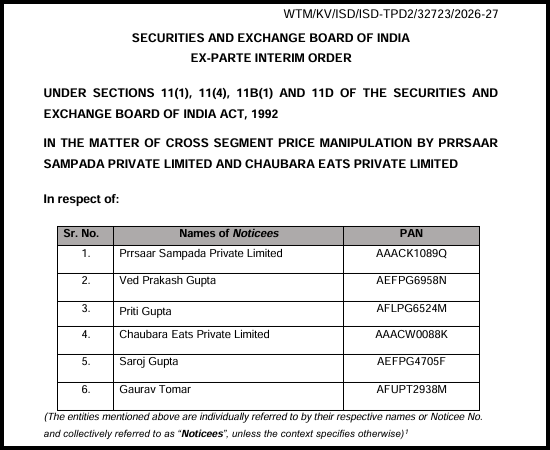
Then there’s Chaubara Eats Private Limited. Despite the food-sounding name, this story has nothing to do with restaurants.
It’s simply another company, connected to the same people sitting behind Prrsaar.
The whole case began with a small red flag. SEBI’s own internal analysis, done jointly with NSE, noticed unusual trading behaviour coming out of Prrsaar’s account.
That one flag is where the entire investigation quietly started.
Inside the Gupta Family Business Behind Prrsaar and Chaubara
A fairly technical trading story suddenly turns into something a lot more personal at this point.
SEBI dug into Ministry of Corporate Affairs records, and what it found there was hard to ignore.
Ved Prakash Gupta and Priti Gupta run Prrsaar. Saroj Gupta and Gaurav Tomar run Chaubara.
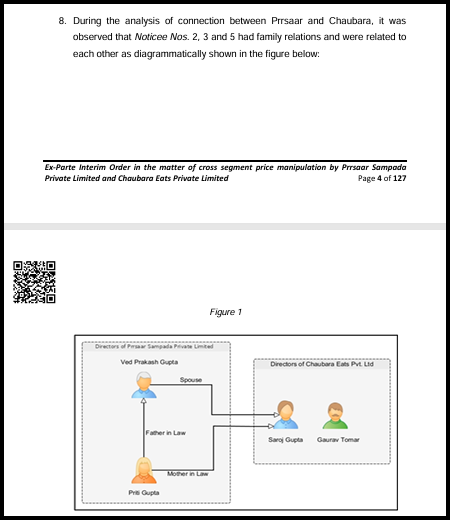
Ved Prakash Gupta is Saroj Gupta’s husband. Priti Gupta, the second director at Prrsaar, is their daughter-in-law.
All three even share the same residential address, a flat in Rohini, Delhi.
SEBI also found they shared common mobile phone numbers between them, along with a single common email ID used across both companies.
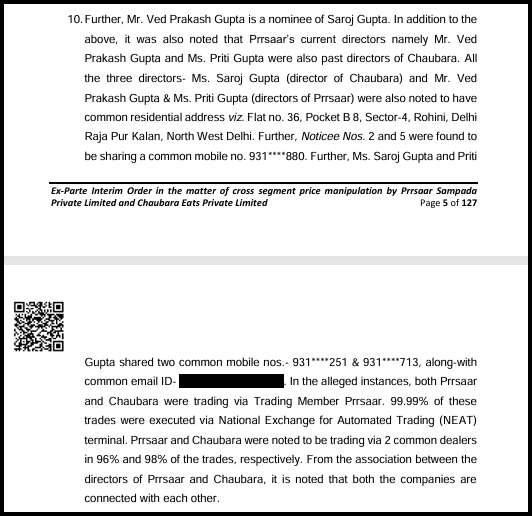
So when Prrsaar’s suspicious trading slowed down after NSE sent it a warning letter, the same pattern simply moved next door, into Chaubara, run by that same family.
What Is Cross Segment Price Manipulation in the Stock Market?
This is the single most important idea in the entire order, so it’s worth slowing down for.
Every stock that has options trading on it also has futures trading on it. Picture futures and options as two ends of a see-saw, both tied to the same underlying stock.
Here’s the actual mechanical link, in the simplest terms possible. Say a stock is trading at ₹100, and there’s a call option that lets you buy it at ₹105, currently priced at ₹3.
If the futures price for that stock suddenly jumps to ₹103, that ₹105 call option is no longer such a distant bet. It’s now closer to being worth something, so its price rises too, maybe to ₹4 or ₹5.
Push the futures price down instead, to ₹97, and that same call option drifts further from ever paying off, so its price falls.
This is simply how options are priced, everywhere, every day. It’s not a trick; it’s basic math. Prrsaar and Chaubara didn’t invent this link.
They just found a way to exploit it by shoving the futures price around on purpose.
For most traders, that link is background market behaviour, something that happens on its own, without anyone deliberately steering it.
Prrsaar and Chaubara saw it as an opportunity instead. They realised they could push the futures price around deliberately, purely to drag the linked options price wherever they wanted it to sit.
That’s the entire idea behind cross-segment manipulation, in one sentence. You rig one segment purely to profit in a different, but connected, segment.
Why Traders Are Calling This India’s Own Jane Street Scandal?
If you’ve followed market news lately, the name Jane Street might already ring a bell.
Jane Street is a giant global trading firm that SEBI banned in mid-2025, accused of manipulating Indian index options using massive trades in the linked cash and futures markets.
That case involved a foreign quant giant, thousands of crores, and one of India’s most talked-about market bans in recent memory.
This new story shares the same basic playing field, using one connected market segment to artificially drag prices around in another, linked segment, purely for profit.
The scale here is obviously much smaller, and the players are a homegrown broker and a quiet family business rather than a global trading powerhouse.
But the core idea, exploiting the mathematical link between two segments of the same stock, is the same trick, just running at a very different size.
That’s exactly why retail traders online have started nicknaming this India’s own, homegrown version of that much bigger, more famous story.
How the Prrsaar-Chaubara F&O Scam Actually Worked?
SEBI’s order lays out a four-step process behind this scheme. Let’s turn each step into something you can follow along with.
Step 1: Pick An Easy Target
They chose small, thinly-traded stocks sitting in the bottom 100 F&O names on NSE, stocks that don’t need a lot of money to push around.
Step 2: Set a Trap in Options First
Before touching futures at all, they’d quietly place large options orders on all four sides of the market at once.
Sell calls above the current price. Buy calls below it. Sell puts above it. Buy puts below it. All four, sitting there, waiting.
Think of it like placing a bet on every possible outcome of a game before it even starts, so that no matter which way the result swings, one of your bets is already a winner.
These orders simply sat unfilled in the order book, waiting, since real market prices hadn’t reached those exact levels yet.
Step 3: Attack the Futures Price
Now came the move that pulled the trigger. They’d aggressively sell futures contracts well below the going price, crashing it downward.
Then, just as aggressively, they’d buy futures contracts back above the going price, pushing it right back up.
Sell, buy, sell, buy, over and over, in clear, back-to-back patches spread across the trading day.
Step 4: Let the Trap Spring Itself
Every time the futures price got yanked in one direction, the linked options price moved with it, straight into one of the waiting orders from Step 2.
Here’s the deceptive part of the plan. On the futures side, they’d often take a small, deliberate loss. That loss was never the goal.
It was simply the tool used to trigger a much bigger profit, sitting patiently on the options side.
Think of it like a magician’s misdirection. You lose a little with one hand purely to win big with the other, while everyone’s attention stays fixed on the wrong hand.
How a 79-Minute KFin Technologies Trade Generated ₹1.29 Crore in Profit?
Numbers make a story easier to picture, so here’s one real day from the order, broken down simply.
On December 3, 2025, Prrsaar traded in KFin Technologies (KFINTECH) futures and options for just 1 hour and 19 minutes, between 9:15 AM and 10:34 AM.
In the main December futures contract, they bought and sold in a way that locked in a loss of ₹66.57 lakh, on purpose, by design.
At the same time, in a different, middle-month futures contract on the same stock, they made a small ₹8.68 lakh profit, moving in the opposite direction.
SEBI’s order notes this second, opposite-direction trade looks like it existed purely to confuse automated surveillance systems watching for suspicious, one-sided patterns.
And across seven different options contracts on that same stock, in that same hour, they walked away with a combined profit of ₹1.29 crore.
One deliberate small loss. One decoy trade thrown in for cover. One very large, very real profit, all engineered from a single stock, in roughly the time it takes to watch a movie.
Fake Orders and Cancelled Trades: The Swiggy Deception Angle
The story doesn’t stop at moving futures prices around. SEBI found a second layer of deception sitting right on top of it.
In several time patches, the entities placed large futures orders far away from the actual market price, orders that looked real but were never meant to be filled.
These fake-looking orders created an artificial sense of extra demand or extra supply in the market, pulling other traders’ attention toward them.
The moment their real, favourable options trades got executed elsewhere, these decoy orders were simply cancelled, as if they’d never existed.
On the KFin Technologies day alone, roughly 35% of all their futures orders ended up fully cancelled this way.
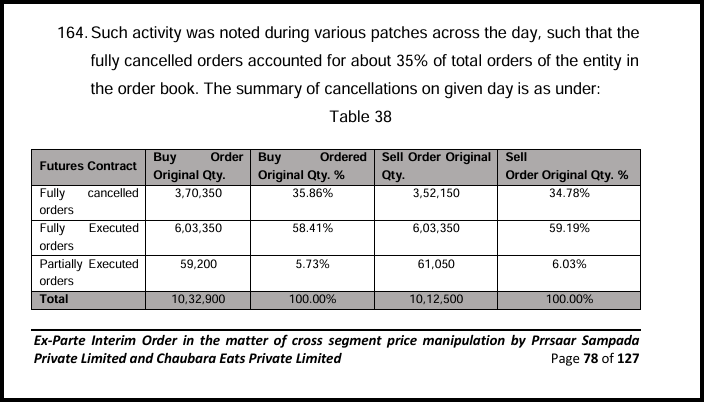
The same pattern showed up again in Swiggy futures on June 16, 2026, this time run through Chaubara.
On that single day, 76.55% of buy orders and 84.33% of sell orders were cancelled outright.
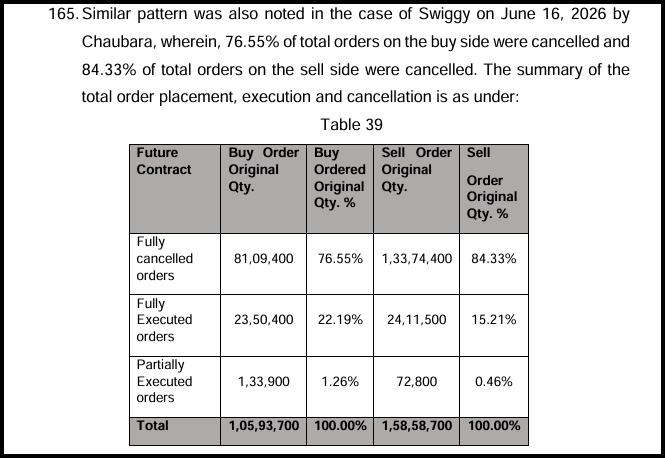
In plain words, most of what looked like real trading interest that day wasn’t real at all. It was stage-dressing, built to make the market believe something that wasn’t true.
How Prrsaar and Chaubara Secretly Matched Trades?
Just when the picture feels complete, SEBI’s order adds one more layer worth knowing about.
Between March and June 2026, while Chaubara was busy pushing futures prices around, SEBI noticed something sitting quietly on the other side of many of those trades.
Prrsaar itself.
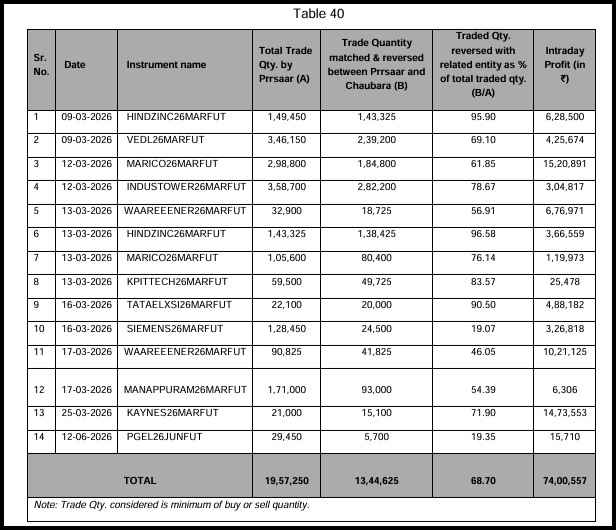
Across 14 separate instances, 68.7% of Chaubara’s manipulated futures trades were matched directly against Prrsaar, the same related entity, on the other end.
On some single days, that overlap climbed as high as 95% to 96%, an unusually precise pattern for something meant to look like coincidence.
This back-and-forth trading between two connected entities added up to a further ₹74,00,557, roughly ₹74 lakh, sitting completely separate from the main ₹28.12 crore figure.
SEBI has noted this particular thread is still under active investigation, and hasn’t been added to the total yet.
The Full ₹28.12 Crore Manipulation List Across 23 Trading Days
Zoom back out now, and here’s the full scale of what this playbook delivered, day after day.
This wasn’t a one-time trick they got lucky with. SEBI found the same playbook repeated across 23 separate trading days.
13 of those days belonged to Prrsaar, targeting stocks like BDL, Godrej Properties, 360One, KFin Technologies, Godrej Consumer, UnoMinda, Prestige Estates, and Mphasis.
10 of those days belonged to Chaubara, targeting Waaree Energies, Torrent Power, Swiggy, Marico, Lodha, Jio Financial Services, and Hindustan Zinc.
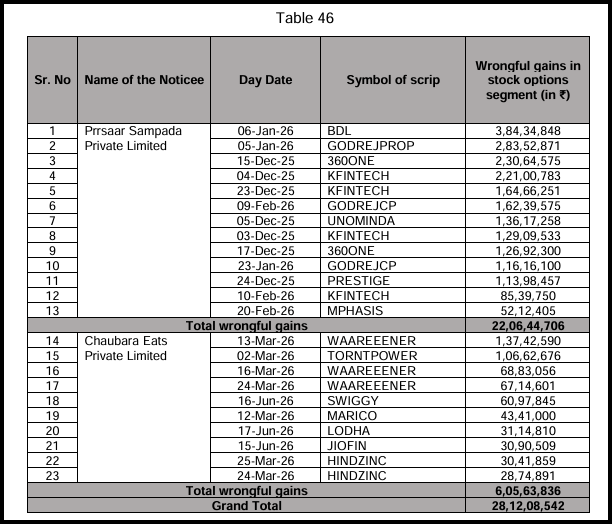
The single biggest day alone brought in ₹3.84 crore from one stock, in one day of trading.
Add every day up together, and the total lands at ₹28,12,08,542, just over ₹28.12 crore.
It’s worth being clear here. SEBI has stated explicitly that none of these listed companies, KFin, Swiggy, Godrej, or any other name on this list, are accused of anything. They were simply the stocks being used as someone else’s playing field.
Why SEBI Believes the Real Scam Is Even Bigger?
Here’s a detail that’s easy to skim past, but it matters for understanding where this case actually stands right now.
SEBI didn’t analyse every trade these entities ever made. It picked the top 13 and top 10 most profitable days purely to build this urgent interim case quickly.
More suspicious trading days sit outside this shortlist, still waiting to be examined in full.
On top of that, the ₹74 lakh coordinated-trading figure covered above hasn’t been added to the ₹28.12 crore total yet, and neither has any suspicious activity SEBI is separately examining in the plain cash market.
Even more striking, SEBI notes the same trading pattern reportedly continued through Chaubara as recently as August 2026, well after this investigation’s own cut-off date of June 2026.
So the ₹28.12 crore figure on the table today is very likely a floor, not anywhere close to a ceiling.
How SEBI Cracked Down on Prrsaar and Chaubara: The Key Takeaways
Since this is an ex-parte interim order, SEBI acted immediately, without waiting to hear the other side first, because it judged the situation urgent enough to demand exactly that.
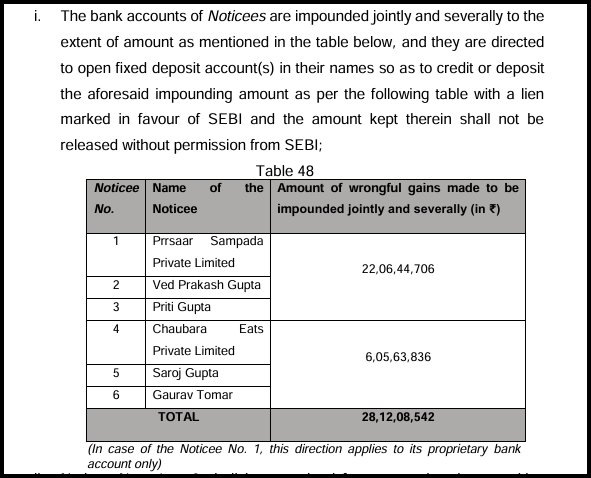
All bank accounts belonging to the six Noticees have been frozen, and they’ve been directed to move the impounded amount into a fixed deposit with a lien marked in SEBI’s favour.
Prrsaar must lock away ₹22.06 crore, and Chaubara must lock away ₹6.06 crore, together adding up to the full ₹28.12 crore figure.
All six have been banned from trading in the securities market. For Prrsaar specifically, this ban only touches its own proprietary trading account, not the regular broking services it provides to its actual clients.
Their demat accounts can no longer be debited, their assets can’t be sold off or transferred away, and they must hand SEBI a complete list of everything they own within just 15 days.
They do get 3 months to close out any derivative positions that were already open before this order landed, so pre-existing positions aren’t left stranded.
And they have 21 days to file their side of the story and request a personal hearing, since this is still only an interim order, not yet a final, settled one.
Why Company Directors Cannot Escape Personal Liability?
A company on paper is just paperwork. Real people make the decisions behind it, and SEBI’s order makes that point deliberately.
Under Section 27 of the SEBI Act, directors who were actually running a company’s day-to-day business can be held personally responsible too, not just the company as a separate legal entity.
That’s exactly what happened here, to Ved Prakash Gupta, Priti Gupta, Saroj Gupta, and Gaurav Tomar, each individually.
A fifth director at Chaubara, who only joined the company in June 2026, hasn’t been named as a Noticee this time, since their role mostly fell outside the period under examination.
SEBI has kept the door open to act against them separately later, should the wider investigation find otherwise.
One more detail worth knowing.
Past tribunal rulings say this kind of liability is usually treated as individual, based on what each person actually gained themselves, rather than everyone being punished together as one undivided group.
Hats Off to SEBI: A Well-Deserved Round of Applause
Let’s take a moment away from the scam itself and talk about the people who caught it.
This wasn’t a sloppy scheme that stuck out like a sore thumb. It was built carefully, with fake trades thrown in on purpose to fool the computers watching for trouble.
And the person accused of running it wasn’t some stranger. It was a broker SEBI itself had licensed. That makes catching it a bigger deal, not a smaller one.
Think about what SEBI actually had to do here. No confession. No tip-off. Just trade logs, KYC forms, and old company records.
From that, they figured out a husband, his wife, and their daughter-in-law were quietly running this together, right down to the same address and the same phone number.
That’s not luck. That’s someone actually sitting down and doing the digging.
SEBI also didn’t wait around. The moment NSE’s first warning letter got ignored and the scheme just moved to a different family company instead, SEBI moved straight to freezing the money.
And here’s the part that says a lot about how seriously they’re treating this. SEBI isn’t pretending ₹28.12 crore is the whole story.
They’ve openly said there’s likely more, and they’re still digging.
For a market where the accused was a licensed broker, that’s exactly the kind of response retail traders should want to see.
Think a broker or advisor may have wronged you?
Register with us and we’ll help you figure out your next step.
What This SEBI Order Means for Every Retail F&O Trader?
If you’ve ever wondered why a small-cap stock’s futures price suddenly spiked or crashed for no obvious reason on an ordinary trading day, this is exactly the kind of activity that can cause it.
You don’t need to have personally traded KFin Technologies or any of these specific stocks to have been affected by it.
This kind of manipulation distorts prices for everyone trading that stock at that moment, not just the people running the scheme.
The single biggest lesson here is one of trust, and it cuts in a specific direction. A SEBI registration confirms a firm cleared the entry requirements at some point.
It isn’t a lifetime guarantee of honest, ongoing conduct.
Prrsaar’s core license here was as a stock broker, so if this case has made you want to check SEBI registered broker status for any name you currently use, it takes about two minutes
And if you believe you’ve lost money because of a broker’s manipulative or fraudulent conduct, our step-by-step guide on how to file complaint against stock broker walks you through the exact process, starting from your first email onward.
Conclusion
This order is a reminder that market manipulation doesn’t always look obvious from the outside.
It can hide behind a valid SEBI registration, a quiet family business structure, decoy orders, and trades engineered specifically to dodge automated detection systems.
What gave it away wasn’t luck. It was patient, detailed investigative work, tracing connections across companies, family relationships, and thousands of individual trades, one thread at a time.
SEBI has frozen ₹28.12 crore for now, but by its own admission, this is likely just where the story currently stands, not where it ends.
Report. Recover. Stay Fraud Free.
They deliberately moved futures prices up and down to trigger pre-placed options orders, profiting from the manipulated options prices while often taking a small, intentional loss in futures, and placing fake orders that were later cancelled to fake genuine market interest. ₹28.12 crore total, made up of ₹22.06 crore from Prrsaar and ₹6.06 crore from Chaubara, based on just 23 analysed trading days out of many more still under review. They're connected. The directors are family, husband, wife, and daughter-in-law, and the companies shared an address, phone numbers, and an email ID between them. Yes. The market ban applies only to Prrsaar's own proprietary trading account, not the broking services it provides to its actual clients. This is an interim, ex-parte order. The Noticees have 21 days to respond and request a hearing before anything about this case becomes final. No. SEBI has explicitly stated these listed companies were simply the stocks being traded on and are not accused of any wrongdoing themselves. Very likely yes. SEBI only analysed the most profitable 23 days out of many more, hasn't yet added in the ₹74 lakh coordinated-trading figure, and says related activity continued as recently as August 2026. Both cases involve using one derivatives segment to artificially move prices in a linked segment for profit, though Jane Street's case was on a far larger, global scale.Frequently Asked Questions



 Add us as a preferred source on Google »

