
Quick Summary
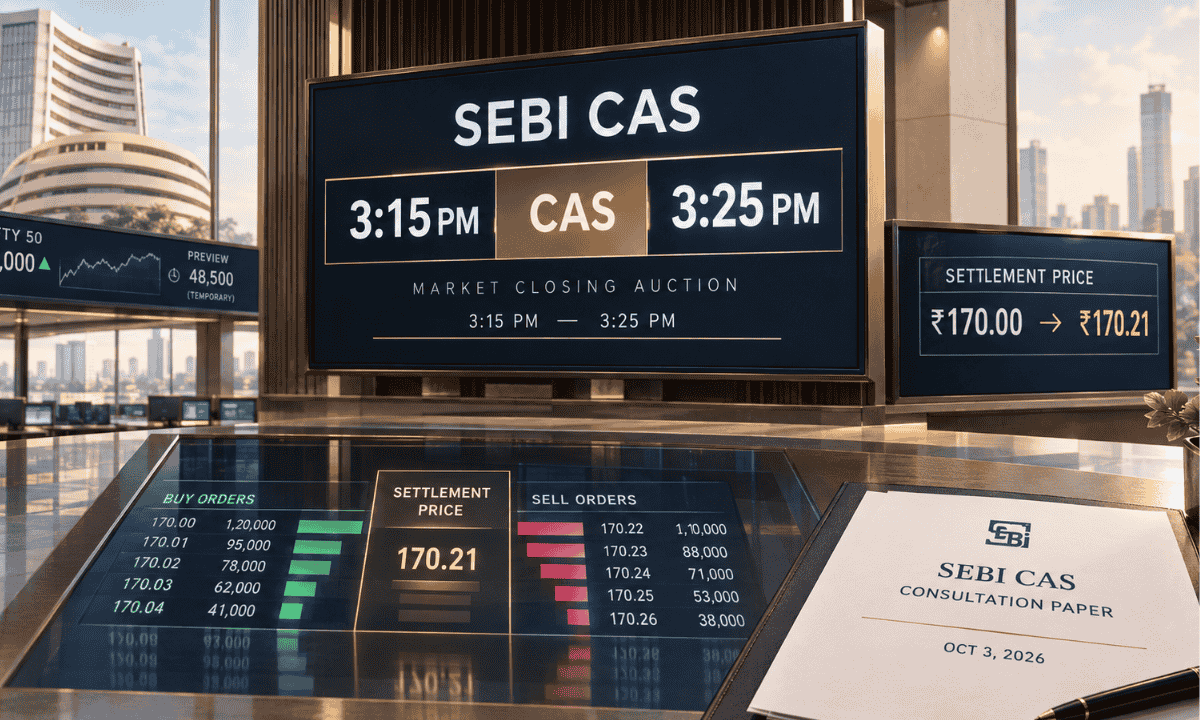
SEBI has released a detailed consultation paper proposing changes to how the Closing Auction Session, or CAS, decides settlement prices for F&O contracts on expiry day. The paper offers two possible fixes for the settlement price formula, suggests changing market closing times, wants to stop showing a confusing “index preview” number during the auction, and proposes new rules for cancelling orders and handling iceberg orders. Nothing changes yet. SEBI is only asking for public feedback, due by October 3, 2026, before deciding anything final.
If you trade Nifty or Bank Nifty options, or even just a few stock futures now and then, this paper affects you more than most SEBI papers do.
This is the full consultation paper, all 17 pages of it, and it’s genuinely worth understanding properly.
So let’s slow down and go through it piece by piece, in plain language, with no assumption that you already know what any of these terms mean.
CAS, VWAP and IEP: Key Terms Explained
You’ll see a handful of short forms again and again in this piece.
Let’s get them out of the way first.
CTS just means normal, regular trading, the buying and selling you do all day, exactly like you already know it.
CAS is the new closing auction, a short window at the end of the day where the exchange works out one single “fair” closing price instead of just averaging recent trades.
VWAP stands for Volume Weighted Average Price. In simple words, it’s just an average price, but bigger trades count for more in that average than smaller ones.
Expiry day is the last day an F&O contract is valid. Whatever price gets fixed that day decides how much money changes hands on your contract.
Settlement price is the official number used to work out your profit or loss when a derivative contract expires.
Keep these five in mind. Everything else in this paper builds on top of them.
What Is the Closing Auction Session (CAS)?
Picture the stock market’s last few minutes of the day as a small, silent auction, not the usual continuous buying and selling.
Before August 2026, a stock’s closing price was worked out by simply averaging all the trades that happened in the final 30 minutes of the day.
Under CAS, that changed completely. Now, for a short window, buyers and sellers submit their orders, but nothing trades immediately.
The exchange collects all these orders and calculates the single price at which the largest number of shares can actually change hands.
Only then does trading actually happen, all at once, at that one calculated price. That number becomes the stock’s official closing price for the day.
Think of it like a group of people quietly writing down the price they’re willing to pay or accept on a piece of paper, and the auctioneer working out the one price that matches the most buyers to the most sellers, all at the same moment.
Why This SEBI Consultation Paper Matters for F&O Traders?
Fair question. This sounds like something only exchanges and big institutions should worry about.
Here’s why it isn’t.
If you’re holding options or futures that expire on a given day, your final profit or loss isn’t based on the last live price you saw flash on your screen.
It’s based on this CAS closing price, whether you placed any order during that window or not.
So a few minutes of unusual activity in an auction you didn’t even participate in can still change how much money lands in your account that evening.
That direct link between the auction and your money is exactly why this consultation paper matters to you, even if you’ve never heard the word “auction” used for the stock market before.
What SEBI Found in Its Market Data Analysis?
SEBI didn’t just have a hunch that something needed fixing. It went back and pulled real trading numbers from the first month of CAS.
What it found was that derivatives trading stayed unusually heavy right up to, and even during, the auction window, especially on expiry days.
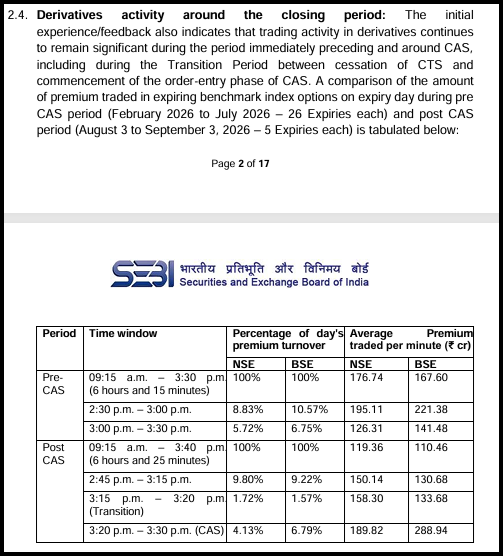
There’s also a short, easy-to-miss gap called the Transition Period: the handful of minutes between normal trading stopping and the auction actually beginning.
You’d expect that gap to be quiet, since regular trading has already ended. It wasn’t.
During that five-minute gap alone, an average of ₹791.50 crore worth of options changed hands on NSE, and ₹668.38 crore on BSE, on a typical expiry day.
That’s a genuinely large amount of money moving in a window most traders don’t even think about as “active” trading time.
SEBI also noticed something else worth understanding on its own, something called the Indicative Equilibrium Price, or IEP.
What Is the IEP, and Why Does It Trip People Up?
During the auction, the exchange shows you a running preview of what the closing price might be, based on the orders received so far.
That preview number is the IEP.
The important word there is “preview.” It is not a real, executed price. Nobody has actually bought or sold anything at that number yet.
Think of it like your provisional exam result before the final marksheet comes out. It gives you an idea, but it can still shift before it’s official.
As more orders come in, or existing ones get changed or withdrawn, this preview number keeps moving, right up until the very last second of the auction.
SEBI found that traders were treating this shifting preview number as if it were a done deal, and making real trading decisions in the derivatives market based on it.
That’s the exact behaviour this consultation paper is trying to discourage, by tightening how settlement prices actually get calculated.
Also Read: Prrsaar Sampada SEBI Order, 84.33% of sell orders cancelled on a single Swiggy trading day.
SEBI’s Two Proposed Fixes for the Settlement Price Formula
We first flagged this review the day SEBI announced it was coming, in our earlier piece on the SEBI CAS settlement price formula.
That piece was the teaser. This is the actual paper it promised.
With that background in place, here’s the actual heart of the paper. SEBI has laid out two competing ways to fix the settlement price formula.
Only one of these will eventually become the permanent rule, but they could be introduced in stages rather than all at once.
Option 1: Blend the Old Method With the New One
This option is called the Blended VWAP. As the name suggests, it mixes two things instead of relying on just one.
It takes the last 30 minutes of normal trading and the last 10 minutes of the auction, and blends both into a single settlement price.
Here’s the clever part. The blend isn’t a fixed 50-50 split, or any other fixed ratio. It depends entirely on how much real money actually traded in each window that day.
So if ₹9,000 crore worth of shares traded in normal trading, and only ₹1,000 crore traded during the auction, the auction only gets a 10% say in deciding the final settlement price, exactly matching its real share of the day’s activity.
Option 2: Go Back to the Old Formula, At Least For Now
This second option is far simpler to picture. Settlement prices would go back to being based only on the last 30 minutes of normal trading, exactly the way things worked before CAS ever existed.
Under this option, whatever happens during the auction simply wouldn’t count towards your settlement price at all.
This wouldn’t be forever, though.
SEBI has proposed that this arrangement would last for a minimum of one year, purely to give the auction more time to mature, before eventually switching over to the blended method anyway.
So Option 2 isn’t really a rejection of the blended idea. It’s more like SEBI saying, “let’s wait and watch a little longer before mixing the two.”
Blended VWAP Settlement Price: A Simple Worked Example
Numbers always make an idea easier to hold onto, so let’s walk through SEBI’s own example, simplified into plain steps.
Imagine an index made up of just three stocks, weighted 50%, 30%, and 20% respectively, to keep the maths light.
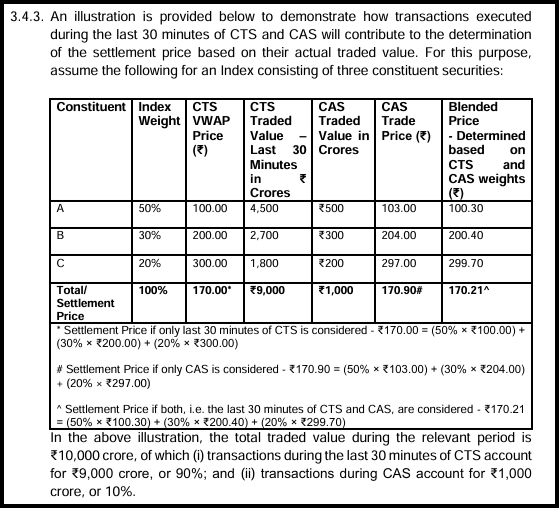
If you used only the last 30 minutes of normal trading to fix the settlement price, the answer works out to ₹170.00.
If you used only the auction’s final price instead, the answer works out to ₹170.90, slightly different because auction conditions weren’t identical to normal trading.
Now blend the two, weighted by how much money actually traded in each window, and you land on ₹170.21.
Notice that ₹170.21 sits much closer to ₹170.00 than to ₹170.90. That’s not a coincidence.
In this example, 90% of the day’s trading happened in normal trading, and only 10% happened during the auction, so the blended price naturally leans towards the session that actually saw more real activity.
That’s the whole logic of Option 1 in one sentence. Whichever session had more genuine trading gets more weight in deciding your final settlement price.
Why SEBI Wants to Stop Showing the Index “Preview” Number?
This next part trips up even fairly experienced traders, so it’s worth slowing down for.
We already covered the IEP, the preview price shown for an individual stock during the auction. For an entire index, like Nifty or Bank Nifty, all these individual preview prices get combined into one number called the Indicative Index Value, or IIV.
In plain words, the IIV is a live, constantly flickering guess at where the whole index currently stands, built from a bunch of prices that haven’t actually been finalised yet.
The danger is that this flickering number can look exactly like a real index movement, even though technically nothing has been traded at that level.
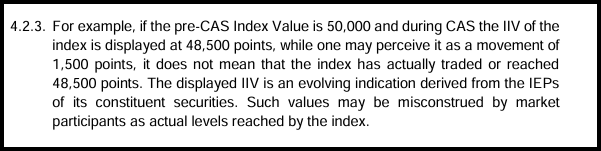
SEBI’s own example makes this crystal clear. Say the index closed the previous day at 50,000 points. During the auction, the IIV suddenly shows 48,500.
At first glance, that looks like a brutal 1,500-point crash. In reality, no actual trade has happened at 48,500 at all. It’s purely a preview, built from orders that are still being adjusted.
Because this number is so easy to misread, especially in the heat of expiry day, SEBI is proposing to stop publishing this flickering index-level number altogether.
Individual stock-level preview prices would still be shown, since those are harder to confuse with a genuine, already-decided price movement.
How SEBI Plans to Change Stock Market Timings?
Since the settlement formula itself might change, SEBI is also rethinking exactly when the trading day actually ends.
Right now, there’s a gap of a few minutes between normal trading stopping and the auction beginning, called the Transition Period.
SEBI wants to shrink this gap from five minutes down to just one minute, freeing up more time for genuine trading instead.
Beyond that shared change, SEBI has put two full timing options on the table.
Option A: Push Everything a Little Later
Under this option, normal trading would continue all the way until 3:30 PM, exactly like it worked before CAS existed.
The auction would then run from 3:31 PM to 3:40 PM, and F&O trading would continue for another 5 minutes after that, wrapping up by 3:45 PM.
Option B: Keep Roughly Today’s Earlier Cut-Off
Under this option, normal trading for CAS-linked stocks would stop at 3:15 PM, close to how things work right now.
The auction would run from 3:15 PM to 3:25 PM, and F&O trading would finish by 3:30 PM.
Either way you look at it, the actual length of the trading day barely changes. What shifts is simply where the auction sits within that day, either later in the afternoon or roughly where it already sits today.
Restricting Order Cancellations During the Auction Window
This next proposal is aimed squarely at stopping people from gaming the auction.
Right now, you’re allowed to place an order during the auction, even one far away from the likely closing price, and cancel it right up until the very last moment.
Some traders were reportedly using this to place large “test” orders just to nudge the preview price in a certain direction, then quietly pulling those orders back before the auction actually locked in.
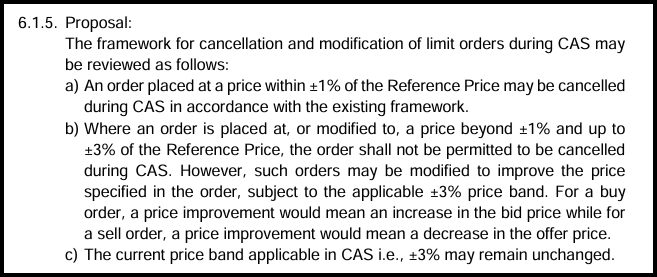
SEBI’s fix draws a clear line at 1% away from something called the Reference Price, which is simply the starting benchmark price the auction uses to begin with.
If your order sits within that 1% zone, nothing changes. You can still cancel it freely, exactly like today.
But if your order sits further out, anywhere up to the wider 3% band that’s already allowed, you would no longer be able to cancel it once placed.
You could only adjust it to make it more likely to actually execute, never simply withdraw it.
Think of it like placing a bet that you’re allowed to raise, but not take back, once you’ve gone past a certain point. It’s meant to make the auction book a more honest reflection of what people genuinely want to trade.
How Will Iceberg Orders Work in the Closing Auction?
One more technical term before we wrap up the proposals: an iceberg order.
This is a large order that gets deliberately split into smaller, visible chunks, so only a small slice of the full order shows up in the order book at any given moment, much like how only the tip of an iceberg shows above the water.
Right now, if part of that hidden order hasn’t been filled by the time normal trading ends, it simply vanishes. It doesn’t carry forward into the auction at all.
SEBI wants to change that. Under the new proposal, any leftover, unfilled portion of an iceberg order would automatically convert into a normal, fully visible order and join the auction instead of disappearing.
The idea here is fairness. A large investor’s genuine trading interest shouldn’t just evaporate purely because of how their order happened to be structured earlier in the day.
How to Send Your Feedback to SEBI Before October 3, 2026
Here’s the part that’s easy to skip past, but genuinely matters. This is still only a consultation paper. Nothing here is law yet, and today’s settlement price formula works exactly as it did yesterday.
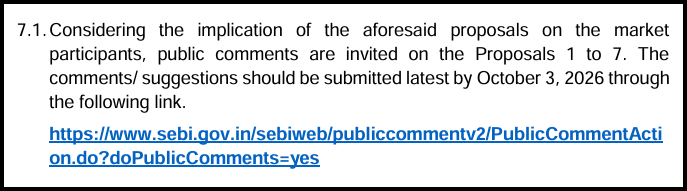
SEBI has clearly asked for public feedback on all seven proposals covered in this paper, and this isn’t restricted to brokers, exchanges, or big institutions.
Retail F&O traders are just as welcome to share their views, and honestly, your everyday trading experience is exactly the kind of feedback a paper like this needs.
Here’s where to submit it, and when it’s due:
Submit your comments here
Deadline: October 3, 2026
If you run into any technical trouble while filling out that online form, SEBI has also shared a backup email address, [email protected], where you can send your written comments directly instead.
What This SEBI Consultation Paper Means for F&O Traders Today
To be very clear, nothing changes today. Your expiry-day settlement still runs through the same CAS-based formula that’s been in place since August 2026.
The real value in reading a paper like this early is that you’re not caught off guard later, once SEBI actually finalises which option it’s going with.
If you regularly carry positions into expiry, especially in index options, it’s worth bookmarking this topic and checking back once the comment window closes and SEBI shares its final decision.
And if a settlement price swing during this first, still-evolving month of CAS already cost you money, and you genuinely believe your broker mishandled how your position or margin was managed around that time, that’s a separate matter worth raising on its own.
You can start that process through a SEBI complaint against broker, which walks you through exactly how to escalate it, step by step.
Conclusion
This consultation paper is a good example of a regulator actually doing its job properly, watching how a brand-new system behaves in the real world, and being willing to adjust it within just a month of launch.
The two settlement price options, the timing changes, and the stricter order cancellation rules all point in the same direction: making the closing price something traders can genuinely trust, rather than a number a handful of last-minute orders can quietly nudge around.
Whether you agree with SEBI’s specific proposals or not, the window to actually say so closes on October 3, 2026, and that part is entirely up to you.
Report. Recover. Stay Fraud Free.
No. This is only a consultation paper. The current CAS-based settlement methodology stays exactly as it is until SEBI notifies a final rule. Heavy derivatives trading continues right up to and during the auction window, and traders were reacting to a shifting preview price that isn't final, which SEBI feels adds unnecessary uncertainty to how settlement gets decided. Option 1 blends the last 30 minutes of normal trading with the auction price, weighted by how much actually traded in each. Option 2 temporarily ignores the auction entirely and reverts to the old, pre-CAS formula for at least a year. The IEP is a running preview of where the auction's closing price might land, based on orders received so far. It keeps changing until the auction actually ends, so it isn't a price anyone has actually traded at yet. Because this flickering, index-wide preview number can be mistaken for an actual index move, even though no real trade has happened at that level, which risks misleading traders during a critical part of the day. Only if it's placed within 1% of the reference price. Orders placed further out, within the wider allowed 3% band, could only be adjusted, not cancelled, under the new proposal. Submit your comments through SEBI's public comment form before October 3, 2026, or email [email protected] if the online form gives you any technical trouble.Frequently Asked Questions





 Add us as a preferred source on Google »

