

Quick Summary: SEBI is reviewing how settlement prices for derivative contracts get calculated after the Closing Auction Session went live in the equity cash segment on August 3, 2026. The review follows a month of stakeholder feedback, including inputs raised on social media, after the CAS closing price began deciding settlement values on expiry day. No penalty or entity is involved here, this is a policy review, not an enforcement action. SEBI will issue a consultation paper on the proposed changes within about a week of this press release.
Why Is SEBI Suddenly Talking About Settlement Prices Again?
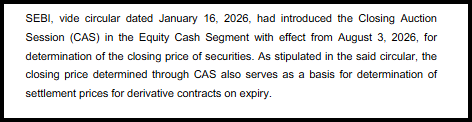
SEBI rolled out the Closing Auction Session, or CAS, in the equity cash segment from August 3, 2026. The circular behind it was dated January 16, 2026.
CAS was meant to fix a long-standing problem. The old closing price was just an average of the last 30 minutes of trades, and it could drift from what the market actually agreed the stock was worth.
Under CAS, the price that comes out of that final auction window doesn’t just become the day’s closing price. It also decides the settlement price for derivative contracts that expire that day.
That link between the cash market close and F&O settlement is exactly what’s now under the scanner.
The Two Rounds Of Consultation Nobody Talks About
CAS wasn’t rushed. SEBI ran two rounds of public consultation, one on December 5, 2024 and another on August 22, 2025, before finalising the framework.
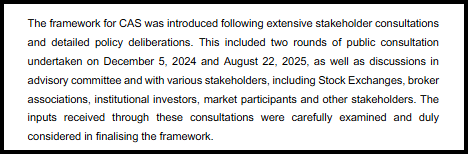
Exchanges, broker associations, institutional investors and other market participants were all part of those talks. SEBI says their inputs were “carefully examined” before the framework went live.
So this isn’t SEBI reversing course on a whim. It’s SEBI reacting to what actually happened once real money started flowing through the new system.
What SEBI Says It Heard In The First Month?
SEBI closely tracked CAS through its first month of live trading, right from August 3 to early September 2026.
That monitoring pulled in feedback from stock exchanges, brokers, proprietary traders, software vendors, mutual funds, industry bodies and FPIs.
A lot of that feedback didn’t come through formal channels either. SEBI specifically mentions social media as one of the routes people used to flag issues.
That’s notable. It tells you retail sentiment on trading apps and timelines genuinely fed into a regulatory review.
The One Complaint That Made SEBI Move
Out of everything SEBI heard, one issue stood out enough to trigger a formal review: how the settlement price for derivative contracts on expiry gets determined using the CAS closing price.

In plain terms, if the final auction price on expiry day is volatile or thin on liquidity, it can swing the settlement value of every F&O contract expiring that day. For traders holding positions into expiry, that’s not a small detail.
What Happens Next?
SEBI has confirmed it “may be proposing certain changes” to the settlement price methodology for derivative contracts. A formal SEBI CAS consultation paper will follow in about a week from the September 3, 2026 press release.
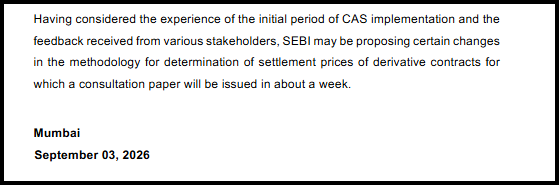
That means the current CAS-linked settlement price rule stays exactly as it is until the paper comes out. Nothing changes for expiries happening this week.
Once the paper is published, it will likely open for public comments before any final rule is notified.
What This Means If You Trade F&O?
If you hold positions into expiry, your settlement still runs through the existing CAS methodology for now. Nothing changes until SEBI’s consultation paper is out and a final rule gets notified.
Track that paper closely once it lands, since it will spell out the actual proposed change to the settlement price formula.
If a broker mishandled your margin call or expiry-day execution during this volatile first month, start by noting down the trade timestamps, chat logs, and call records.
Once you have that evidence together, and you genuinely believe the fault was the broker’s, you can file complaint against stock broker.
Grievances aren’t limited to brokers though. Any SEBI-regulated intermediary, including exchanges and clearing members, can be held accountable through the regulator’s own grievance channel.
For that route, investors can raise it as a SEBI SCORES complaint, which sends the grievance directly to the entity concerned.
Sometimes the issue sits with the exchange’s own settlement or auction process rather than your broker’s conduct.
If your trade ran on the National Stock Exchange, that’s the route to file complaint in NSE.
BSE-listed trades follow a similar process, just through a separate grievance desk.
For those, the BSE complaint portal is the designated channel.
Most complaints get resolved at one of these stages, but not always.
If it escalates further and needs resolution outside the exchange’s internal process, the SMART ODR complaint portal is the designated route for market-related disputes.
Frequently Asked Questions
1. What exactly is the Closing Auction Session (CAS)?
It’s the mechanism SEBI introduced from August 3, 2026, to decide a stock’s official closing price through a short auction window instead of a simple time-average of trades.
2. Why does CAS matter to F&O traders specifically?
Because the CAS closing price also becomes the settlement price for derivative contracts that expire that day, not just the cash market close.
3. Is SEBI cancelling or pausing CAS?
No. SEBI is only reviewing the settlement price methodology for derivatives. CAS itself continues to operate as it currently does.
4. When will the new proposal come out?
SEBI says a consultation paper will be issued in about a week from the September 3, 2026 press release date.
5. Will this change apply immediately once published?
No. A consultation paper is typically opened for public comments first, so any final rule change would come only after that process.
6. Does this review mean SEBI found something wrong with a broker or exchange?
No, this is a methodology review, not an enforcement or penalty action against any named entity.
7. What should I do if I lost money due to a settlement price swing this past month?
Document the trade and expiry details first. If you believe your broker was at fault, you can file a complaint against stock broker or raise it as a SEBI SCORES complaint.
Report. Recover. Stay Fraud Free.




 Add us as a preferred source on Google »

