
Quick Summary
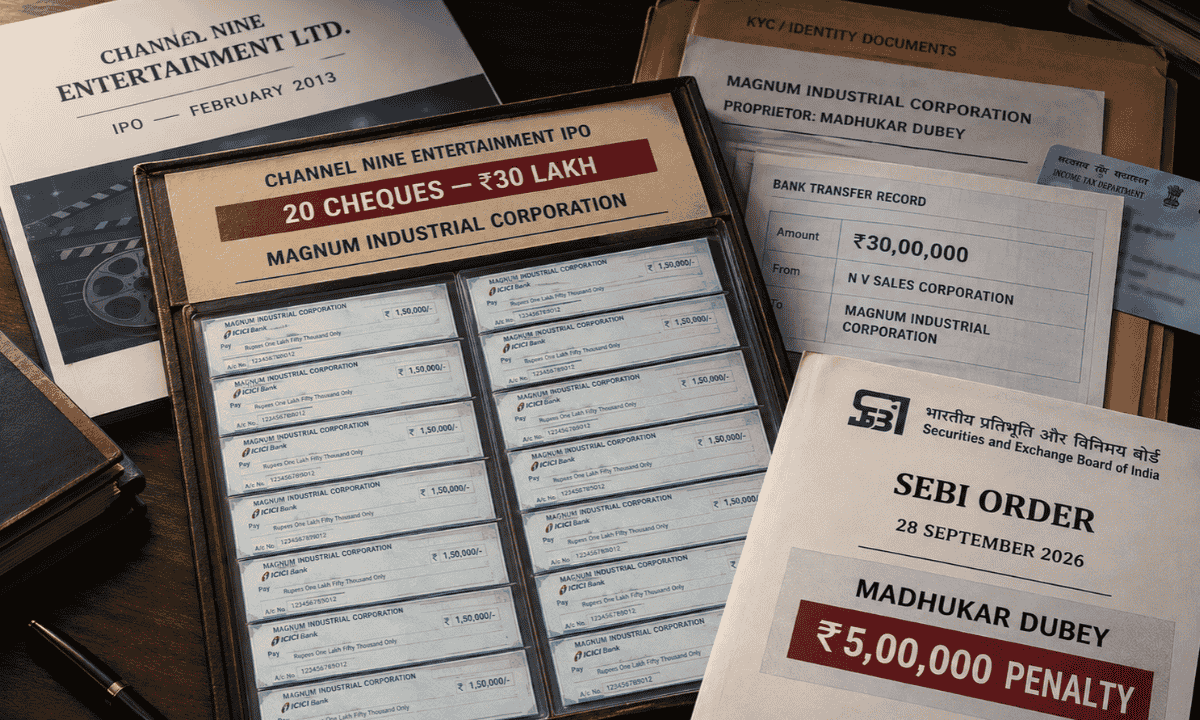
SEBI has fined Madhukar Dubey and his firm Magnum Industrial Corporation ₹5 lakh under Section 15HA in the Channel Nine Entertainment IPO case. Dubey said he was only a driver and that his late employer misused his KYC. SEBI’s Adjudicating Officer did not accept this. The order points to 20 cheques worth ₹30 lakh from his firm, his conflicting statements, and his delay in reporting the misuse. SAT had sent the case back for a fresh hearing in September 2025. SEBI passed the order on September 28, 2026.
Can a driver really be held legally responsible for a ₹30 lakh market manipulation scheme if he says he knew nothing about it?
Madhukar Dubey said he was only a driver, but SEBI’s latest order tells a different story.
Twenty identical cheques were issued from his proprietorship firm, and his statements had several contradictions. His attempt to put the blame on a deceased businessman did not work during the rehearing.
In its decision dated September 28, 2026, the regulator imposed a ₹5 lakh penalty on him and also showed how identity documents can be misused in penny stock IPOs.
If you think giving your identity documents to a boss or someone you know is harmless, this case may make you think twice.
Channel Nine Entertainment IPO Case: What Are the SEBI Charges?
Madhukar Dubey and his proprietorship, Magnum Industrial Corporation, face SEBI action over the IPO of Channel Nine Entertainment Ltd.
SEBI first passed an order on February 28, 2022 against thirteen noticees. Dubey was Noticee 2.
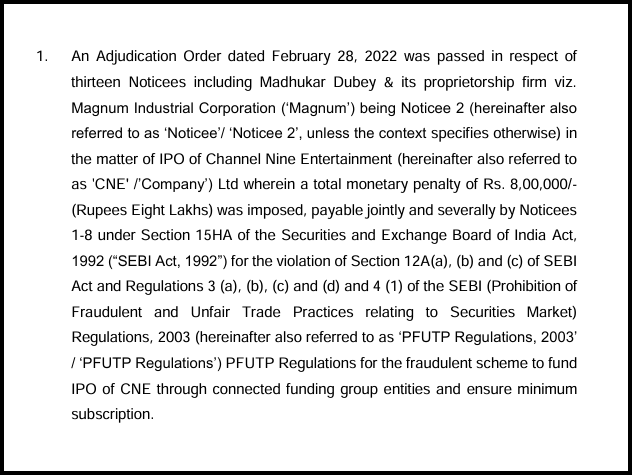
That order set a total penalty of ₹8 lakh, which Noticees 1 to 8 pay jointly. It found a scheme to fund the IPO through connected entities.
Dubey appealed to the Securities Appellate Tribunal, and the story moved from there.
SAT Remand Order: Why Did SEBI Re-Hear the Madhukar Dubey Case?
Dubey told SAT that he worked as a driver for Vijay Jindal. He said Jindal misused his KYC and other credentials.
He also said he lives in Ghaziabad and did not know about the proceedings. He pointed to SEBI’s newspaper notices of October 9, 2020, and March 8, 2022.
Jindal’s alleged misuse also came up in a second IPO case, HPC Biosciences. SAT had already sent that matter back.
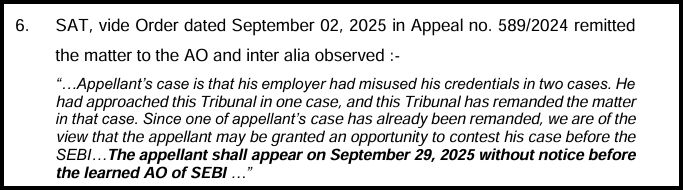
On September 2, 2025, the SAT sent this case back too. It asked SEBI to give Dubey a chance to contest.
A new Adjudicating Officer took up the case on September 17, 2025. It moved to Medha Sonparote on June 9, 2026.
Timeline of SEBI Proceedings: From Show Cause Notice to Final Order
The rehearing ran for about a year.
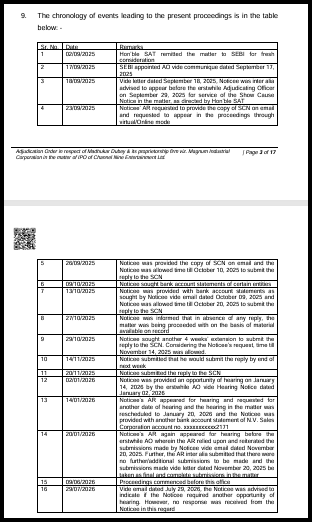
SEBI gave him the show cause notice by email on September 26, 2025. He asked for bank statements and for more time more than once.
He sent his reply on November 20, 2025. His representative attended hearings on January 14 and January 20, 2026.
On July 29, 2026, SEBI offered another hearing. He did not reply.
Channel Nine IPO Scam: How the ₹1,171 Lakh Funding Scheme Worked?
SEBI issued the show cause notice on December 10, 2018. It covers Channel Nine’s IPO of February 2013, which allotted 46,86,000 shares.
SEBI said the IPO would not have met minimum subscription without a funding group. It said the company and its directors ran the scheme with that group.
The company raised ₹1,171.50 lakh. It moved ₹1,140 lakh to various entities, and ₹500 lakh went to funding group entities.
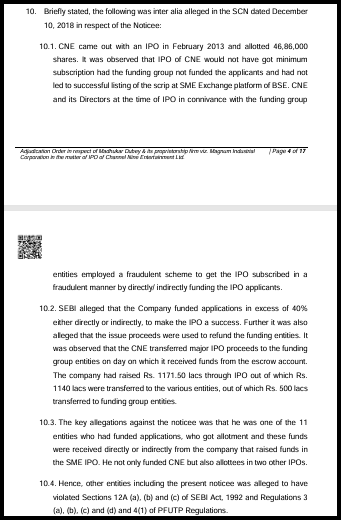
SEBI named Dubey as one of the entities that funded applicants. It also said he funded allottees in two other IPOs.
The charges are under Sections 12A(a), (b) and (c) of the SEBI Act and Regulations 3(a) to (d) and 4(1) of the PFUTP Regulations.
Other SME IPO cases show how SEBI reads inflated demand. Our write-up on the Trafiksol SEBI order covers an IPO that drew 345 times its size.
The ₹30 Lakh Paper Trail: How 20 Cheques Funded Non-ASBA Retail Applicants?
SEBI’s evidence is a money trail, and it is short.
Magnum Industrial Corporation issued 20 cheques of ₹1.5 lakh each for 20 non-ASBA retail applicants. All 20 got allotment.
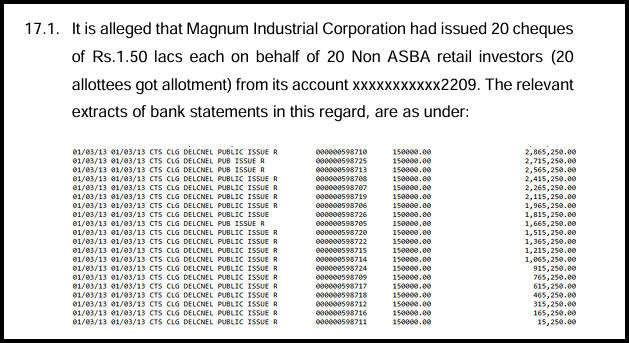
Each applicant asked for 6,000 shares, so the group got 1,20,000 shares in total. The cheques came from Magnum’s account ending 2209.
Magnum got that ₹30 lakh from N V Sales Corporation on February 28, 2013. That is another firm in Dubey’s name, from an account ending 2171.
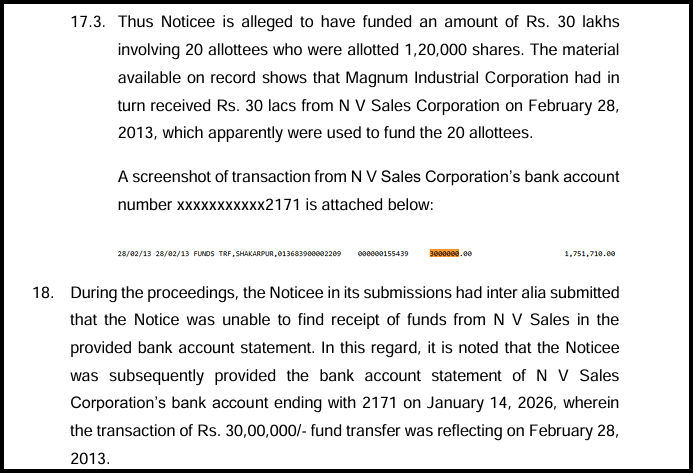
Dubey said he could not find that transfer in the statements he first got. SEBI gave him the N V Sales statement on January 14, 2026, and the transfer shows on it.
The Driver Defence: Did Vijay Jindal Misuse Madhukar Dubey’s KYC?
Dubey’s reply of November 20, 2025, made seven main points.
He said he was Jindal’s driver from 2010 to 2015. He denied any link to Magnum, Alliance Traders, N V Sales or A One Furniture.
He said Jindal opened those firms and bank accounts with the credentials Dubey gave in good faith.
He said he got no money or benefit.
He argued that SEBI left out others. HPC Biosciences, AMS Powertronics and Jindal himself were not noticees.
He also said police refused his complaint against Jindal because Jindal had died.
Why SEBI Rejected Madhukar Dubey’s Driver Defence?
During the rehearing, SEBI’s Adjudicating Officer carefully dismantled Madhukar Dubey’s claim of being an innocent driver whose identity was hijacked.
A close look at the bank transactions, conflicting statements, and delayed legal actions revealed five critical reasons why his defense failed to stand up in court:
- The firms belong to him: Dubey did not say he was unaware of the two proprietorships. The order says a proprietor answers for cheques issued in the firm’s name.
- His statements conflict: In the 2024 HPC order, he said he had worked as a driver for over 15 years doing petty jobs. The AO also noted that a web search of his address shows premium flats.
- The expert report did not help: He filed a handwriting report comparing his signatures with the firm’s KYC forms. The AO said a paid private expert, with no other evidence, does not inspire confidence.
- He filed no complaint in time: In the 2024 case, he said he made no FIR after learning of the misuse on July 4, 2023. The AO called the FIR in this case an afterthought.
- Jindal’s death leaves the claim unproven: The order says his claim about Jindal remains unsubstantiated.
Who Funded the Channel Nine IPO: The Table of Eight Funding Entities
SEBI’s table lists eight funding group entities in the SCN of December 2018.
Together they funded ₹507 lakh for 92 allottees, who got 19,80,000 shares.
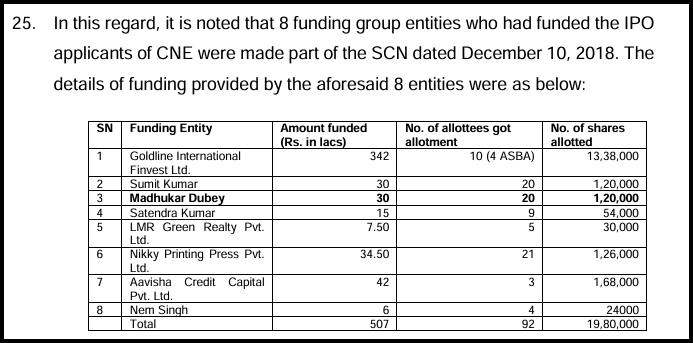
| Funding entity | Funded (₹ lakh) | Allottees | Shares |
|---|---|---|---|
| Goldline International Finvest Ltd. | 342 | 10 (4 ASBA) | 13,38,000 |
| Sumit Kumar | 30 | 20 | 1,20,000 |
| Madhukar Dubey | 30 | 20 | 1,20,000 |
| Satendra Kumar | 15 | 9 | 54,000 |
| LMR Green Realty Pvt. Ltd. | 7.5 | 5 | 30,000 |
| Nikky Printing Press Pvt. Ltd. | 34.5 | 21 | 1,26,000 |
| Aavisha Credit Capital Pvt. Ltd. | 42 | 3 | 1,68,000 |
| Nem Singh | 6 | 4 | 24,000 |
The AO said the case is about a scheme by the company’s promoters, directors, and the funding group.
Noticees 10 to 13 signed the prospectus, and the order says it carried false and misleading information on the IPO objects.
Dubey’s Repeat Record: Three Earlier Penalties and a 2020 Restraint
SEBI lists seven earlier actions against Dubey. The AO counted them under the repetitive nature of the default.
On December 22, 2020, SEBI barred him from the securities market in four IPO matters.
These were Channel Nine, HPC Biosciences, Esteem Bio Organic Food Processing, and Eco Friendly Food Processing.
| Case | Order date | Penalty |
|---|---|---|
| IPO of Esteem Bio Organic Food Processing Ltd | April 28, 2022 | ₹5,00,000 |
| IPO of Eco Friendly Food Processing Park Ltd | July 29, 2022 | ₹6,00,000 |
| IPO of HPC Biosciences Ltd | February 29, 2024 | ₹10,00,000 |
SEBI Penalty Analysis: Why ₹5 Lakh Was Imposed Under Section 15HA?
Section 15HA sets a floor of ₹5 lakh. The ceiling is ₹25 crore or three times the profit, whichever is higher.
The AO found no quantified gain for Dubey and no quantified loss for investors. The order still sets the penalty at the minimum of ₹5 lakh.
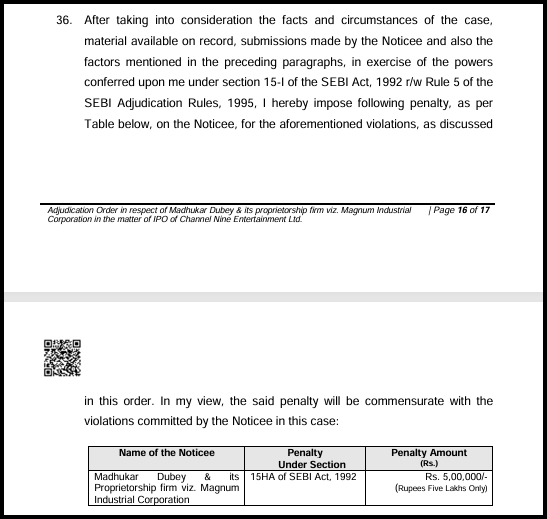
Dubey has 45 days to pay through SEBI’s online payment link. If he does not, SEBI can start recovery under Section 28A. That includes attaching and selling property.
SEBI’s own order calls this a fraudulent scheme to get the IPO subscribed. Those are SEBI’s findings. Dubey has gone to the SAT before so that he can challenge this order too.
How to Protect Your PAN and KYC Documents?
Dubey’s defence shows how costly a misused KYC can get, even if the claim is true.
You can cut the risk before it starts. Never hand over PAN, Aadhaar, or signed forms to a person who says they will “file returns” or “open an account” for you.
Our guide on how to protect yourself from cyber crime explains how criminals misuse PAN and Aadhaar to open accounts in other people’s names.
How to Check If Fake Accounts or Firms Are Registered Under Your PAN?
Do this check once a year.
Look at your PAN records, your credit report and your depository statements.
Ask each bank and broker you use whether any account, firm or demat account sits under your PAN that you did not open.
If you already know which demat account is affected, whether it’s frozen, showing a login error, or someone else is trading in it, our guide on demat account issue shows how to fix it and recover your money.
What to Do the Day You Find Your KYC Was Misused?
Delay hurt Dubey’s case, so move fast.
The steps after the first four depend on whether SEBI registered the firm involved.
Start with these four steps, whoever is behind it:
- Save proof first. Keep KYC copies, statements, letters, and any account or firm details you find.
- Write to the bank. Ask the branch and its grievance officer in writing to close the account. If the bank does not act, go to the RBI ombudsman.
- Check your other records. Look at your credit report, your GST registrations and your monthly depository statement.
- File a police complaint. Ask for an FIR copy. Use cybercrime.gov.in or 1930 only if money moved online.
If the Broker or Firm Involved Is Registered With SEBI
Check the name on SEBI’s list of registered intermediaries first. A broker, depository participant or adviser with a licence counts as registered.
If it is on the list, file a SCORES SEBI complaint. SCORES covers it because SEBI regulates that firm.
Attach your FIR copy, your KYC proof and the account details.
If the Firm Involved Is Not Registered With SEBI
If the name is not on SEBI’s list, SCORES has no regulated firm to send your complaint to. That also holds for the person who misused your KYC.
Email SEBI directly instead. Our guide on file complaint with SEBI lists what to include.
Add the police complaint from step 4. Call 1930 too if money moved online.
If You Already Have a SEBI Notice in Your Name
Receiving a formal Show Cause Notice (SCN) from SEBI means legal proceedings have officially begun against you, making immediate action essential.
Even if your KYC details were stolen or misused, ignoring the notice or delaying your response will drastically weaken your legal defense and lead to ex parte penalties.
- Reply before the deadline. Ask for any document you need, such as bank statements.
- Attach your proof. Include the FIR copy, your bank complaint, and your signature records.
- Attend the hearing. Dubey’s representative attended two hearings but did not accept SEBI’s last offer of one.
- Report the misuse at once. The AO held it against Dubey that he filed no complaint after he learned of the misuse.
Conclusion
Madhukar Dubey said he was a driver and a victim. SEBI looked at 20 cheques, ₹30 lakh, conflicting statements, and a late complaint, and fined him ₹5 lakh.
The September 28, 2026 order keeps the penalty at the legal minimum, but it lists three earlier fines and a 2020 market ban.
If someone asks for your PAN or KYC, treat it as if you are lending your name.
Report. Recover. Stay Fraud Free.
SEBI found that his firm, Magnum Industrial Corporation, funded 20 applicants in the Channel Nine Entertainment IPO. It held that he took part in a fraudulent scheme to get the IPO subscribed. The penalty is ₹5,00,000 under Section 15HA of the SEBI Act. He has 45 days to pay. He said he was a driver for Vijay Jindal, and that Jindal misused his KYC to open the firms and bank accounts. The AO cited his conflicting statements, an unsupported handwriting report, and no timely bank or police complaint. The order also says the claim about Jindal stays unproven. The Securities Appellate Tribunal sent it back on September 2, 2025, so Dubey could contest the case. No, it is the minimum. Section 15HA allows up to ₹25 crore or three times the profit. Write to the bank and broker, file a police complaint, save your records, and complain about any demat or trading account through SCORES.Frequently Asked Questions




 Add us as a preferred source on Google »

