
Quick Summary
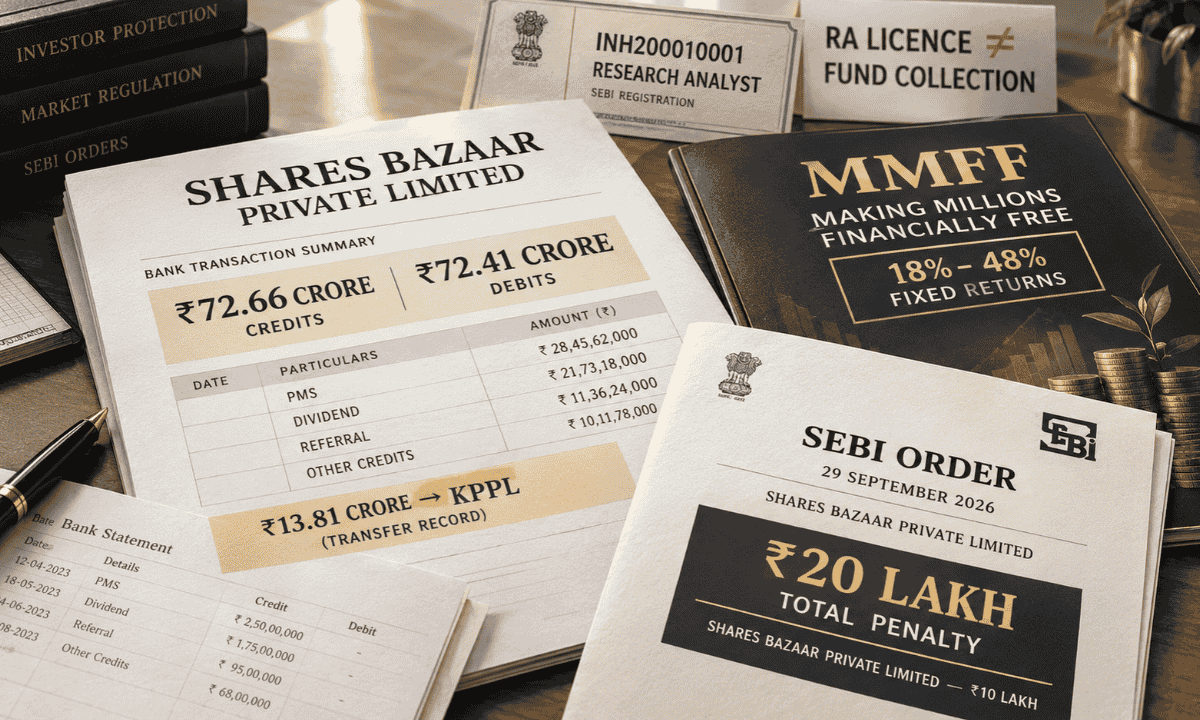
SEBI has fined Shares Bazaar Private Limited and four of its directors and CEOs a combined ₹20 lakh. The order covers the MMFF scheme, which promised assured returns of 18% to 48% a year. SEBI found that Shares Bazaar ran this as a Research Analyst, a role that does not permit collecting client money. The order also rejected the firm’s defence that the funds were debentures, not an investment scheme. SEBI dated it September 29, 2026.
Think holding a SEBI Research Analyst license gives a firm the green light to take your money?
Think again.
A Research Analyst can write reports and share stock calls, but collecting investor funds is strictly off-limits.
Yet according to SEBI’s latest order dated September 29, 2026, that is exactly what Shares Bazaar was caught doing.
Here is how an RA license got dragged into a multi-crore fund collection scheme, and what SEBI just did about it.
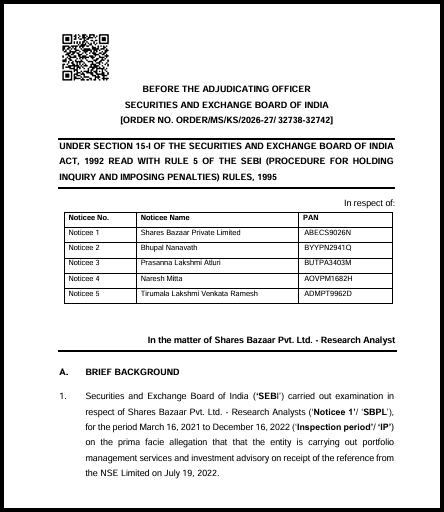
SEBI Order on Shares Bazaar Private Limited
SEBI’s order names five noticees. Each one is fined separately.
SEBI ordered Shares Bazaar Private Limited to pay ₹10,00,000 under Section 15EB.
Bhupal Nanavath, a director, pays ₹3,00,000. Prasanna Lakshmi Atluri, also a director, pays ₹3,00,000.
Naresh Mitta, the current CEO, pays ₹1,00,000. Tirumala Lakshmi Venkata Ramesh, the ex-CEO, pays ₹3,00,000.
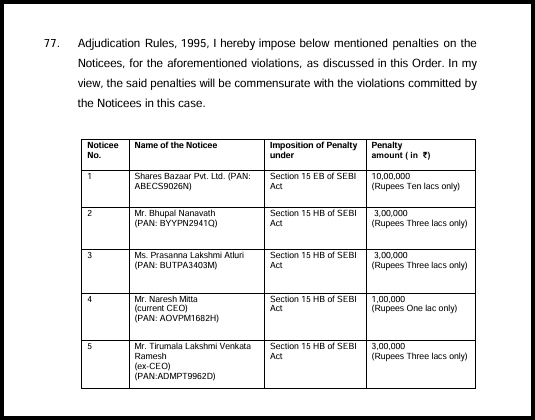
Together, the five penalties add up to ₹20,00,000. SEBI gives each Noticee 45 days to pay.
What Is the MMFF Scheme SEBI Fined Shares Bazaar Over?
SEBI examined Shares Bazaar for the period March 16, 2021 to December 16, 2022.
The trigger was a reference from NSE, sent to SEBI on July 19, 2022. NSE suspected Shares Bazaar was running portfolio management and investment advisory services.
Shares Bazaar launched a scheme called “Making Millions Financially Free” (MMFF).
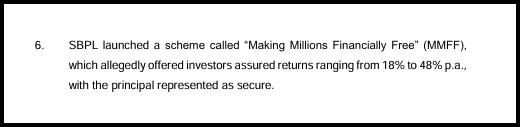
MMFF promised investors a fixed return of 18% to 48% a year. It also promised the principal was secure.
Investors were told their money would go into the equity market, in a portfolio built just for them. That is how a Portfolio Management Service, or PMS, works.
A Research Analyst is not permitted to run a PMS. Regulation 2(u) limits a Research Analyst’s role to preparing reports, giving buy or sell calls, and setting price targets.
The ₹72.66 Crore Bank Trail Behind the MMFF Scheme
SEBI checked one ICICI account used for the scheme. Over the inspection period, it recorded ₹72.66 crore in credits and ₹72.41 crore in debits, across more than 3,400 transactions each way.
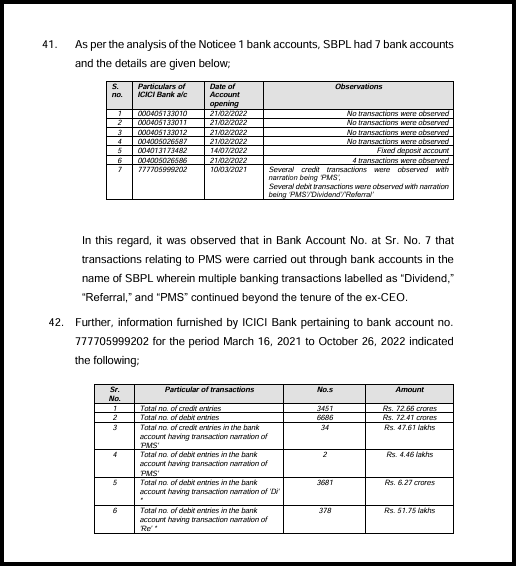
Credit entries were marked “PMS.” Debit entries were marked “PMS,” “Dividend,” or “Referral.”
SEBI found this pattern in three places. Money paid new investors’ returns using money from later investors.
It also paid out referral commissions, a method SEBI links to Multi-Level Marketing.
And a large share moved to Kisaan Parivar Private Limited (KPPL), a separate firm run by director Bhupal Nanavath.
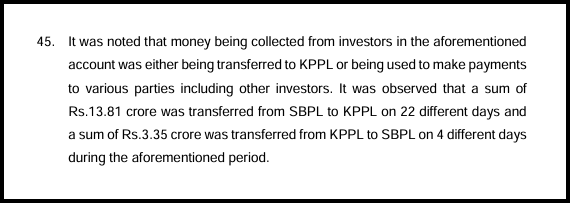
SEBI recorded ₹13.81 crore moving from Shares Bazaar to KPPL over 22 transactions. ₹3.35 crore moved back over 4 transactions.
SEBI could not find any of these credited amounts actually invested in the securities market, despite the “PMS” label on them.
Why SEBI Rejected the Debenture Defence?
Shares Bazaar gave SEBI an explanation for the money. It said the funds were not MMFF returns at all.
It said 198 investors held Compulsorily Convertible Redeemable Debentures (CCDs). “Referral” meant repayment of principal. “Dividend” meant interest on the debentures.
SEBI checked the documents Shares Bazaar gave in support. The Board Resolution for the CCDs carries the date October 6, 2023.
The sample debenture certificate is dated December 20, 2022.
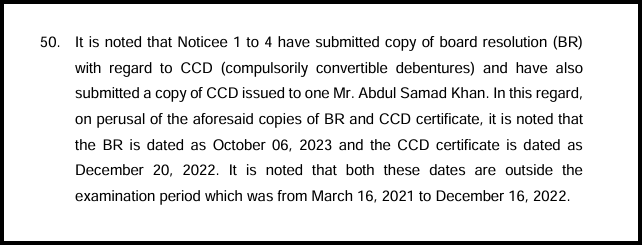
Both dates fall after the inspection period ended on December 16, 2022.
SEBI also noted that a private placement of debentures to 198 investors needs filings under the Companies Act, 2013. Shares Bazaar provided none of them.
SEBI’s order calls the CCD explanation an afterthought, raised only once SEBI’s investigation had begun.
Shares Bazaar SEBI Order: Why the Website Stayed Live After SEBI’s Warning?
Shares Bazaar gave a second explanation. It said its website went live by mistake.
It said a developer put the site on a live server instead of a test one, and investors mistook it for a working platform.
SEBI sent Shares Bazaar an advisory letter on March 17, 2022. Shares Bazaar wrote back on March 28, 2022, assuring SEBI it was not running any unregistered activity.
SEBI checked archived versions of the site from archive.org. A cached page dated May 20, 2022 still showed PMS content, two months after the assurance letter.
The live PMS pages remained visible until at least September 12, 2022. Bank records show Shares Bazaar still collected money under MMFF as late as December 16, 2022.
The website also stated it had “2500+ PMS clients,” and that 60% were HNI clients. SEBI treated this as active marketing, not an accidental leftover page.
How SEBI Assessed Liability for the Directors and CEOs?
Not every Noticee played the same role, and the order treats each one differently.
Tirumala Lakshmi Venkata Ramesh, the ex-CEO, told SEBI during the investigation that he personally developed MMFF. He expected Shares Bazaar would get a PMS licence soon after.
He resigned on March 7, 2022. He did not respond to the show cause notice or attend any hearing, so SEBI proceeded against him ex parte.
Naresh Mitta took over as CEO on March 30, 2022, after Ramesh’s exit. He argued he never held signing power, never got Board confirmation, and left the firm on January 6, 2023.
SEBI still fined him, but at ₹1,00,000, the lowest amount among the five.
Bhupal Nanavath and Prasanna Lakshmi Atluri, both directors during the scheme, argued MMFF was never approved by the Board.
SEBI’s answer: the scheme kept running under Shares Bazaar’s name and bank accounts even after Ramesh left. Nobody on the Board stepped in to stop it.
Under Section 27(1) of the SEBI Act, a director is liable for the company’s violations during their time in office, whether or not they personally designed the scheme.
The Ex-CEO Defence: Why Shares Bazaar’s Police Complaint Failed to Convince SEBI?
Shares Bazaar told SEBI it had already dealt with Ramesh. It said it filed a police complaint against him.
SEBI read the complaint. It accused Ramesh of leaking company data and damaging the firm’s reputation.
The complaint said nothing about unauthorised fund collection, or about Ramesh acting beyond the Board’s mandate.
SEBI’s order says the complaint cannot excuse the company from what happened with investor money during his tenure.
What Two Investors Told SEBI About the MMFF Scheme?
SEBI directly contacted two investors while building its case.
Vipin Patil sent ₹5,00,000 to Shares Bazaar on October 29 and 30, 2021. No signed service agreement existed at the time, only a draft one, pending SEBI registration.
Patil later withdrew his money for personal reasons. He confirmed Shares Bazaar returned his funds along with the promised returns, after around five months in the scheme.
Vinayak Hegde had a service agreement dated July 14, 2022. It carried a director’s signature, but not his own.
SEBI treated both accounts as confirmation that money moved on the promise of fixed returns, dressed up as a portfolio built in the investor’s name.
₹72 Crore Mobilised, ₹20 Lakh Fine: How SEBI Decided Shares Bazaar’s Penalty?
Section 15EB and Section 15HB set the penalty range. Both run from ₹1 lakh upward, with different upper limits for the firm and for individuals.
Section 15J tells SEBI to weigh three things: unfair gain, investor loss, and repeat conduct.
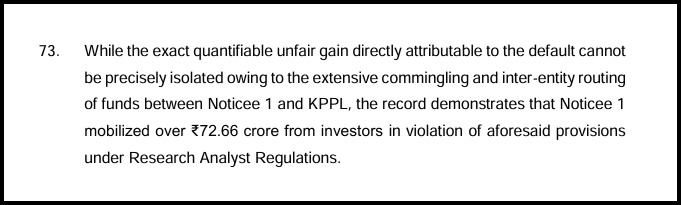
SEBI could not isolate an exact unfair gain, since funds moved repeatedly between Shares Bazaar and KPPL. It did note that Shares Bazaar mobilised over ₹72.66 crore from investors.
As a mitigating point, the order records no specific complaints of unpaid principal in the file before it.
SEBI also listed prior directions against Shares Bazaar: an AIF restraint order (February 2024), a stock broker licence cancellation (July 2024), and a confirmatory AIF order (October 2024). None carried a separate monetary penalty.
Is Shares Bazaar Still SEBI Registered as a Research Analyst?
This order does not cancel the Research Analyst registration. It only imposes a penalty.
Shares Bazaar’s registration number is INH200010001, and it remains active as a Research Analyst as of this order.
Its separate stock broker registration was already cancelled in a different order dated July 31, 2024.
Is this the only action taken against the Founders?
A ₹20 lakh SEBI penalty addresses regulatory violations, but the legal troubles don’t stop at SEBI’s doors. Parallel criminal proceedings are also underway against the key figures behind the scheme.
This penalty order is separate from the criminal case against the founder. Our coverage of the Bhupal Naik arrest explains the FIR, the bail rejection, and the regulatory warnings that came before it.
Why an RA Licence Never Covers Assured Returns?
A Research Analyst licence covers reports and recommendations. It has never covered collecting money or promising a fixed return.
Our explainer on can a SEBI registered analyst give a profit guarantee sets out exactly what the RA Regulations permit and what they do not.
What to Do If You Invested in the MMFF Scheme?
If you sent money to Shares Bazaar under MMFF, gather your records first. Payment receipts, the service agreement draft, and any emails all matter.
Check whether you actually received your principal and returns, as Vipin Patil did, or whether payouts stopped.
File a SCORES SEBI complaint if your money is still outstanding. SCORES applies here because Shares Bazaar holds a live SEBI registration.
Conclusion
This order settles one specific question: did a Research Analyst have any business running an 18% to 48% assured-return plan?
SEBI’s answer is no, backed by a ₹72.66 crore bank trail, a debenture defence that fell outside the inspection dates, and a website that stayed live months after SEBI’s own warning.
The ₹20 lakh penalty spans the firm and four individuals, scaled to each one’s actual role. If you are still owed money under MMFF, the SCORES route above is where to start.
Report. Recover. Stay Fraud Free.
SEBI fined Shares Bazaar Private Limited ₹10 lakh, and four directors and CEOs a combined ₹10 lakh, for a total of ₹20 lakh. MMFF, or "Making Millions Financially Free," promised investors a fixed return of 18% to 48% a year with the principal represented as secure. A Research Analyst's role is limited to research reports, recommendations and price targets under Regulation 2(u). It does not cover collecting client money or running a portfolio scheme. No. The Board Resolution and sample debenture were both dated after the inspection period ended, and required Companies Act filings were never provided. No. SEBI fined the company ₹10 lakh, three individuals ₹3 lakh each, and the current CEO ₹1 lakh, scaled to each person's role. No. This order imposes a penalty only. SEBI cancelled its separate stock broker registration in an earlier order dated July 31, 2024. Collect your payment records and any agreement, then file a complaint on SEBI's SCORES portal, since Shares Bazaar holds an active Research Analyst registration.Frequently Asked Questions




 Add us as a preferred source on Google »

