
Quick Summary
It is very unusual for a genuine investment opportunity to arrive through an unsolicited call.
SEBI has exposed cases where even TV guest experts leaked tips before airing them for personal gain.
A cold caller offering free demo tips is a documented pattern used to build trust before a paid pitch.
This checklist covers exactly how to respond the moment an unknown caller offers you a stock tip.
Millions of retail traders trust guest experts on primetime TV for confident, on air stock calls.
SEBI’s own investigation found some of those same experts leaking tips before they ever aired, worth Rs 7.36 crore in an exposed scheme.
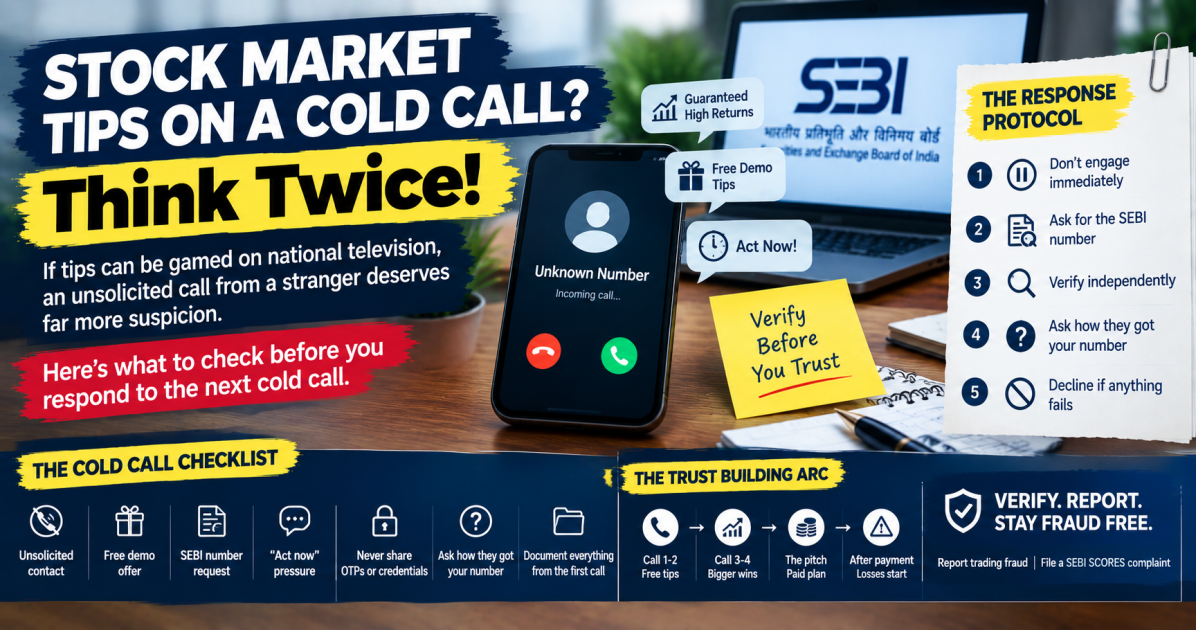
If tips can be gamed on national television, an unsolicited call from a stranger deserves far more suspicion.
Here’s what to check before you respond to the next cold call.
The Response Protocol
1. Don’t engage immediately: take a moment before responding to any unsolicited tip or investment pitch.
2. Ask for the SEBI number: and note it down exactly as given, without acting on it yet.
3. Verify independently: check the number on SEBI’s official website before any further conversation.
4. Ask how they got your number: and treat a vague or evasive answer as a serious warning sign.
5. Decline if anything fails: end the engagement immediately if verification fails at any step.
The Cold Call Checklist
Run through these points the moment an unknown number offers you stock market advice.
- Unsolicited contact itself: Genuine advisors rarely cold call individuals out of nowhere with unprompted tips.
- Free demo offer: A free trial period with a few winning calls is a documented pattern to build trust before a paid pitch.
- SEBI number request: Ask for their registration number immediately, and verify it independently, not from what they tell you.
- “Act now” pressure: Urgency around joining a plan or missing an opportunity is a manipulation tactic, not a genuine time limit.
- Never share OTPs or credentials: No legitimate advisor needs your login details or one time passwords for anything.
- Ask how they got your number: A vague or evasive answer about how they obtained your contact details is a warning sign.
- Document everything from the first call: Save call recordings, screenshots, and messages in case you need to report the incident later.
The Trust Building Arc, From First Call to Paid Pitch
| Stage | What Happens | Purpose |
| Call 1-2 | Small, believable free tips shared | Builds initial credibility and trust |
| Call 3-4 | Slightly bigger wins, more confidence | Deepens emotional investment |
| The pitch | Paid plan or account handling offered | Converts trust into a financial commitment |
| After payment | Accuracy drops, excuses begin | Losses start once trust has been monetised |
Even Trusted Sources Aren’t Immune
SEBI’s order against a media backed scheme found guest experts leaking tips before broadcast, documented in Zee Business stock tip scam.
If a familiar TV face can be part of a scheme like this, an anonymous cold caller deserves no automatic trust at all.
Bottom Line
The safest response to any cold call stock tip is verification first, conversation second.
You can report trading fraud and access checklists for every scam pattern through Fraud Free.
If a cold call led to financial loss involving a SEBI matter, you can file a SEBI SCORES complaint with your documentation.
Report. Recover. Stay Fraud Free.
Frequently Asked Questions
It's uncommon for genuine SEBI registered advisors to cold call individuals with unsolicited tips. Most legitimate engagement starts with the investor seeking out a registered service, not the reverse.
This is a documented trust building tactic. A few small, real seeming wins early on make the eventual paid plan or account handling pitch feel far more credible than it actually is.
Yes. SEBI's investigation exposed a scheme involving TV guest experts leaking stock tips before they aired live, allowing associated traders to profit at retail investors' expense.
Never share your trading account login credentials, OTPs, or passwords with anyone claiming to offer tips or advisory services, regardless of how convincing or official they sound.
Document the call details, ask for and verify their SEBI registration number independently, and avoid acting on any tip until you've confirmed the caller's legitimacy through official channels.
It varies, but the pattern typically involves a handful of small, believable wins before a subscription or account handling offer follows. Accuracy often drops noticeably once payment is made.




 Add us as a preferred source on Google »

