

Quick Summary
A SEBI registered research analyst cannot guarantee returns, promise a fixed profit, or assure loss recovery. The law bans it, and registration makes it worse, not safer, because a registered analyst agreed to the rules and broke them anyway. SEBI has fined analysts from ₹6 lakh up to ₹60 lakh for exactly this. Analysts rarely say “guaranteed” out loud, so this page shows you the phrases they hide it behind, the real SEBI cases, and how to protect yourself.
Someone messages you: “Our SEBI-registered analyst guarantees 200% returns this month.”
It sounds official, so you want to know if that is even allowed.
It is not. No research analyst can guarantee your returns, registered or not.
These claims circulate every day across Telegram groups, social media ads, and paid advisory funnels, usually wrapped in urgency and false credibility to rush you into paying.
This page breaks down how the promise works, the real SEBI orders that punished it, and what to do if an analyst made it to you.
Can a Research Analyst Promise Returns Legally?
No. A SEBI registered research analysts gives recommendations based on analysis.
They do not control what the market does.
Prices move on company results, global events, and sentiment nobody can predict. No analyst can promise what a stock will do next. Anyone who says they can is either lying or breaking the law, and usually both.
The moment an analyst promises you a guaranteed return, that promise becomes a violation. It does not matter whether they hold a valid registration.
Here is the part that surprises people.
Registration makes the violation more serious, not less.
A registered analyst signed up to follow SEBI’s rules and then chose to break them. So a promise from a “SEBI registered” analyst is not safer. It is a bigger breach.
What SEBI’s Rules Actually Say?
SEBI bans guaranteed return promises through several overlapping rules, so there is no gap to slip through.
- SEBI (Research Analysts) Regulations, 2014, Regulation 16 and the Code of Conduct under Regulation 24: an analyst must act honestly and never promise or imply guaranteed returns.
- SEBI Advertisement Code for Research Analysts, Clause C(x): bars any claim of guaranteed returns or accuracy percentages in marketing.
- PFUTP Regulations, 2003, Regulation 4: treats a false or misleading profit promise made to induce investors as a fraudulent practice.
- SEBI Circular on PaRRVA, 2023: any performance claim must be independently verified before an analyst can use it to sell.
The SEBI Master Circular for Research Analysts, June 2025, and the December 2024 amendments tightened this further, restricting analysts from executing trades or assuring profits and strengthening disclosure rules.
Together, these cover every form the promise can take, spoken, written, or implied, on a call, in a chat, or on a YouTube thumbnail.
What Can a SEBI Registered Research Analyst Do?
A registered analyst produces structured research reports.
Each one carries a company overview, financial analysis, a valuation method, the key risks, and a recommendation with a target price and time horizon.
They disclose any shareholding in the recommended security. They cannot execute trades for you.
They cannot charge more than ₹1,51,000 per year per client family. And every recommendation carries a disclaimer that past performance does not guarantee future results.
That transparency runs right through to their track record.
Whether a research analyst can show past performance to a client is itself limited by SEBI, so a legitimate one never leads with cherry-picked wins the way a guaranteed-return operator does.
How Analysts Promise Returns Without Saying “Guaranteed”?
Here is the trap.
A promise rarely uses the word “guarantee” out loud, because the analyst knows that word is illegal.
Instead, they use softer phrases that carry the same meaning.
Watch for these, because each one is a guarantee wearing a disguise:
- “You can expect a minimum of 8 to 10% a month.” A minimum return is a guarantee by another name.
- “Our calls are 90% accurate.” An unverified accuracy claim implies a near-certain outcome.
- “We will recover your losses within 30 days.” A direct loss-recovery promise, which the rules ban outright.
- “Follow our calls strictly, and you will not lose.” Conditional, but it still promises an outcome.
- “Our subscribers make 3 to 4% every week.” Past performance dressed up as what you will earn.
- “The market is good right now; this is a guaranteed opportunity.” Market timing is sold as a certainty.
- “Earn up to ₹5,000 daily” on a video thumbnail. A public profit promise with no disclaimer.
SEBI looks at the effect of the language on you, not just the exact words.
So all of these count as a guarantee, even without the word.
And the jump from a free demo call to a paid subscription pitch almost always includes at least one of them. Spotting them in the moment is your first defence.
How These Guaranteed Return Scams Actually Work?
Fraudsters hide these promises inside advisory models that look credible.
The formats change, but the promise underneath stays the same.
Telegram and WhatsApp trading groups share a few winning calls, then push a paid “premium” group with false guarantees, often taking payment off-platform so recovery is harder.
“Sure shot” intraday calls promise 100% accuracy, which SEBI prohibits, and many sit on top of pump-and-dump setups where the operator exits early.
90% accuracy claims show cherry-picked winning trades while the real record shows losses.
Profit-sharing models demand 20 to 50% of your gains, which SEBI treats as portfolio management that needs a separate licence.
Offering it without one is illegal, and you can check our full guide on it: can a research analyst share profit in India?
AI and algo claims promise that a bot removes risk. No algorithm removes market risk, and SEBI recognises this as a growing misuse.
A single operator often runs several of these at once, a Telegram group claiming 90% accuracy, offering a profit split, and branded as AI-powered.
The thread through all of them is the same: a guaranteed return no analyst can legally promise and no market can reliably deliver.
Real SEBI Orders Against Guaranteed Return Promises
These are documented adjudication orders.
Every entity below held a valid SEBI Research Analyst registration at the time.
SEBI fined each one anyway, which proves registration is no shield.
| Analyst / Firm | What SEBI found | Penalty |
|---|---|---|
| Manish Goel (Aug 2023) | Assured returns on WhatsApp and Telegram, no research backing | ₹60 lakh |
| Prerna Sharma, Algologic Live (INH000006819) | YouTube thumbnails promising daily profit | ₹15 lakh |
| Streetgains Research Services | Sales staff promised returns on WhatsApp, backed by profit screenshots | ₹8 lakh |
| Arun N, Harmonics Traders (INH200007353) | Profit claims on X and Telegram under a branded handle | ₹7 lakh |
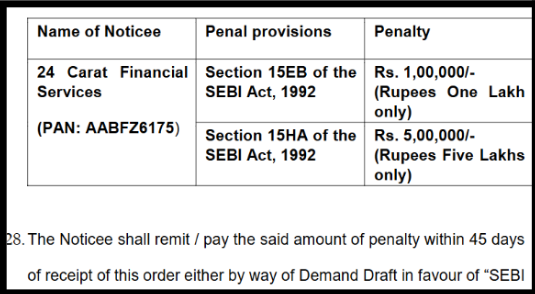
| 24 Carat Financial Services (Oct 2022) | Assured-profit commitments, no research rationale | ₹6 lakh |
Each case adds a different lesson, so they are worth reading individually:
1. Manish Goel: ₹60 Lakh for Chat-Based Promises
SEBI found that Manish Goel promised assured returns through WhatsApp and Telegram messages, with no research to back the calls and no risk disclosures.
SEBI treated the messages as misleading communication under the PFUTP Regulations and fined him ₹60 lakh, the largest penalty in this group.
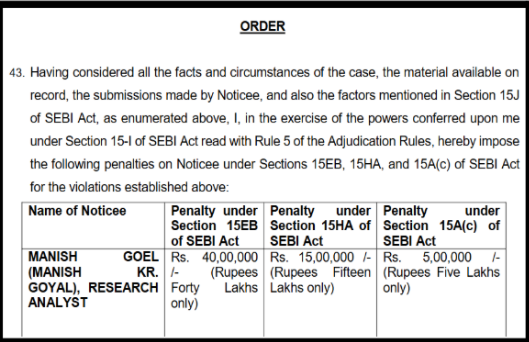
The lesson: the medium does not matter. A guaranteed return claim in a chat carries the same violation and penalty as one on a website.
2. Prerna Sharma, Algologic Live: ₹15 Lakh for YouTube Thumbnails
Prerna Sharma ran a YouTube channel called Algologic Live to promote her services.

SEBI’s inspection found the video thumbnails made direct profit promises; one read “Earn profit up to 5000 with Algologic,” another “How to make 5000 profit daily.” (Adjudication Order No. Order/SM/SM/2025-26/31941.)
SEBI ruled she was promising assured returns to pull viewers into paying and fined her ₹15 lakh.
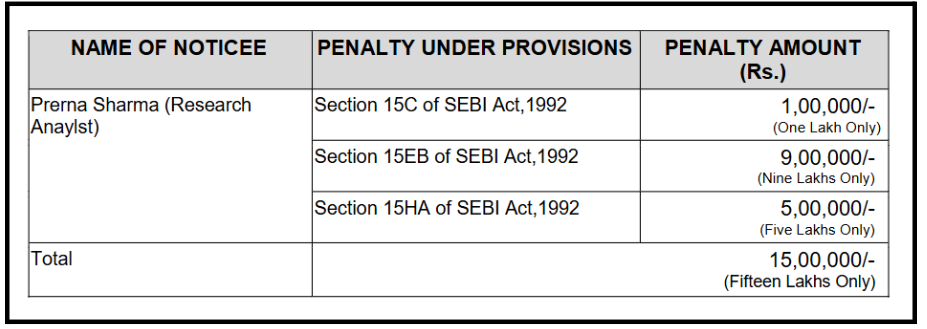
The lesson: public content counts, not just private messages to clients. A thumbnail is a promise.
3. Streetgains: ₹8 Lakh, and the Promise Came From a Salesperson
SEBI inspected Streetgains Research Services, run by proprietor Kumar Venkataramegowda Santhosh, and found WhatsApp chats between its sales executives and clients.
In one, an executive told a client that premium trades “will get good returns” and attached profit screenshots to push a higher subscription. (Adjudication Order No. Order/JS/YK/2025-26/31573.)
SEBI fined the firm ₹8 lakh.
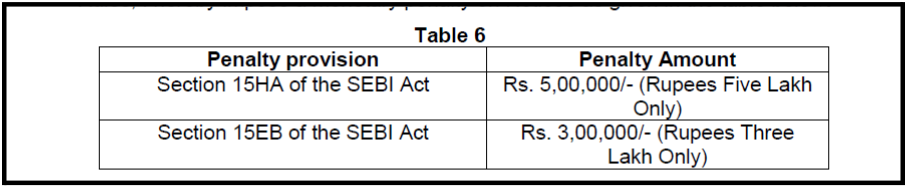
The lesson, and it is the important one: the promise came from a salesperson, not the registered analyst, and SEBI held the firm responsible anyway.
Everyone acting for the analyst is bound by the same rules.
4. Arun N, Harmonics Traders: ₹7 Lakh for Social Media Claims
Arun N ran Harmonics Traders and posted profit claims on X and Telegram under a brand that displayed his registration number (INH200007353, PAN ARHPA4708R).
SEBI found he used lines like “Free Money for All” and unsupported high-return claims to induce investors. (Adjudication Order No. Order/BM/DS/2024-25/30906.)
SEBI split the penalty across the violations:
| Violation | Section | Penalty |
|---|---|---|
| Code of Conduct (RA Regulations) | Sec 15EB | ₹2,00,000 |
| PFUTP + RA Code + SEBI Circular | Sec 15HA | ₹5,00,000 |
| Total | ₹7,00,000 |
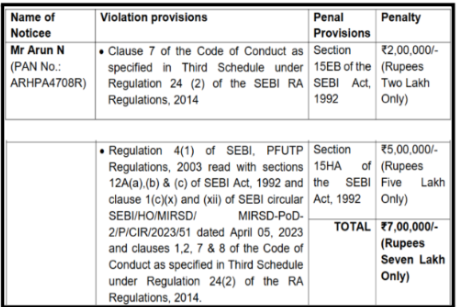
The lesson: posting a “344% return” or “Free Money for All” on Twitter or Telegram crosses the legal line the moment you are a registered entity, even framed as a celebration.
5. 24 Carat Financial Services: ₹6 Lakh for No Research Rationale
When SEBI inspected 24 Carat Financial Services, it found assured-profit commitments to clients and no proper research rationale behind the calls, a breach of Regulation 25(1)(ii).
SEBI fined the firm ₹6 lakh.
The lesson: without a recorded basis for each recommendation, a “sure shot” tip is just gambling dressed as research.
Every one of these carries the same message.
A registration number does not make a return promise legal. SEBI inspects its own registered analysts, finds these promises, and fines them regardless.
If you want the complete step-by-step, our guide on how to complain against SEBI registered research analyst walks through every stage.
Want someone to handle the filing for you?
We pin down the exact SEBI rule that was broken, organise your evidence, and take your complaint through SCORES to arbitration.
How to Spot the Warning Signs Before You Pay?
You do not need the rulebook. A few signals tell you an analyst is crossing the line.
They use guaranteed, assured, or “near-certain” language anywhere, on a call, in a chat, or on their site. They refuse to give you written research reasoning.
They let a salesperson make the promises and then claim the analyst is not responsible.
Or they wave away your questions with a website disclaimer while the guarantee sits in your WhatsApp.
That last one matters.
A disclaimer on a website does not cancel a guarantee made in a chat or a call.
Both count, and both work as evidence in a complaint.
Conclusion
Can a research analyst guarantee returns? No.
Any registered analyst who breaks SEBI’s rules the moment the promise leaves their mouth.
Manish Goel paid ₹60 lakh for promising returns on WhatsApp and Telegram.
Prerna Sharma paid ₹15 lakh for profit promises on YouTube thumbnails. Streetgains paid ₹8 lakh when its salespeople made the promises. Registration protected none of them.
So before you trust any analyst, ask one direct question: will you put that guarantee in writing, with your SEBI registration number next to it?
If they refuse, they have just answered you.
Frequently Asked Questions
No. Registration lets an analyst give research and recommendations. It never lets them promise a fixed return, assured profit, or loss recovery. Any such promise is a violation the moment they make it.
Yes. SEBI looks at what the language implies, not the exact words. An accuracy claim or a "minimum return" promise carries the same meaning as a guarantee and breaks the same rule.
No. As the Streetgains case showed, SEBI holds the registered analyst and firm responsible for what their sales staff promise. Everyone acting for them is bound by the same rules.
No. A website disclaimer does not cancel a guarantee made in a chat or on a call. Both count, and the promise in your WhatsApp is strong evidence in a complaint.
SEBI's orders range from ₹6 lakh to ₹60 lakh, depending on the scale and how the promise was made. Serious cases can also cost the analyst their registration.





 Add us as a preferred source on Google »

