
Quick Summary
If your Motilal Oswal bills feel heavier than they should, you are not imagining a pattern. The broker’s own disclosure shows hundreds of excess charge complaints every year, peaking at around 403 in 2024-25, and NSE tribunals have ordered the broker to refund brokerage in multiple churning cases, the largest a full ₹7,39,592 refund. This page gives you the official rate card to check your bills against, the complaint numbers, the churning cases with what each investor recovered, and the exact route to claim your own charges back.
You opened your ledger, saw what brokerage ate this quarter, and something did not sit right.
Maybe the charges outran the trades you remember approving.
Maybe an advisor kept pushing volume, and the bills kept growing with it.
The line between normal fees and excess charges has a clear test, and tribunals have already forced this broker to hand brokerage back when it crossed that line.
This page walks you through the rates, the numbers, the cases, and your claim.
What Counts as Motilal Oswal Excess Charges?
You have a statement open in one tab and a doubt you cannot quite name.
The charges look big, but big compared to what, and that missing comparison is exactly why most investors never move past the doubt.
So before anything else, here is your baseline, the broker’s own official rate card, laid out plainly.
Hold your contract notes against each line as you read, because every dispute on this page starts with one number not matching another.
Equity delivery at 0.20 percent, intraday and futures at 0.02 percent, and equity or currency options at ₹20 per lot.
On the demat side, every debit transaction costs around ₹30 to ₹35, the AMC is ₹199 from the second year, margin pledge runs ₹31 per scrip, account closure ₹60, and reactivation ₹150 per instruction.
Charges become excess in three common ways.
Rates applied higher than your agreed plan. Fees appearing that were never disclosed. And brokerage multiplying because the trading volume itself was pushed on you.
The third one is the expensive one, and it has a name.
Also Read: JM financial RM mismanaging account, a relationship manager who vanished right after funding.
What Does the Complaint Data Show About Charges?
Right now you might feel like the only one arguing with a brokerage bill.
You are not, and there is official proof. Every broker must disclose how many investors complained each year, and those numbers are public.
The table below covers five years of that record.
Run your eye down the last column, because that is where the charge related complaints sit, and watch how it moves after 2023:
| Year | Active Clients | Total Complaints | Excess Charge Complaints |
|---|---|---|---|
| 2021-22 | 896,851 | 445 | Around 125 |
| 2022-23 | 879,629 | 516 | Around 62 |
| 2023-24 | 879,629 | 498 | Around 220 |
| 2024-25 | 1,014,875 | 1,078 | Around 403 |
| 2025-26 | 904,002 | 761 | Around 338 |
Two movements matter.
After 2023-24, charge related complaints jumped sharply, from 62 to 220 to 403, far faster than the client base grew.
And even as total complaints eased in 2025-26, 338 investors still formalised a charges grievance, keeping the concern near its peak.
Whatever sits behind the rise, the pattern says charge disputes at this broker stopped being rare.
And the numbers are not the only official record on this subject, because the regulator has acted on the broker’s conduct directly, a history covered on our page: SEBI penalty against Motilal Oswal.
Also Read: PhonePe excess charges, 224 of 336 complaints, all tracing back to one issue.
Brokerage Churning by Motilal Oswal
Now the practice behind the worst of those bills, in plain words.
Churning is the quiet one.
There is no single dramatic trade to point at.
Instead, your account is traded far more than it should be, and each trade skims a little brokerage, until the broker has earned handsomely while you have lost.
It is harder to spot than an unauthorised trade, because on paper you may have agreed to each order. Most investors assume that if trades were authorised, the matter ends there.
Reality is messier, because in derivatives especially, the line between advice, suggestion, and pressure blurs quickly, and excessive trades can carry technical consent yet still break the rules on how that consent was obtained.
The warning signs cluster into four.
Trades placed without your clear approval, a pattern covered fully on our page: Motilal Oswal unauthorised trading.
Securities bought and sold repeatedly in short windows with no strategy behind them.
A trading pattern that only makes sense as brokerage generation. And a broker who never quite explains the purpose of the trades or the charges.
When the volume only makes sense as a way to generate brokerage, tribunals have a name for it, and a remedy.
The Award That Shows Exactly How Churning Is Judged
One NSE arbitration award is worth reading closely, because it shows what evidence decides these cases.
The dispute arose from currency derivatives trading in November 2022.
The investor said multiple intraday trades were executed, risks were downplayed to a novice, she was assured a limited downside of around ₹8,000, she was influenced into repeated trades, and the brokerage crossed ₹1.2 lakh.
Motilal Oswal denied wrongdoing. Trades carried consent, contract notes and SMS alerts went out, brokerage matched the agreed terms, and the client had prior experience.
The arbitrator examined contract notes, ledgers, KYC papers, email and SMS records, and crucially, the call recordings the broker was directed to produce, across two hearings in December 2023 and February 2024.
Three findings came out.
The trades were not unauthorised, since the recordings showed the client accepting the proposals and never instructing a stop.
But the client was influenced, with the arbitrator observing a significant element of suggestion and allurement to increase her trades, obviously done to earn brokerage, conduct held against Clause 4.5.2 of the Exchange F&O Trading Regulations and the principles of fair dealing.
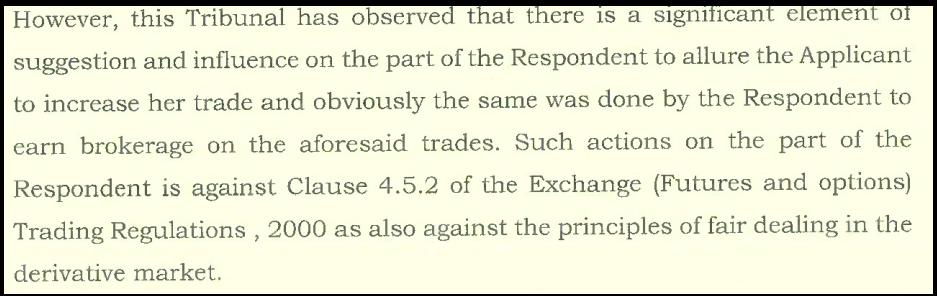
And the brokerage of ₹1,20,006 was undisputed, which gave the tribunal a clean number to act on.
The verdict ordered 50 percent of the brokerage, ₹60,003, refunded within 15 days. Not a token award, a measured penalty tied directly to the broker’s conduct rather than market losses.
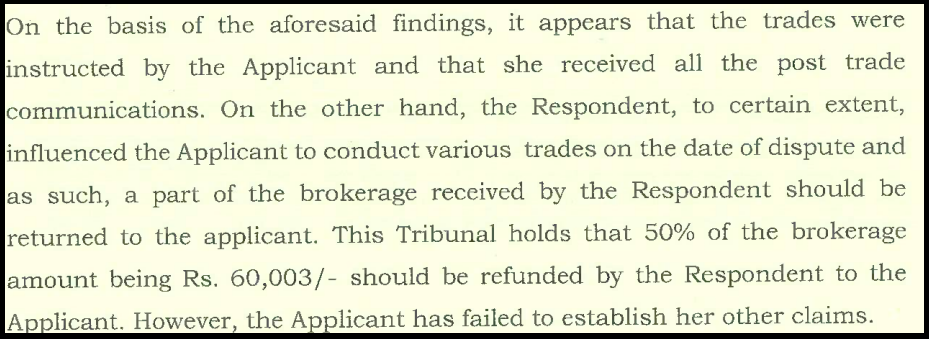
The lesson is precise.
Consent existed, but the manner in which it was obtained crossed a regulatory line, and that is how churning usually surfaces, not as outright fraud, but as regulatory misconduct that costs the broker its fees.
The Refunds Kept Coming: Four Awards, Up to the Full Brokerage
That award is not alone. Tribunals have applied the same rule across cases of every size, and the ceiling is the full amount.
The case that set the standard involved a fresh investor whose advisor was changed without consent.
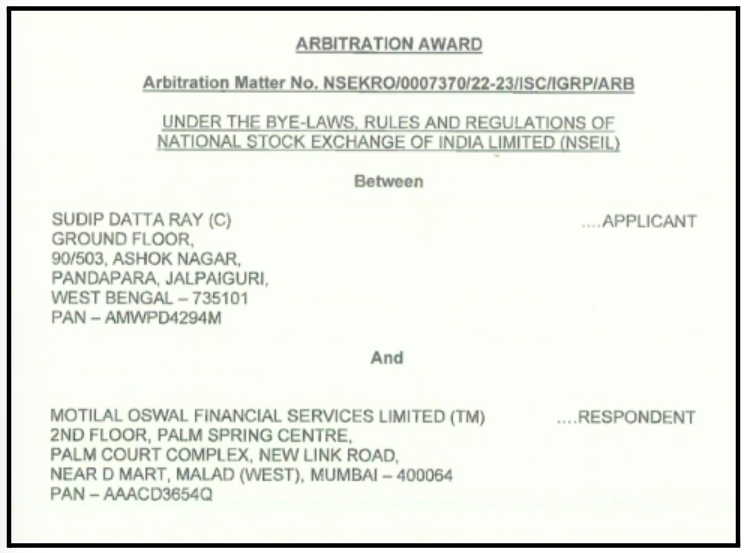
The new advisor told him his portfolio was in loss, pushed him toward option trading to recover it, and insisted he pledge his entire portfolio.
He asked repeatedly to trade small lots, was swayed into bigger ones, lost over eleven lakh within weeks, was steered into currency trading he did not understand, and was even sold an insurance policy dressed as an investment.
The tribunal found no record of the client placing any order, only the broker deciding and the client concurring, and held the whole exercise existed to generate brokerage.
The principle it applied deserves memorising.
A broker cannot take advantage of its own wrong, so when brokerage is the direct product of conduct breaching its duty, the broker cannot keep it.
The entire ₹7,39,592 was ordered refunded.
The other awards scale the same rule. ₹1,36,000 refunded, half the brokerage, where the broker earned ₹2,72,000 while the client lost ₹2,93,567 in four days.
₹1,01,958 refunded, 80 percent plus tax, where a representative claiming to be a SEBI registered stock advisor promised assured daily returns and induced trading completely against a novice’s economic status.
And the ₹60,003 award above completes the set.
The refund tracks how far the broker overstepped, from half the brokerage to all of it.
Also Read: Moneylicious Securities Excess Charges, why unexplained charges deserve a written breakdown, always.
What to Do If Your Account Was Churned?
Churning is proven through pattern, not a single trade, so your evidence file is about volume and influence.
Build it now, while everything is still downloadable:
- Your full trade ledger for the period, showing frequency and volume.
- The total brokerage charged across that period.
- Contract notes showing how much capital went to charges versus market loss.
- Every call recording, WhatsApp chat, or email where someone pushed you to trade more, pledge holdings, or add funds.
- Any record of you asking to trade small, or to stop, that was overridden.
Then run the comparison that reveals it.
Put the brokerage earned next to the loss you suffered. In the winning cases the two figures sat close together, and that closeness is what exposed the churning, because a broker earning nearly as much as you lose is working the account for fees.
And watch for the advisor line.
Brokers execute orders, they are not licensed to advise or guarantee returns, so anyone at the broker claiming to be a registered advisor or promising assured profits handed you evidence of inducement.
Where that person was a local franchise or sub broker rather than head office staff, the accountability route runs through our page: Motilal Oswal authorised person complaint.
How Hard Is Churning to Prove? The Honest View
One thing this page owes you before the filing steps, because churning is harder to prove than it is to feel.
If you placed your own orders and the volume was genuinely your choice, a churning claim is difficult.
Where you have room is influence and unsuitability. A novice pushed into heavy or unsuitable trading. An advisor steering the account.
A brokerage bill that swallowed a large share of your capital.
That is where every winning case above lived, and the stronger your evidence of being pushed, the closer to a full refund you get.
Did the brokerage on your statement grow faster than anything else in your account?
We will reconcile the brokerage earned against your actual loss, isolate the trades that only make sense as fee generation, and build your claim on the same fair dealing rules these tribunals applied, through every forum until it pays.
Your Bills Told You Something Is Wrong. Here Is Where That Feeling Goes Next
Everything on this page so far has been evidence, the rates, the numbers, the awards. What you do with it is a separate skill, and it has its own order.
The road from a suspicious statement to money back runs through the broker’s grievance desk, the regulator, the exchange, and finally the tribunal that ordered every refund above.
Skip a stage, and the next one sends you back to complete it.
Walk it right, and each stop stacks pressure on the one before.
The complete route, with the exact emails, the customer care numbers, the SCORES filing walkthrough, and the timelines each stage owes you, is our step by step guide: how to file complaint against Motilal Oswal.
And filing does one thing more than recovering your money.
Every documented complaint becomes one more record the system cannot ignore, one more brick in a scam free India built by investors who refused to absorb a wrong quietly.
Conclusion
Excess charges at this broker are not a fringe complaint, they are hundreds of grievances a year, and churning is the practice that produces the worst of them.
But the record now runs the other way too.
Tribunals have ordered refunds of ₹60,003, ₹1,01,958, ₹1,36,000, and the full ₹7,39,592, all on the same principle, that a broker cannot keep fees earned by breaching its duty.
If your bills feel wrong, check them against the rates above, build the file, and climb the ladder.
The brokerage may be recoverable, in part or in full.
Report. Recover. Stay Fraud Free.
Equity delivery is 0.20 percent, intraday and futures 0.02 percent, and options ₹20 per lot, with demat debits around ₹30 to ₹35 per transaction and AMC of ₹199 from the second year. Anything consistently above your agreed plan belongs in a written query to the broker. Churning is excessive trading driven by the broker's interest in generating brokerage rather than yours as an investor. It is proven through the pattern and volume of trades and the share of capital consumed by charges, not through any single disputed order. Yes, where the volume was induced. Tribunals have ordered this broker to refund between 50 percent and the full brokerage, with awards of ₹60,003, ₹1,01,958, ₹1,36,000, and ₹7,39,592 in the reviewed cases. Compare the brokerage earned against your loss over the same period, gather the ledger, contract notes, and every message pushing you to trade, and preserve any record of your requests to trade small being overridden. Influence and unsuitability are what tribunals act on. No. A broker executes the orders you place, and tribunals have held repeated suggestion and allurement to increase trades, done to earn brokerage, against Clause 4.5.2 of the exchange trading regulations, refunding the fees that conduct produced.Frequently Asked Questions




 Add us as a preferred source on Google »

