
Quick Summary
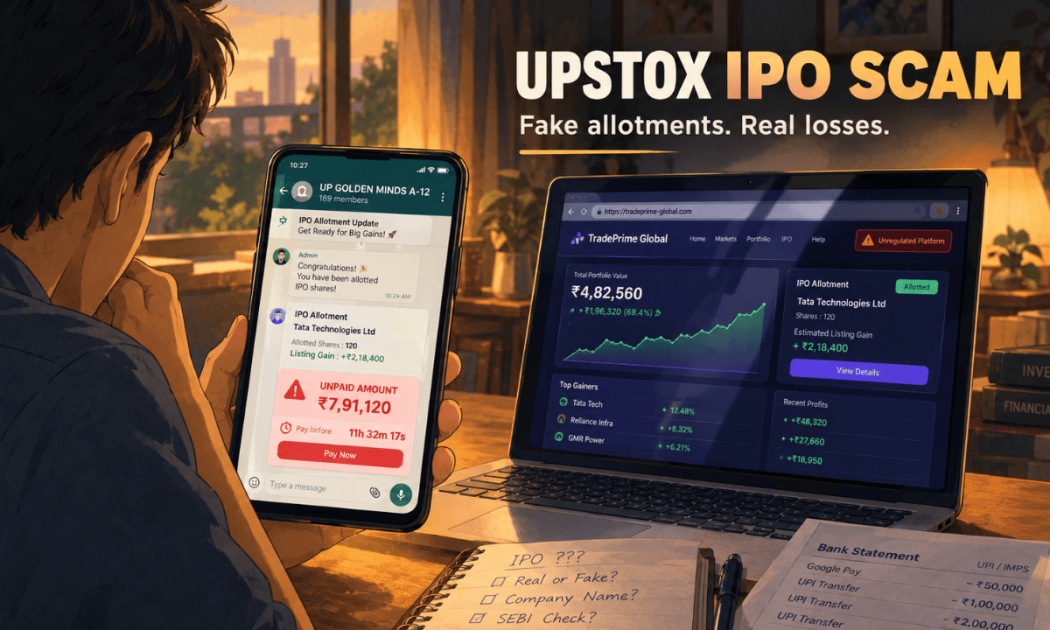
This Upstox IPO scam runs through a WhatsApp group called “UP Golden Minds A-12” and a lookalike website using a purple “UP” logo. In the case we reviewed, an investor topped up ₹2,20,025 between 25 September and 6 October 2026. Six “block trades” showed ₹45,854.98 in profit. Then the site allotted him a real SME IPO at a fake price and showed ₹7,91,120.01 as unpaid, with his balance in minus. Nothing in these records links the real Upstox to any of it.
If you’re reading this, chances are a WhatsApp group in Upstox’s name has told you that you won an IPO allotment.
Now there’s a big “unpaid amount” sitting on your screen with a deadline attached.
It feels urgent because it’s designed to.
The group looks professional, the profits looked real, and the IPO they named is a genuine one that actually listed on the stock exchange.
We went through one investor’s screenshots, from the WhatsApp group to the final payment demand, to show how this Upstox IPO scam is put together.
If your story matches and you want to report financial fraud India, the steps near the end tell you exactly where to begin.
Upstox IPO Scam India
Before getting into the screenshots, it helps to know what’s actually being sold.
The pitch isn’t a normal Upstox account, and that difference is where the trap begins.
The group offers what its admin calls an “Upstox premium institutional account.”
Members are told this account gets them block trades, IPO allotments and FPOs that ordinary investors can’t access through their own demat accounts.
There’s no app to download. Everything happens on a website opened in the phone’s browser, at an address ending in “upcapitalvip.us.cc.”
Upstox’s own website is upstox.com, and that’s the only address that matters here.
The scam then follows three stages.
First come small, profitable “block trades” to build trust.
Next, the deposits grow.
Finally, the site declares an IPO allotment far larger than the balance, and the shortfall becomes a bill the investor is pushed to pay.
A real IPO allotment never creates a debt you owe.
If you apply through your own broker, the money is blocked in your own bank account, and if you get fewer shares, the rest is simply released.
Is the Upstox WhatsApp Group “UP Golden Minds A-12” Real?
Most people who land here want a straight answer about the group itself.
The screenshots tell us what it looked like from inside, and Upstox’s own public statements fill in the rest.
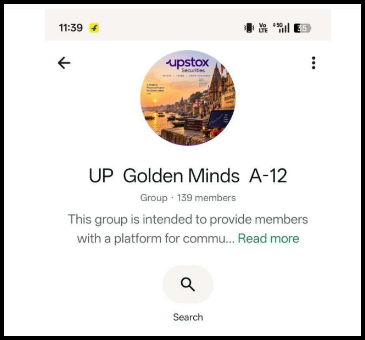
The group was named “UP Golden Minds A-12” and had 139 members.
Its display picture carried an “upstox Securities” logo over a photo of the Varanasi ghats, which gives it an Indian, familiar feel right away.
It had at least two admins.
One used the display name “Anannya Das” with a blue tick, and the other was listed with a UK phone number starting +44.
By the time the investor took his screenshot, he had been removed from the group.
Upstox is a real stock broker.
It operates as Upstox Securities Private Limited and is registered with SEBI under INZ000315837. You can confirm this on SEBI’s website.
Nothing in the screenshots we reviewed links that company to this group, the website, or the bank accounts used.
The pattern matches impersonation, where a trusted brand name is borrowed to win strangers over.
Upstox has itself warned about fake WhatsApp channels using its name.
It has said publicly that it contacts customers only through its official website and listed social media accounts, and that it never asks customers to transfer money through links or pay in cash.
On its community forum, Upstox has replied to members who shared similar “block trading” and IPO group screenshots.
It said those channels are not official and have no connection with Upstox.
How Did the Fake Upstox Website upcapitalvip Look?
Once you’re inside the website, it’s easy to see why people trust it.
Here’s what the investor saw on his screens, piece by piece.
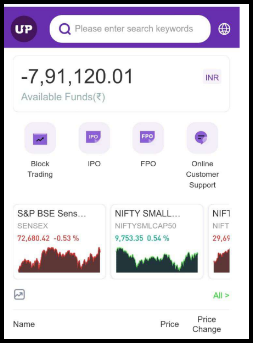
The homepage carries a round purple “UP” logo and Upstox like colours.
It has live looking cards for Sensex, Nifty Smallcap 50 and stocks such as Reliance and HDFC Bank, with tabs for Home, Market, News, Orders and My Account.
Right below the balance are four buttons: Block Trading, IPO, FPO and Online Customer Support.
That’s the menu of the scam in one row.
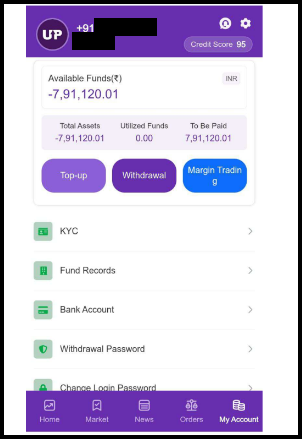
The My Account page adds a few touches that real brokers don’t use.
There’s a “Credit Score 95” badge, a separate “Withdrawal Password,” and buttons for Top up, Withdrawal and Margin Trading.
That credit score badge matters later.
It’s what the admin points to when she warns that not paying could hurt his “personal credit standing.”
Upstox Customer Service on WhatsApp Shared Private Current Accounts
Deposits didn’t go through a payment gateway or to a broker’s account.
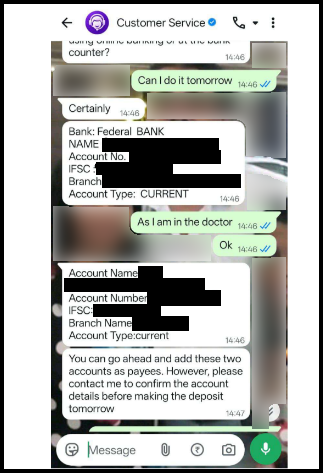
A WhatsApp contact named “Customer Service,” also with a blue tick, sent bank details in the chat.
In one exchange, it shared two current accounts at two different banks, both in the names of private businesses with no visible link to Upstox.
It asked him to add both as payees and to confirm the account details before depositing the next day.
A SEBI registered broker collects client money only in its own designated client bank accounts.
If a “support” chat keeps changing the account and it’s in some unrelated firm’s name, that alone is reason to stop.
Also Read: IndusInd Securities DMA Account, where another investor faced a ₹4 lakh “due” IPO bill after ten deposits.
Upstox Block Trading Profits That Built Trust
Nobody hands over lakhs on day one.
For about two weeks, the website gave this investor a string of small wins, and each one came right before a bigger deposit.
The Fund Records page shows his top ups growing step by step.
It starts with ₹8,000 on 25 September, then ₹25 as what looks like a test transfer, then ₹25,000, and later ₹50,000 three times in October.
| Date shown on the site | Top up amount |
|---|---|
| 25 September 2026 | ₹8,000 |
| 27 September 2026 | ₹25 and ₹25,000 |
| 28 September 2026 | ₹10,000 and ₹15,000 |
| 29 September 2026 | ₹12,000 |
| 1 October 2026 | ₹50,000 |
| 5 October 2026 | ₹50,000 |
| 6 October 2026 | ₹50,000 |
| Total in the screenshot | ₹2,20,025 |
Alongside those deposits, the site ran “block trades” in well known names such as IRB Infrastructure, HDFC Life, Tata Steel, GMR Airports, and Bank of Baroda.
Each was bought one day and sold a day or two later at a profit.
Look at how the trade size climbs with the deposits.
The table below is read straight off the Fund Records screens, buying cost first and sale value second.
| Stock shown | Bought for | Sold for |
|---|---|---|
| IRB Infrastructure Developers | ₹6,602.57 on 25 Sep | ₹6,865.26 on 28 Sep |
| HDFC Life Insurance | ₹45,208.59 on 28 Sep | ₹52,111.32 on 29 Sep |
| Tata Steel | ₹70,723.34 on 29 Sep | ₹70,817.21 on 1 Oct |
| GMR Airports | ₹68,600.04 on 1 Oct | ₹73,744.80 on 5 Oct |
| Bank of Baroda | ₹1,24,377.35 on 5 Oct | ₹1,39,098.22 on 6 Oct |
| Vedanta Aluminium Metal | ₹2,19,328.60 on 6 Oct | ₹2,37,791.38 on 7 Oct |
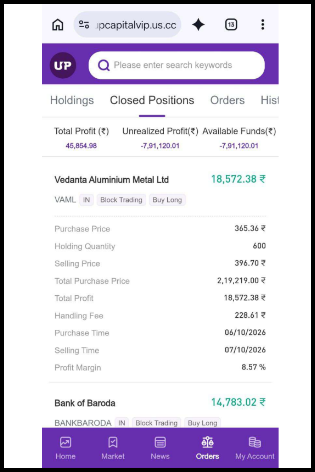
The Closed Positions screen added it all up as ₹45,854.98 in total profit.
A single Vedanta trade alone showed ₹18,572.38 profit at an 8.57% margin overnight.
Real block deals happen on the exchange’s block deal window, between large investors.
They show up in your contract notes and your NSDL or CDSL statement.
None of these trades would appear there, because they existed only on this website.
The Acme India Industries IPO Allotment Trap and the ₹7.91 Lakh Unpaid Bill
This is the part that turns a fake profit into a demand for fresh money.
If your screen shows an “unpaid amount” right now, read this section slowly.
On 6 October, the site entered an IPO application in Acme India Industries, a real company whose SME IPO was open that week.
It showed a subscription quantity of 10,00,000 shares at ₹151, and an allotment of 7,000 shares.
At ₹151 a share, 7,000 shares come to ₹10,57,000.
The site marked ₹2,65,879.98 as “committed capital” and the remaining ₹7,91,120.01 as “unpaid.”
Here’s the detail that’s easy to miss.
The committed capital matches ₹28,088.59 taken on 6 October plus the ₹2,37,791.38 Vedanta sale on 7 October, almost to the rupee.
In other words, every rupee in his balance, including the latest “profit,” went into the IPO.
His Available Funds turned into minus ₹7,91,120.01, and the money was no longer something he could even ask to withdraw.
What the Upstox WhatsApp Group Admin Said About the Unpaid Amount?
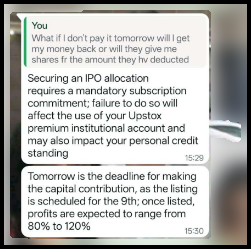
When he asked whether he would get his money back if he didn’t pay, the admin’s replies all pushed in one direction.
Here’s what the chat on 7 October shows.
- Securing the allocation needed a “mandatory subscription commitment.” Not paying would affect his “Upstox premium institutional account” and could “impact your personal credit standing.”
- “Tomorrow is the deadline” for the capital contribution, since the listing was on the 9th.
- Once listed, “profits are expected to range from 80% to 120%.”
- If he didn’t pay, the shares would stay “unsubscribed” and his funds would “remain tied up in the IPO shares.”
His own reply says it best: “what if I cannot make it, will my amount what I saved be wiped out.”
That fear is exactly what the deadline is built to create.
An IPO application can’t touch your credit score.
Credit bureaus build your score from loans and credit cards reported by lenders, not from a website’s “credit score” badge.
Real Acme India Industries IPO vs. What the Site Showed
Because the IPO is real, you can check the site’s numbers against public data.
Put them side by side and the fake figures fall apart on their own.
| Detail | What the fake site showed | The real IPO, per public listings |
|---|---|---|
| Price per share | ₹151 | ₹186 to ₹196 price band |
| Exchange | Not mentioned | BSE SME platform |
| Shares allotted | 7,000 | Lot size of 600, so allotments come in multiples of 600 |
| Allotment date | Shown as allotted by 7 Oct | Basis of allotment fixed on 7 Oct 2026 |
| Listing gain | 80% to 120% “expected” | Listed on 9 Oct 2026 at ₹221, about 12.8% above ₹196 |
| Who checks allotment | The website itself | The registrar, Bigshare Services, and BSE’s IPO status page |
7,000 isn’t even a multiple of 600.
No genuine allotment of this IPO could have produced that number, at that price, through a website nobody at the exchange knows about.
Is the website telling you to pay lakhs before a deadline or lose everything you’ve already put in?
We help investors work out what’s recoverable, which complaints to file first, and how to stop the losses from growing.
Warning Signs of an Upstox WhatsApp Group Scam
You may be in a different group with a different name, but the script rarely changes.
Check what you’ve been told against the signs below, and if even two match, treat it as a scam.
- A “premium institutional account” offered to you as a retail investor through WhatsApp.
- A website or link that isn’t upstox.com, or an app that isn’t the official Upstox app from the Play Store or App Store.
- Deposits to current accounts of unrelated businesses, shared in a chat and changed from time to time.
- Quick, steady profits on “block trades” that you never see in your contract notes or demat statement.
- An IPO allotment bigger than your balance, followed by a bill and a deadline.
- Threats about your credit score, your account being frozen, or your money being “tied up.”
- Profit promises such as 80% to 120% on listing day.
If you’re unsure about any broker message, log in to the official Upstox app yourself and check your orders and holdings.
Anything that isn’t there isn’t yours.
Also Read: Sam Pro App, where a fake trading app in SAMCO’s name showed ₹2.47 crore against ₹30 lakh of real deposits.
What to Do If You Lost Money in the Upstox IPO Scam?
If you’ve already sent money, the next few hours matter more than anything else.
These steps are in the order that gives you the best chance of freezing funds before they move on.
1. Report It on the Cyber Crime Portal
Call 1930, the national cyber fraud helpline, as soon as you can.
Then file a written complaint on cybercrime.gov.in with your transaction details and screenshots.
Fast reporting gives the police a chance to place holds on the receiving accounts.
Our guide on how to file a cyber crime complaint walks you through each field so nothing important gets left out.
2. Don’t Pay the Unpaid Amount or Any Release Fee
Stop all further payments, whatever the deadline says.
Paying the “unpaid amount” won’t release your balance; in a fake trading app scam like this, it usually leads to the next charge, such as a tax, an unlocking fee or a withdrawal fee.
Be careful of anyone who contacts you later offering to recover your money for an upfront fee.
3. Inform Your Bank and Upstox
Write to your bank’s fraud desk with every UTR or transaction reference and ask them to raise a dispute with the receiving banks.
You can also report the impersonation to Upstox at [email protected], attaching the group details and the website address.
That helps Upstox warn others and get the pages taken down.
4. Save Your Evidence Before It Disappears
Websites like this go offline without warning, and groups remove members, just as this one did.
Capture everything now, even what seems minor.
- Screenshots of every website page, including Fund Records, Closed Positions and IPO Subscription History.
- The full website address as it appears in your browser.
- Exported WhatsApp chats with the group, the admin and “Customer Service,” with media.
- Bank statements and UTR numbers for every deposit.
- Phone numbers and display names of every contact involved.
Losing money this way is upsetting, and it’s normal to want to act on everything at once.
Our page on what to do if online scam happens lays out the follow up steps after the first complaint, so you can move one step at a time.
Disclaimer: This article relies on screenshots a victim shared with us, with his personal details removed, along with public information on Upstox and the Acme India Industries IPO. It reports what those records show and does not accuse Upstox, Acme India Industries, or any holder of the bank accounts involved of wrongdoing.
Conclusion
This Upstox IPO scam works because every piece borrows something real.
The brand is real, the stocks in the “block trades” are real, and the IPO it named actually listed on BSE.
What isn’t real is the website, the profit, and the ₹7.91 lakh bill.
The fake allotment doesn’t match the real IPO’s price, lot size or listing gain, and the money only ever went to private current accounts.
If you’re in a group like this, stop paying, save your evidence, and report on 1930 today.
Check every trade inside the official Upstox app, never inside a link someone sends you.
Report. Recover. Stay Fraud Free.
Upstox says it contacts customers only through its official website and listed social media accounts. The group in this case, “UP Golden Minds A-12,” used a lookalike website and private bank accounts, and nothing in the records links it to Upstox. It’s the name this group gave its offer. Retail investors apply for IPOs through their own broker or bank, with money blocked in their own account. No broker sells special IPO or block trade access through a WhatsApp group. No. In a genuine IPO, your application money is blocked upfront and nothing is owed after allotment. An “unpaid amount” on a website, with a deadline and threats, is a demand for fresh money, so stop payments and report it. No. Upstox’s official website is upstox.com. The upcapitalvip.us.cc address in this case showed fake block trades and a fake IPO allotment, and deposits went to unrelated private current accounts. Call 1930 and file a complaint on cybercrime.gov.in with your screenshots and UTR numbers. Inform your bank’s fraud desk, and report the impersonation to Upstox at [email protected].Frequently Asked Questions



 Add us as a preferred source on Google »