

Quick Summary
Moneylicious Securities, the company behind the Dhan trading app, has seen its complaint volume rise sharply, from just 1 complaint in 2021-22 to 377 in 2024-25, before falling to 142 in 2025-26. Two arbitration cases tell very different stories: one trader won ₹4,53,081.60 after the broker’s system rejected his exit orders for fifteen minutes, another lost his claim entirely because he waited too long to report a similar issue. SEBI has also penalised the firm ₹3,00,000 for fund segregation and reporting violations. This blog covers all of it, plus what actually counts as excess charges and exactly how to escalate your own complaint.
You’ve probably used Dhan. Most active traders have, or at least know the name.
What you’ve probably never heard of is Moneylicious Securities Private Limited, the actual company running the app behind that brand.
A Moneylicious Securities complaint doesn’t usually start with the company name at all; it starts with a Dhan user hitting a wall, and only later discovering which entity they’re actually dealing with.
This blog pulls together everything worth knowing before that happens to you: the real complaint numbers, two arbitration cases with completely opposite outcomes, a SEBI penalty order, and the excess charges pattern that’s harder to pin down than it first appears.
Moneylicious Securities Private Limited
Moneylicious Securities Private Limited (MSPL) is an Indian stockbroking company offering retail broking across multiple exchanges and segments.
It’s also the entity behind Dhan, the technology-led trading platform most retail traders actually recognise.
Founded in 2012, the company operates as a SEBI-registered stockbroker with memberships on NSE, BSE, and MCX.
That’s a real, long-standing registration.
It’s also not a guarantee that every experience on the platform goes smoothly, which is exactly what the rest of this data shows.
How Many Moneylicious Securities Complaints Are There?
Numbers help more than impressions do here, so let’s look at what the actual complaint volume has done over the past five years.
| Year | Active Clients | Total Complaints |
|---|---|---|
| 2021-22 | 32,388 | 1 |
| 2022-23 | 4,69,961 | 14 |
| 2023-24 | 4,69,961 | 200 |
| 2024-25 | 9,71,760 | 377 |
| 2025-26 | 9,99,144 | 142 |
The jump between 2022-23 and 2023-24 is the one worth sitting with. Complaints went from 14 to 200 while the client base stayed exactly flat at 4,69,961.
That’s not growth-driven, something changed operationally that year.
By 2024-25, the platform reports resolving the large majority of complaints filed against it, a figure worth confirming independently if you’re currently mid-dispute, since resolution rates and resolution quality aren’t always the same thing.
Types of Complaints Investors File Against Moneylicious Securities
Complaints against any broker tend to fall into a handful of recognisable categories, and Moneylicious is no exception.
- Type I, Non-receipt or delay in payment, covers traders not receiving their payout on time, usually pointing to settlement or processing issues on the broker’s side.
- Type II, Non-receipt or delay in securities, applies when the broker delays delivering shares to a client’s demat account, often from back-office or settlement errors.
- Type IV, Unauthorised trading, involves trades executed without the client’s consent, or misuse of client funds or shares.
This is the most serious category by nature, and it has its own dedicated breakdown on our Moneylicious Securities unauthorised trading page, where the real year-by-year percentage climbs from 7.14% in 2022-23 to 24.64% in 2025-26. - Type V, Service-related, covers slow support, unresponsive customer care, platform issues, or delayed query resolution, general service inefficiencies rather than a specific financial harm.
- Type V, Closing out or squaring up, is a separate concern under the same numbering, arising when a broker squares off a position without proper notice, often during margin shortfalls or system-triggered actions.
- Type VIII, IPO related, covers issues during IPO applications, blocked funds not being released, application errors, or failed bid processing.
- Type IX, Others, is the catch-all for technical glitches, account issues, or anything that doesn’t fit cleanly elsewhere.
Also Read: ACML Capital Markets reviews, the honest review, the full complaint record and real user feedback together.
Moneylicious Securities Excess Charges
Many investors depend on brokerage firms to execute their trades and manage transactions in the stock market.
These brokers charge certain fees for their services, which usually include brokerage and other transaction-related costs.
However, sometimes investors may notice higher-than-expected charges in their trading accounts.
Such charges can gradually reduce the overall returns on investments. In some situations, these costs may arise because of excessive trading in the account.
When trades are carried out mainly to generate brokerage fees instead of benefiting the investor, it may indicate brokerage churning, where repeated buying and selling of securities takes place mainly to generate commissions rather than serve the client’s actual goals.
Here’s what the data suggests about how much of Moneylicious’s overall complaint volume ties back to charges specifically.
| Year | Total Complaints | Complaints Linked to Excess Charges |
|---|---|---|
| 2021-22 | 1 | None reported |
| 2022-23 | 14 | Around 4 |
| 2023-24 | 200 | Around 141 |
| 2024-25 | 377 | Around 214 |
| 2025-26 | 142 | Around 72 |
A necessary caveat here: NSE does not maintain a dedicated “excess charges” complaint category the way it does for unauthorised trading. These figures represent charges-related grievances identified within the broader complaint data, not an official classification, which is why they’re presented as approximate rather than exact.
Even accounting for that, the pattern holds across every year measured, a substantial share of total complaints trace back to charges or fee-related concerns, not a one-time spike.
You may suspect brokerage churning specifically if you notice trades appearing in your account without clear prior approval, an unusually high volume of buying and selling with no coherent strategy behind it, account activity that seems oriented toward generating brokerage rather than returns, or a broker who can’t clearly explain why a trade was executed or how a charge was calculated.
Moneylicious Securities Arbitration Cases
Despite its overall reputation, Moneylicious has faced arbitration at NSE, and the two cases on record tell genuinely different stories depending on how the evidence held up.
Case 1: The Fifteen Minutes That Cost, and Then Recovered, ₹4,53,081.60
Some trading losses come from a bad call. This one came from a button that would not work.
Bharat Bhaychandbhai Vaghari, a trader from Gujarat, held a Bank Nifty 53400 call option, lot size 736, total quantity 11,040. The price had climbed toward his target of ₹94.50.
On paper, he was sitting on close to ₹6,00,000 in unrealised profit.
At 11:04 AM on 12 July 2024, he tried to sell. The system rejected the order. He tried again. Rejected again. Market order, limit order, stop-loss every version bounced.
For fifteen minutes, from 11:04 to 11:19, the exit door stayed shut while the price slid underneath him. Every rejected order was a few thousand more rupees of profit gone.
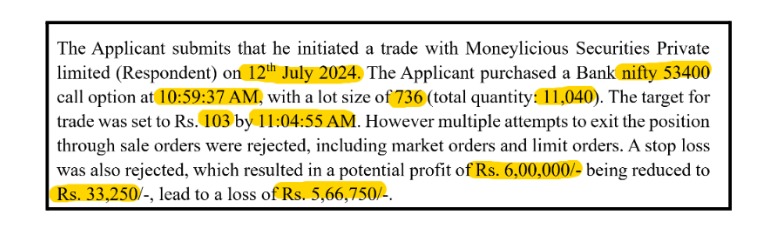
At 11:19 AM, the position finally closed at ₹53.46, far below the ₹94.50 he’d been aiming for. His ₹6,00,000 profit had shrunk to ₹33,250.
Moneylicious’s defence was that a BSE technical issue had affected the industry that day. It offered no exchange communication, no incident report, nothing to actually back that claim up.
The arbitrator wasn’t willing to accept a broker’s word without proof, and held that a broker must provide uninterrupted service to execute orders in time.
When it fails and can’t show the failure came from elsewhere, the loss is the broker’s to bear.
This case was represented by our team, and we handled the entire arbitration process on behalf of the client, from preparing documents to presenting the facts clearly.
The compensation figure itself came directly from the broker’s own trade log. We fixed two prices to two timestamps: ₹94.50, the market price at 11:05 AM when the first sell order was rejected, and ₹53.46, the actual exit price at 11:19 AM.
The difference, ₹41.04 per unit, multiplied across the 11,040 quantity, came to exactly ₹4,53,081.60.
| Detail | Value |
|---|---|
| Matter number | NSE-SB-2024-07-620797 |
| Respondent | Moneylicious Securities Private Limited |
| Amount awarded | ₹4,53,081.60 |
| Default interest | 12% per annum if unpaid within one month |
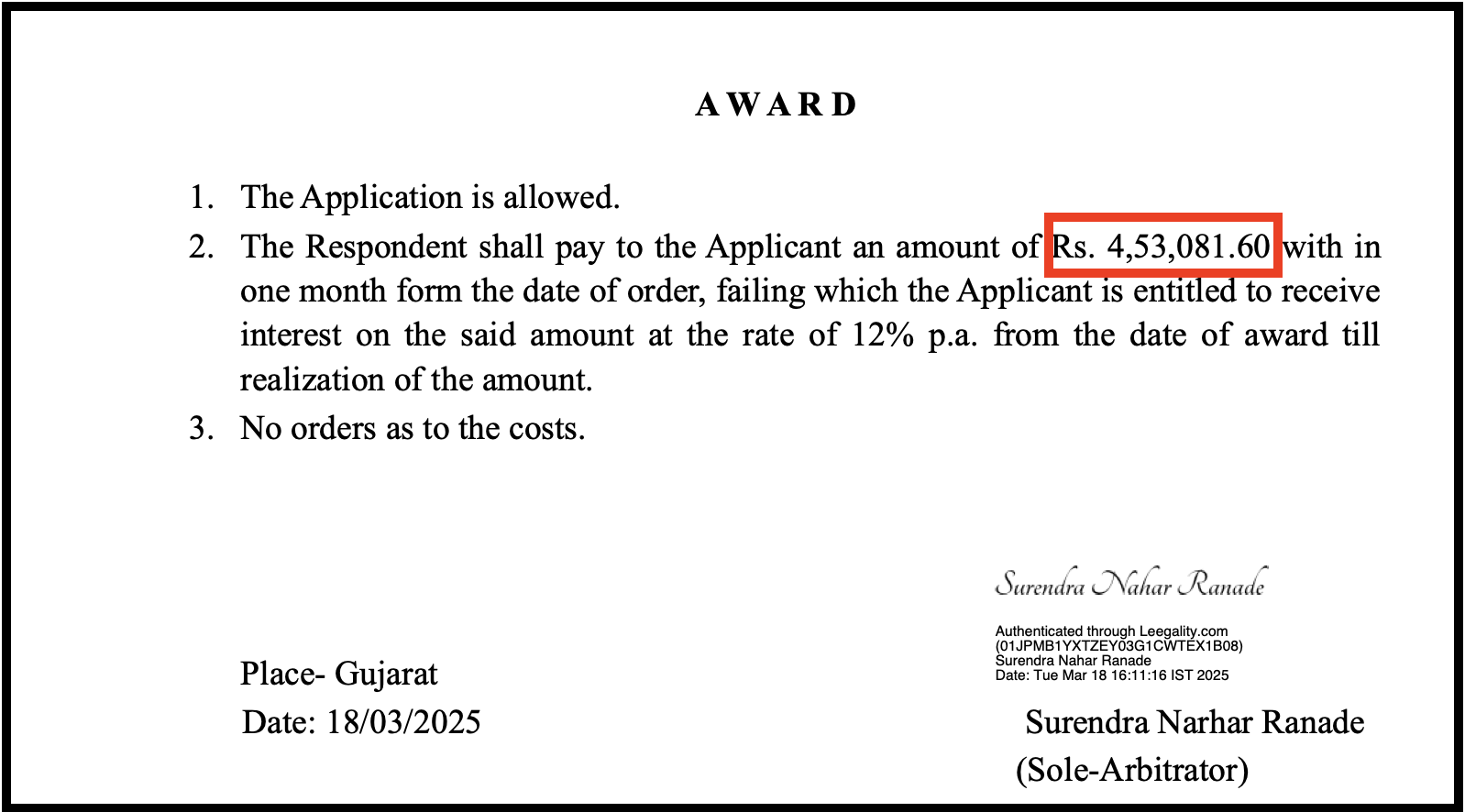
The strength of this claim was that the broker generated every input for it. Order timestamps, rejection records, final exit price, all pulled from its own system.
There was nothing left for the broker to dispute, because it was disputing its own data.
Case 2: The Claim That Failed on Timing, Not Facts
When trading apps freeze, crash, or stop responding at the worst possible moment, the financial damage can be real. But are brokers automatically liable when that happens?
This second case, between Brijesh Meshram and Moneylicious Securities Pvt. Ltd. (Dhan App), shows why the answer isn’t always yes.
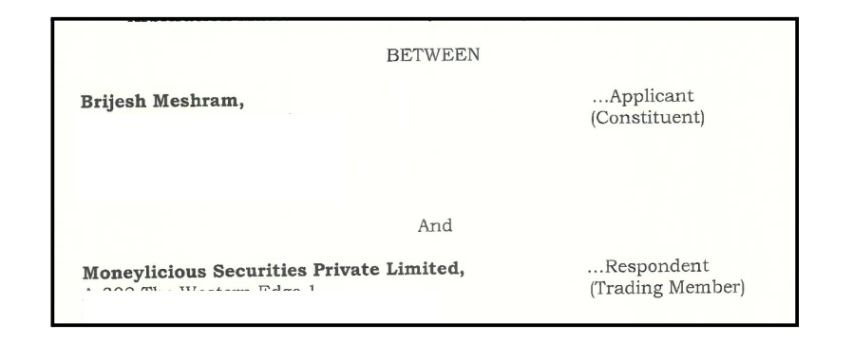
Brijesh Meshram, an active F&O trader, claimed the Dhan app malfunctioned across four consecutive days, March 20, 21, 22, and 23, 2023.
According to him, the app hung during live trades, stopped responding despite a stable internet connection, prevented him from squaring off positions, and caused him significant losses as a result.
He filed an arbitration claim seeking ₹2,32,000 in compensation.
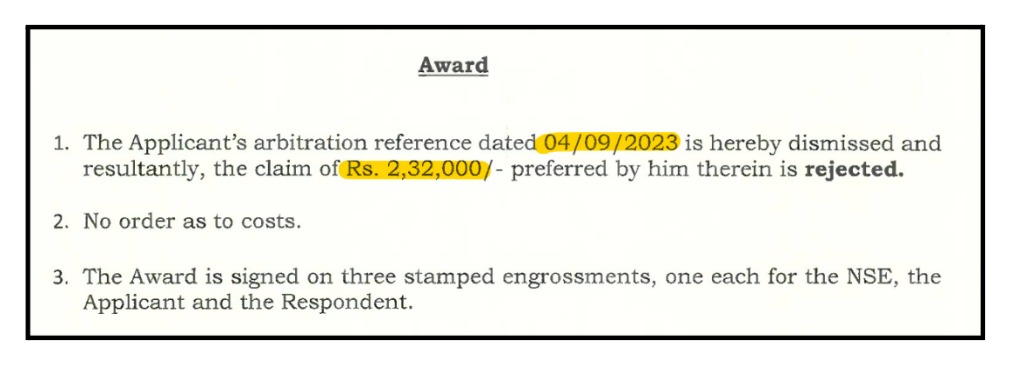
Here’s where the case turned. Meshram did not raise the complaint immediately; he waited 15 days before reporting the issue. That delay became central to the outcome.
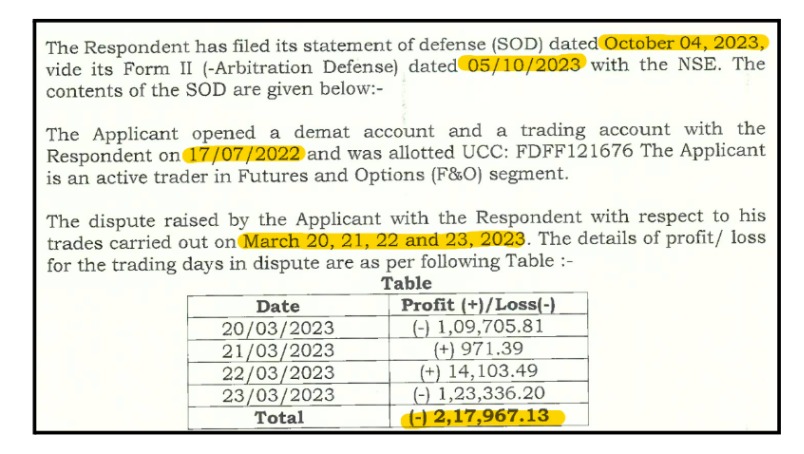
The arbitrator noted that without concrete evidence, the claimed loss of ₹2,17,967.13 couldn’t be conclusively linked to the alleged disruption, and Moneylicious argued the 15-day gap itself weakened the credibility of the claim.
With no technical evidence, no proven IBT clause violations, and no demonstrated exchange-side error, the arbitrator rejected the claim entirely, dismissing the application on 4 September 2023.
The key difference between these two cases isn’t the broker; it’s the paper trail. Vaghari had timestamped, broker-generated evidence captured within minutes.
Meshram had a strong-sounding claim with no contemporaneous documentation behind it.
That gap decided both outcomes.
SEBI Orders Against Moneylicious Securities
Apart from the arbitration record, SEBI has also taken direct regulatory action against this broker.
SEBI regularly inspects its registered brokers to confirm they’re following the rules, and Moneylicious didn’t come through that inspection clean.
SEBI’s ₹3 Lakh Penalty on Moneylicious Securities
SEBI passed this order after inspecting Moneylicious Securities Pvt. Ltd. (a broker and DP) and finding compliance gaps spanning April 2018 to 18 October 2019.
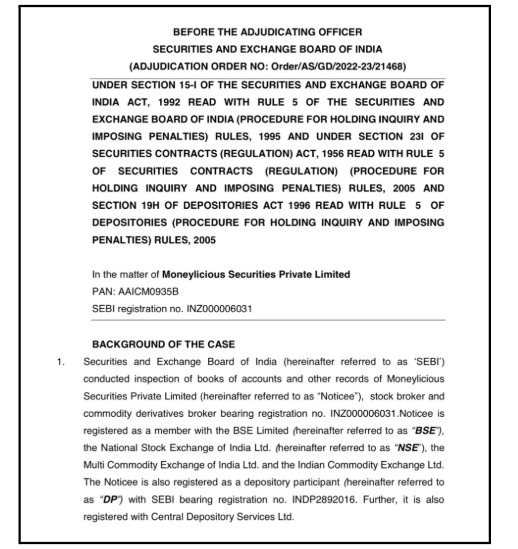
The purpose of the inspection was straightforward: to confirm client money was protected, reporting was accurate, and the broker maintained the minimum financial strength required to operate.
Why SEBI acted: the inspection found signs that client funds weren’t properly protected or handled, and that required regulatory reporting was incorrect. Based on those findings, SEBI issued a show-cause notice and ultimately passed a penalty order.
The specific violations:
- Misuse of client funds in the equity segment: on 17 of 38 sample days, available funds were less than clients’ credit balances, a clear red flag for possible use of client money.
- Non-segregation of client funds: SEBI identified 1,611 transfers between client bank accounts and non-client accounts, violating segregation requirements.
- Incorrect weekly enhanced supervision reporting: wrong figures were reported to the exchange for a sample date, 27 September 2019.
- Net worth non-compliance: the broker reported net worth above ₹1 crore, but NSE’s own calculation showed roughly ₹0.49 crore, below the regulatory requirement.
What SEBI imposed: a total penalty of ₹3,00,000, split as ₹2,00,000 under SCRA and ₹1,00,000 under the SEBI Act.
Some charges didn’t stick; a commodity-segment misuse allegation was attributed to a different entity, and an “interest levy” concern wasn’t established since no actual charging was demonstrated.
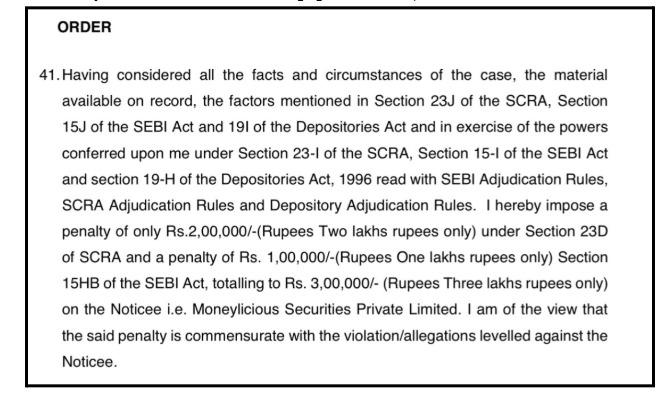
What this teaches any investor evaluating a broker: client money should never mix with the broker’s own funds; segregation isn’t optional.
Compliance reporting has to be accurate, since incorrect reporting is itself a violation regardless of intent. And a broker’s stated net worth is worth verifying independently rather than taking at face value.
Dealing with an unresolved issue on Moneylicious Securities or the Dhan app and not sure what your evidence is actually worth?
Our team will review your trade logs and order timestamps the same way we built the Vaghari case, and helps you find out if you have a claim worth filing.
How To File a Complaint Against Moneylicious Securities?
If you notice excess charges, unauthorised activity, or unresolved service issues, escalation doesn’t have to mean guessing what comes next. SEBI and the exchanges run a specific, structured sequence for exactly this, and knowing each stage before you start puts you in a stronger position.
Start by examining your own trade records and statements closely. Check contract notes and account statements for unusual trades or repeated transactions that don’t match your instructions.
Next, seek a direct explanation from the broker. Contact them and ask specifically why a trade or charge occurred, understanding the stated reason helps you judge whether it’s actually justified.
Keep documentation of every interaction, account statements, emails, and any other broker communication, since these become essential if you need to escalate later.
If the broker doesn’t resolve things on its own, here are the channels available to you, each suited to a different stage of the dispute.
File through the SEBI SCORES complaint portal, which brings the regulator directly into the process and puts the broker on a defined response timeline.
You can also approach the exchanges directly. NSE and BSE both maintain investor grievance systems that review complaints against their registered brokers.
For structured online resolution, a SMART ODR portal filing moves your case into conciliation before it needs to go further.
If the dispute still isn’t resolved, share market arbitration through the exchange where the broker is registered is the final step. As both cases above show, the outcome usually comes down to whether you have timestamped, contemporaneous evidence, not just a strong sense that something went wrong.
If you want to know the full process in detail, check our guide on complaint against broker to SEBI.
Conclusion
Moneylicious Securities, now operating under the Dhan brand, has built a significant presence in the Indian retail trading market. That presence comes with a documented history worth understanding before you rely on it.
Complaint volume has grown sharply over five years.
Two arbitration cases show that outcomes hinge almost entirely on how quickly and thoroughly you document a problem when it happens.
A SEBI penalty confirms that even a long-established, widely-used broker can fall short on fund segregation and accurate reporting.
None of this means avoid the platform outright.
It means know the pattern, keep your own records, and act fast if something looks wrong, because as both arbitration cases prove, speed and documentation are what actually decide these disputes.
Report. Recover. Stay Fraud Free.
Frequently Asked Questions
Complaints rose from 1 in 2021-22 to a peak of 377 in 2024-25, before falling to 142 in 2025-26, according to the platform's own reported data.
Yes. In one case, the broker was ordered to pay ₹4,53,081.60 after its system rejected a trader's exit orders for fifteen minutes with no proof the fault lay elsewhere.
Yes. A separate claim over alleged app malfunctions was dismissed entirely because the trader waited 15 days to report the issue, weakening the evidence behind the claim.
SEBI fined the firm ₹3,00,000 for non-segregation of client funds, incorrect reporting to the exchange, and reporting an inflated net worth figure.
No. NSE doesn't maintain a dedicated excess charges category, so any figure isolating that pattern is an estimate drawn from broader complaint data, not an official classification.





 Add us as a preferred source on Google »

