
Quick Summary
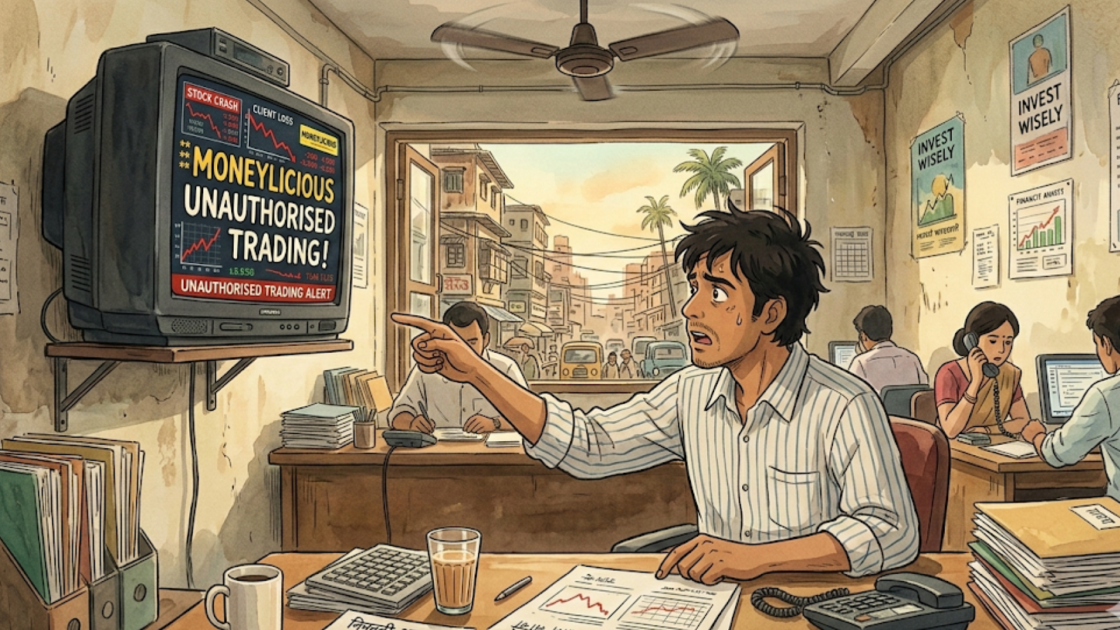
Unauthorised trading complaints against Moneylicious Securities have climbed from 7.14% of total complaints to 24.64% over recent years, a more than threefold increase in share even as total complaint volume has fluctuated. This category, NSE’s Type IV, covers trades executed without a client’s consent or misuse of client funds and securities. This blog explains what actually counts as unauthorised trading, why the proportion matters more than the raw count, the specific evidence you need to build a claim, and where to find the full arbitration case that shows exactly how this kind of dispute gets decided.
Moneylicious Securities unauthorised trading complaints have grown from a minor category to one of the most significant reasons investors escalate against this broker, and the shift shows up clearly once you isolate the numbers.
Moneylicious runs the Dhan app, a platform most active traders recognise even if they’ve never heard the company name behind it.
That familiarity can work against you.
A brand you already trust makes it easier to assume a strange trade in your account was your own mistake rather than something the broker did without your consent.
What Counts as Unauthorised Trading by Moneylicious Securities?
Unauthorised trading, under NSE’s own classification, means a trade was executed in your account without your permission, or that client funds or securities were misused in some way.
The distinction that matters here is proof, not intention.
A broker doesn’t need to have acted maliciously for a trade to count as unauthorised. It simply needs to have happened without a verifiable instruction from you.
That’s a meaningfully different standard than most investors assume going in.
You don’t have to prove the broker meant to defraud you; this isn’t the same as building a case for brokerage churning, where the question is excessive trading rather than consent.
Here, you only have to show the trade wasn’t authorised, and the burden then shifts to the broker to prove otherwise.
Why Is Moneylicious Securities Unauthorised Trading Rising as a Share of Complaints?
Raw complaint counts move up and down for all kinds of reasons: client growth, a bad quarter, a system update gone wrong.
The percentage a specific category makes up of the total tells a more honest story about where the real problem is concentrated.
For Moneylicious, that percentage has moved sharply in one direction. Unauthorised trading complaints made up 7.14% of total complaints in an earlier reporting year.
In the most recent year on record, that figure stands at 24.64%.
That’s not a small drift. It means unauthorised trading has gone from a minor slice of the complaint pie to nearly a quarter of everything filed against the broker.
A rising share like this usually points to one of two things: either detection and reporting have genuinely improved, more investors now recognise what an unauthorised trade looks like and report it, or the underlying frequency of unauthorised activity has actually increased.
Either explanation is worth taking seriously if you’re currently trading on this platform.
Warning Signs of an Unauthorised Trade in Your Account
Unauthorised trading rarely announces itself with a single dramatic event. It shows up as a pattern of smaller signals that are easy to dismiss individually.
Here’s what’s worth watching for in your own Dhan account:
- A trade confirmation SMS or email for an order you don’t recall placing is the clearest possible sign, and it should never be dismissed as a system glitch without checking further.
- Positions that don’t match your stated risk appetite or trading history, a sudden shift into F&O when you’ve only ever traded cash equity, for example, is worth questioning immediately.
- An account balance that’s moved without a corresponding decision you remember making deserves the same scrutiny as an unexplained bank transaction.
- A support team that can’t produce a clear, specific explanation for a disputed trade, beyond a general reference to market conditions, is itself a signal something isn’t being properly documented on their end.
What Evidence Do You Need to Prove Unauthorised Trading?
Since the burden ultimately falls on the broker to prove a trade was authorised, your job is to make that proof impossible for them to produce, or to gather enough of your own record that the gap becomes undeniable.
Download your complete order history and trade confirmations for the disputed period the moment you notice something wrong. Delays make this harder, not easier, since brokers aren’t required to preserve every record indefinitely.
Save every SMS and email alert tied to your account, even ones that seem routine, since the absence of an expected alert can be as telling as the presence of an unexpected one.
Keep a written log of any calls or messages with your broker or relationship manager, and if a call happened with no recording or written follow-up, note the date and what was said as close to real time as possible.
If your broker doesn’t respond properly once you raise this, our guide on how to file a complaint against stock broker covers exactly what a written complaint needs to include to be taken seriously.
Cross-check your own trading pattern against the disputed trade. If it’s wildly inconsistent with how you’ve traded every other week, that inconsistency itself becomes part of your case.
Found a trade on your Moneylicious Securities or Dhan account that you never approved?
Our team will review your order history and communication records, build the evidence gap the broker needs to answer for, and helps you file a claim that holds up.
What Does a Real Unauthorised Trading Dispute Against Moneylicious Look Like?
Numbers and definitions only go so far.
Our page on Moneylicious Securities complaint covers a real, decided arbitration case where a trader’s exit orders were rejected for fifteen minutes, and the outcome came down entirely to timestamped evidence pulled directly from the broker’s own trade log.
That case wasn’t filed as unauthorised trading specifically, but the underlying lesson applies directly here too.
The strength of any dispute against this broker, unauthorised trading included, rests on whether your evidence is precise, dated, and hard to argue with, not on how strongly you feel something went wrong.
Conclusion
Moneylicious Securities unauthorised trading complaints have gone from a small fraction of total grievances to nearly a quarter of everything filed against the broker, and that trajectory alone is reason enough to check your own account activity carefully.
A familiar brand name doesn’t guarantee every trade in your account was one you actually approved.
The responsibility for proving authorisation sits with the broker, but only if you’ve kept the records that make that proof possible to demand.
If the broker doesn’t cooperate, escalating through SEBI SCORES portal puts the regulator directly into the process.
Check your order history regularly, question anything that doesn’t match your own trading pattern, and don’t wait weeks to raise something that looked wrong on day one.
Report. Recover. Stay Fraud Free.
From 7.14% of total complaints in an earlier reporting year to 24.64% in the most recent year, more than a threefold increase in proportion. A trade executed in your account without your consent, or any misuse of your funds or securities by the broker, regardless of whether the broker intended harm. The broker does. Once you can show a trade wasn't clearly instructed by you, the responsibility shifts to the broker to produce verifiable proof of consent. As soon as you notice it. Order histories and communication records become harder to retrieve or verify the longer you wait to raise the issue. No. Unauthorised trading means a trade happened without your consent. Excess charges involve a trade you may have approved but fees that don't match what you were told to expect.Frequently Asked Questions


 Add us as a preferred source on Google »

