

Quick Summary
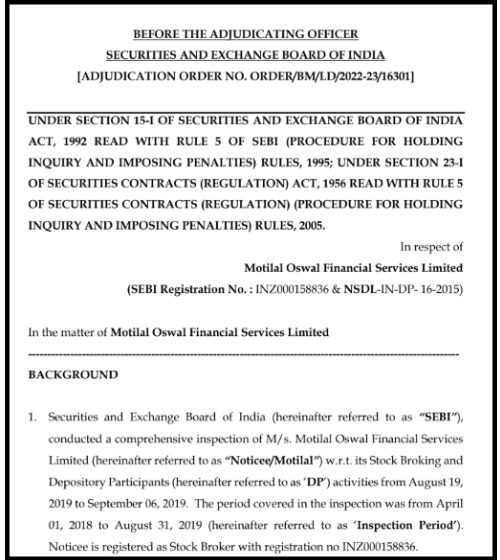
On April 29, 2022, SEBI Adjudicating Officer Barnali Mukherjee fined Motilal Oswal Financial Services ₹25 lakh after a 2019 inspection. The officer held six findings established, led by the use of client credit balances and a ₹16.84 crore margin shortfall. It is the largest of the five penalty orders against the firm since 2022. This page tells the story of the inspection, the firm’s defence and the officer’s ruling, with a link to the original order.
Picture the money in a broker’s accounts on an ordinary Thursday.
Some of it belongs to the broker. Most of it belongs to people like you, waiting for their next trade or their next withdrawal.
SEBI’s rule is blunt: client money must stay protected. In August 2019, the regulator decided to check whether that held true at Motilal Oswal.
How Did SEBI’s Inspection of Motilal Oswal Begin?
From August 19 to September 6, 2019, SEBI’s inspectors went through the firm’s broking and depository books.
They looked back at April 2018 to August 2019.
Their findings reached the firm on April 30, 2020, and the firm replied on June 11, 2020.
SEBI then issued a show cause notice on November 1, 2021, and the two sides met at a hearing on February 14, 2022.
The Adjudicating Officer wrote that the instances in her order were illustrative, drawn from sampling and test checks of the books.
Was Client Money Used for Other Purposes at Motilal Oswal?
This was the heart of the case, and the officer’s answer was yes.
SEBI runs a simple daily test: client bank funds plus collateral, less clients’ credit balances. The result must never fall below zero.
Across 52 sample dates, the result was negative on 11 of them.
The gap ranged from ₹79 crore to ₹226 crore, and the worst day was July 26, 2018, at ₹226.20 crore.
The firm had a ready explanation. It said it also held units of two mutual funds, including funds run by its own group, and that counting them turned the result positive.
The officer did not accept that. She wrote that under the clearing corporation’s lists those units are non cash collateral, so they cannot count.
She found misuse of client funds on all 11 dates.
Here the story needs a careful word. The order records no client complaint and says the exact loss cannot be worked out.
The risk was to client money, not a proven loss.
What Happened With the ₹16.84 Crore Margin Shortfall?
Next, the inspectors looked at margin.
SEBI alleged that margin reported to the exchange was short by ₹16.84 crore across three clients, one day each. The largest gap was ₹15.89 crore on April 24, 2019.
The exchange had noticed money moving between segments without enough credit behind it.
The firm replied that a June 2018 exchange circular allowed it to report segment by segment.
The officer read the firm’s own records and found a debit balance in the cash segment.
Funds had moved without enough credit in all segments, and she held the finding established.
Which Other Lapses Did the Officer Uphold?
The rest of the order reads like a checklist of everyday duties, each one tested and each one found wanting.
SEBI said nine clients were given fresh exposure while carrying a debit older than the allowed T+2+5 days, adding up to ₹24.52 crore.
The officer upheld eight of the nine. She accepted the ninth as a futures rollover, which is not new exposure.
Then came KYC. The details of 7,246 clients had not been uploaded to the central registry.
The firm later fixed 7,141 records, closed 57 accounts and suspended 48 codes, but the officer wrote that fixing it later does not cure the lapse.
The inspectors also asked for proof of telephone orders for nine clients, who belonged to three authorised persons.
The firm could not show it, and the officer wrote that the responsibility to record orders lies with the broker.
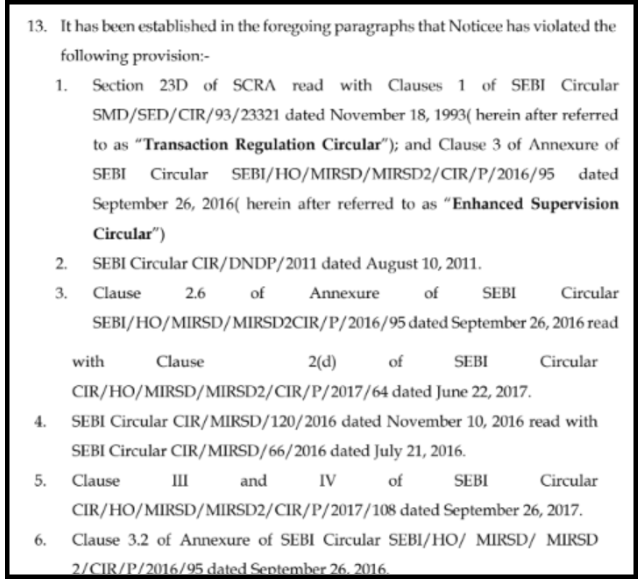
Finally, the weekly supervision report of July 26, 2019 did not match SEBI’s numbers.
It over reported collateral with the clearing member by ₹159.03 crore. The firm called the errors clerical, and the officer did not accept that as an excuse.
How Did the Officer Arrive at ₹25 Lakh?
When the facts were in, the officer turned to the penalty.
She found no quantifiable gain to the firm and no way to measure loss to clients.
What weighed on her was repetition.
She noted that the firm had been penalised under the same section by an earlier order, and said deterrence was needed.
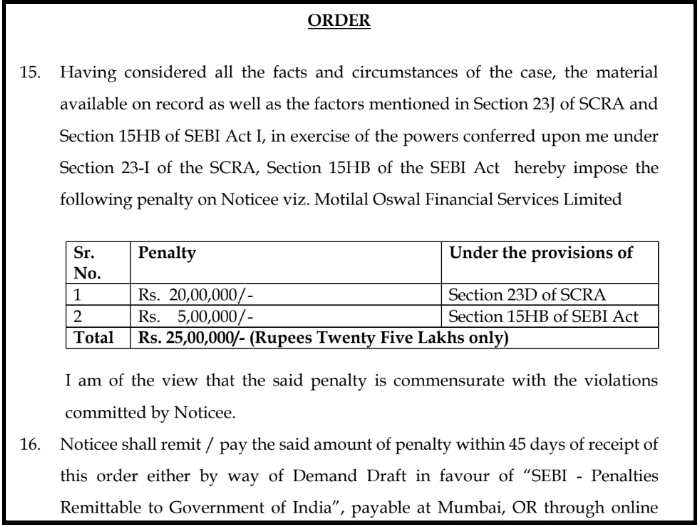
The result was ₹25 lakh in two parts: ₹20 lakh under Section 23D of the Securities Contracts (Regulation) Act and ₹5 lakh under Section 15HB of the SEBI Act.
Payment was due within 45 days.
What Can an Investor Learn From This Order?
The lesson is that a promise of safety is only as good as the daily books behind it.
Most investors never see those books, so the checks have to start with what you can see.
But is Motilal Oswal reliable? Its regulatory history is one factor investors should consider alongside their own account records.
Compare your ledger with your contract notes every month, and ask for a written statement of the funds the broker holds for you.
If a credit balance does not match, raise it in writing the same day.
When the broker’s answer does not settle it, our guide to file complaint against stock broker walks you from the grievance desk up to the exchange.
This order is one of five.
Our master page on the SEBI penalty against Motilal Oswal lines them up side by side.
Think your funds were mishandled?
We read your ledgers, contract notes and statements, map them against SEBI’s client fund rules and draft the complaint. Register with us for a free consultation.
Report. Recover. Stay Fraud Free.
Frequently Asked Questions
No loss was recorded. The order says the exact loss to clients cannot be ascertained and notes no client complaint. It penalises the handling of client funds.
You can access the complete adjudication order directly on the official SEBI website under their enforcement or orders section to review all paragraphs, technical findings, and the firm's submissions in full detail.
No. Penalties under these sections go to the Government of India and do not compensate clients.



 Add us as a preferred source on Google »