

Quick Summary
ACML Capital Markets shows a consistently low, near-fully-resolved complaint record across five reporting years, with zero arbitration cases received or pending in any year on file. Despite that, five separate, independently posted user reviews describe recurring login failures, broken password recovery, and unreliable authentication systems, alongside a documented case of a KYC delay that blocked a client’s account during active trading. This blog covers the firm’s regulatory background, the real year-by-year complaint data, and the exact steps to take if you run into the same problems.
Thinking about opening a trading account? You’ve probably come across ACML Capital Markets, a brokerage with a long track record in India’s financial space.
On the surface, it ticks a lot of boxes. But as with any broker, it’s important to look beyond just the brand name.
Spend a little time researching, and you’ll notice a mix of client reviews and complaints popping up across different platforms.
That’s not unusual, but it is something you should pay attention to, especially when your hard-earned money is involved.
So before you take the next step, let’s break down what people are saying, the kind of issues that have been raised, and what you can do if you ever run into trouble while using ACML’s services.
ACML Capital Markets Ltd.
A broker’s history tells you more than its brochure does, and ACML’s goes back further than most newer platforms competing for the same clients today.
ACML Capital Markets has been operating since 2000, promoted by the former Ahmedabad Stock Exchange Limited, now known as ASEL Financial Services Limited.
That lineage matters, it’s not a fresh fintech entrant riding a marketing push, it’s a firm with two and a half decades of actual operating history behind it.
The company holds membership with both NSE and BSE, and runs active operations across equity cash, currency, F&O, and the commodity segment through MCX.
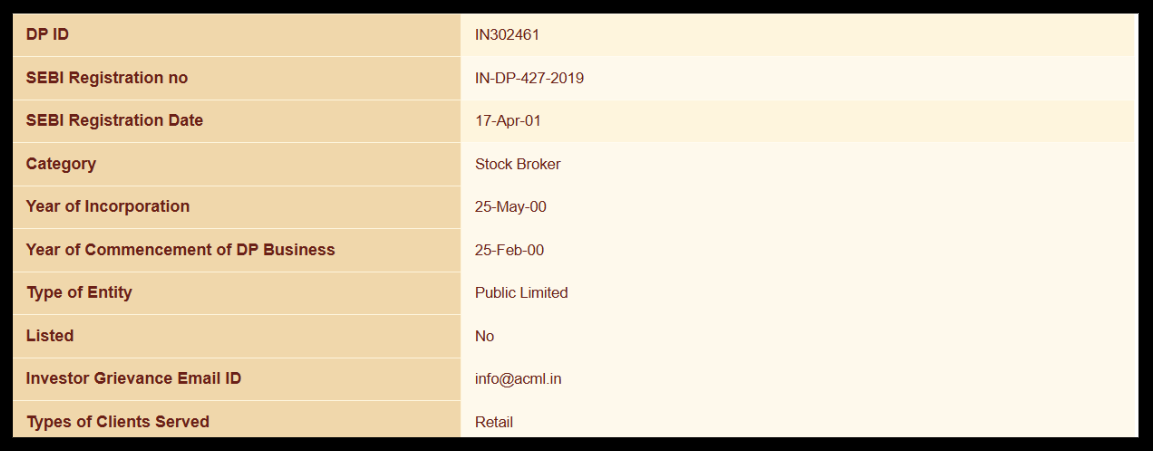
It also functions as a depository participant with both NSDL and CDSL, giving it a genuinely full-service footprint rather than a narrow, single-segment offering.
On paper, that’s a reasonably complete, well-credentialed broker. But as with any firm, credentials alone were never the right place to stop looking, which is exactly why the actual complaint record below matters more than the registration list.
Also Read: Aaritya Broking complaints, a claimed 2 lakh users, and 1,28,152 on actual record.
What Does ACML’s Official Complaint Data Actually Show?
Numbers from the exchange carry more weight than a star rating ever will, since they’re tracked independently of the broker’s own marketing.
So it’s worth starting here:
| Particulars | 2021-22 | 2022-23 | 2023-24 | 2024-25 | 2025-26 |
|---|---|---|---|---|---|
| Complaints Received | 14 | 2 | 6 | 11 | 2 |
| Complaints Pending | 1 | 0 | 0 | 0 | 0 |
| Arbitration Cases Received | 0 | 0 | 0 | 0 | 0 |
| Arbitration Cases Pending | 0 | 0 | 0 | 0 | 0 |
| Complaints Resolved (rolling 12 months) | 13 | 2 | 6 | 11 | 2 |
| Arbitration Resolved | 0 | 0 | 0 | 0 | 0 |
The pattern across five years is remarkably consistent.
Complaint volume stays low throughout, never crossing 14 in any single year, and 2021-22’s single pending case is the only complaint across the entire window that wasn’t resolved within the same reporting period.
Zero arbitration cases, received or pending, show up in any year on this table.
That holds across the full five years shown, which means disputes at this broker simply aren’t escalating to formal, third-party resolution, either because they’re genuinely being resolved early, or because affected clients aren’t pushing far enough to reach that stage.
The recurring themes behind this small complaint volume are specific too: difficulty logging into the trading application, problems with the authentication system, and delays or complications during KYC processing.
These read as operational and technical issues rather than anything pointing toward fund misuse or deliberate misconduct.
A low, consistently resolved complaint count paired with zero arbitration across five straight years does generally point toward functional internal processes on paper.
That said, a quiet official record doesn’t automatically mean a quiet user experience, which is exactly where the reviews below start telling a noticeably different part of the story.
Also Read: ATS Broking complaints, roughly ₹2,00,000 in fees, across two separate accounts.
ACML Capital Markets Ltd. Reviews
Official complaint data only captures what gets formally filed and escalated through the right channel.
A lot of day-to-day frustration never makes it that far; it just gets posted as a review instead, which is exactly where this next picture comes from.
1. Locked Out Even After Resetting the Password
Picture the scenario first, because it’s probably the most common moment of panic in trading.
You open the app during market hours, your password doesn’t work, and your first move is the obvious one: click “forgot password,” follow the reset flow, enter the new one.
That’s exactly what Paurav Raval did in a review posted in May 2024.

Except it didn’t work. He went through the entire recovery process the app itself provides, and still couldn’t get back into his own account afterward.
He called the service disappointing, and his conclusion wasn’t a passing complaint; he directly questioned whether the app’s usability was good enough to justify keeping it at all, suggesting ACML either fix it or pull it from the Play Store.
What makes this review worth taking seriously isn’t the frustration in the tone; plenty of one-star reviews are just venting.
It’s that the specific mechanism he describes, a password reset that genuinely doesn’t resolve the underlying login failure, is a technical claim that’s either true or it isn’t.
It’s not a subjective complaint about customer service speed; it’s a precise, testable description of a broken system.
2. An Interface That Looks Fine Until You Try to Log In
Herry Cop’s review, from April 2023, is actually more useful than a purely negative one would be, because he draws a clear line between two different things most reviewers lump together.
The interface itself, he said, seemed reasonably well designed. The problem wasn’t the app’s appearance or layout at all.

What dragged the experience down was what sat underneath that interface, the authentication system, which simply didn’t function reliably when he actually needed to log in.
That distinction matters more than it might first appear.
A broker can spend real money on a polished, modern-looking app and still fail at the one function that determines whether a client can trade at all.
Herry’s review is essentially telling you ACML got the paint job right and the foundation wrong, which is arguably worse for a trading platform than the reverse would be.
3. The Same Verification Failure, a Different User, a Different Month
By itself, one person’s login trouble could be a device issue, a network hiccup, bad luck on a given day. Pratik Vora’s review, from June 2023, is what starts turning this from an isolated incident into something that looks structural.
He described recurring verification failures specifically during login attempts, not a one-time glitch but a repeating pattern, with the constant authentication problems making the overall app experience genuinely frustrating.

Here’s why this third review carries more weight than the first two on their own.
Two unrelated users, writing independently, two months apart, describing the identical category of failure: verification breaking down during login.
When separate people with no connection to each other land on the same specific complaint, that’s no longer “this one person had a bad experience.”
That’s a pattern showing up consistently enough to leave a trail across public reviews.
4. Correct Credentials, Still No Access
V K Shah’s review, also from June 2023, pushes the claim further than any of the previous three.
Where two reviewers above described repeated failures and friction, Shah stated something more absolute: login wasn’t possible at all, even with correct credentials entered.

That framing rules out the most common excuse for a login problem: user error. If someone’s typing the wrong password, that’s on them.
If someone’s entering the right password and the right username and still can’t get in, the issue has moved from “user mistake” to “system-level access failure,” a different and more serious category entirely.
Calling the app unreliable outright, as Shah did, is a strong word to use in a public review.
Coming after two other reviews already describing authentication trouble in the same general window of months, it reads less like an outlier opinion and more like confirmation of what the previous two reviewers were already pointing at.
5. A KYC Delay That Locked a Client Out During a Live Market Moment
The first four reviews all center on login and authentication. Patel Ritesh’s review shifts to a genuinely different, and in some ways more consequential, category of problem: KYC processing.
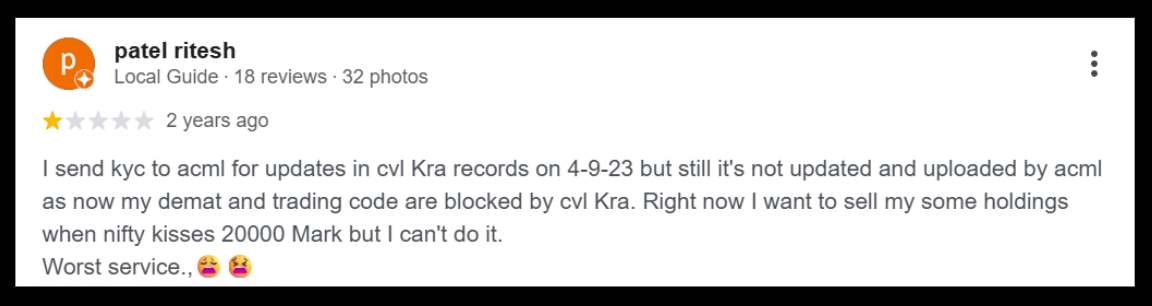
According to the review, the client submitted documents for a KYC update with CVL KRA, the central KYC registry agency that brokers are required to route this through.
The update wasn’t completed in time. The result wasn’t a minor inconvenience; it was the client’s entire demat and trading account getting blocked.
What makes this specific case worth flagging above a routine processing delay is the timing.
The account lockout didn’t just sit there as an abstract inconvenience; it prevented the client from executing trades during what the review describes as a genuinely time-sensitive market moment, the kind of window where a few hours or days of delay can mean a real, missed opportunity rather than just annoyance.
And according to the review, there was no clear communication from the broker explaining why the delay was happening or how long it would actually take to resolve.
A login problem costs you a frustrating ten minutes. A KYC-driven account block during a live market moment can cost you the trade itself, which is a meaningfully different scale of consequence.
Locked out of your ACML Capital Markets account, or stuck in a KYC delay with no clear timeline?
Our team will review your documentation, map the right escalation channel for your specific issue, and help you file a complaint built to actually get a response.
How To File a Complaint Against ACML Capital Markets?
Knowing a problem exists is only half the battle; actually getting it resolved means working through the right channels in the right order, and most investors don’t know that sequence until they’re already stuck mid-dispute.
Here’s the actual path, step by step:
Step 1: Document Everything First
Before contacting anyone, gather trade statements, emails, chat records, call logs, and payment proofs.
A clear, time-stamped record is what actually strengthens your position later, not a vague memory of what happened.
Step 2: Contact the Broker Directly
Raise a formal written complaint through email or ACML’s official grievance channel, naming your client ID, the specific transaction or issue, and the resolution you’re actually looking for.
Written communication creates a trail; a phone call doesn’t.
Step 3: Escalate Through SEBI SCORES
If the broker doesn’t resolve your issue within the expected timeline, a SEBI SCORES complaint puts the matter formally on the regulator’s radar, with every supporting document submitted alongside it for the record.
This is the same channel that applies regardless of which broker you’re dealing with, since every SEBI-registered intermediary falls under the same grievance framework.
Once it’s filed, you can track your SEBI complaint status directly, so you’re not left guessing whether anything’s actually moving behind the scenes.
Step 4: Move to SMART ODR
If the issue is still unresolved after SCORES, a SMART ODR portal filing shifts the dispute into mediation or conciliation, where both sides present their case against documented evidence rather than continuing an open-ended back-and-forth.
Given ACML’s own record shows zero disputes reaching arbitration so far, this step is worth using deliberately if you feel your complaint is being quietly stalled rather than genuinely resolved.
Step 5: Pursue Arbitration as the Final Step
If none of the above settles it, arbitration in stock market through NSE or BSE puts an independent arbitrator in charge, reviewing your full submitted record and issuing a decision that’s legally binding either way.
For the full process laid out start to finish, our guide on how to file a complaint against a stock broker walks through every one of these stages in more depth, useful background regardless of which broker you’re actually dealing with.
Conclusion
ACML Capital Markets is a recognised, long-standing brokerage firm with real credentials behind it, and its official complaint record, five years of low volume and near-total resolution, genuinely backs that up on paper.
But the same window shows real users repeatedly running into friction that never escalated into a formal complaint: difficulty logging in, authentication errors, and a KYC delay that cost at least one client a real trading opportunity.
If you encounter any of these specific issues yourself, acting quickly matters more than waiting to see if it resolves on its own.
Keeping proper records from the start, and knowing which complaint channel actually applies to your situation, is what determines whether a frustrating login issue stays a minor inconvenience or becomes something you have to escalate formally.
Being aware, responsive, and proactive is what actually protects your account, not the broker’s clean exchange data alone.
Report. Recover. Stay Fraud Free.
No. Exchange data across five reporting years shows a consistently low complaint volume, a near-complete resolution rate, and zero arbitration cases received or pending in any year. Login failures, password recovery problems, unreliable authentication systems, and delays in KYC processing are the recurring themes across independent user reviews. Yes. One documented review describes exactly this, a delayed KYC update with CVL KRA led to an account being blocked during an active, time-sensitive market moment. Yes. It's been operating since 2000, holds NSE and BSE membership, and functions as a depository participant with both NSDL and CDSL. Document the exact error and timestamp immediately, raise a formal written complaint with the broker's grievance channel, and escalate to SEBI SCORES if it isn't resolved quickly.Frequently Asked Questions




 Add us as a preferred source on Google »