

Quick Summary
Ethical Research is based in Indore and run by Kratika Yadav. The firm holds SEBI Research Analyst registration INH000018179, valid since August 2, 2024.
This page covers the complete registration record. It also covers the exact steps to verify any research analyst’s status yourself.
If you’ve been searching for a SEBI-registered research analyst to guide your stock market decisions,
you may have come across Ethical Research, an Indore-based firm run by Kratika Yadav.
Their website, ethicalresearch.in, positions the firm as a research and advisory resource for retail investors.
Before you sign up or make a payment, it helps to know exactly what the regulatory record says.
Is Ethical Research Company SEBI-Registered?
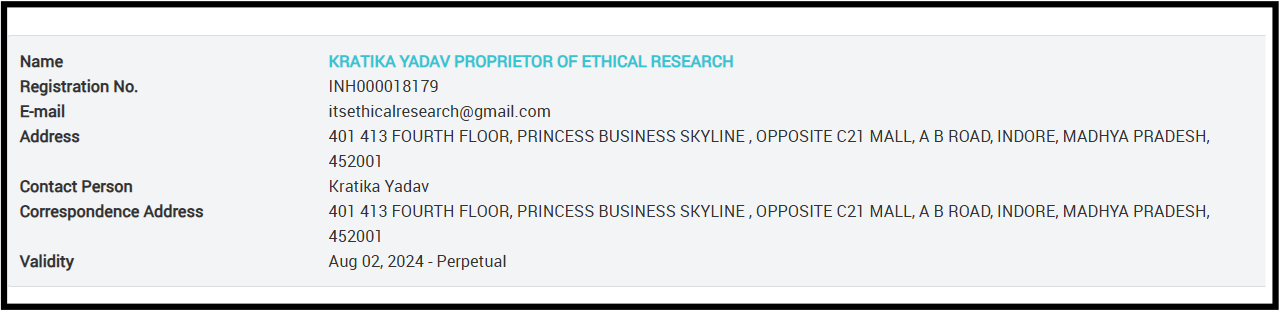
Here’s a factual snapshot of the entity.
| Entity Name | Ethical Research |
| Proprietor | Kratika Yadav |
| SEBI Registration Number | INH000018179 |
| Registration Type | Research Analyst (RA) |
| Registration Validity | August 2, 2024, Perpetual, subject to SEBI compliance |
| Registered Office | 401-413, Fourth Floor, Princess Business Skyline, Opposite C21 Mall, A.B. Road, Indore, Madhya Pradesh 452001 |
| Contact Email | [email protected] |
| Contact Person | Kratika Yadav |
So, if your first checkpoint as an investor is “are they SEBI registered,” Ethical Research Company does clear that bar.
The firm operates as a sole proprietorship, meaning Kratika Yadav is personally responsible for the research and advisory services offered under this registration.
But here’s the important part most people miss.
Being SEBI registered is a starting point, not the final decision-maker.
How Can Investors Verify Ethical Research Indore’s Registration Themselves?
A registration number displayed on a website is easy to type, and just as easy to fabricate. The only way to actually know if it’s real is checking it against SEBI’s own records, not the firm’s own claims about itself.
Verification takes just a couple of minutes, and skipping it is exactly how scams succeed.
Here are three ways to do it, each catching a different kind of problem.
1. Use the Official SEBI Website
Go directly to the SEBI website and check the intermediary database.
Navigate to Intermediaries, then Market Infrastructure Institutions, then Research Analysts.
Check the registration status active, suspended, or cancelled, the registration number, the validity period, and the official contact details.
If the name doesn’t appear, the entity isn’t registered, no matter what it claims.
2. Cross-Verify the Registration Number
Fraudsters often display fake or copied SEBI registration numbers, assuming most investors won’t verify them.
Take the registration number provided by Ethical Research Indore and search for it directly on SEBI’s official database.
Match the entity name, registered address, and official email ID.
If any of these details don’t align, or the number belongs to a completely different entity, that’s a clear red flag.
3. Check SEBI’s List of Registered Intermediaries
SEBI publishes official lists of registered entities.
Download the latest list and search for the company name manually.
This helps when a website or an ad looks convincing but isn’t genuine.
When Should You File a Complaint Against a Research Analyst?
SEBI has set clear guidelines for its registered entities regarding their operation.
A SEBI-registered Research Analyst is legally authorised to provide investment recommendations based on objective analysis.
But registration alone is only a basic compliance requirement, not a guarantee of accuracy, profits, or ethical behaviour.
If your RA violated these rules, or you’ve already paid and have a grievance, here’s how to escalate it step by step.
1. Collect Your Records
Gather every piece of evidence, payment receipts, bank statements, invoices, WhatsApp chats, emails, call recordings, and any agreements shared with you.
Arrange them chronologically.
Strong documentation forms the backbone of any successful complaint.
2. Raise the Issue Directly With Your RA
Before going to SEBI, attempt to resolve the issue directly with the firm in writing.
Keep a record of this communication.
3. File a Complaint in SCORES
If you don’t receive a satisfactory response, file a SCORES SEBI complaint.
Register yourself on the portal, submit your complaint with supporting documents, and clearly describe the issue, including dates and amounts.
SEBI forwards the complaint to the registered entity, which is required to respond.
After filing on SCORES, the intermediary typically has 21 days to respond.
4. Lodge a Complaint in SMART ODR
For further escalation, SEBI’s SMART ODR portal provides a mediation-based approach, often faster and less formal than legal proceedings.
5. Stock Market Arbitration
If the issue remains unresolved, arbitration in share market becomes the final step,
a formal process where an independent authority reviews the case and delivers a binding decision.
Confused about navigating a regulatory complaint on your own?
Our team helps investors at every step. Tell us your situation, and we’ll help you review it and draft a properly documented complaint.
For the complete complaint history, the seven-complaint SCORES trend, and the full service review, check our page: Ethical Research Analyst.
Disclaimer: No SEBI order, adjudication, or arbitration ruling has been issued against Ethical Research or Kratika Yadav as of this writing.
The observations above are based on the firm’s own disclosures, shared for informational purposes only.
Conclusion
Ethical Research is a legitimately SEBI-registered Research Analyst entity, with an active registration granted in August 2024 and perpetual validity.
As of the time of writing, there are no regulatory orders, penalties, or sanctions against the firm, a clean regulatory record by available standards.
Verify the registration yourself, ask for written terms, and demand a transparent performance record before you subscribe.
Report. Recover. Stay Fraud Free.
Frequently Asked Questions
Yes, under registration number INH000018179, active since August 2, 2024, run by proprietor Kratika Yadav.
Search the entity name or registration number directly on SEBI's official intermediary database, and match the name, address, and email against what the firm displays.
No, registration confirms legal permission to operate, not accuracy, profitability, or ethical conduct.
401-413, Fourth Floor, Princess Business Skyline, Opposite C21 Mall, A.B. Road, Indore, Madhya Pradesh 452001.
SEBI's SCORES portal shows the firm's official complaint record directly. As of the latest data, seven complaints were filed in FY 2025-26, all marked resolved.





 Add us as a preferred source on Google »

