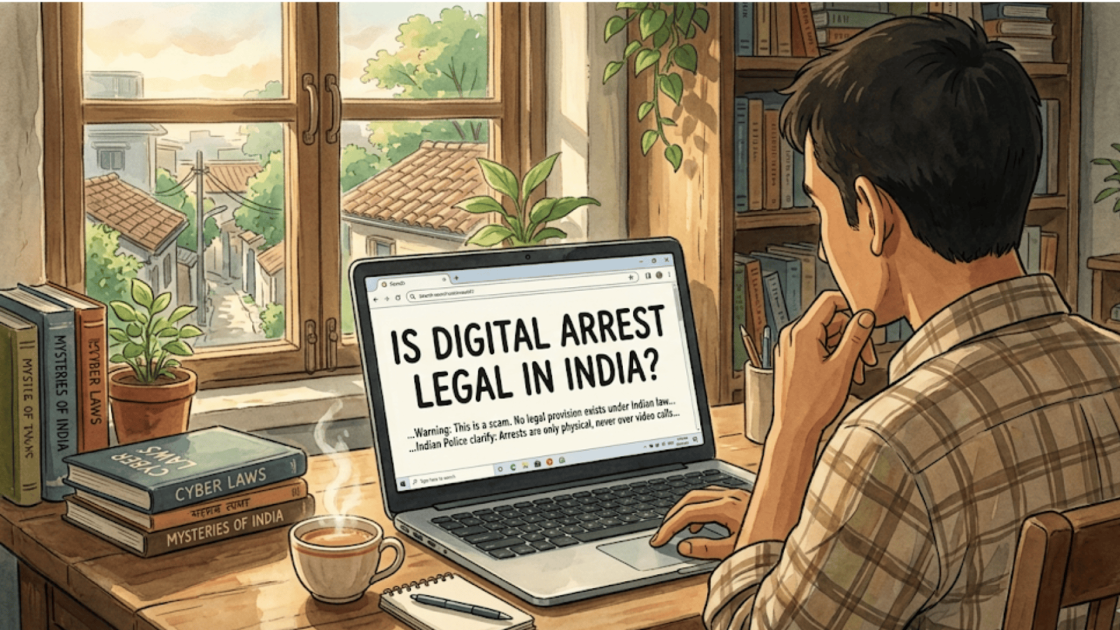
The term digital arrest is a terrifying new trick in the cybercrime world. It is a harmful tactic because it does not just aim for your wallet; it goes for your mental peace.
Scammers use intense psychological pressure to paralyze you.
They want you to believe you are the main suspect in a massive crime. Plus, they make you think you have to act right this second to avoid a jail cell.
Most people follow their orders because, let’s be honest, the situation feels incredibly official and scary.
But here is the thing – digital arrest is a staged performance designed to rob you.
In this blog, we will break down how this scam works, whether it is legal, and exactly what to do if you are targeted.
What Is Digital Arrest?
A digital arrest is a scam where criminals pretend to be police or high-ranking government officials.
They will claim you are involved in something heavy, like money laundering or an illegal parcel. Their goal is simple: Make you panic, so you stop thinking clearly.

It usually starts with a phone call. The person on the other end says they are a police officer from a central agency like the CBI or ED.
To make the act look real, they use a few clever tricks:
- They use formal, scary language to sound like real authorities.
- They send fake official notices and warrants that look surprisingly authentic.
- They will even do video calls from rooms that look just like police stations or courtrooms.
Once you are scared, they try to isolate you. They will tell you not to hang up or talk to anyone else. This is so you do not have a chance to check the facts or call a friend.
Finally, they demand a security deposit or verification fee to clear your name. The moment you pay, they disappear.
Is Digital Arrest Legal?
Digital arrest is completely illegal and does not exist in our legal system. No law in India allows a judge or a cop to arrest you over a WhatsApp call.
If anyone tells you that you are being digitally arrested, you are talking to a scammer. There are zero exceptions to this.
In India, legal arrests follow a very strict set of rules.
A real arrest requires the police to be physically present.
They must show you proper identification, an arrest warrant, and tell you exactly why you are being arrested.
You also have the legal right to call a lawyer or tell your family immediately. No real officer will ever force you to stay on a video call for hours.
Plus, they will not ask for money to settle a case. Legal stuff just does not happen over random video chats.
-
What the Law Says About These Scams?
Even though the arrest is not real, the act of doing this is a major crime.
Fraudsters can be charged with impersonation scam, cheating, and extortion under the Bharatiya Nyay Sanhita (BNS) and the IT Act.
These are serious charges that can lead to years in prison.
The government is cracking down on these gangs, but staying aware is your best defense.
Digital Arrest Scam Real Cases In India
There are numerous digital arrest complaints reported every year. Some of the recent ones include:
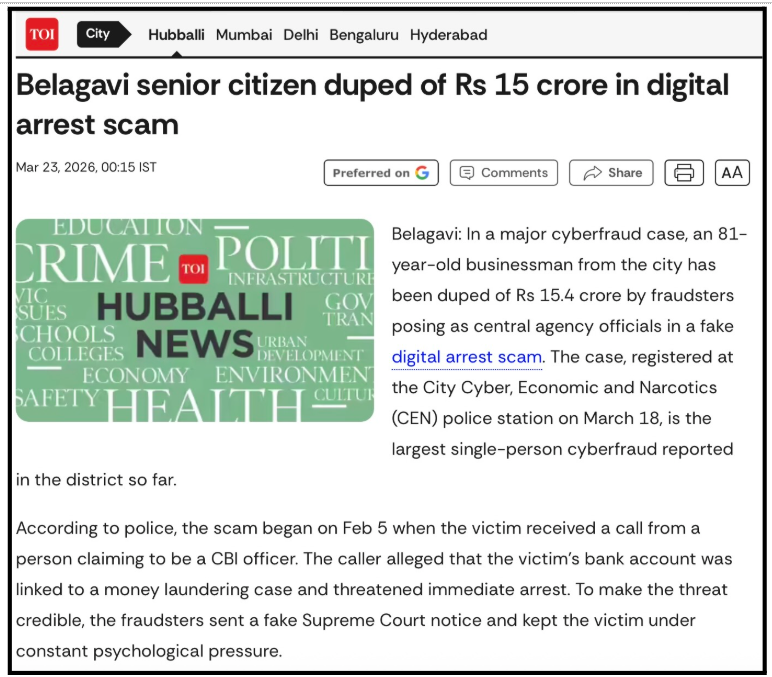
1. The ₹ 15.4 crore Scam with 81-Year-Old Belagavi Businessman
In one of the biggest cases yet, an 81-year-old businessman in Belagavi was cheated of ₹15.4 crore.
The scammers, posing as CBI officers, kept him under digital arrest for six weeks!
They claimed his account was linked to money laundering.
Plus, they forced him to liquidate his long-held stock investments. He was so terrified that he did not even tell his family until his son visited for a holiday.
This shows that the scam is not just a quick call, it can be a long-term psychological trap.
2. The Vizag ATS Scam
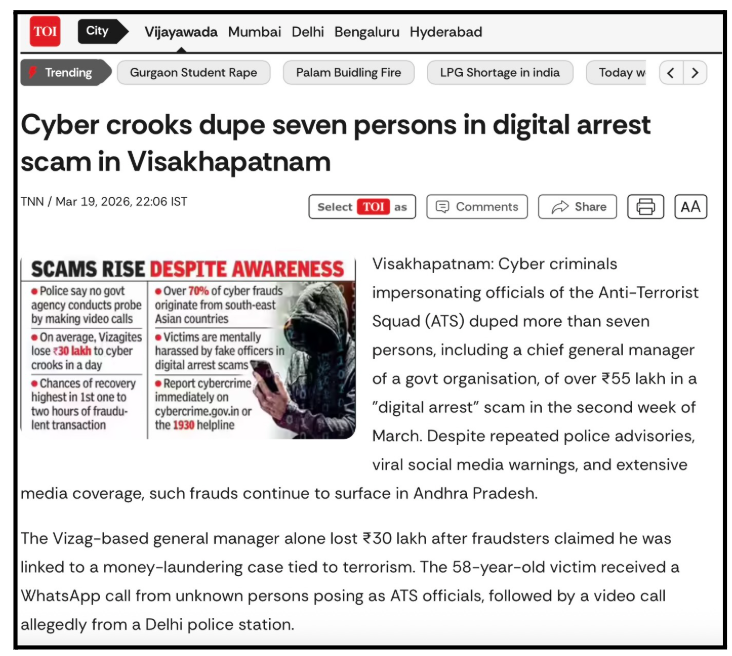
In March 2026, scammers posing as Anti-Terrorist Squad (ATS) officials targeted several people in Visakhapatnam.
One victim, a senior manager at a government firm, lost ₹30 lakh.
The scammers claimed he was linked to a terror-funding case. They forced him to lock himself in a room for a confidential investigation over a video call.
Terrified by the threat of anti-terror laws, he transferred the money before realizing he had been tricked.
Six other people in the same city lost another ₹25 lakh to the same gang.
3. The Noida Woman’s ₹8 Lakh Nightmare
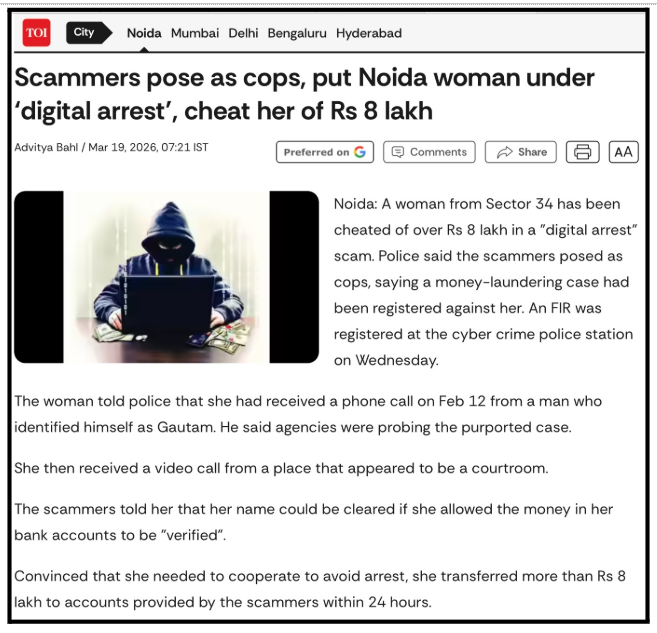
A woman in Noida recently lost ₹8 lakh after scammers pretended to be high-ranking police officials. They accused her of being part of a money-laundering syndicate.
They even showed her a fake courtroom over a video call. The surroundings looked so real, and the officers were so aggressive.
She felt she had no choice but to pay a verification fee to clear her name.
As soon as the transfer was complete, the scammers blocked her and vanished.
This case is a perfect example of how quickly fear can lead to a massive financial loss.
What To Do In Such Cases?
If you have been hit by this, you have to act fast. Quick action is really the only way you might get your money back.
1. Gather Your Evidence First
Before taking any action, gather all the evidence. Take screenshots of the video calls, the WhatsApp chats, and any documents they sent you.
Most importantly, save your bank transaction IDs (UTR numbers) and the exact time of each payment. Having this stuff organized makes it much easier for the police to track the money.
2. Call the Cybercrime Helpline
This is the most critical step. Call the cybercrime helpline the second you realize it is a scam.
If you report it within the first hour or two, the police can often freeze the money in the scammer’s account before they withdraw it.
So, do wait until the next morning; every single minute counts.
3. File Cybercrime Complaint
Go to the national cybercrime portal and file a detailed complaint online. Upload all those screenshots and the evidence you collected.
This creates an official digital record that helps authorities across the country connect your case to other victims.
4. Contact Your Bank Immediately
Call your bank’s fraud department or go to your branch in person right away.
Tell them your account was used for a cybercrime. Banks can try to stop the payment from being settled.
5. File a Physical FIR
An online report is a good start, but a physical FIR at your local police station or Cyber Cell is even stronger.
Explain exactly what happened and get a signed copy of the FIR. You will need this for any legal stuff or bank insurance claims later on.
Need Help?
If you have been targeted, it is natural to feel overwhelmed or even a bit embarrassed. But listen: stop talking to the scammers immediately.
Do not send another rupee, no matter what they say or how they threaten you.
If you are clueless about the next steps, you can check out the details of reporting in our fraud response plan for guidance and support.
These can assist victims by guiding them through every single step of the reporting process.
Our goal is to make sure you have a clear plan, so you do not feel lost while fighting to get your money back.
Conclusion
The concept of a “digital arrest” is a complete fabrication and holds no legal standing in India.
It is a psychological trap built entirely on fear, fabricated urgency, and the impersonation of fake authority.
To protect yourself, it is essential to understand the digital arrest modus operandi, which typically begins with a terrifying phone call claiming your Aadhaar card or phone number has been linked to illegal activities like money laundering or narcotics.
Once the scammers have you on the line, they use video calls, often wearing fake uniforms in front of mock police station backdrops, to “interrogate” you.
This is the core of their strategy: isolating you from family and friends while demanding you stay on camera for hours.
Just remember: no real legal authority in India, whether it’s the CBI, ED, or local police, will ever arrest you over a Skype or WhatsApp call, nor will they ever ask for a “security deposit” to clear your name.