Most people don’t expect their bank account to get involved in a scam.
You use your account for your own needs, so the idea feels distant. It sounds like something that happens to someone else.
But that’s not how it actually works.
In many cases, people step into it without realising what they are doing.
They agree to a simple request, accept an easy offer, or follow instructions that don’t seem risky at the time.
Nothing feels wrong in that moment. Only later do they understand that their account became part of something much bigger.
In this blog, you’ll see real mule account cases in India and how these situations actually play out in real life.
What is a Mule Account?
A mule account is a bank account that someone uses to move money on behalf of another person.
The account holder receives money and transfers it further, often without fully understanding where the money comes from or why it is being moved.
In many cases, someone else controls the transactions. The account holder follows instructions instead of making their own decisions.
At that point, the account stops serving its original purpose. It becomes a channel to move money from one place to another.

This is how most mule account situations begin, not with intention, but with small decisions that don’t seem risky at the time.
Real Mule Account Scam Cases in India
These are not isolated stories.
They show how normal decisions slowly turn into serious problems when a bank account gets used in the wrong way.
Case 1: Renting a Bank Account for Easy Money (Gujarat)
A man agreed to let someone use his bank account in exchange for a small commission.
The work felt simple. He received money, transferred it, and earned a small amount each time. He didn’t question the source because the process looked routine.

The report shows that more than ₹10 lakh passed through his account, while he earned only a small fraction of that amount.
Authorities later linked his account to fraud complaints from different states. The transactions he handled were not isolated. They formed part of a larger chain.
The moment he allowed someone else to use his account, he lost control of what it was being used for.
Case 2: Accounts Used in a Mule Account Racket
In this case, a group actively recruited people to open bank accounts that could later be used for transactions.
They didn’t position it as fraud. They presented it as a simple process where individuals only needed to open accounts and share access.
Many people agreed without fully questioning how their accounts would be used.

The report shows that these accounts became part of a structured mule account racket.
Once the accounts were set up, they were used to receive and transfer money linked to cyber fraud.
The activity didn’t happen randomly. The accounts handled regular transactions and formed a network that allowed money to move across multiple layers.
Authorities later identified the pattern and took action against the people involved in managing and operating these accounts.
This case shows how organised setups collect and use multiple accounts to move money, even when the account holders don’t control the transactions directly.
Case 3: Mule Account Network Linked to Foreign Operators (Punjab)
A group created multiple bank accounts using fake identities.
They structured these accounts in a way that allowed money to move quickly across different layers.
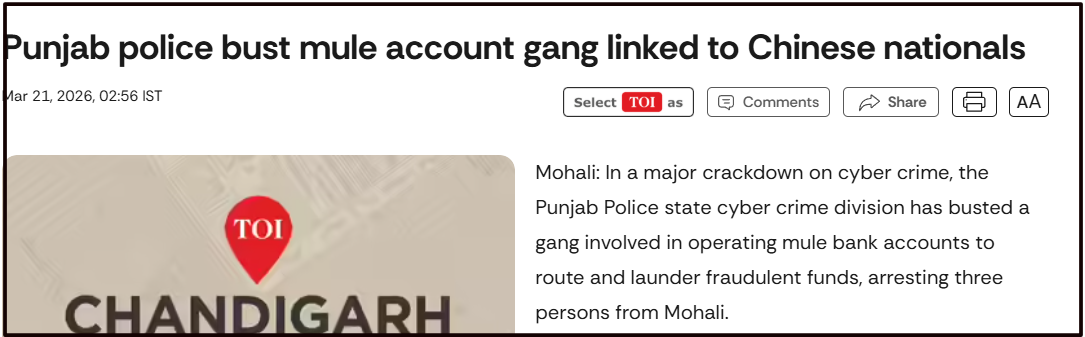
The report reveals that this network connected to foreign operators and handled large volumes of money.
The funds didn’t stay in one place. They moved rapidly and were often converted into crypto.
This was not random activity. It followed a clear system designed to hide the trail. Mule accounts don’t always operate alone.
They often form part of organised networks that extend beyond local boundaries.
Case 4: Small Commissions Leading to Legal Trouble (Kolkata)
Some individuals agreed to let others use their accounts for small commissions.
They didn’t see the risk. They treated it as an easy way to earn extra money without much effort.

The report shows that these accounts became part of multiple fraud transactions.
Authorities traced the flow of money and reached these account holders. Even though they didn’t plan the scam, their accounts played a role in moving the funds.
Handling money for someone else, even for a small amount, can still connect you to the entire transaction chain.
Case 5: Large Mule Account Network Handling Crores
In a major case, a network used multiple bank accounts to move illegal money across different layers.
Each account acted as a step in the process, making it harder to trace the original source.

The report highlights that transactions worth several crores moved through these accounts.
Authorities followed the trail and uncovered a structured system where each account played a specific role.
Some account holders knew their involvement, while others did not fully understand it.
A single account may look small, but it can still become part of a system handling large-scale fraud.
These cases may look different on the surface, but they follow the same pattern.
Someone else controls the flow of money, and the account holder becomes part of the chain without fully understanding it.
In some cases, people agree to it. In others, they don’t even realise what’s happening.
But in both situations, the account still gets used.
That’s what makes mule accounts risky. It doesn’t take a big decision. It often starts with something small that doesn’t feel serious at the time.
And by the time it becomes clear, the account is already involved.
Mule Account Red Flags
When you look at these cases closely, the pattern becomes clear.
The situations may differ, but the warning signs remain the same. They appear early, and they repeat across different cases. If you notice these, you should not ignore them.
1. Easy Money for Using Your Account
In Case 1 and Case 4, people agreed to use their accounts because the offer looked simple.
They didn’t need effort or investment.
They only needed to receive and transfer money. If someone offers money just for using your account, it is not a normal situation.
2. Someone Else Controls Your Transactions
In multiple cases, the account holders didn’t decide the transactions.
They followed instructions and the moment someone else controls when and how money moves in your account, it becomes a risk.
3. You Don’t Know the Source or Purpose of Money
In Case 2 and Case 3, money moved through accounts without clear explanation.
The account holders didn’t know where the money came from or why it was being transferred.
If you cannot explain a transaction clearly, you should not treat it as normal.
4. You Hand Over Access to Your Account
In Case 2, people gave their ATM cards and account details to someone else.
They trusted the process without understanding the consequences. Once you give access, you lose control over how your account is used.
5. Your Account Only Moves Money
In Case 3 and Case 5, accounts acted only as channels.
Money came in and went out quickly without staying. If your account only transfers money and doesn’t serve your own use, it shows a clear pattern.
These red flags don’t appear suddenly.
They show up early, often in simple forms. Recognising them at the right time can prevent the situation from moving further.
How to Detect a Mule Account Early?
These cases show one clear thing. The problem doesn’t appear suddenly. It builds through small actions and repeated patterns.
You can detect it early if you pay attention to how your account actually works.
- Check who makes the decisions: If someone else tells you when to receive or transfer money, your account is not under your control
- Check if every transaction makes sense to you: If you cannot clearly explain why money came in or went out, you should not ignore it
- Look at how money moves in your account: If money comes in and goes out quickly without staying with you, it shows a pattern
- Notice your role in the transaction: If you only receive and transfer money for others, your account is acting as a channel
- Compare it with your normal usage: If your account activity doesn’t match your usual behaviour, something has changed
How To File A Mule Account Complaint in India?
Once you notice these signs or relate your situation to the cases above, don’t wait for complete clarity.
In most cases, delays happen because people feel unsure.
They keep thinking about what might have happened instead of acting on what they already see.
But early action matters.
- Inform your bank immediately: Tell your bank what you have noticed and highlight the transactions that don’t match your understanding. This helps them review and control further activity.
- Report Cybercrime Complaint: Report the issue as soon as possible and clearly explain what you noticed in your account. Mention how the transactions happened, what felt unusual, and when you first identified the issue.
- Provide accurate details in your complaint: Share transaction information, timelines, and any communication so your case is easier to understand.
- Stop all further transactions: Avoid using the account for sending or receiving money until you get clarity. Continuing activity can make the situation harder to manage.
- Keep your records ready: Save your transaction history, messages, and any instructions you received. These details help you explain your situation clearly.
Taking action early helps you stay in control before the situation becomes more complicated.
Need Help?
After seeing these cases and signs, you may still feel unsure about your own situation. You may notice something similar in your account, but you may not know how serious it is or what step to take next.
This is where many people hesitate. They don’t act because they are not fully sure, and that delay can make things harder.
In tis regard, you can check the details of our online fraud response plan which can guide you on how to move forward with clarity.
Conclusion
In recent years, there has been a massive surge in mule account complaints across India, where innocent individuals find their bank accounts frozen because they were unknowingly used to layer “black money” from cyber crimes.
These cases don’t start with something that looks like fraud.
They begin with simple decisions that feel normal at the time, which is why most people don’t question them.
But once a bank account becomes part of that process, it connects to transactions and outcomes that go far beyond what the account holder intended.
The difference comes from noticing these situations early and understanding what doesn’t make sense.
When you stay aware of how your account is being used and question anything that lacks clarity, you give yourself the chance to stop the problem before it grows.