A few months ago, a student agreed to help someone transfer money through his bank account.
He didn’t think much of it. The person promised him a small commission for each transaction.
At first, nothing felt wrong. Money came in, he sent it forward, and he earned a little.
Then one day, his account stopped working. The bank froze it and few days later, he got a call related to a fraud case.
That’s when he realised something, that the money he moved didn’t belong to the person who sent it.
This is how a mule account works.
People don’t plan to get involved in fraud. Most of them think they’re just helping someone or earning easy money.
But once your account becomes part of that chain, things change quickly.
In this blog, you’ll understand what a mule account actually means, how it works, and why this one mistake can create serious problems.
What is a Mule Account?
A mule account is a bank account that someone uses to move illegal money.
Scammers don’t use their own accounts because they know banks can track them. So they look for someone else whose account they can use instead.

That “someone else” becomes the mule.
Sometimes, people agree to it for easy money. Sometimes, they don’t even realise what’s happening.
But in both cases, the account gets used to receive and transfer money that usually comes from fraud.
For example, a scammer cheats someone online and gets ₹50,000. Instead of taking that money directly, he sends it to your account.
Then he asks you to transfer it to another account.
At that moment, your account becomes part of the fraud chain.
And here’s the important part; the bank and the police don’t see intent first. They see your account in the transaction.
That’s why even one transaction can create serious trouble.
Types of Mule Accounts
Not everyone who ends up in a mule account situation gets there the same way.
Some people walk into it without knowing. Some take the risk for quick money. And in some cases, people don’t even realise their account is being used.
Let’s break this down in a simple way.
1. Unknowing Mule
This is the most common situation.
A person thinks they are doing a small job or helping someone with a transaction. They receive money, send it forward, and maybe earn a small commission.
Nothing feels wrong in the beginning. But the problem is simple, they never check where the money is coming from.
And that’s where things go wrong.
2. Knowing Mule
Here, the person understands what’s happening but still goes ahead.
They allow someone to use their account because they want easy money. They know the transactions look suspicious, but they ignore it.
This is not confusion, but a choice. And that choice can lead to serious legal trouble.
3. Compromised Account
Sometimes, the account holder doesn’t even get a choice.
Scammers gain access through fake links, OTP scams, or phishing calls. Once they get control, they use the account to move money without the owner knowing.
Everything looks normal until one day the account gets blocked. That’s when the reality hits.
Why Scammers Use Mule Accounts?
Scammers don’t use mule accounts by chance. They use them because it protects them.
If they use their own account, they get caught quickly.
So they push the risk onto someone else. When money passes through your account, your name shows up first. Not theirs.
They also move money through multiple accounts to break the trail.
By the time anyone tries to trace it, the money has already moved ahead. And that’s the whole idea, to stay hidden while someone else takes the risk.
How To Detect Mule Account?
Most mule account scams follow a simple pattern, even if they don’t look like it at first:
- It starts with a fraud – Someone loses money through a fake job, investment offer, or a convincing scam call.
- The scammer avoids using their own account -They need someone else’s account so their name doesn’t appear anywhere.
- The money enters the mule account -This becomes the first stop after the fraud happens.
- Instructions come immediately – The scammer tells the account holder to transfer or withdraw the money quickly.
- The money keeps moving – The scammer sends the money across multiple accounts to break the trail.
- The scammer stays hidden – The scammer disappears before anyone can trace the fraud back to them.
- The mule account gets caught in the middle – The investigation first targets the mule account when the victim reports the fraud.
Mule Account Risks in India
Most people think helping with one or two transactions won’t cause any harm. But once your account gets linked to a fraud, the situation can change quickly.
1. Your Bank Can Freeze Your Account
Banks monitor transactions closely. If they detect suspicious activity, they freeze your account without prior notice.
You may lose access to your money, even when you need it urgently.
2. Authorities May Contact You
Once someone reports fraud, authorities review your account activity. Your bank or the cybercrime department may contact you and ask about those transactions.
3. Your Account May Link to Multiple Cases
Your account may handle money from multiple sources. In many cases, one mule account connects to several fraud complaints from different places.
4. This Can Affect Your Financial Record
Banks flag your account when they detect suspicious activity.
This can impact your banking history and even affect your credit score, making future financial activities difficult.
5. You May Face Legal Consequences
Even if you didn’t plan the scam, your account still appears in the transaction chain. Authorities may take legal action based on your account’s involvement.
Most people realise the seriousness only after banks block their accounts.
By that time, handling the situation becomes much harder.
Mule Account Red Flags
Most people don’t realise what’s happening until things go wrong.
But if you look closely, the warning signs are usually clear.
- You are offered easy money for using your account: Someone promises quick earnings just for receiving and transferring money. This is one of the most common ways mule accounts start.
- You receive money from unknown sources: Money suddenly comes into your account from people you don’t know. If you can’t explain the source, you should not touch it.
- You are asked to transfer money immediately: You are told to move the money quickly to another account. This urgency is used to avoid detection.
- Someone asks for your bank details or OTP: No genuine job or service needs this level of access. Sharing it gives full control of your account.
- You are added to Telegram or WhatsApp task groups: These groups often start with small tasks and payments, then slowly involve you in money transfers.
- You ignore your own doubt: If something feels off and you still go ahead, you are taking a serious risk.
If even one of these signs applies to you, pause and rethink. One small step here can lead to bigger problems later.
Mule Account Cases in India
These are not just concepts, but real people across India have already faced this situation, and most of them didn’t realise the risk when they started.
Case 1: Renting a Bank Account for Quick Money
A man agreed to let someone use his bank account in exchange for a commission.
The offer looked simple. He only needed to receive money and transfer it further. He didn’t question the process because it didn’t look risky at that time.

The report shows that more than ₹10 lakh moved through his account, while he earned only a small amount in return.
Authorities later linked his account to fraud complaints across multiple states.
The transactions he handled were not isolated. His account became part of a wider chain where money moved through different accounts.
Once he allowed access to his account, he lost control over how it was being used.
Case 2: Mule Account Network Linked to Foreign Operators
A group created multiple bank accounts using fake documents and identities. They used these accounts to receive money and move it quickly across different accounts.
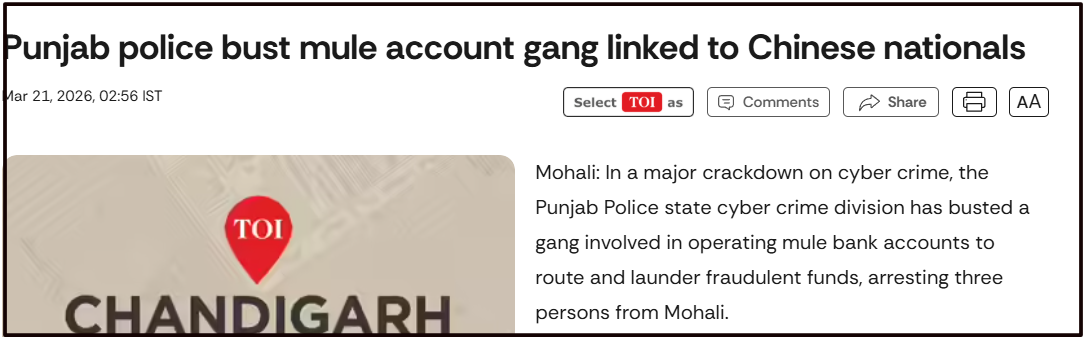
The report reveals that this network was linked to foreign operators and handled large volumes of money. The funds moved rapidly and were often converted into cryptocurrency to avoid tracking.
This was not random activity. It followed a structured system designed to break the transaction trail.
Mule accounts often operate as part of larger networks, where each account plays a role in moving money across the system.
Case 3: Accounts Used in a Mule Account Racket
In this case, a group recruited people to open bank accounts for handling transactions.
They presented the process as simple and asked people to share access after opening the accounts. Many people agreed without fully understanding how others would use their accounts.

The report highlights that these accounts were later used in a structured mule account racket. Money moved regularly through these accounts as part of cyber fraud activity.
The accounts did not operate independently. They worked together as part of a system that allowed money to move across multiple layers.
This shows how organised groups collect and use multiple accounts to move money without keeping it in one place.
How To File A Mule Account Complaint?
If you think your bank account has been used in a mule account setup, don’t ignore it.
Most people hesitate here. They feel confused.
They hope it’s a small issue that will go away on its own. But, once your account gets linked to a fraud transaction, things can escalate quickly.
The sooner you act, the better your chances of limiting the damage.
Here’s what you should do.
- Inform your bank immediately: Contact your bank as soon as you notice any suspicious activity. Clearly explain what happened and point out the transactions you don’t recognise.
- Call the cyber crime helpline: Report the issue without delay. Quick reporting can sometimes help in stopping or tracing the money.
- File Cybercrime Complaint: Submit complete details, including your account information, transaction history, and any messages or screenshots related to the case.
- Keep all records and proofs safe: Save everything; messages, emails, transaction alerts. These details can support your case during investigation.
- Stop using the account for further transactions: Avoid any activity in the account until the issue is resolved. Even a small transaction can create more complications.
Taking these steps can help you respond quickly, but the situation can still feel overwhelming.
You may not know what happens next or how the process actually works after you file a complaint.
That’s completely normal. If you need clarity or guidance on how to handle this properly, the next section will help you understand what to do next.
Need Help?
If you think your bank account has been used in a mule account setup, don’t ignore it.
Most people hesitate here because they feel confused or embarrassed.
They often hope it’s a small technical glitch that will resolve itself over time.
However, the reality is much more serious; once your account is flagged in a series of mule account complaints filed by victims of cybercrime, the authorities and banks move swiftly to freeze your assets and investigate your involvement.
If you are still confuse about theprocess, you can check out our cyber fraud response plan to get more clarity on the process and next steps.
Conclusion
A mule account never looks risky in the beginning. It usually starts with something small. A simple request. An easy way to earn money. Nothing feels serious at that point.
But once your account becomes part of that chain, things change quickly.
Your account can get frozen. You may face questions you weren’t prepared for. And fixing the situation is never as easy as the first step looked.
That’s why it’s important to stay alert. If you don’t know where the money is coming from, don’t let it pass through your account.
One small decision here can save you from a much bigger problem later.