
Have you ever dreamed of turning a small investment into a fortune overnight, only to wake up to a nightmare of empty bank accounts and shattered trust?
Ponzi scams promise exactly that: guaranteed high returns with little risk.
In reality, they are nothing more than a dangerous illusion that preys on our hopes and greed.
In India, these schemes have exploded in popularity, leaving millions in financial ruin and raising a chilling question: could you be the next victim without even realizing it?
In this blog, let’s understand what a Ponzi scam is, how it works, some real thrilling cases across India, identification of Ponzi scams, and reporting in case you become a victim.
What is a Ponzi Scam?
A Ponzi scam is a fraudulent investment scheme where scammers promise sky-high returns to lure people in, but they don’t actually invest the money.
Instead, they pay early investors using cash from new victims, creating an illusion of profits until no fresh money comes in and the whole thing collapses.
This is exactly how a Ponzi scam works: money simply rotates from new investors to old ones, with no real profit-generating business behind it. The system survives only as long as fresh funds keep flowing in.
It is named after Charles Ponzi, who ran one of the first Ponzi scams in the 1920s, promising 50% returns in one month. These scams start small with real-looking payouts to build trust.
Have you ever wondered why those early “success stories” vanish when you ask for proof?

The operator pockets most funds for a luxury lives, leaving thousands broke and broken.
Is Ponzi Scheme Legal in India?
The law in India is clear: no legitimate business can promise fixed, risk-free profits indefinitely.
When returns come from new investors rather than actual business earnings, the structure moves from “ambitious investment” to an illegal Ponzi scheme.
Legal status isn’t about how professional the website looks; it’s about where the money actually comes from.
Under the Banning of Unregulated Deposit Schemes Act (2019) and SEBI guidelines, any setup that rotates funds between members without a registered regulatory framework is unlawful.
The Indian authorities prioritise the “movement of money” over marketing promises when deciding if a platform is operating within the law.
Ponzi Scams in India
Ponzi scams have plagued India for years, with victims losing billions.
For instance, cyber frauds, including Ponzi schemes, caused over ₹52,976 crore in losses across six years up to 2025, and investment frauds alone accounted for 77% of financial hits in 2025.
Reports show thousands of cases annually, like around 3,000 Ponzi-related incidents in 2023, affecting lakhs of people nationwide.
States like Maharashtra, Gujarat, Hyderabad, and Assam bear the brunt due to high digital adoption and economic aspirations.
Let us have a look at some of the major Ponzi scams in India that happened in various states, leaving investors empty-handed!
1. Ponzi Scam in Hyderabad
Hyderabad has become a major hotspot for Ponzi scams, where fraudsters use digital platforms to trap investors.
One such case, the Falcon Invoice Discounting scheme, promised returns of up to 22% while falsely claiming links with reputed firms like Amazon.
Investigations revealed it collected over ₹4,000 crore from nearly 7,000 investors, with around ₹792 crore identified by authorities as suspected cheated investor funds before police action in 2025.

Many victims, from traders to salaried professionals, lost their hard-earned savings and later protested for justice.
Another blow was the DB Stock Broking scam, run by Deepankar Barman. It attracted thousands through fake stock tips and high-yield bonds, leading to losses over ₹500 crore in Telangana alone.
Authorities seized luxury assets, but recovery remains a pipe dream for most.
Hyderabad’s IT boom ironically fuels these scams, as scammers use apps and Telegram groups to target young professionals asking, “Is this the fast track to financial freedom?”
2. Ponzi Scam in Assam
Ponzi scams in Assam are hit hard by exploiting rural trust and cultural ties, often masked as community investment drives.
The Vishal Phukan scheme stands out, where the promoter promised 300% returns on fixed deposits, scamming over 10,000 people and pocketing ₹2,500 crore before fleeing in 2024.
Although he was arrested, funds vanished into layered bank accounts and crypto wallets.
Families sold land and jewelry to invest, only to face despair when payouts stopped.
Rose Valley scam defrauded lakhs across Northeast India with promises of tourism and real estate profits, causing ₹15,000 crore in losses. SEBI bans and CBI raids exposed the scam.
Assam’s border proximity aids money laundering, turning what seemed like safe “local schemes” into statewide catastrophes.
Why do they persist here?
Assam has high unemployment and low financial literacy, that make desperate folks wonder, “Could this be my big break?”
3. Ponzi Scam in Maharashtra
Maharashtra, India’s financial powerhouse, ironically hosts some of the largest Ponzi scams in India, blending Mumbai’s glamour with widespread rural outreach.
The Saradha chit fund collapse in the early 2010s wiped out 1.7 million depositors for over ₹30,000 crore, promising steady returns via travel packages. Political links delayed justice, leaving victims protesting for years.
More recently, the ₹1,000 crore Money Matters scam targeted middle-class savers with fake mutual fund schemes.
Pune and Nagpur have seen surges in crypto Ponzi outfits like GainBitcoin, which duped 10,000+ investors for ₹2,000 crore by touting “OneCoin” as the next Bitcoin.
Maharashtra’s dense population and banking hubs make it a scammer’s paradise, with losses hitting thousands of families annually.
Ever thought, “If it’s registered in Mumbai, it must be legit?” That’s the hook that keeps the cycle spinning.
4. Ponzi Scam in Gujarat
Gujarat’s entrepreneurial spirit has been hijacked by audacious Ponzi scams in India, especially those targeting vulnerable communities.
The 2025 Bhupendrasinh Zala fraud stole ₹6,000 crore meant for tribal student scholarships, rerouting it into an MLM pyramid.
A 30-year-old mastermind bought 17 properties and luxury cars before arrest, affecting thousands in tribal belts.
Earlier, the Diamond Trade scam by Jatin Sparsh defrauded 15,000 investors of ₹2,200 crore via fake jewellery trading apps, promising 10% monthly yields.
IL&FS and other deposit schemes added billions more in losses.
Gujarat tops charts with high scam density due to strong community networks.
Wondering why these hotspots?
It often starts small in ambitious regions, spreading via social media and word-of-mouth before exploding.
Some Other Ponzi Scam Cases
Here are three recent, heart-wrenching cases that expose the human cost behind the numbers.
1. Rs 5 Crore Vanishes
Brothers posing as directors of IIT Capital Technologies and AV Solutions ran conferences promising 7% monthly returns via an unbeatable AI stock tool.

It all started with small deposits that showed fake profits.
A 45-year-old victim invested Rs 20 lakh from May 2023 to July 2025, but when he sought withdrawal, they shut down websites, deleted chats, and threatened him after splurging on luxuries.
Over Rs 5 crore was lost across investors, with the Economic Offences Wing now probing.
2. Rs 850 Crore Heist
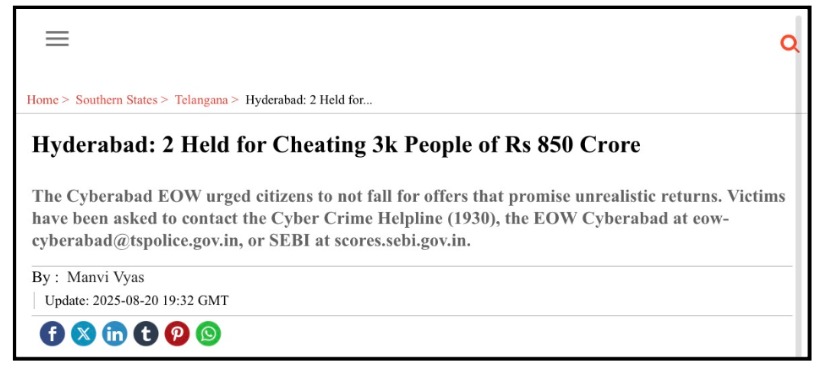
Capital Protection Force Private Limited’s Falcon Invoice Discounting scheme promised 11-22% returns on 45-180 day deposits since 2021.
They used flashy ads and initial payouts to build trust.
It duped over 3,000 people nationwide, including many from Hyderabad, for Rs 850 crore before collapsing when new funds dried up, leaving families homeless and desperate.
Hyderabad police arrested two key men, but recovery remains a distant hope.
3. Rs 114 Crore Tech Fraud
Metalloids Technologies lured investors with astronomical returns on tech investments via unregistered schemes.
They collected Rs 114.52 crore before the bubble burst.
Hundreds of victims, from salaried workers to retirees, were left penniless, sparking outrage and an Enforcement Directorate PMLA case that revealed the scam’s tech facade hid pure fraud.
How to Identify a Ponzi Scam?
Spotting a Ponzi scam early can save your wallet and peace of mind.
Here are key red flags to watch:
- Guaranteed high returns with no risk: Legit investments like stocks or mutual funds always fluctuate. Ponzi promises like 20-50% fixed gains scream fraud, as no ethical scheme beats inflation that effortlessly.
- Unclear business model: If they dodge questions on how money multiplies, and vague “trading algorithms” or “secret deals.” If you suspect any, it is better to run because real firms share audited reports.
- Referral bonuses and pyramid vibes: Heavy emphasis on recruiting friends for commissions? That’s MLM disguised as Ponzi, unsustainable without endless new victims.
- Fake testimonials and urgency: Glowing reviews from unknowns, plus “limited spots” deadlines, create FOMO; always verify via SEBI or RBI sites.
- Unregistered entities: Check if they’re SEBI-approved or not. If it is an offshore app and flaunts its offshore regulatory status, then check for the concerned authority’s official statements.
- Inconsistent payouts: People often get initial investments so that they can build trust. Soon after, they start giving you excuses if you try to withdraw your money.
Question every “sure thing” you hear at family gatherings or WhatsApp forwards.
How to Report a Ponzi Scam?
If you suspect a Ponzi scam or have fallen victim, acting fast not only helps recover funds but stops scammers from ruining more lives. India has clear channels to report and fight back, starting with solid proof.
Follow these steps to report effectively:
- Collect Evidence: Gather all proofs like bank statements, transaction receipts, chat screenshots, promises in emails or ads, and victim testimonials to build a strong case.
- File a Cyber Crime complaint Online: Visit the online portal, select “financial fraud,” upload evidence, and get a complaint acknowledgment for tracking.
- Lodge FIR at Local Police: Head to your nearest station or Economic Offences Wing if big money is involved, submit evidence, and demand an FIR under cheating laws.
- Complaint to SEBI or RBI: For investment scams, lodge a complaint with SEBI through its SCORES portal, or report the scheme on the RBI Sachet portal by providing complete scheme details for appropriate regulatory action.
- Escalate to ED if Needed: If crores are involved, alert the Enforcement Directorate via their site for money laundering probes.
Need Help?
We understand that losing your hard-earned money can be extremely frustrating, but don’t worry and fight back for your money.
All you need to do is register your complaint with us.
We will guide you in drafting your complaint properly and reporting it to the right portal, so that the resolution is in your favour.
Conclusion
Ponzi scams in India are more than financial crimes: they steal futures, break families, and erode trust in a digital age where greed masks as opportunity.
From Hyderabad’s tech mirages to Gujarat’s massive heists, these stories remind us that if it sounds too good, it probably is a ticking bomb.
Stay vigilant, educate your loved ones, and report suspicions immediately to turn the tide.
Real wealth comes from patience and knowledge, not shortcuts. By spotting red flags and acting swiftly, you protect not just yourself but your community, too.