Most people don’t question their broker when things are going smoothly. As long as trades are executing and the account looks fine, there’s a sense of trust.
But that trust really gets tested when something goes wrong. Because in trading, even a small issue; like a delay in execution or an unexpected trade, can lead to real financial loss.
That’s where complaints start to matter. 5paisa is a popular discount broker in India. It attracts users with low brokerage and easy access to the market.
But like any platform handling money, it also receives complaints from users. So instead of just asking whether 5paisa is good or bad, it makes more sense to ask:
What are users actually experiencing?
In this blog, we’ll look at the kind of complaints people are raising, what the official exchange data shows, and what you should do if you face a similar issue.
5Paisa Complaints Overview
Let’s get one thing clear first. 5paisa is a SEBI-registered broker, so it works under proper regulations. But users still face issues.
When you go through complaint platforms, forums, and investor discussions, you notice a pattern. The same problems keep showing up again and again.
Some issues stay small. Users raise a ticket, follow up, and move on. But some complaints go deeper. They affect trade execution, account activity, or fund access. And when that happens, the impact is real.
Because in trading, the issue is not just what went wrong. The real issue is how the broker handles it.
Before jumping to conclusions, let’s look at the most common complaints users raise against 5paisa.
Common Complaints Against 5paisa
When you go through user feedback across platforms, a few issues keep coming up repeatedly. These are not one-off cases. Different users report similar experiences.
Here are the most common ones:
1. Unauthorized Trading
Some users report trades appearing in their accounts without placing them.
- Positions show up unexpectedly
- Orders execute without clear confirmation
- Users don’t receive timely alerts
This becomes serious very quickly because it directly impacts your funds.
2. App Glitches During Market Hours
Many complaints point towards technical issues at crucial times.
- App freezes or crashes during trading hours
- Orders fail or get delayed
- Platform lags during high market activity
In a fast-moving market, even a small delay can change the outcome of a trade.
3. Difficulty in Exiting Trades
This is where frustration turns into loss.
- Sell orders don’t execute on time
- Users struggle to square off positions
- Delays lead to unwanted losses
When you can’t exit a trade when you want to, you lose control and that’s risky.
4. Portfolio & Holdings Issues
Some users report inconsistencies in their accounts.
- Holdings don’t reflect correctly
- Delays in portfolio updates
- Confusion in showing profit/loss
Even if temporary, this creates panic, especially for new investors.
5. Customer Support Delays
Support becomes critical when money is involved but this is where users often feel stuck.
- Slow responses
- Generic replies
- Multiple follow-ups for resolution
The issue is not just the problem, it’s how long it takes to fix it.
These complaints don’t mean every user faces them. But the repetition of these issues across different users is something you shouldn’t ignore.
Exchange Complaint Data (NSE)
Instead of relying only on user reviews, let’s look at official exchange data. This gives a clearer picture of how many complaints users actually raise against 5paisa and how the broker handles them.
Here’s the year-wise data:
| Financial Year | Total Clients | No. of Complaints | % of Complaints | Resolved Complaints | % Resolved | Arbitration |
|---|---|---|---|---|---|---|
| 2022–23 | 1,238,401 | 397 | 0.032% | 381 | 95.97% | 6 |
| 2023–24 | 1,238,401 | 412 | 0.033% | 401 | 97.33% | 3 |
| 2024–25 | 1,497,822 | 689 | 0.046% | 689 | 100% | 1 |
| 2025–26 | 1,322,411 | 611 | 0.046% | 556 | 91.00% | 0 |
At first glance, the percentage of complaints may look small. But in absolute numbers, hundreds of users raise issues every year. And when money is involved, even a single unresolved complaint matters.
The real question is not just how many complaints exist, it’s what this data actually tells us.
The complaint percentage seems small, which makes it easy to ignore. But a closer look tells a different story.
The number of complaints increases from 397 in 2022-23 to 689 in 2024-25, and stays high at 611 in 2025-26.
This shows that more users are reporting issues over time. The complaint percentage also rises from 0.032% to 0.046%. It may look small, but it still represents real users facing real problems.
While the client base grows, the jump in complaints feels sharper than the growth alone can explain. This raises a valid question about how smoothly the platform is scaling.
The resolution rate also drops from 100% in 2024-25 to 91% in 2025-26. That dip stands out and suggests that resolution is not always consistent.
Arbitration cases fall to zero, which could mean quicker resolutions or fewer escalations. The data doesn’t confirm which.
Overall, the data shows that complaints are increasing and resolution is not always perfect. And that’s something you shouldn’t ignore.
5paisa Arbitration Case
Complaints don’t always end at customer support or even SEBI.
When a dispute remains unresolved, it moves to arbitration. At this stage, an independent panel reviews the case using trade logs, margin records, and exchange rules.
These cases matter because they show how things actually play out when the issue becomes serious.
Incorrect Margin Display and Large Trading Loss
This case started when the user pledged shares and saw a much higher margin in the app than what was actually available. Based on that, she took a large position.
Later, the system corrected the margin. Once that happened, her account fell below the required limits, and the broker squared off her positions, leading to a significant loss.
The user argued that the incorrect margin display misled her into taking that position. The broker, however, stated that margin updates can change and users are responsible for managing their exposure.
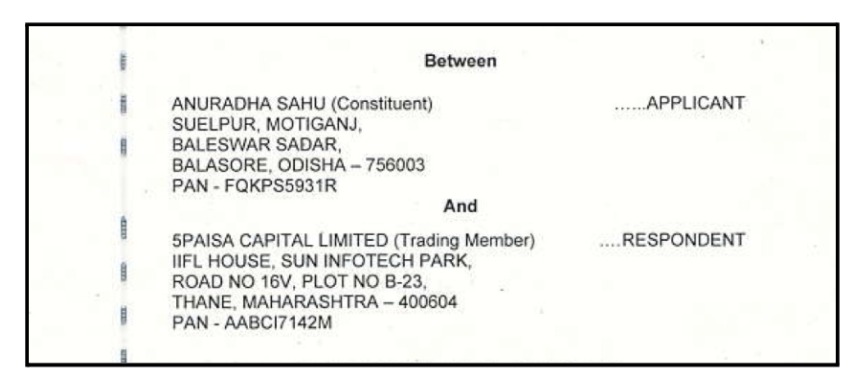
When the case went to arbitration, the panel focused on the sequence of events. It reviewed how much margin was actually available, what the system displayed, and how the positions were taken.
The panel also considered the size of the trade. The user had taken a very large position based on the displayed margin. This became an important factor in the decision.
This is where the case becomes more complex. On one hand, the platform showed incorrect data. On the other hand, the user acted aggressively based on that data.
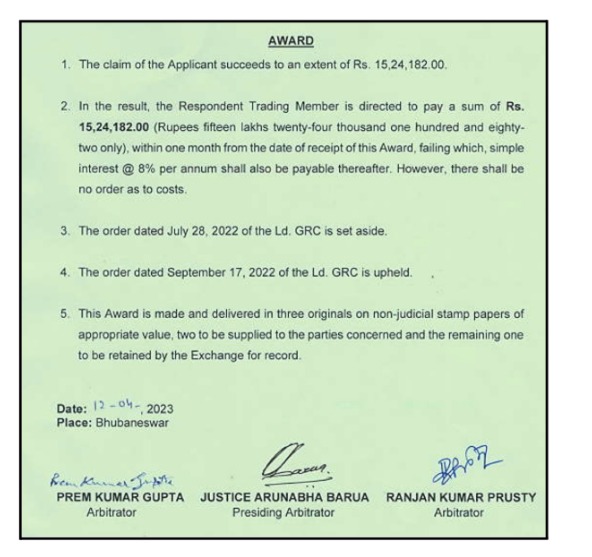
After reviewing all records, the panel did not place full responsibility on one side.
It acknowledged that the platform displayed incorrect margin initially. At the same time, it noted that the user took an unusually large position based on that value.
The panel held both sides responsible to some extent and did not impose a full penalty on the broker.
5 Paisa User Reviews
User reviews add another layer to the story.
They come directly from people who have used the platform. When multiple users raise similar concerns, those patterns become hard to ignore.
Let’s look at a few examples.
1. Delay in Support Resolution
One user shared that they couldn’t use the app because their issue stayed unresolved for over a month. The problem was not just the issue itself, but the fact that support kept the ticket open without closing it despite follow-ups.
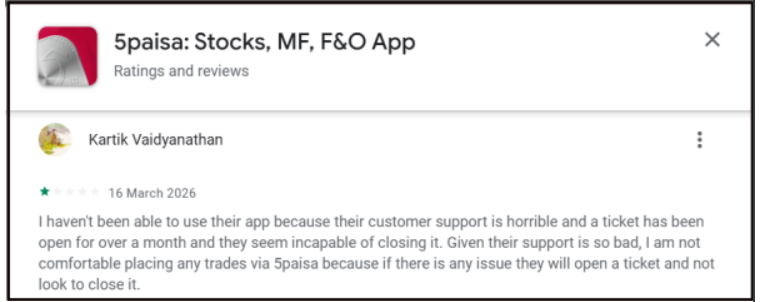
This clearly shows a recurring problem, slow support and lack of resolution. When users don’t get timely help, they lose confidence in the platform.
2. Charges and Account Concerns
Another user complained about hidden charges and unexpected activity in their Demat account. The review also points out poor app performance and features not working properly.
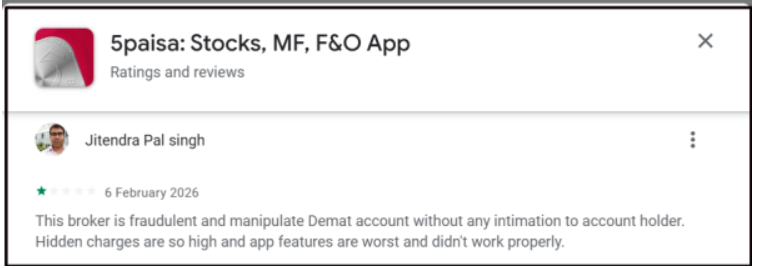
This raises two serious concerns: unclear charges and trust issues related to account handling. When users repeatedly question charges, it creates doubt around transparency.
3. IPO Status Inaccuracy
In this review, the user pointed out that the IPO bid status did not match the actual action taken. This created confusion during a time-sensitive process.
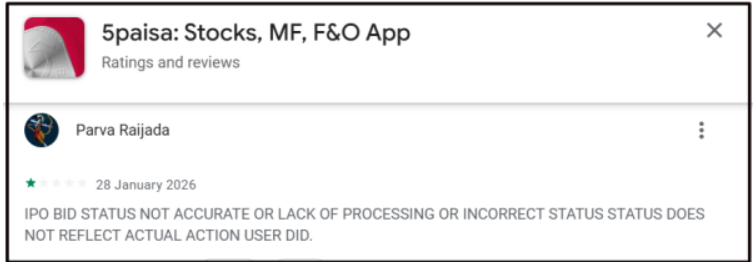
This shows a reliability issue. When the platform displays incorrect or delayed information, users start questioning its accuracy.
A single review doesn’t prove anything.
But when users repeatedly report the same issues, support delays, unclear charges, and system inconsistencies, it signals a pattern. This doesn’t mean every user faces these problems.
But it clearly shows that these issues exist and keep coming up across users.
When To Take Action Against Brokers?
Not every issue needs escalation. Sometimes, a small delay or minor glitch gets resolved with basic support.
But you shouldn’t ignore everything either. You need to step in and take action when the issue starts affecting your control over your trades or money.
Here are situations where you should not wait:
1. Unauthorised Activity in Your Account: If you notice trades or positions that you didn’t place, don’t ignore it. This directly affects your funds and needs immediate attention.
2. Inability to Exit Trades: If your sell order doesn’t execute or you can’t square off a position on time, take it seriously. Delays here can lead to losses.
3. Incorrect Deduction of Funds: If money gets deducted wrongly or you notice unexplained charges, act quickly instead of waiting.
4. Portfolio or Holdings Issues: If your holdings don’t reflect correctly for a long time or your portfolio shows inconsistencies, don’t assume it will fix itself.
5. No Response from Support: If support delays repeatedly, gives generic replies, or stops responding, you should escalate the issue.
These are not small issues. They directly impact your control over trades and funds. If you don’t get a quick resolution, move beyond basic support and take proper action.
How To File a Complaint Against Stock Broker?
If 5paisa doesn’t resolve your issue properly, don’t stop at customer support. You can take the matter to the regulator through SCORES (SEBI Complaints Redress System).
Step 1:Document All Evidence
Start by collecting proof related to the suspected issue. Save contract notes, account statements, trade confirmations, screenshots of transactions, and any communication with the broker.
Keeping detailed records strengthens your case if the dispute needs to be escalated.
If the dispute needs to be escalated, having all proof readily available ensures that your complaint is taken seriously and handled more efficiently.
Step 2: File a Complaint With Your Broker
Before approaching regulators, you must first raise a formal complaint with the broker’s customer support or grievance redressal team.
Explain the issue clearly, attach supporting documents, and request a written response.
Attach all relevant supporting documents, such as contract notes, account statements, screenshots of the issue, or email conversations.
Proper documentation helps the broker understand your concern quickly and reduces delays in resolution.
Step 3: File a Complaint in SCORES
If your issue doesn’t get resolved, go to the SCORES platform and create your account. Once you log in, choose the correct complaint category related to your broker.
Step 4: Escalate if Required
If you are not satisfied with the response, you can escalate the complaint through arbitration in the stock exchange.
The key is simple: if the issue is serious, don’t stay stuck at basic support. Use the proper channel and push for a resolution.
Need Help?
Dealing with a broker issue while your money is stuck can get stressful quickly.
Most people struggle to understand what went wrong or how to file a strong complaint. And delays only make things worse.
We can help you review your case, identify issues, and guide you through the right complaint and escalation process.
Register with us, and take action before the problem grows.
Conclusion
5 Paisa sits in a grey zone for many investors. On one side, it is a SEBI‑registered discount broker with low brokerage, a full grievance redressal structure, and approval to run newer offerings like an online bond platform.
On the other hand, there are serious concerns for which SEBI has already penalised it.
Several users have publicly complained about 5Paisa unauthorised trading, glitches, difficulty exiting trades, missing holdings, poor customer support.
Additionally, many have highlighted recurring 5Paisa not working issues during critical trading hours.
For a common investor, this simply means 5 paisa cannot be treated as a “blind trust” platform.
It may work for basic, low‑frequency investing if you are careful, but it looks risky for heavy intraday trading or for parking large, long‑term holdings when so many issues are tied to execution and service.
So the point is not to label it as good or bad. The real point is awareness. If you use 5paisa, stay alert. Track your trades, check your account regularly, and don’t ignore anything that feels off.
Because in trading, small issues don’t stay small for long. And the faster you act, the better you protect your money.