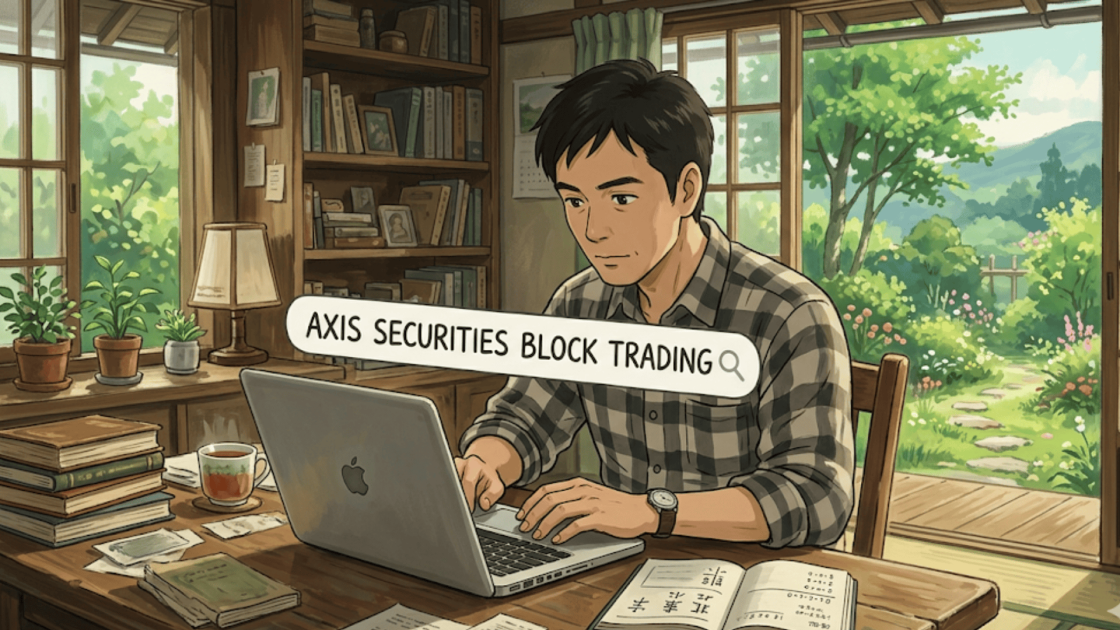
You might have seen this recently. A WhatsApp message pops up. Someone adds you to a group claiming to be from Axis Securities.
They talk about “block trading opportunities” and show profits that look very real.
At first, it feels convincing. People in the group keep sharing screenshots of successful trades. Some even claim they made money in just a few days. So naturally, you start thinking, maybe this is genuine.
But this is exactly where things go wrong.
Across India, people have already lost lakhs of rupees in similar setups. Scammers use trusted names like Axis Securities to build confidence.
Then they push you to install apps, transfer money, and invest in so-called exclusive deals. Everything looks professional. Nothing feels suspicious, until you try to withdraw.
In this blog, we will break it down step by step. You’ll see real cases, understand how this scam actually works, and learn how to spot the warning signs before it’s too late.

What is the Axis Securities Block Trading Scam?
Axis Securities Block Trading is not a separate special scheme or investment product; it usually refers to block deals (large share transactions) executed through a broker like Axis Securities.
Recently, many people have started receiving messages about “Axis Securities block trading opportunities.”
These usually come through WhatsApp or Telegram groups. At first, it looks genuine.
The group uses the name of Axis Securities. People introduce themselves as advisors or analysts.
They talk about special block trading deals and claim that only selected members can participate.
So naturally, it builds trust. But this is not how real investing works.
In these setups, scammers misuse the Axis name to make everything look credible.
They create a professional environment, share trade discussions, and slowly push users towards investing money. Here’s the key problem.
The money does not go into a proper demat or trading account. Instead, they ask you to transfer it to bank accounts they control.
That’s where the actual fraud starts.
In reality, Axis Securities does not offer any block trading access through WhatsApp groups or private messages.
So if you come across such offers, don’t assume it’s a rare opportunity. It’s most likely an impersonation scam.
Real Case Studies of Axis Securities Impersonation Scam
These scams are not just theories. Real people have already lost significant amounts of money after trusting such “block trading” offers.
Let’s look at a few actual cases.
1. Ghaziabad Man Loses ₹9 Lakh via Fake Axis WhatsApp Group
It usually starts with something very simple.
A man from Ghaziabad came across an online advertisement related to stock market investment. Soon after, he was added to a WhatsApp group that appeared to be associated with Axis Securities. At first, nothing seemed unusual.
The group looked active. Members shared profit screenshots regularly. Trades were discussed in detail. Everything was designed to make the setup feel real and trustworthy.

This is not just a random claim. The case was reported in the news, which shows how organized these scams have become. But the most important detail comes next.
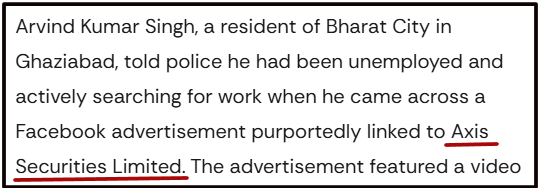
As clearly mentioned, the fraudsters used the name of Axis Securities to gain trust. This is where most victims get convinced, because the brand name makes everything look credible.
After building that trust, they pushed him to invest. Instead of directing him to a proper demat or official trading platform, they asked him to use a platform suggested within the group and transfer money.
Over time, he ended up investing around ₹9 lakh. Then the real problem started.
When he tried to withdraw his funds, the platform showed errors. Soon after, he was asked to pay additional charges. Every step created a new condition, making it harder to get his money back.
In the end, access stopped completely, and the entire amount was lost.
2. Hyderabad Teacher Duped of ₹69 Lakh in Investment Scam
In another case, a teacher from Hyderabad got pulled into a similar setup. She was added to a group where investment opportunities were being discussed using the name of Axis Securities.
At first, everything looked structured.
The group shared regular updates about trades. Profits were shown consistently. Conversations felt professional, and guidance was given at every step. Naturally, it started to build confidence.
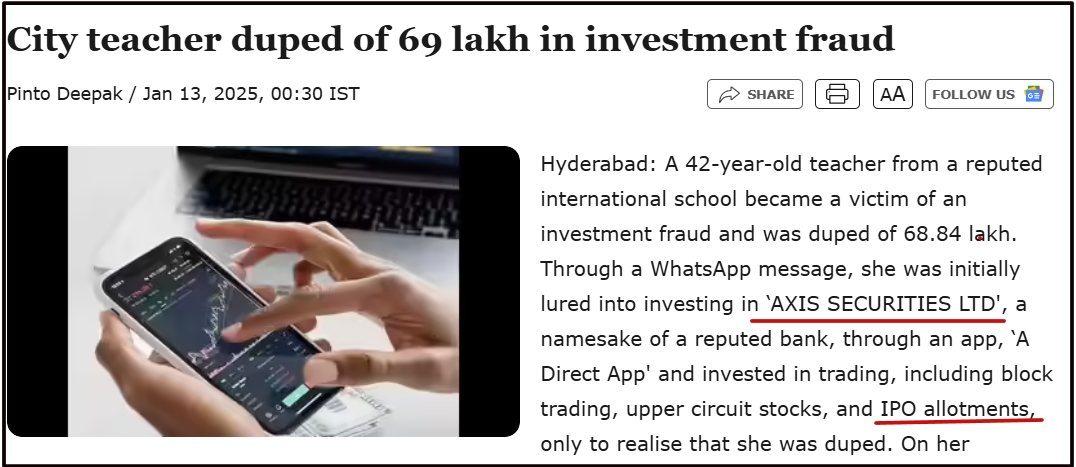
This case was also reported in the news, which shows that these scams are not isolated incidents. Similar patterns are being seen across different cities. After a few days, she decided to invest.
She was asked to use a trading platform suggested by the group. The interface looked genuine, and her account started showing profits. This made the setup feel even more real. Then things started to change.
When she tried to withdraw her earnings, she was told to pay additional charges. First, it was taxes. Then processing fees. After that, more payments were demanded under different reasons.
Each time, she was assured that withdrawal would happen next, which never did.
Over time, she ended up losing around ₹69 lakh. The platform stopped responding, and all communication eventually broke down.
3. 63-Year-Old Victim Loses ₹43 Lakh in Axis Impersonation Fraud
In another reported case, a 63-year-old individual was targeted by fraudsters posing as officials from Axis Securities. This time, the approach was more direct.
The scammers contacted him and introduced themselves as professionals associated with Axis. They spoke confidently, shared investment ideas, and created a setup that looked organised and reliable.
At first, there was no reason to doubt it. The conversations felt genuine. The guidance seemed structured. Everything pointed towards a legitimate investment opportunity.
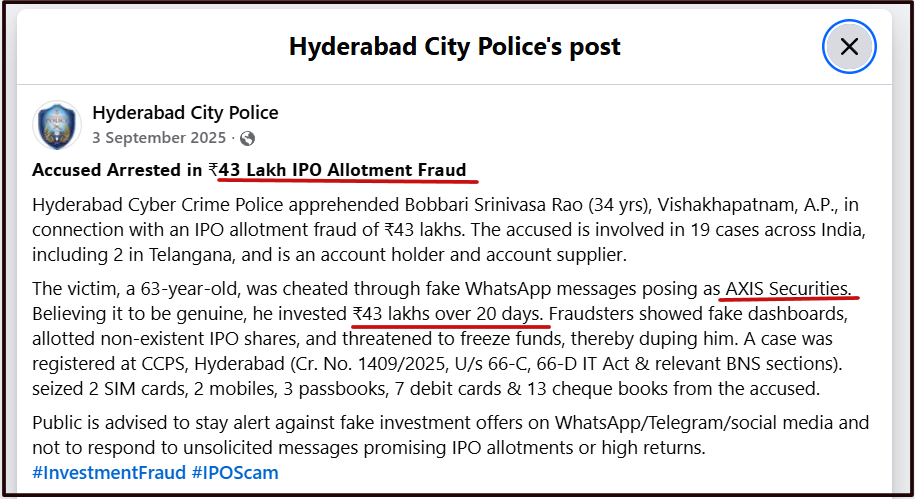
This case was also highlighted by authorities, which confirms that such impersonation scams are actively being tracked and reported. After gaining his trust, they encouraged him to invest.
Just like the other cases, the process appeared smooth in the beginning. Profits were shown on the platform, which made the investment look successful. Then the situation changed.
When he tried to withdraw his money, new conditions started appearing. He was asked to pay additional charges. Despite following instructions, the withdrawal never happened.
Eventually, all communication stopped and he ended up losing around ₹43 lakh.
When you look at real cases like these, it’s easy to understand why investors start questioning whether block trading is truly safe before believing high-return promises.
How Block Trading Scams Work?
These scams follow a structured pattern, and understanding each step helps you identify them early.
Let’s break down how scammers gradually pull people into this trap.
Step 1: Initial Contact Through Social Media
Scammers usually contact you through WhatsApp, Telegram, or social media advertisements. They either add you to a group or redirect you through investment-related ads.
At this stage, everything appears normal and does not raise any immediate suspicion. No genuine broker or investment platform approaches investors through random WhatsApp groups or unsolicited messages.
Step 2: Trust Building With Fake Profits
After joining, you start seeing regular messages about successful trades and profits. Group members actively share screenshots and claim they earned money recently.
This repeated activity slowly builds trust and makes the setup look genuine. Scammers control these messages and screenshots, and most group participants are part of the same fraudulent setup.
Step 3: Fake Trading Platform or App
After gaining your trust, they introduce a trading app or website. The platform looks professional and often resembles real investment applications.
This similarity makes it difficult for users to identify that it is fake. The platform is completely controlled by scammers, and the displayed profits are only manipulated numbers.
Step 4: Asking for Investment
Once you feel confident, they encourage you to start investing money. Instead of using a proper trading account, they ask for direct bank transfers or UPI payments.
They present this process as a standard step to begin trading. In legitimate investing, money always goes into your own demat or broker account, not someone else’s bank account.
Step 5: Withdrawal Trap
Initially, the platform shows profits, which motivates you to withdraw your money. At this point, they introduce conditions like taxes, processing fees, or account upgrades.
Each payment leads to new demands, delaying the withdrawal further. No genuine investment platform requires additional payments just to allow withdrawal of your own funds.
Step 6: Disappearance
After collecting enough money, scammers stop responding and shut down their operations. The app stops working, and the group becomes inactive or completely disappears.
By this time, recovering the lost money becomes extremely difficult. Scammers exit once they maximise their gains and immediately move on to target new victims.
This approach builds gradually, which is why many people fail to recognise the scam in its early stages.
How to Identify a Block Trading Scam?
These scams often look convincing at first, but certain warning signs can help you identify them early if you pay close attention.
- Scammers promise fixed or guaranteed returns within a short period, making the opportunity look safe and highly profitable.
Reality: No one can guarantee profits in the stock market, and such claims clearly indicate a scam. - They present the opportunity as exclusive and available only to selected members, while creating urgency to push quick decisions.
Reality: Genuine investments are never offered through private groups with limited-time pressure or restricted access. - They ask you to download a trading app through a link instead of using official app stores.
Reality: Legitimate financial platforms are always available on trusted app stores and never require APK downloads from unknown sources. - They request you to transfer money directly to personal bank accounts or UPI IDs instead of a proper trading account.
Reality: In real investing, funds go into your own demat or broker account, not someone else’s account. - They show consistent profits on the platform but create obstacles when you try to withdraw your money.
Reality: Fake platforms display profits to build trust, but they never allow actual withdrawals. - They introduce themselves as advisors or experts and guide you throughout the process with confidence and authority.
Reality: Scammers use fake identities and scripted communication to appear professional and trustworthy.
These signs may appear gradually, but identifying even a few of them early can help you avoid serious financial loss.
How to Report Trading Scams in India?
If you realise that you may have been targeted or have already transferred money, follow these steps carefully to act quickly and limit further damage.
1. Stop All Further Payments
Stop sending any more money immediately and avoid engaging with the scammers once you recognise suspicious activity.
Even a small additional payment can increase your losses and make recovery harder.
2. Inform Your Bank Immediately
Contact your bank as soon as possible and request them to freeze or flag the transaction if it is still in process.
Acting quickly improves the chances of blocking or reversing the fraudulent transfer.
3. File Cybercrime Complaint
File a complaint with complete details of the incident, including how the scam started and how the money was transferred.
You can report the case through the national cyber crime portal or by calling 1930.
4. Collect and Preserve Evidence
Save all important evidence such as chat screenshots, transaction receipts, app details, and contact numbers used by the scammers.
Organised evidence strengthens your case and helps authorities track the culprits faster.
5. Do Not Delete Anything
Avoid deleting messages, apps, or any related data, as this information can help during investigation and verification.
Maintaining original records ensures nothing critical is lost during the investigation process.
Taking timely action is important, because delays can reduce the chances of recovering your money and tracing the fraudsters.
Need Help?
If you have come across a similar investment opportunity or feel something is not right, do not ignore it.
We understand how these scams work and can guide you on what steps to take next. The sooner you take action, the better your chances of preventing further loss.
Many people wait too long, hoping things will improve, but that only makes the situation worse.
If you suspect you are being targeted or have already committed funds, check out the steps in our online fraud response plan for detailed insights.
You can get more clarity on the next steps.
Conclusion
These cases show that the Axis Securities block trading scam is not isolated.
In fact, such incidents are part of a growing trend of Block trading scams in India, where fraudsters exploit trusted brand names to mislead investors.
At first, everything looks real. Profits appear, conversations feel genuine, and the process seems smooth. But the entire setup is designed to gain trust and take money.
The key mistake people make is trusting the brand name without verifying the source.
So if someone contacts you through WhatsApp or Telegram and promises easy profits, treat it as a warning.
Staying aware and asking the right questions can help you avoid serious financial loss.