

Quick Summary
Choice Broking complaints have grown from 98 in 2023-24 to 168 in 2025-26, with unauthorised trading climbing to 45.66% of all complaints in the most recent year, up from 31.57% four years earlier. One arbitration case, Sapna Bajaj vs Choice Equity Broking, resulted in a ₹33.73 lakh award after the tribunal found the disputed F&O trades were genuinely unauthorised. Real user reviews point to aggressive trade pushing, high brokerage, and pressure to deposit more funds. The Choice FinX app also carries its own pattern of complaints, frequent crashes, missing SIP data, and delayed bid-offer updates near expiry. This blog covers all of it, the full data, the case, four broker reviews, three app-specific reviews, and exactly how to escalate if your own experience matches.
No stock broker operates without complaints. When more people use a platform, more transactions happen, and naturally, some issues come up.
That doesn’t automatically make a broker bad; it reflects scale.
Choice Broking complaints fall into that same space, but one number cuts through the noise fast: nearly half of everything filed against the broker in 2025-26 traces back to unauthorised trading, and one investor’s case over exactly that walked away with a ₹33.73 lakh award.
This blog covers what’s actually happening, the exchange data, the full arbitration case, real user reviews, and the specific pattern behind the Choice FinX app’s reliability complaints, so you know what you’re dealing with before it becomes your problem too.
Choice Broking Complaints Review
Choice Broking operates as a full-service stock broker under the umbrella of Choice International Limited, offering trading and investment services across equities, derivatives, commodities, and mutual funds.
Over the years, it has built a presence among retail investors through a mix of brokerage plans, advisory support, and multiple trading platforms.
As the client base expanded, the volume of daily trades and user interactions grew alongside it, and with that kind of scale, complaints aren’t unusual on their own.
What matters more is the nature of these complaints.
Users have reported issues ranging from platform performance during active market hours to confusion around account activity, unauthorised trading, and unexpected charges.
At times, when relationship managers or dealers are involved, miscommunication can occur, especially if instructions aren’t clearly recorded.
If the issue goes beyond a single disputed trade into how your account is being run day-to-day, that falls under Choice Broking account handling, a separate pattern covering fund management, terminal access, and internal recordkeeping.
The distinction between honest confusion and a genuine violation comes down to evidence, which is exactly what the arbitration case later in this blog turned on.
Choice Broking Exchange Complaint Data
The National Stock Exchange publishes broker-wise complaint data every year, and it gives a much clearer picture than scattered reviews: actual complaints filed, how many got resolved, and how many escalated further.
| Financial Year | Total Clients | Complaints | % of Complaints | Resolved | % Resolved | Arbitration |
|---|---|---|---|---|---|---|
| 2023-24 | 1,84,226 | 98 | 0.053% | 95 | 96.94% | 2 |
| 2024-25 | 2,41,772 | 176 | 0.072% | 176 | 100% | 1 |
| 2025-26 | 2,28,514 | 168 | 0.073% | 153 | 91.07% | 0 |
The complaint ratio stays low across all three years, under 0.1% even at its highest. From a scale perspective, complaints aren’t widespread relative to the client base.
At the same time, the upward drift from 0.053% to 0.073% is worth noting.
It doesn’t signal a red flag on its own, but complaints are rising alongside growth, and as more users join, even minor issues start showing up more often.
The resolution data adds another layer. The broker resolved the majority of complaints each year, even reaching 100% in 2024-25. But the drop to around 91% in the latest year shows the system doesn’t close every issue immediately.
Arbitration numbers stay small too: 2, then 1, then none. Low arbitration doesn’t automatically mean no serious issues; it can also mean users settle earlier or don’t escalate that far.
Read it as a positive sign, but not the only sign.
How Much of Choice Broking’s Complaints Involve Unauthorised Trading?
A total complaint number tells you the scale of the problem. It doesn’t tell you what’s actually driving it.
That’s the gap worth closing here. Two brokers can show the same total, and still be dealing with completely different risks underneath; one might be mostly slow support tickets, the other mostly trades nobody approved.
So before drawing any conclusion from the numbers above, it’s worth breaking out exactly how much of Choice Broking’s complaint volume comes down to this one serious category.
| Year | No. of Complaints | No. for Unauthorised Trading | % of Total |
|---|---|---|---|
| 2021-22 | 57 | 18 | 31.57% |
| 2022-23 | 116 | 50 | 43.10% |
| 2023-24 | 144 | 41 | 28.47% |
| 2024-25 | 267 | 100 | 37.45% |
| 2025-26 | 265 | 121 | 45.66% |
A note on the figures here: this table draws from a different reporting window than the exchange data table above, which is why the totals don’t line up exactly, 144 here versus 98 above for 2023-24, for instance.
Rather than picking one as definitive, the trend matters more than the exact count either way.
Unauthorised trading has consistently made up a substantial share of complaints, and 2025-26’s 45.66% means nearly half of everything filed against the broker involved trades investors say they never approved.
That percentage alone is reason enough to review your own contract notes and trade confirmations regularly, rather than assuming everything in your account reflects what you actually instructed.
The Choice Broking Arbitration Case
Numbers give you the broader picture. A real case shows you exactly how things unfold when a dispute goes beyond a routine complaint.
In Sapna Bajaj vs Choice Equity Broking Pvt. Ltd., the investor escalated to NSE arbitration after getting no resolution at the broker level, a step investors usually take only when they strongly believe something has gone wrong and remains unresolved.
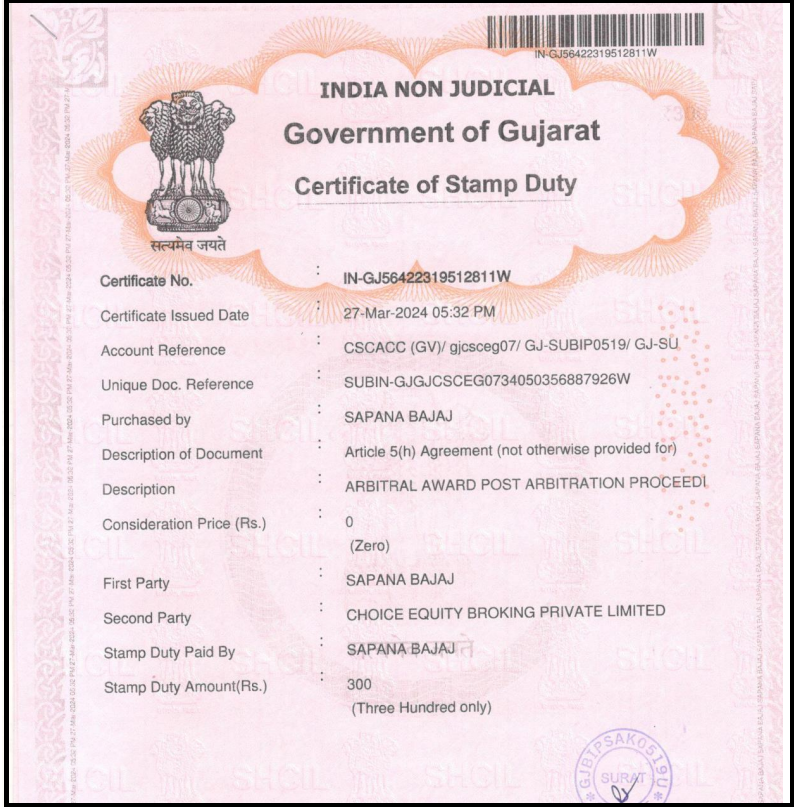
The core issue: the investor alleged the broker executed unauthorised trades in her account, causing significant losses in the F&O segment. In trading, authorisation is everything, and if trades happen without clear consent, that’s a major violation.
Once the case reached arbitration, both sides presented their version. The investor submitted her claim with supporting records.
The broker defended its actions using internal data, trade logs, system records, and account statements.
The dispute was formally registered under NSE’s arbitration mechanism, with a unique reference number tracking it through what became a genuine legal evaluation, not just a complaint sitting in a queue.
The tribunal examined the actual records, checked whether the trades were authorised, verified whether the broker followed proper process, and weighed the investor’s claim against the broker’s defence.
What the tribunal found: The tribunal accepted that the transactions were unauthorised, directly addressing the main allegation.
It verified the losses and accepted the claim amount of ₹33.73 lakh, meaning the panel found the losses were real and specifically linked to the disputed trades.
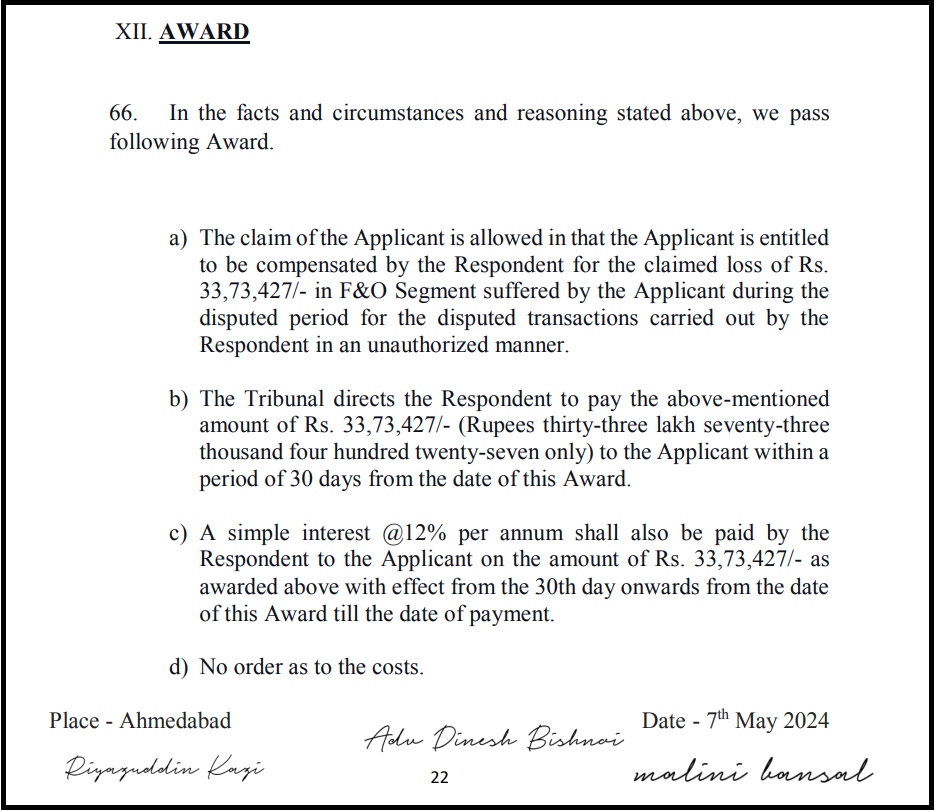
The tribunal directed the broker to pay the full amount within 30 days, and if the broker failed to pay within that window, 12% annual interest would apply until settled, ensuring delay couldn’t work in the broker’s favour.
At the same time, the tribunal did not grant past interest, noting a delay on the investor’s side in initiating arbitration. The panel weighed both sides, not just one.
Choice Broking Reviews
Numbers and arbitration cases give you one side of the picture. User reviews show what people actually experience on the platform.
Reviews can be emotional, and no single one should be treated as absolute truth. But when similar themes repeat, they start indicating patterns worth paying attention to.
1. High Brokerage Charges and Aggressive Trade Pushing
This review reflects frequent trading that led to high brokerage costs, pointing toward frequent trade execution and a real impact on the user’s capital, exactly the pattern that raises concerns about Choice Broking excess charges.
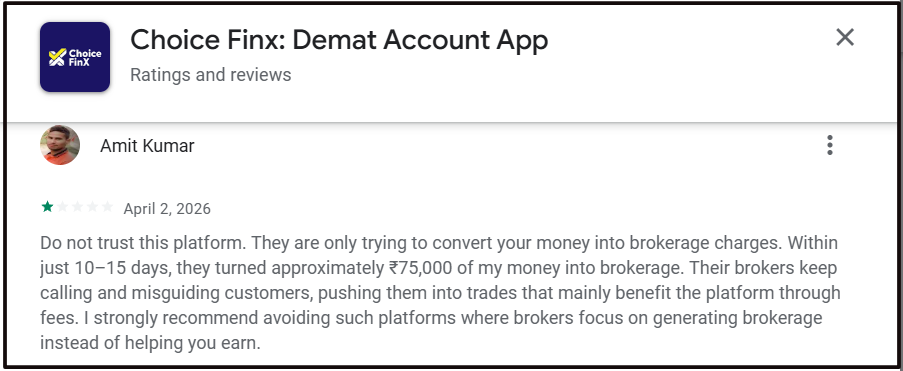
The user’s takeaway was clear: trades were being encouraged in a way that increased brokerage charges significantly within a short time.
In models where brokers or dealers stay actively involved, frequent trading can drive up costs quickly, and without clear control, brokerage can eat into capital faster than expected.
Stay in control of how often you trade, and understand the cost involved in each one.
2. Pressure to Deposit Funds and Take Larger Positions
This review describes pressure and fast-moving communication during onboarding and trading, being pushed to deposit money quickly and move into larger trades without full clarity.
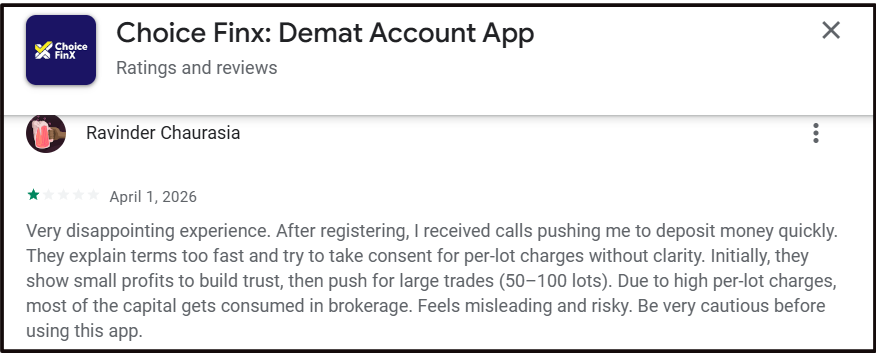
Small profits were shown initially, followed by encouragement to take bigger positions with higher lot sizes, larger trades that directly increase both risk and brokerage.
If terms are explained too quickly or without clarity, pause and verify before proceeding.
3. Concerns Around High Charges and Trust
This review centers on trust and cost structure, the sense that regardless of profit or loss, the platform benefits through higher brokerage charges regardless of the outcome for the client.
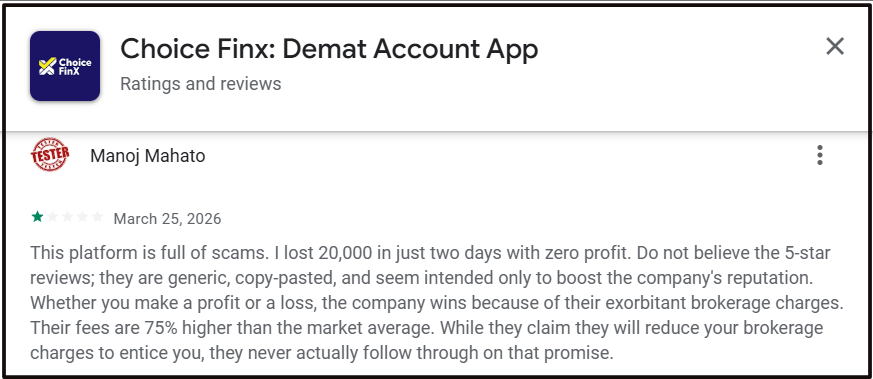
The review also questions the authenticity of positive ratings and mentions promised brokerage reductions that weren’t delivered, pointing toward dissatisfaction with pricing transparency and expectations not matching reality.
Always verify brokerage terms in writing, not verbal assurances.
4. Concerns About Trade Guidance and Losses
This review describes repeated losses while following trade suggestions, and a lack of accountability when trades went wrong, with multiple individuals giving trade calls and shifting responsibility when outcomes turned negative.
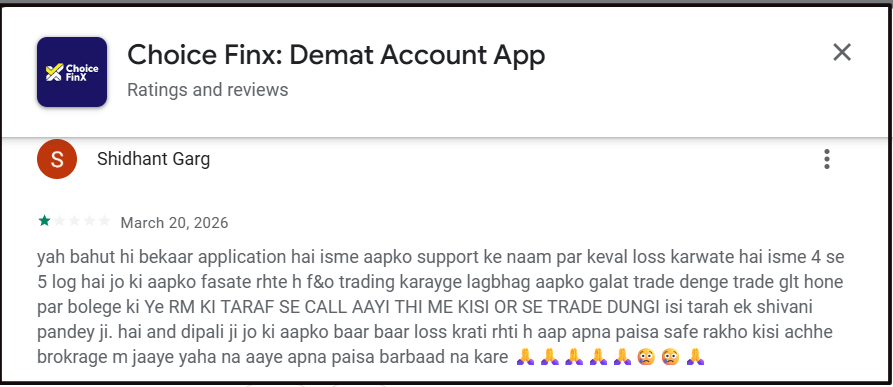
When you rely heavily on external trade calls without full understanding, you lose control over your own decisions. Treat any external trade suggestion carefully, and make sure you understand the trade before acting on it.
Taken together, these four reviews point to consistent themes: brokerage impact, communication clarity, and trade guidance. That doesn’t mean every user faces these issues, but it does show where to stay cautious.
Is Choice FinX Not Working a Common Complaint?
Choice FinX is the mobile trading and investment app behind Choice Broking, previously known as Jiffy, letting users trade stocks, futures, options, commodities, mutual funds, and IPOs from a single integrated platform.
Many users encounter problems with the app while markets are active, which raises the stakes considerably since these are moments when speed actually matters.
These issues generally trace back to three sources: technical instability, account or document restrictions, and exchange-level trading rules.
Technical issues: the app crashes due to stability problems reported by multiple active users, slow syncing delays order placement during volatile sessions, and portfolio data or SIP baskets sometimes fail to display correctly.
Order and account restrictions: orders get rejected when insufficient cleared funds exist, segment activation stays incomplete when income proof or documents remain unsubmitted, and pending UCC, KYC, or bank mandate activation can block trading access for days.
Market and contract restrictions: exchanges restrict trading during extreme volatility, illiquid option contracts fail to execute when buyers or sellers simply aren’t available, and stock options can’t be purchased on expiry day due to physical settlement rules.
Here’s what real users have actually reported about the app:
1. App Crashes and Missing SIP Data After Migration
This review highlights frequent app crashes and delayed real-time performance during trading hours, paired with missing SIP baskets after migrating from the earlier Investica platform.
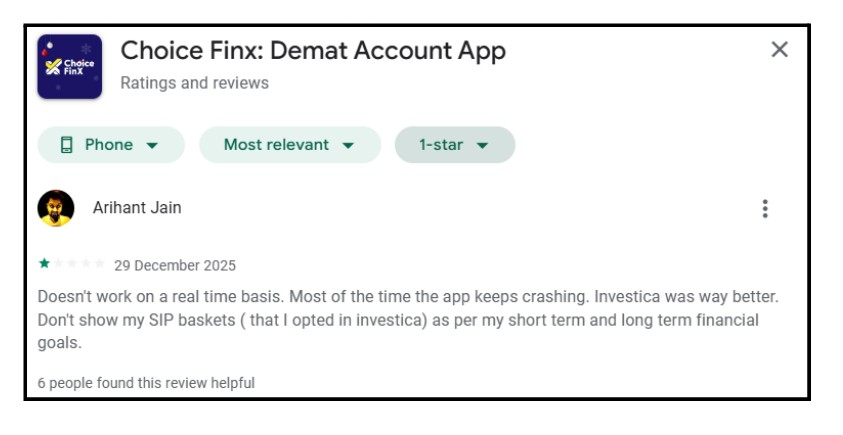
For anyone running systematic investments, losing visibility into your SIP data isn’t a minor glitch; it’s losing track of money that’s actively moving on a schedule you didn’t set that day.
2. Poor Communication and Financial Loss
This review raises concerns about poor communication and delayed support responses, alongside a reported financial loss and dissatisfaction with the overall service experience.
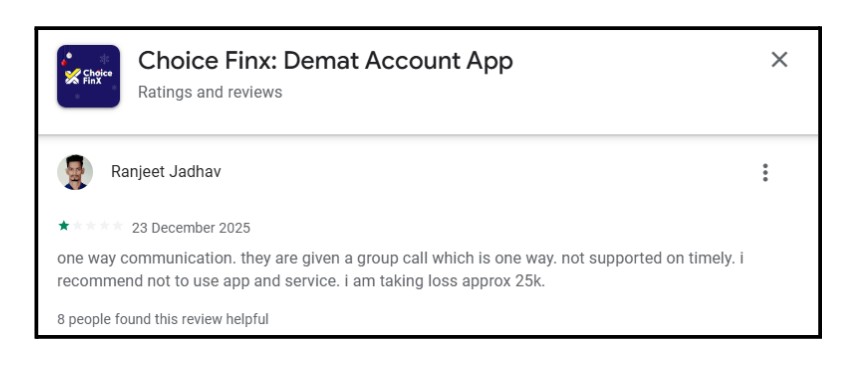
When a technical or service issue overlaps with an actual loss, the order of events matters. Document the timeline immediately rather than waiting to see if support eventually catches up.
3. Delayed Price Data and Margin Release Issues Near Expiry
This review points to delayed bid-offer depth updates and poor price refresh accuracy, along with margin release delays after square-off, specifically near expiry days.
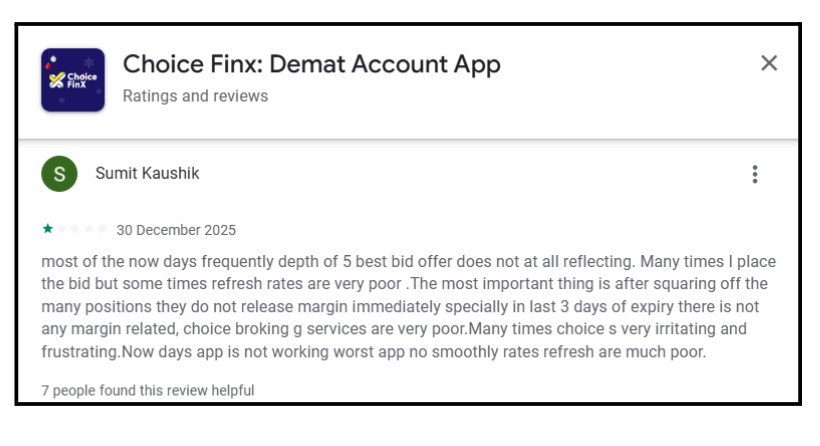
Expiry sessions are exactly when accurate, real-time pricing matters most, and a margin release delay right when you need that capital free for your next move compounds the problem rather than sitting as a separate, unrelated issue.
Found a trade in your Choice Broking account you never approved, or dealing with a Choice FinX issue that’s cost you money?
Our team will review your trade logs and communication records, map the evidence gap the broker needs to answer for, and help you file a complaint built to get a real result.
When Should You Take Action Against Choice Broking?
Not every issue needs escalation. You’ll come across small delays, minor glitches, or temporary confusion, especially during active market hours.
But there’s a clear line between that and a situation genuinely affecting your money or control over your account.
- Unauthorised trades in your account. If you notice trades you did not place or approve, don’t wait or assume it’s a mistake. Act immediately, raise the issue against unauthorized trading, and keep a proper record of all communication.
- Losses you cannot clearly explain. Losses are part of trading, but confusion is not. If a trade doesn’t match your instructions or you don’t understand how it was executed, you need a clear explanation.
- Delay in fund withdrawal or ledger mismatch. If your withdrawal gets delayed or your balance doesn’t match your records, follow up quickly. Issues touching your money should never sit unaddressed.
- No proper response from customer support. One delayed reply is normal. Repeated follow-ups with no resolution means the issue has moved beyond support and needs escalation.
- Platform issues during important trades. If the app lags, freezes, or fails to execute at the right time and it affects your trade, document it and report it properly.
- Lack of clarity or accountability from the broker. If the broker can’t clearly explain what happened in your account, or avoids a direct answer, don’t let it go. You need clarity when your money is on the line.
How to Complain Against Choice Broking?
Once you decide to act, follow a clear, structured process. Most investors either rush into escalation or don’t document things properly, both of which weaken their case.
Start with the broker directly. Raise the issue through official channels, email or in-app support. Clearly explain what went wrong, mention relevant dates and trades, and attach screenshots or statements as proof.
Keep a record of every exchange, and escalate within the broker’s own system if the first response falls short.
If that doesn’t resolve things, file a SEBI SCORES complaint. This brings the regulator directly into the process and increases accountability on the broker’s side.
If the issue still isn’t resolved, an NSE complaint against broker puts the matter in front of the exchange itself, which reviews your complaint and asks the broker to respond within a defined timeline, adding real neutrality to the process.
Where the dispute needs a more structured, conciliation-first path, a SMART ODR registration moves your case into that framework before it needs to escalate further.
If the dispute continues, especially where real financial loss is involved, arbitration is the next step: both sides present their case with evidence, and an independent panel decides based on exchange rules, exactly the process that delivered the ₹33.73 lakh award above.
For the complete process laid out end to end, our guide on complaint against stock broker SEBI walks through every stage in detail.
Conclusion
Choice Broking, like any growing broker, has received a mix of user feedback over time. The overall complaint ratio remains low relative to its client base, and most issues get resolved at the exchange level.
At the same time, the gradual rise in complaints, the significant and growing share tied to unauthorised trading, and the presence of a real ₹33.73 lakh arbitration award all show that problems do arise, and they can escalate seriously when they do.
The arbitration case makes one thing clear: when a dispute becomes serious and stays unresolved, the final decision comes down to evidence, not opinions.
Stay aware, keep proper records, and act quickly when something doesn’t feel right. The difference between a small issue and a major problem often comes down to how early you take action.
Report. Recover. Stay Fraud Free.
98 in 2023-24, rising to 176 in 2024-25, and 168 in 2025-26, with the complaint ratio staying under 0.1% of the total client base throughout. Yes. In Sapna Bajaj vs Choice Equity Broking, the tribunal found the disputed F&O trades were unauthorised and awarded the investor ₹33.73 lakh, with 12% annual interest if unpaid within 30 days. The share climbed from 31.57% in 2021-22 to 45.66% in 2025-26, meaning nearly half of all complaints in the most recent year involved trades investors say they never approved. Real user reviews describe app crashes, missing SIP data after platform migration, delayed price updates, and margin release delays near expiry, worth testing carefully before relying on it for time-sensitive trades. Download your contract notes and trade confirmations immediately, raise a written complaint with the broker, and escalate to SEBI SCORES if the response isn't satisfactory.Frequently Asked Questions



 Add us as a preferred source on Google »

