

Most traders assume a SEBI registration means the advisor is playing by the rules. The case of SEBI action against Amit Guruh Sachdeva puts that assumption to the test.
Amit Guruh Sachdeva is not some anonymous Telegram tipster. He is a registered Research Analyst running Stock Benefits Financial Services from Lucknow, the kind of setup that genuinely looks credible from the outside.
Yet in August 2025, SEBI passed a formal adjudication order against him after an inspection uncovered multiple compliance violations.
If you have ever paid fees to a registered analyst, trusting that registration alone keeps your money safe, this case is worth reading carefully.
Amit Guruh Sachdeva Review
Before we get into the violations, let’s understand who we are talking about.
Amit Guruh Sachdeva runs Stock Benefits Financial Services, based in Lucknow.
Many users wonder: is Amit Guruh Sachdeva SEBI registered?
Yes, he holds a SEBI Research Analyst registration bearing number INH100005190, obtained on August 3, 2016.
He also holds a separate SEBI registration as an Investment Adviser (INA100007745).
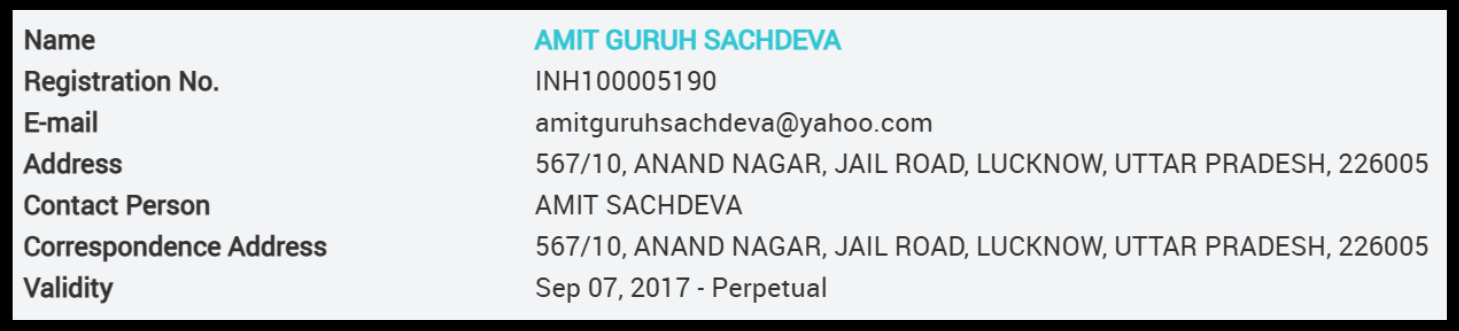
His website promotes services around equity, F&O, Bank Nifty predictions, and commodity tips, with annual packages priced as high as ₹1,50,000 plus GST.
On paper, this looks like a fully compliant, credentialed, professional setup.
But when SEBI’s inspection team arrived at his Lucknow office on March 14–15, 2024, to examine his operations for the period April 2022 to February 2024, what they found told a very different story.
Amit Guruh Sachdeva SEBI Order
SEBI’s Adjudicating Officer Jai Sebastian issued a formal adjudication order (Order Ref. No. ORDER/JS/RJ/2025-26/31614) dated August 28, 2025, after reviewing inspection findings, issuing a Show Cause Notice, and conducting a hearing where Sachdeva personally participated.
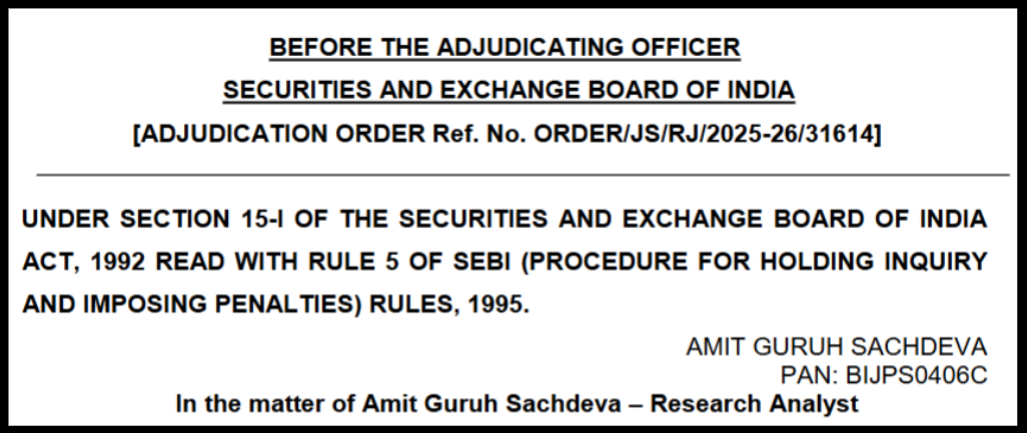
The order documents multiple clear violations of the SEBI (Research Analyst) Regulations, 2014, and related SEBI circulars.
Let’s go through each one:
Violation 1: Failure to Maintain Signed Research Reports and Recommendation Records
The most basic duty of a research analyst is to document what they recommend and why. This is not optional; it is a hard regulatory requirement.
Regulation 25(1) of the SEBI (Research Analyst) Regulations, 2014 mandates that every research analyst must maintain all records relating to their activities for a minimum of five years.
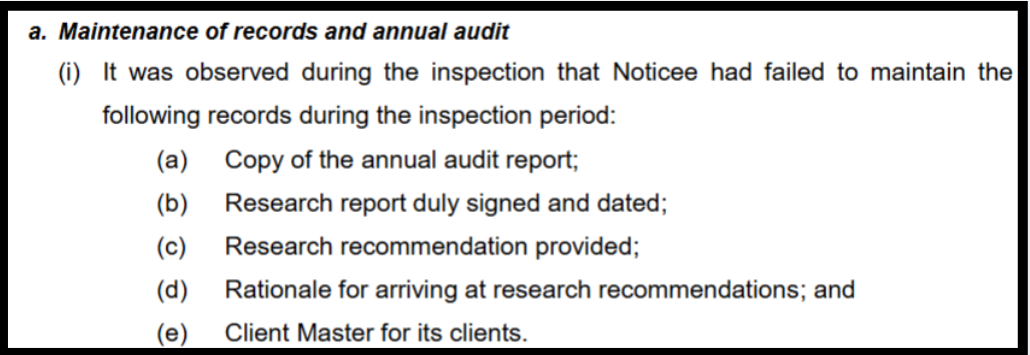
When SEBI’s inspection team examined Sachdeva’s records, they found none of these in proper order. There were no properly signed research reports.
No documented rationale for the calls given to clients. No structured record of what had been recommended and when.
Despite receiving multiple notices and being given multiple chances to produce documentation, Sachdeva could not establish that he had maintained any of the records that Regulation 25(1) requires.
Violation 2: Annual Compliance Audit Report Without a Valid UDIN
Under Regulation 25(3) of the RA Regulations, every research analyst is required to get an annual audit conducted of their compliance with regulatory requirements.
This audit must be done by an independent auditor, and the report must be duly maintained.
During inspection, Sachdeva submitted an annual audit report, but SEBI found that the report was missing a UDIN (Unique Document Identification Number).
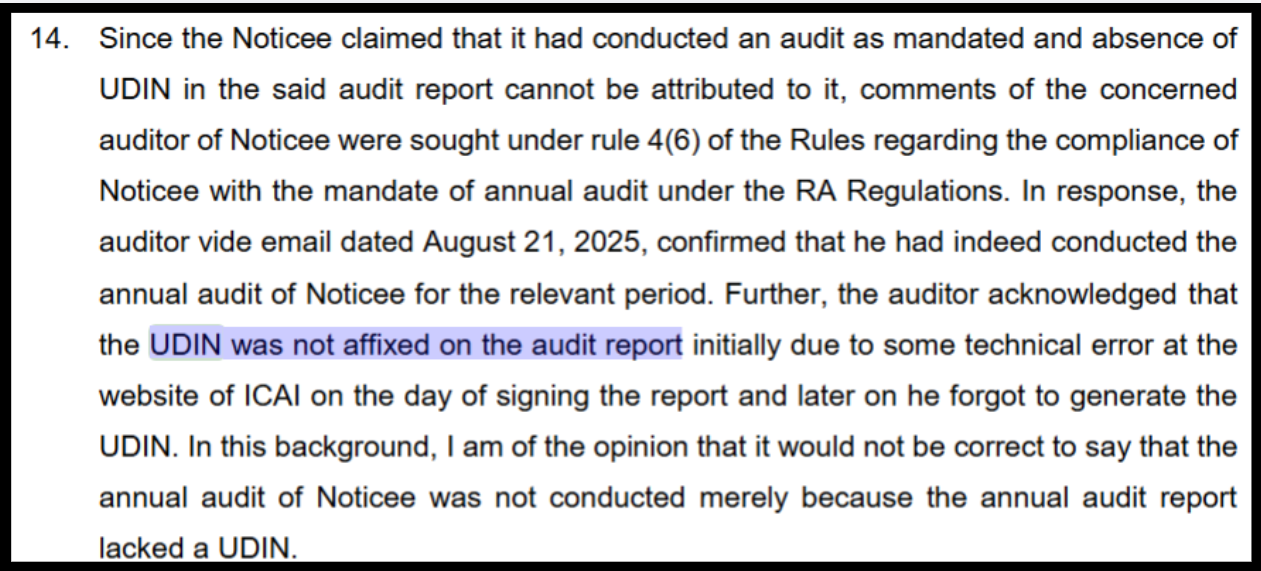
A UDIN is the unique identifier assigned to each document certified by a Chartered Accountant. Without a UDIN, the authenticity and genuineness of an audit document cannot be verified. It essentially becomes a piece of paper without regulatory standing.
When SEBI pointed this out, the auditor’s explanation was that the UDIN had been missed due to a “technical issue.”
However, SEBI’s position was clear: a compliance audit report without a valid UDIN does not meet the regulatory requirement of a properly conducted and documented annual audit.
The responsibility for ensuring a proper audit report lies with the registered RA, not the auditor.
Violation 3: No Client Master Details Maintained
Alongside research reports and rationale, Regulation 25 also requires research analysts to maintain a proper client master list, essentially a structured record of who their clients are, what services they are subscribed to, and the details of the engagement.

SEBI’s inspection found that Sachdeva did not maintain a proper client master record. For an RA offering high-value annual packages to multiple paying clients, this is a significant compliance failure.
The client master is not just a formality; it is the foundation for accountability, audit trails, and investor protection.
Without a client master, there is no way for SEBI or any external reviewer to even determine the full scope of who was being serviced, under what terms, and whether proper agreements were in place with each client.
Violation 4: Denying a Website Existed to Avoid Mandatory Investor Charter Disclosure
This is one of the most striking violations in the entire order, because it was not an oversight; it was a direct contradiction between what Sachdeva told SEBI and what SEBI found independently.
SEBI’s Circular dated December 13, 2021, lays down a clear rule: every research analyst who operates a website must prominently display the Investor Charter on that website.
During inspection proceedings, Sachdeva stated position was that he did not operate a website and therefore had no obligation to display the Investor Charter.
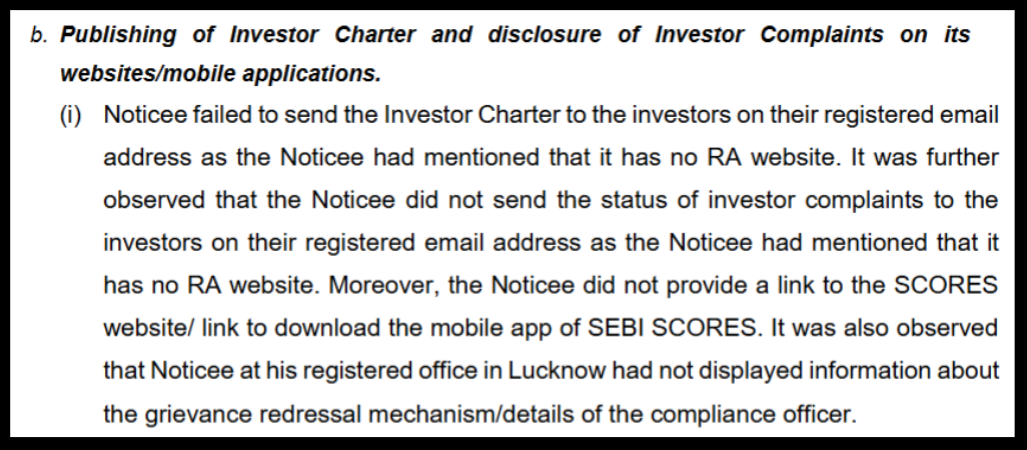
But SEBI investigated, and found the website stockbenifits.com fully operational, prominently displaying his SEBI RA registration number (INH100005190), a complete user agreement, fee structures, payment details, and active promotion of his research advisory services.
This was not a dormant or personal page. It was a functioning, client-facing website being actively used to attract subscribers and onboard paying clients.
SEBI’s order concluded that Sachdeva was using the website as a commercial platform to acquire clients while simultaneously denying its existence to SEBI to avoid the mandatory disclosure obligation.
The Investor Charter was neither displayed on the website nor sent to clients via email or any other means.
Violation 5: Clients Not Given Access to the SEBI SCORES Grievance Platform
Under the same SEBI Circular of December 13, 2021, every research analyst is required to proactively provide all clients with a direct link to the SEBI SCORES platform, both the website and the mobile application.
SEBI’s inspection found that Sachdeva had not provided the SCORES website link or the SCORES mobile application link to clients.

When confronted, he admitted that he had not shared the dedicated mobile app link. For the website link, he could not confirm or produce any evidence that it had ever been shared with clients.
SEBI treated the absence of confirmation as proof of non-compliance. The violation was established on both counts, the website link and the mobile app link.
Violation 6: Grievance Redressal Details and Compliance Officer Information Not Displayed at Registered Office
SEBI regulations require every registered research analyst to display, at their registered office premises, the complete details of their grievance redressal mechanism and the name and contact information of the Compliance Officer.
This physical display is mandatory so that any client who visits the office can immediately identify how to raise a complaint and who is responsible for compliance.
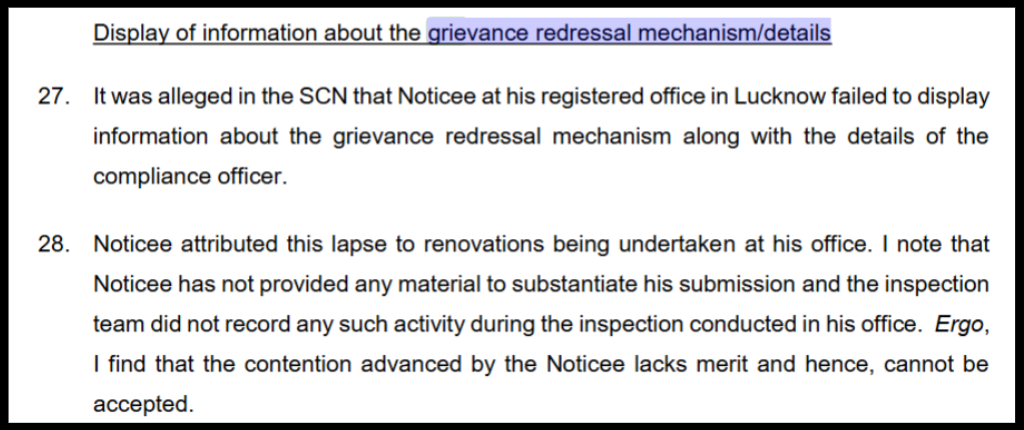
SEBI’s inspection team visited Sachdeva’s registered Lucknow office and found that none of this information was displayed. No grievance redressal details. No compliance officer name or contact. Nothing.
Sachdeva’s explanation during the hearing was that renovations were being carried out at the office at the time of the inspection visit, which is why the required information wasn’t displayed.
SEBI’s adjudicating officer examined this claim carefully and rejected it outright. The inspection team had found no evidence of any renovation activity at the office on the dates of the inspection.
No supporting documentation, no contractor invoices, no photographs of renovation work, and no other material were submitted to support the renovation claim.
Amit Guruh Sachdeva Final Penalty
After reviewing all findings, the hearing submissions, and the replies submitted by Sachdeva, SEBI’s Adjudicating Officer concluded that the violations were clearly established.
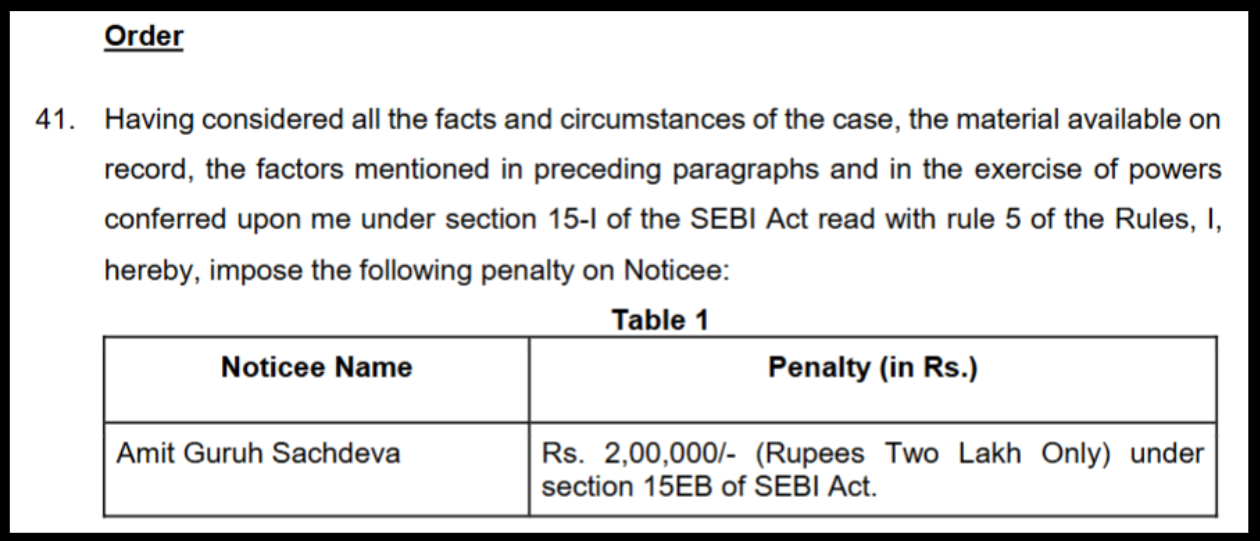
SEBI imposed a total monetary penalty of ₹2,00,000 (Rupees Two Lakh) on Amit Guruh Sachdeva under Section 15EB of the SEBI Act, 1992.
The penalty covers violations of:
- Regulations 25(1) and 25(2) of the SEBI (Research Analyst) Regulations, 2014.
- Clauses 1, 2, 6, 7, and 8 of the Code of Conduct prescribed for Research Analysts.
- Clauses 2 and 4 of the SEBI Circular dated December 13, 2021.
The order was issued on August 28, 2025, and is on public record on the SEBI website.
What Retail Investors Can Learn From This?
The Amit Guruh Sachdeva SEBI case is not about a completely unknown, unregistered operator. It is about a SEBI-registered, certified, and seemingly credentialed analyst who quietly failed at the most basic regulatory obligations.
That is exactly why it matters for every retail investor.
Here are the key takeaways from this case:
- SEBI registration is the starting point, not the finish line: A registered RA can still violate multiple regulations while actively operating. The badge tells you the person has a number; it does not tell you whether they follow the rules that come with it.
- No research records means no accountability: When an RA cannot produce signed reports, rationale, or recommendation logs, you have no way to challenge bad calls, verify what was promised, or build a case if things go wrong. Always ask for documented research before paying.
- If no Investor Charter was sent to you, that is already a violation: This document is your formal introduction to your rights as a client. If your RA never shared it, that is a red flag and a confirmed non-compliance.
- The absence of a SCORES link is not a small omission: It is the deliberate or negligent removal of your most direct path to the regulator. Any legitimate RA will proactively share this with every client.
- Expensive packages do not guarantee compliance: Paying ₹1.5 lakh per year for services does not mean the RA is meeting basic regulatory requirements. Fees and compliance are two entirely separate things.
- Ask for the SCORES complaint link before signing up: If an advisor hesitates or cannot share it immediately, take that seriously.
How To Lodge a Complaint Against a Research Analyst?
If you have paid for services from Amit Guruh Sachdeva and faced issues, missing calls, non-delivery of services, pressure selling, upselling, or any form of financial harm, here is how to take proper action.
The process is structured and accessible to every retail investor.
Step 1: Gather All Your Evidence First
Before you file anything, collect everything you have:
- Payment receipts, bank statements, and UPI screenshots
- WhatsApp messages, trade calls, or Telegram messages received
- Email correspondence with the firm
- Any call recordings, if available
- Invoices or fee agreements signed
Prepare a simple timeline: when you paid, what was promised, what you actually received, and when communication stopped or went wrong. This timeline will be the backbone of every complaint you file.
Step 2: Send a Formal Written Complaint to the Firm
Write a clear, factual email to Sachdeva’s official contact or his registered office in Lucknow, stating the exact issue, amounts paid, promises made, and what resolution you are seeking.
Keep it brief and factual, no threats, no emotional language. This creates a mandatory paper trail. Save their response, or the lack of one, as further evidence.
Step 3: File a Complaint in SCORES
SEBI’s SCORES (Securities Complaint Redressal System) platform is your primary official channel for complaints against SEBI-registered intermediaries.
File a detailed complaint against Amit Guruh Sachdeva. Upload all your documentation and describe your timeline clearly.
SEBI tracks complaints against registered entities directly through this system, and the RA is required to respond.
Step 4: Register a Complaint with Smart ODR
If your SCORES complaint does not result in a satisfactory resolution within a reasonable time, move to SEBI Smart ODR (Online Dispute Resolution), SEBI’s mandated conciliation and arbitration platform for disputes between investors and registered intermediaries.
This is a structured online process that does not require you to go to court. You register your case, upload your evidence, and request a conciliation session.
An independent conciliator reviews the matter and facilitates a resolution between both parties.
Step 5: Stock Market Arbitration
If conciliation through Smart ODR does not resolve the matter, you can escalate to formal arbitration. An independent arbitrator reviews the full evidence and issues a binding decision.
Strong documentation, everything you collected in Step 1, becomes critical at this stage.
Need Help?
Navigating the complaint process alone can feel overwhelming, especially when the other side is unresponsive.
If you need support in assessing your case, organising evidence, drafting the SCORES complaint, or being guided through Smart ODR and arbitration, you can register with us for specialised investor assistance services for step-by-step support.
Conclusion
The SEBI order against Amit Guruh Sachdeva, issued in August 2025, sends a clear message: the market regulator does not look away from compliance failures just because someone holds a registration certificate.
When an RA maintains no research records, hides an active website from the regulator, and keeps investors away from their own grievance channels, these are not small paperwork oversights.
They are failures that directly affect the rights and protection of every paying client.
The ₹2 lakh penalty may seem modest relative to the fees charged, but the order itself is now permanently on SEBI’s public record. It is searchable, verifiable, and available to every investor doing their homework.
For retail traders and investors, the lesson is direct: always verify before you trust. Check the SEBI website for past orders. Search SCORES for complaints.
Ask for the Investor Charter. Demand documented research rationale. A SEBI registration number is where due diligence begins, not where it ends.
And if you have already paid and found yourself in trouble, the complaint process is available to you. Use it.





 Add us as a preferred source on Google »

