
You search for a reliable stock advisor. Someone calls, gives you two or three free “demo” calls that go right, and then pushes you into a ₹1,50,000 annual package.
The calls slow down. The losses begin. Then comes the silence. This is not a hypothetical; this is exactly what multiple investors of Amit Guruh Sachdeva have reported.
And in August 2025, SEBI officially stepped in.
The question isn’t whether rules were broken. The question is how long this was allowed to continue. In this blog, we will disclose the truth behind Amit Guruh Sachdeva.
Amit Guruh Sachdeva Details
Is Amit Guruh Sachdeva SEBI registered? Yes, he holds SEBI Research Analyst Registration Number INH100005190 and is operating from Lucknow, Uttar Pradesh.
His firm, AGS Research Advisory (formerly known as Stock Benefits Financial Services), offers subscription-based stock market advisory services to retail and HNI investors across India.
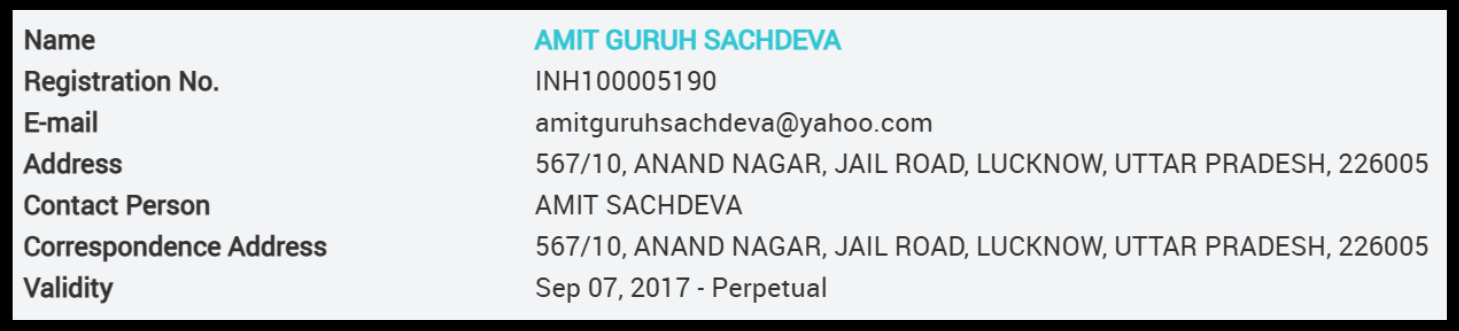
He holds SEBI Research Analyst Registration Number INH100005190 and BSE Enlistment No. 5253.
His website claims 17+ years of experience in the stock market, and he lists previous employment with firms like Motilal Oswal and MF Global. He holds NISM-Series-X-A and X-B Research Analyst certifications along with a PGDBM in Finance.

His services span equity stocks, derivatives (F&O), currency, MCX, portfolio hedging, and index strategies.
Subscription plans start from ₹15,000 per month and go up to ₹1,50,000 annually, all plus 18% GST. The website is polished, the branding is professional, and the credentials appear legitimate at first glance.
But here is what makes this story more complicated.
SEBI’s inspection of his operations, covering the period April 2022 to February 2024, revealed multiple documented violations that directly impact every paying client.
The story only gets more interesting from here. Let us look at exactly what the regulator found.
Also Read: Fiscal Solution and Research, an advisory firm’s claims against SEBI’s real rules.
SEBI Action Against Amit Guruh Sachdeva
In August 2025, SEBI’s Adjudicating Officer issued a formal penalty order against Amit Guruh Sachdeva after inspecting his operations for the period April 2022 to February 2024.
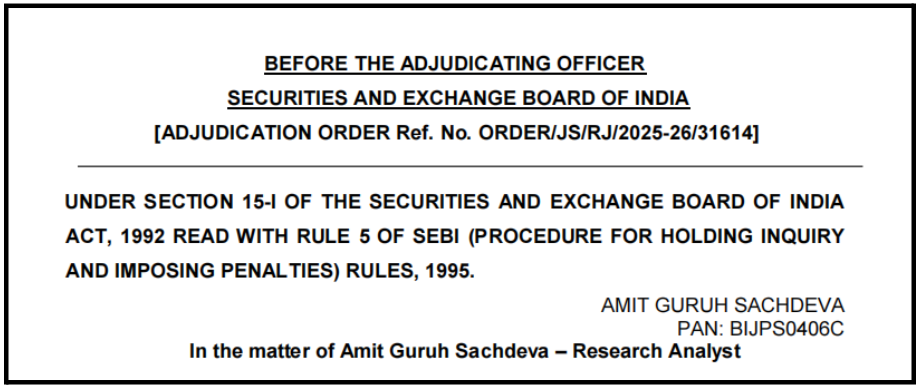
The inspection took place on March 14–15, 2024. What SEBI found was deeply concerning for anyone who had paid for his services.
Violations by Amit Guruh Sachdeva
SEBI documented three categories of proven violations.
These are not paperwork technicalities; they directly affect your ability to verify what you were told, hold the advisor accountable, and complain if things go wrong.
1. No Research Records Maintained
Regulation 25 requires research analysts to maintain reports, recommendation records, rationale, and client lists, but Sachdeva kept none and only submitted a single email screenshot dated June 2024 after the inspection ended.
Despite multiple notices and a hearing, he provided no documentation, leaving no verifiable record of what recommendations were given, why, or to whom.
2. Website Misrepresentation and Disclosure Avoidance
Sachdeva claimed he had no RA website and therefore no obligation to display mandatory disclosures.
However, SEBI found his site stockbenifits prominently displaying his RA registration, user agreement, payment details, and promotion of research advisory services.
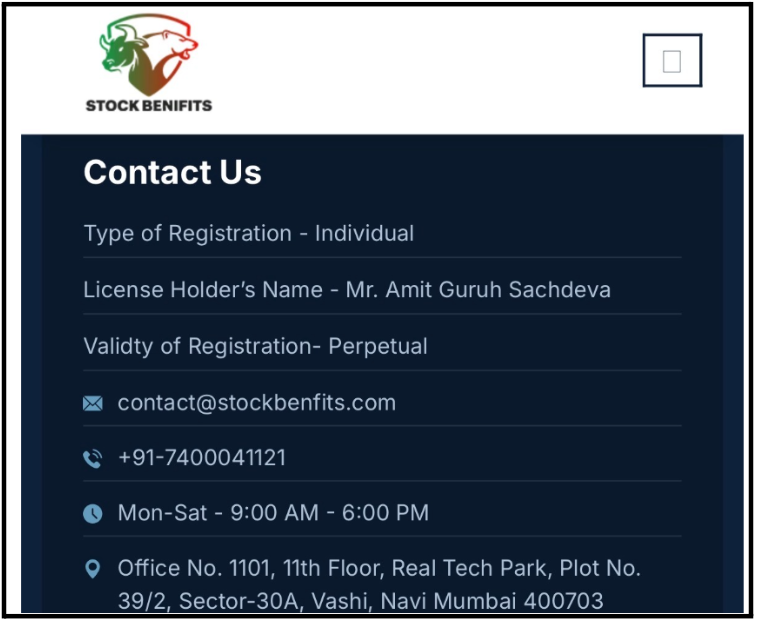
The order concluded that this was a deliberate attempt to acquire clients through the website while avoiding mandatory disclosure requirements.
3. Hiding the Investor Charter and Blocking Grievance Access
SEBI’s December 2021 circular requires RAs to display the Investor Charter on their website or share it via email, and to provide access to the SCORES grievance platform, but Sachdeva did neither.
He also failed to display grievance redressal and compliance officer details at his Lucknow office, and his claim of renovations was rejected after SEBI found no such activity.
Penalty
SEBI’s Adjudicating Officer Jai Sebastian imposed a monetary penalty of ₹2,00,000 (Rupees Two Lakh) under Section 15EB of the SEBI Act, vide Order Ref. No. ORDER/JS/RJ/2025-26/31614, dated August 28, 2025.
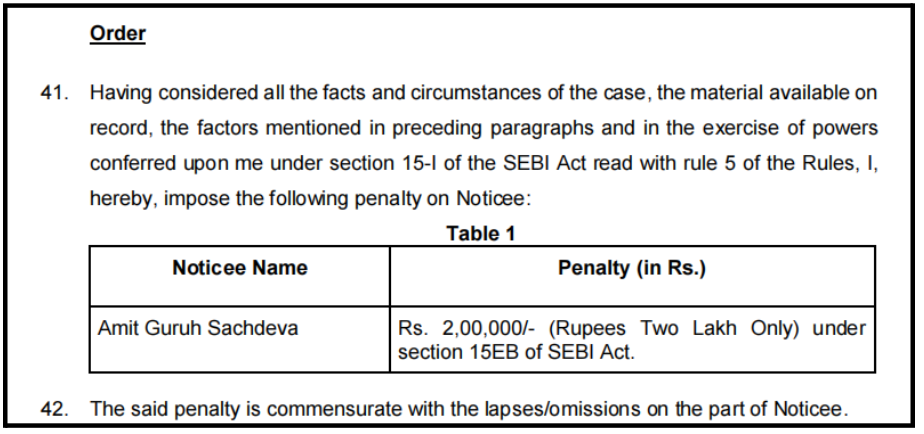
The penalty covered violations of Regulations 25(1) and 25(2) of the RA Regulations, Clauses 1, 2, 6, 7, and 8 of the RA Code of Conduct, and Clauses 2 and 4 of the SEBI Circular dated December 13, 2021.
Why It Matters for Investors?
This order is not just a regulatory formality. It reveals a pattern of deliberate non-compliance that puts every paying client at a real disadvantage.
- No records means you cannot prove what advice you received or challenge a bad call
- No Investor Charter means you were never formally told your rights as a client
- No SCORES link means the advisor actively blocked your easiest path to complain
- Hidden website means RA services were marketed without the disclosures SEBI mandates
- SEBI registration alone does not protect you, compliance with rules is what actually matters
Also Read: Springpad AI review, a ₹9 workshop that funnels into ₹1 lakh courses.
Amit Guruh Sachdeva Complaints
Public reviews across multiple platforms tell a consistent story.
Investors who paid for AGS services report the same cycle: exciting promises before payment, random or loss-making calls after payment, and silence or blame-shifting when things go wrong.
1. Calls Based on Luck, Not Research
User Vipin reported that the advisory team appeared inexperienced and unprofessional, that calls looked more like guesswork than researched recommendations, and that when trades failed, the response was “it’s your bad luck.”
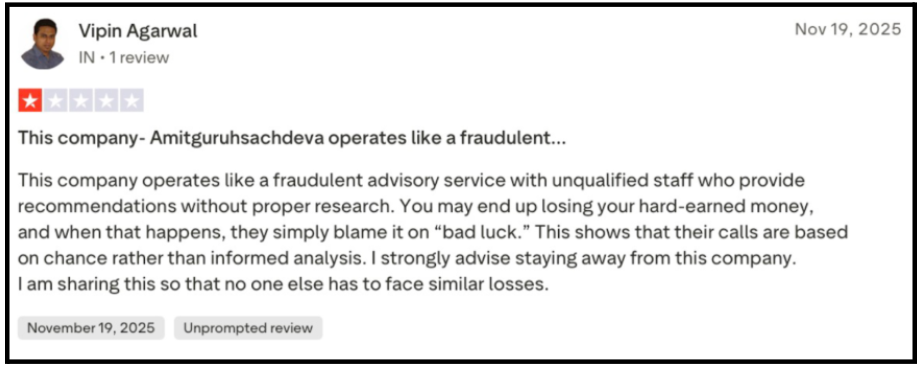
This aligns directly with SEBI’s finding that no research rationale existed behind any of the calls being sold.
2. Forced to Buy High Quantities for Commission
A user reported that the firm initially promised high profits but later provided random trading calls, leading to losses, and alleged that representatives misled clients and pushed large quantities to earn commissions.
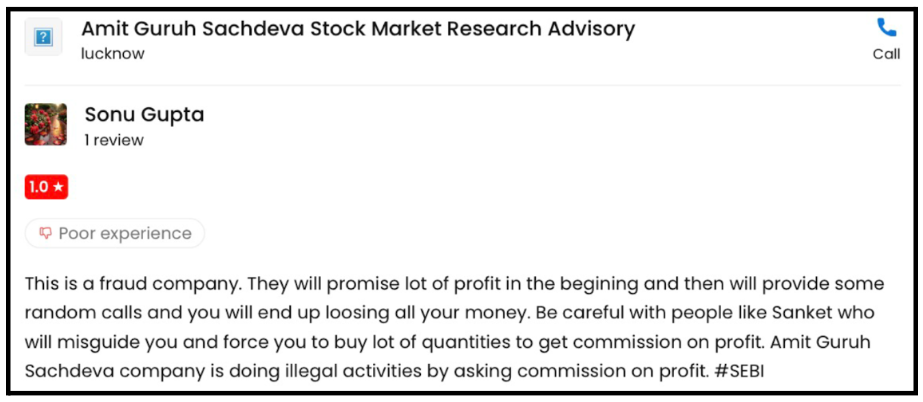
Charging commissions on profits is explicitly prohibited under SEBI RA Regulations, and multiple users have independently described similar practices.
3. Demo Call Used as Bait, Then Upsell After Payment
User Yogit described the full pattern: executive called, talked about huge profits, gave one demo trade, then created urgency to pay by saying “the market is good right now and registration takes time.”
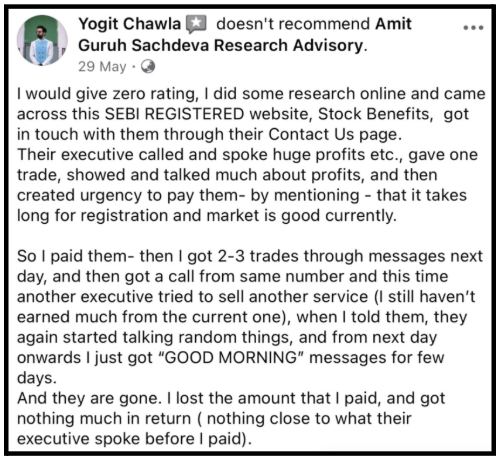
After paying, he received a few trade messages and then immediately got a call from the same number trying to sell another service before he had earned anything.
Communication then dropped to just “Good Morning” messages and stopped. He wrote: “I lost the amount that I paid, and got nothing much in return.”
4. Six-Month Service Stopped in Three Months, No Refund
User Mukhtiyarul Hasan paid ₹88,500 for a premium package. An additional ₹49,500 was then taken from him on the promise of a 30% profit.
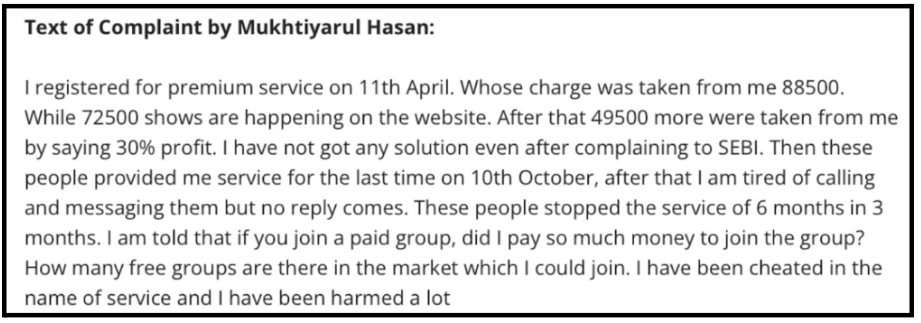
Service stopped after three months, calls went unanswered, and even after complaining to SEBI, no resolution came.
Can You Trust Amit Guruh Sachdeva?
Beyond the SEBI order, several red flags emerge from the firm’s own publicly available conduct and documents.
Together, these paint a clear picture for any investor doing due diligence.
1. Demo Calls Without Disclosure
AGS’s own Ad Disclaimer page states: “Our Website/Firm/Company does provide free demo services for once, these services should not be misinterpreted by the customer as lifetime free recommendation.”

The problem is that SEBI treats demo calls as research services, meaning they require full disclosures and cannot cherry-pick profitable trades to mislead prospects.
2. No Verifiable Research Behind Expensive Packages
AGS charges ₹15,000/month, ₹40,000/quarter, ₹80,000/half-year, and ₹1,50,000/year, all plus 18% GST.
Yet SEBI’s inspection confirmed that no signed research reports, no recommendation rationale, and no client records maintained for the entire inspection period.
The firm’s public research report page lists only 5 broad sector-level PDFs, the earliest from January 2026, none of which constitute specific F&O call research justifying lakhs in fees.
3. Upselling While Existing Clients Are Still Losing
Yogit Chawla’s review captures this exactly; he had not recovered anything from his current subscription when AGS called to sell him a second plan.
Mukhtiyarul Hasan was charged an extra ₹49,500 as an upsell on top of his ₹88,500 subscription. Multiple user complaints describe AGS executives verbally promising that losses will be recovered.
Selling upgrade packages before delivering on existing commitments is a consistent pattern across independent complaints on JustDial, Facebook, ConsumerComplaints, and Trustpilot.
4. Profit Commission Demands
Multiple users specifically allege that AGS demanded commission on profits, presenting it as standard practice.
Under SEBI RA Regulations, research analysts cannot charge performance-linked or profit-linked fees. This is a clear legal prohibition.
Yet users Sonu Gupta, Nitin Malik, and Alok all independently describe this as a direct experience with AGS executives by name.
What Investors Should Keep in Mind?
Before paying any advisory firm, SEBI-registered or not, verify these points. A registration number is a starting point, not a finish line.
- SEBI registration doesn’t mean trustworthiness: check the SCORES portal for complaints and orders before paying
- Demo calls are a sales tool, not proof of accuracy: two profitable free calls tell you nothing about long-term performance
- “90% accuracy” is a banned claim: any RA making this claim is already violating SEBI’s Advertisement Code
- Demand documented research rationale: a genuine RA will have signed, dated reports backing every call
- Verbal promises of recovery are illegal: any such promise in a sales call is itself a SEBI violation
- Get the Investor Charter before paying: failure to share it is already a regulatory breach
- Confirm the SEBI SCORES link: if not shared proactively, treat it as a red flag
- Expensive does not mean accountable: ₹1.5 lakh per year does not guarantee better research, service, or any protection from loss
SEBI’s own study, which AGS quotes in its fine print, shows that 9 out of 10 F&O traders lose money. Any advisor charging lakhs of rupees owes you verifiable proof, not polished promises.
How To File a Complaint Against Research Analyst?
Many investors searching for what to do if you paid a research analyst and lost money land here feeling overwhelmed and unsure where to begin.
The steps below give you a clear, actionable path forward.
Step 1: Document Everything Immediately
Gather every piece of evidence, payment receipts, bank transfer records, WhatsApp messages, trade calls received, email threads, and call recordings if available.
Without documentation, your case is weak. Start compiling this right now, before anything gets deleted.
Step 2: Send a Formal Written Complaint to the Firm
Send a written complaint by email and by registered post to the firm’s grievance officer, clearly stating the dates, amounts paid, promises made, services not delivered, and losses incurred.
This creates a mandatory paper trail and gives the RA a chance to respond. If they don’t respond within a reasonable time, that becomes further evidence of non-compliance.
Step 5: Lodge a Complaint in SCORES
SEBI SCORES is the official investor grievance platform. Create an account, file a detailed complaint, and attach all your documents. SEBI directly tracks complaints against registered intermediaries here.
This step puts your complaint formally on record with the regulator who already penalised this firm
Step 6: File a complaint in SMART ODR
If SEBI SCORES does not resolve the matter, Smart ODR (Online Dispute Resolution) is the next step. This is SEBI’s mandated conciliation and arbitration platform for disputes between investors and registered intermediaries.
Register your case, upload evidence, and request a conciliation session for a structured resolution process.
Step 7: Navigate Arbitration if Needed
For cases requiring arbitration in stock market, we offer complete support. This covers preparing the application, assembling solid evidence, and accompanying you through every phase until closure.
Need Help?
If you have lost money to AGS or a similar advisory firm, you do not have to navigate the process alone.
Getting the documentation, drafting, platform selection, and escalation sequence right can significantly impact the outcome.
We help victims by assessing case strength, organising evidence, and drafting complaints aligned with SEBI regulations.
Our support includes step-by-step guidance through SCORES and Smart ODR, representation in conciliation, and assistance throughout arbitration to pursue recovery.
So, if you are facing issues with any registered entity, then register with us without any further delay.
Conclusion
The case of Amit Guruh Sachdeva teaches an important lesson and raises a question every investor eventually asks: can you trust SEBI registered research analysts based on their registration number alone?
This case gives a clear answer. Being registered with SEBI doesn’t guarantee trustworthiness.
When SEBI imposed a Rs. 2 lakh penalty in August 2025, it wasn’t just about enforcing rules but about protecting investors like you.
Sachdeva’s violations reveal a pattern of cutting corners. No proper records, hidden website operations, missing disclosure documents, and ignored investor links to the regulator.
These aren’t small administrative oversights. They’re systematic failures that prevent you from verifying what was recommended, what was promised, and what went wrong.
Before trusting anyone with your money, verify their SEBI registration, search for public complaints, confirm they’ve sent the Investor Charter, and ensure they provide access to SEBI SCORES.
Regulatory actions like this one show the system is working, but the responsibility to choose wisely remains yours. Don’t let the next cautionary tale be yours.





 Add us as a preferred source on Google »

