

You followed the market all day, waited for the perfect setup, and still missed the move. Or worse, you entered late and watched the trade reverse. That’s the frustration that pushes many traders toward automation.
Algo trading, once reserved for hedge funds and institutional players, is now accessible to retail traders in India through platforms like Tradetron.
The promise is simple and attractive: create your strategy without coding, test it on past data, and let it execute trades automatically while you focus on other things.
But before you hand over control to an automated system, one question naturally comes up: is Tradetron actually safe to use?
The answer isn’t a simple yes or no. It depends on how you define safety.
In this blog, we break it down clearly across four key areas: platform credibility, SEBI’s stance, real user experiences, and the practical risks every trader should be aware of before getting started.
Tradetron Details
Tradetron is a technology platform, not a broker, not a research analyst, and not a SEBI-registered investment advisor.
It was founded in 2019 by Umesh Ranglani and operates from San Jose, United States, with active operations in Mumbai, India.
The platform connects to SEBI-registered brokers via APIs, allowing users to deploy automated strategies into their own brokerage accounts.
This distinction matters because it defines the boundaries of Tradetron’s responsibility and answers the frequently asked question: is Tradetron SEBI registered?
Since the platform provides the infrastructure and does not manage your money or place trades directly, it functions as a software provider rather than a financial intermediary.
The strategies on its marketplace are created by third-party users, not by Tradetron itself. When you deploy a marketplace strategy, you are trusting an anonymous or semi-anonymous creator with your live trading account.
Understanding this is the first step to assessing whether the platform is safe for your specific situation.
Is Tradetron Safe or Not?
Legitimate and safe are not the same thing.
Tradetron is a real, operational platform that has been running since 2019; it is not a scam. But before you deploy live capital, here is what the actual record shows across the dimensions that matter most to retail traders.
- Financial Safety: No algo platform eliminates market risk. Live execution mismatches and early deployments documented by users have caused real capital losses before traders even understood what went wrong.
- Regulatory Safety: SEBI issued show-cause notices to 120+ brokers for Tradetron API integrations in 2024, escalating to adjudication orders by March 2026. This is an ongoing situation, not a closed chapter.
- Broker Integration Risk: Some brokers continued Tradetron integrations even after submitting written undertakings to SEBI that they had severed ties. Verify your broker’s current status directly before going live.
- Backtesting Reliability: Tradetron’s own FAQ confirms the backtesting engine is still in beta for certain keywords. Users have reported queues lasting days and credit discrepancies after payment.
- Paper vs Live Gap: Multiple users document a severe divergence between paper trading results and live execution on the same strategy, same day. For options traders, this gap can erode capital fast.
- Marketplace Accountability: Strategies are created by third-party users, not Tradetron. Return figures are not independently audited. When disputes arise, the platform directs users to deal with creators directly.
- Support Reliability: Response times exceeding 100 minutes, agents repeating the same questions without reading prior history, and tickets closed without resolution are the most consistent complaints across all platforms.
- Intellectual Property: A publicly documented allegation raised concerns about support staff copying user strategies. The platform has not publicly addressed this.
These concerns are not isolated opinions.
User complaints have been rising consistently, and the patterns that emerge across Google Play, the App Store, and independent review platforms tell a story worth reading carefully before you subscribe.
Tradetron Reviews
Across Google Play reviews, the Apple App Store, and independent platforms, several recurring complaint themes emerge from Tradetron users.
These are not isolated incidents but consistent patterns that deserve attention before any purchase decision.
1. Subscription Paid, Service Absent
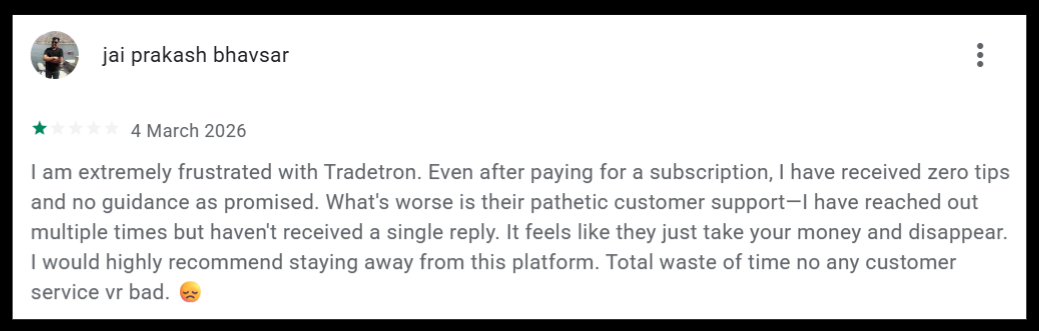
Jai Prakash Bhavsar’s March 2026 Google Play review describes paying for a subscription, receiving zero tips or guidance as promised, and reaching out to support multiple times without a single reply.
He characterised the experience as the company taking money and disappearing. This is not a singular account.
Multiple users across review platforms describe a similar pattern: payment processed smoothly, meaningful support absent entirely.
2. Backtesting Queue and Billing Discrepancies
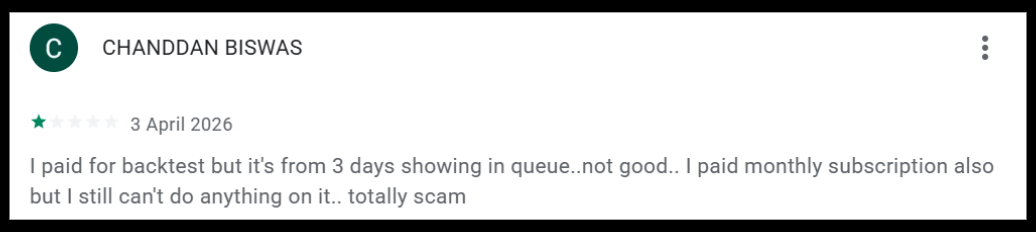
Chanddan Biswas (April 2026) paid separately for a backtest credit and found it stuck in the queue for three consecutive days. He also holds a monthly subscription but described being unable to do anything meaningful on the platform.
The backtesting feature is one of Tradetron’s flagship capabilities, marketed as a tool to validate strategies before going live.
When it fails to execute promptly, the entire value proposition of the platform collapses for users.
3. Live Execution Mismatch
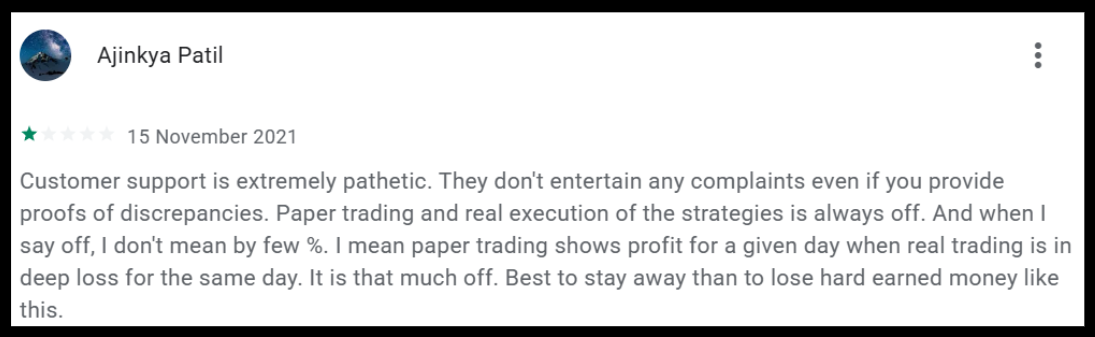
Perhaps the most financially dangerous complaint type concerns the gap between paper trading results and live execution.
Ajinkya Patil (November 2021) described this discrepancy as severe: a strategy showing profitable paper trades on a given day while the real account is in deep loss on the same strategy and same day.
He described this not as a small percentage deviation but as a fundamentally different outcome. This is the kind of gap that can cause significant capital erosion before a trader even identifies what is happening.
4. Early Deployment and Unexpected Exits

Hrishikesh Shukla (March 2023) subscribed to the premium tier after watching Tradetron’s own tutorials on YouTube. His strategies were deployed and squared off in seconds, far before the specified trigger times, resulting in losses and unexpected brokerage charges.
He spent days attempting to reach support, was eventually told to review FAQs, and received no resolution.
This type of technical behaviour, where a strategy fires at unexpected times, is particularly dangerous in options trading, where entry timing drives most of the outcome.
5. Backtesting with Future Data
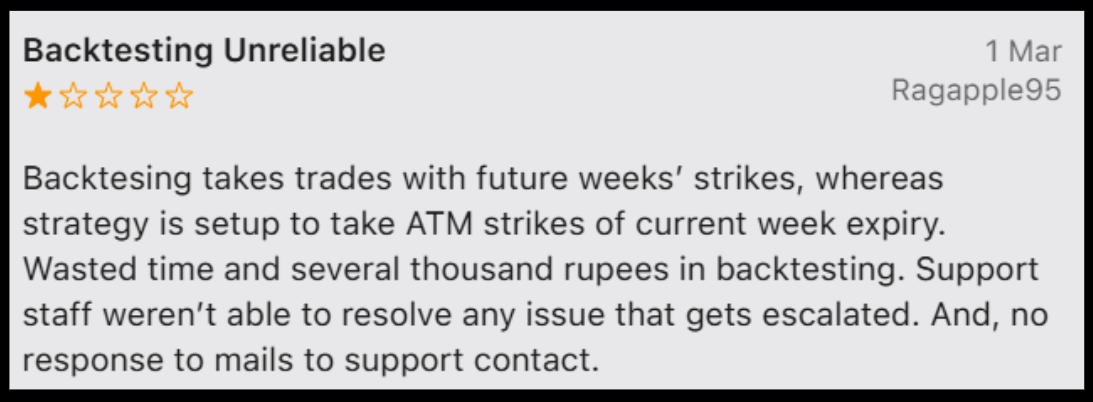
A user identified as Ragapple95 flagged that the backtesting engine was using future week strikes rather than the current week ATM strikes, which the strategy was configured for.
This is not a cosmetic error. Running backtest data with the wrong strikes produces results that have no relationship to what the strategy would have done in real time.
The user reported losing thousands of rupees based on backtested expectations that the live system could not replicate, and received no response when escalating the issue to support.
6. Marketplace Accountability Gap
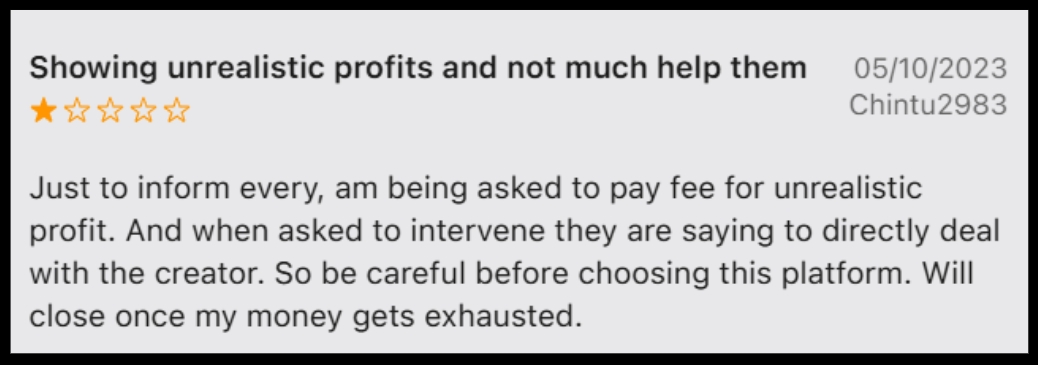
One of the more structural issues users highlight is Tradetron’s hands-off stance toward its own marketplace.
When subscribers encounter unrealistic profit claims or face losses from third-party strategies, Tradetron’s position has been to direct users to deal with the strategy creator directly.
A user reviewing on the App Store noted being asked to pay performance fees for returns that were never realised, with no intervention from the platform.
For retail traders who discover a marketplace strategy’s real performance only after deploying live capital, this accountability gap is a serious concern.
Tradetron SEBI Order
The safety question around Tradetron cannot be addressed without understanding the regulatory action that has unfolded around the platform. This is not a rumour or speculation.
It is a documented sequence of events based on SEBI’s publicly available enforcement records.
The 2022 Circular
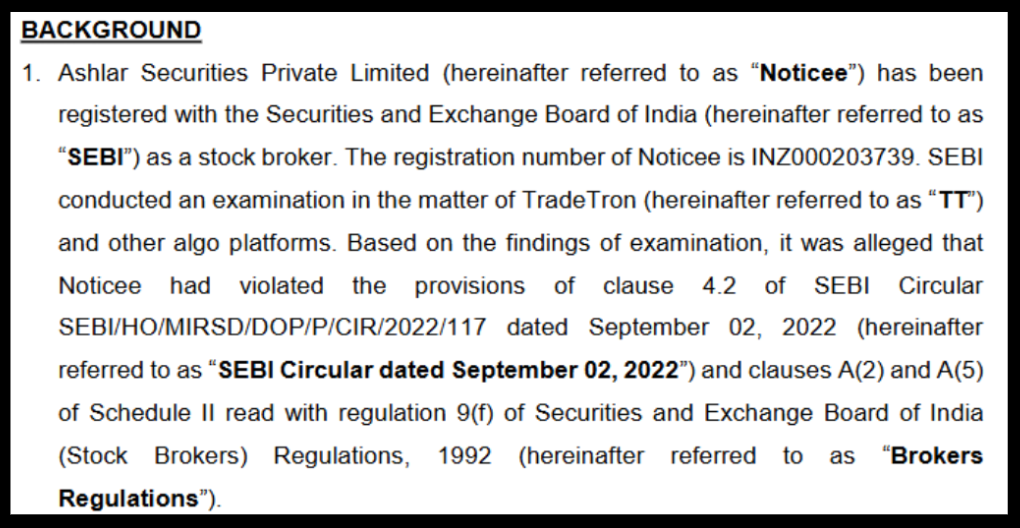
SEBI issued a circular in 2022 that explicitly prohibited stockbrokers from associating with algorithmic trading platforms offering assured or guaranteed returns. The rationale was straightforward: markets cannot guarantee returns, and any platform claiming otherwise is misleading investors.
The circular placed the compliance burden on brokers, requiring them to ensure they had no business ties with non-compliant algo platforms.
The October 2024 Show-Cause Notices
In October 2024, SEBI issued show-cause notices to over 120 stockbrokers for maintaining API integrations with Tradetron.
The regulator’s position was that certain strategies displayed on the Tradetron marketplace carried claims of assured returns, making continued broker association a violation of the 2022 circular.
The list of brokers receiving notices was not limited to small or obscure firms. It included major names such as Zerodha, Motilal Oswal Financial Services, ICICI Securities, HDFC Securities, Angel One, 5Paisa Capital, Kotak Securities, and several others across the industry.
The March 2026 Adjudication Orders
By March 2026, the Securities and Exchange Board of India shifted its approach from issuing preliminary notices to passing formal adjudication orders.
Unlike a show-cause notice, these orders carry enforceable legal consequences.
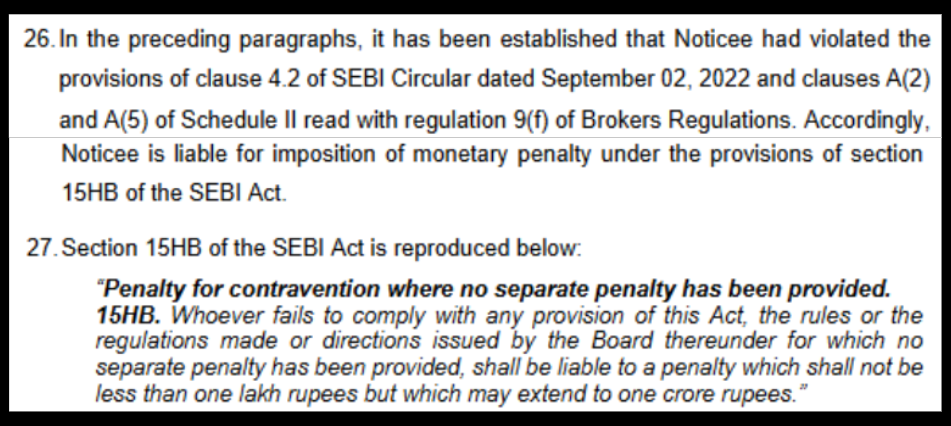
Several brokers, including those mentioned in the Ashlar Securities SEBI order, were subjected to such orders due to their association with platforms like Tradetron and other similar algo-based systems.
The regulator’s findings indicated that certain brokers continued to maintain API integrations with these platforms despite having submitted written assurances stating that such connections had been discontinued.
SEBI also moved to impose a penalty of Rs. 1,00,000/- (Rupees One Lakh) on the noticee under Section 15HB of the SEBI Act.
For retail traders, this development has practical implications.
Brokers linked with Tradetron or comparable platforms may be facing regulatory penalties, which could potentially impact platform reliability, service continuity, or the availability of certain API-based integrations.
What Investors Should Keep in Mind?
Before spending money on any algo trading platform, these practices protect retail traders from predictable harm:
- Start with paper trading for at least four to six weeks on any strategy before deploying live capital. Monitor whether paper results match your expectations and whether the engine runs consistently.
- Verify your broker’s current API status with Tradetron. Call your broker’s compliance desk and ask directly whether the Tradetron integration is active and in good standing with SEBI.
- Do not subscribe to marketplace strategies based on displayed ROI alone. There is no independent verification of those numbers. Treat any percentage return claim as informational, not predictive.
- Read Tradetron’s own FAQ carefully. The platform discloses that backtesting is still in beta for some features and that certain keywords available in live trading do not function in the backtest engine. Do not assume a successful backtest predicts live performance.
- Test support before paying. Send a query to the support team at the free tier level. Evaluate response time and quality before committing to a paid plan.
How to File a Complaint If Things Go Wrong?
If you have already faced financial harm or service failures on the platform, here is the sequence of steps to follow:
- Raise it with Tradetron in writing: Email or use their ticketing system. Specify the date, the issue, and the resolution you are seeking. Save all responses and timestamps.
- Contact your broker: If the issue is related to trade execution, position mismatches, or API behaviour, your SEBI-registered broker is the first formal escalation point. They are regulated and obligated to respond.
- Register a Complaint in SCORES: If your complaint involves a SEBI-registered broker or intermediary, file at scores.sebi.gov.in. Select the correct category and attach payment proof, communication records, and a clear description of the harm.
- File a Complaint in SMART ODR: If SCORES does not produce a resolution, SEBI’s SMART ODR platform offers structured mediation between investors and registered intermediaries.
- Stock Market Arbitration: For unresolved monetary claims that have passed through the above channels, formal stock market arbitration provides a legally binding resolution.
Conclusion
Tradetron offers real functionality that many traders find useful. Its no-code builder, multi-broker integration, and marketplace model represent genuine innovation in making algo trading accessible.
But safety is not a binary label.
It depends on how well-informed you are before you start, how carefully you test before going live, and whether your broker’s API integration remains in good regulatory standing.
The SEBI regulatory proceedings surrounding the platform are not a reason to panic, but they are a reason to proceed with care, verify your broker’s status independently, and never deploy capital you are not fully prepared to lose.





 Add us as a preferred source on Google »

