

Can you trust Siddhant Suresh Chandan? That is one important question every trader should ask before following anyone’s advice.
Every trader has, at some point, come across a market “expert” online claiming to predict winning trades with confidence.
Telegram channels filled with profit screenshots, premium groups promising accuracy, and sales pitches that make success look easy; it’s all over the trading world today.
That question matters more than most traders realise. In the stock market, credibility is not determined by social media followers, bold claims, or flashy screenshots; it comes from regulatory compliance and official records.
When the name Siddhant Suresh Chandan appears in trading discussions, it’s important to look beyond the marketing and examine what SEBI’s documented actions and findings actually say.
In this blog, we break down his SEBI registration status, key warning signs traders should understand, the official SEBI order connected to him, important lessons for investors, and the steps you can take if you believe you’ve been affected.
Is Siddhant Suresh Chandan SEBI Registered?
Let’s start with the most important question every trader should ask first.
No. Siddhant Suresh Chandan is not, and has never been, registered with SEBI as an Investment Adviser or Research Analyst.
Under SEBI’s Investment Advisers Regulations, 2013, any individual who charges fees for investment advice, gives stock tips, or provides buy/sell recommendations is legally required to hold a valid SEBI registration before doing any of that.
Without this registration, offering such services is a direct violation of Indian securities law.
SEBI maintains a public database of all registered investment advisers and research analysts on its official website at sebi.gov.in. Siddhant Suresh Chandan’s name is not present in that database as a registered entity.
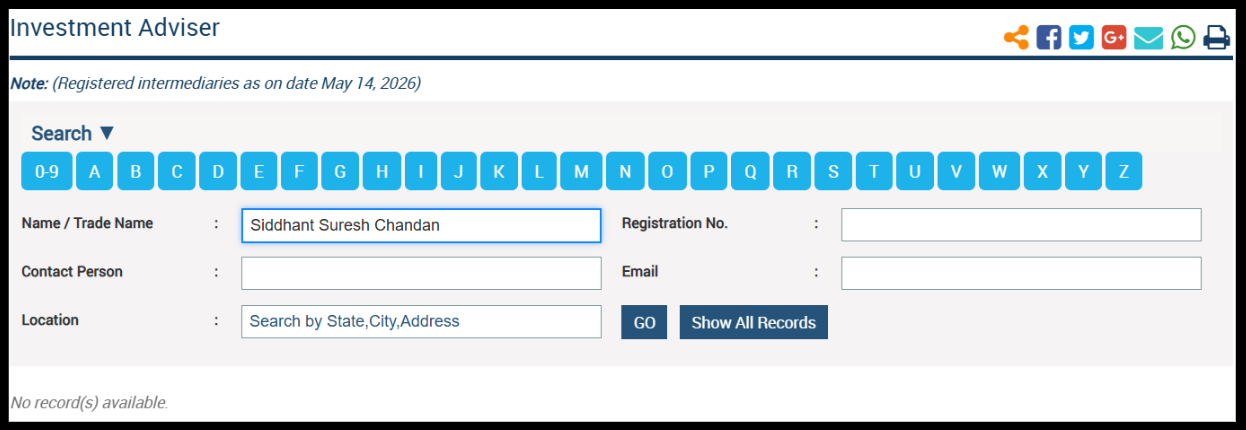
Despite having no valid registration, he was operating a paid Telegram channel, charging subscribers fees for stock market tips, and going further by accessing and managing client demat accounts.
SEBI formally confirmed all of this in its enforcement order.
That is the foundation for the question: Can you trust Siddhant Suresh Chandan? Now let’s look at the bigger picture.
Can You Trust Siddhant Suresh Chandan or Not?
When building a complete picture of whether you can trust Siddhant Suresh Chandan for investment advice, the documented facts speak louder than any claim made on a Telegram channel.
Here are the key red flags that every trader must understand before engaging with someone like him.
1. No SEBI Registration
The single most important filter when choosing any investment adviser is SEBI registration. It is not optional. It is the law.
A person without SEBI registration has no legal standing to charge you for tips, manage your portfolio, or advise you on when to buy or sell.
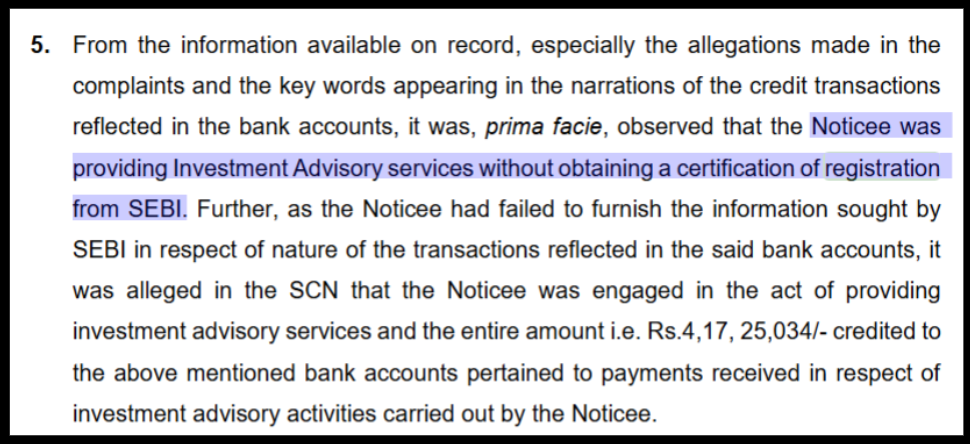
There is no regulatory body overseeing their conduct, no compliance rules they must follow, and no investor protection framework that covers you if things go wrong.
Siddhant Suresh Chandan never held any SEBI registration. Every rupee charged as fees for his advisory services was collected without regulatory authorisation.
2. Promises of 200% Guaranteed Returns
Two investor complaints received by SEBI alleged that Chandan’s Telegram channel promised guaranteed returns of up to 200%. This is not just an unrealistic claim; it is a regulatory violation in itself.
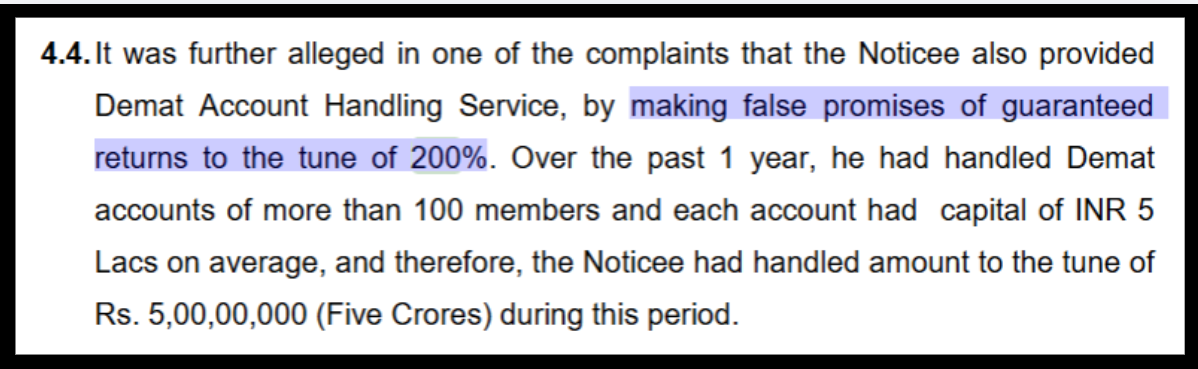
SEBI strictly prohibits any investment adviser, registered or not, from assuring specific profit figures or guaranteeing returns. Markets do not work that way, and anyone who tells you otherwise is either misleading you or setting up a trap.
When someone promises a specific percentage return to get you to subscribe, the goal is to collect your fee, not to protect your capital.
3. Accessing Client Demat Accounts
This is perhaps the most serious red flag of all. Chandan admitted in his own submissions to SEBI that he had been operating the demat accounts of two to four clients every month.
Clients had given him their login credentials and passwords to execute trades on their behalf.
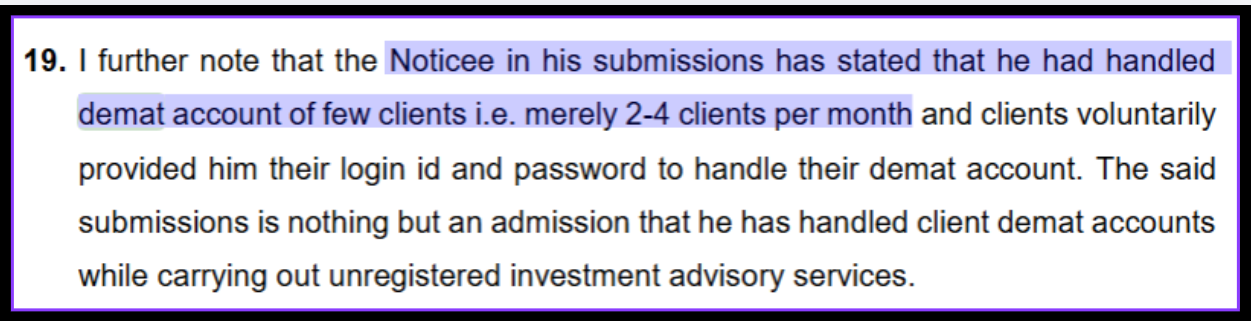
Allowing any unregistered individual to access and operate your demat account is one of the most dangerous things a retail investor can do.
You lose direct control over your own portfolio, and there is no legal protection or audit trail when something goes wrong.
SEBI’s order explicitly stated that this admission confirmed he had been conducting unregistered investment advisory activities while also taking operational control of client accounts.
4. Large Unexplained Credits in Bank Accounts
When SEBI examined his bank accounts, it found a substantial number of credit entries described with language directly connected to stock market activity and securities trading.
His two bank accounts held approximately ₹4.09 crore and ₹7 lakh, respectively.

Chandan’s explanation was that the money came from personal loans from his father, friends, relatives, and a drop-shipping business.
SEBI did not accept this explanation, given the nature and volume of the transactions clearly visible in the records.
Siddhant Suresh Chandan SEBI Order
The story became official on 15 March 2023, when SEBI passed a formal enforcement order against Siddhant Suresh Chandan (PAN: BQWPC6396L), under order number QJA/AA/WRO/WRO/24640/2022-23, issued by Dr. Anitha Anoop, Chief General Manager, SEBI Western Regional Office.
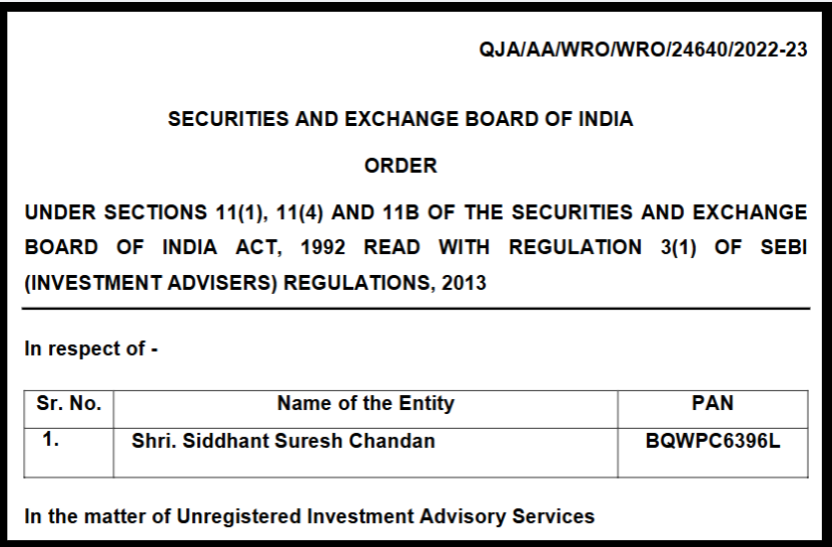
SEBI received two investor complaints alleging that Chandan was running a paid Telegram channel named ‘NO – Bank.Nifty.Options, where he was charging fees between ₹3,000 and ₹25,000 for stock market tips and trading recommendations.
Violations by Siddhant Suresh Chandan
- Operating as an unregistered investment adviser: Providing investment advisory services, giving advice on securities, and charging fees without obtaining mandatory SEBI registration under the Investment Advisers Regulations, 2013
- Charging fees without registration: Collecting money from subscribers in exchange for stock tips and market calls, which is illegal without prior SEBI approval
- Handling client demat accounts: Accessing clients’ demat accounts using their login credentials and executing trades on their behalf while running unregistered advisory operations
- Promising guaranteed returns of 200%: Making misleading and fraudulent assurances of specific return percentages to attract clients and collect fees
- Violating SEBI Act provisions: Acting in a manner that defrauded investors and operated entirely outside the regulatory framework governing investment advisory services in India
SEBI Penalty
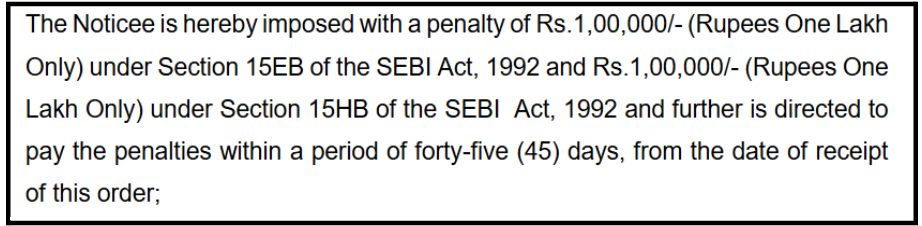
SEBI imposed a total monetary penalty of ₹2,00,000 (Rupees Two Lakhs Only) on the Noticee for violations of securities market regulations.
The penalty was split into two parts: ₹1,00,000 under Section 15EB and ₹1,00,000 under Section 15HB of the SEBI Act, 1992.
The Noticee has been directed to pay the entire penalty amount within 45 days from the date of receipt of the order, failing which further action may be initiated as per the applicable provisions of law.
Beyond the monetary penalty, SEBI issued the following directions:
- Full refund of all fees and consideration collected from clients within three months from the date of the order
- Public notice to be published in two national dailies and one local daily within 15 days, detailing refund modalities and contact details for clients to claim refunds
- Asset freeze, prevented from selling assets, properties, mutual funds, or securities held in demat or physical form, except for the purpose of making refunds
- Remaining balance to be deposited with SEBI into an escrow account for one year for distribution to affected clients; thereafter, transferred to SEBI’s Investor Protection and Education Fund
- Two-year market ban, debarred from accessing the securities market, directly or indirectly, for two years from the date of the order or from the completion of refunds, whichever is later
- Permanent prohibition on conducting investment advisory activities or any securities market activity without obtaining a valid SEBI registration
One important detail that most people miss is that this matter did not end with the 2023 order.
SEBI issued two recovery certificates, RC No. 7807 of 2024 and RC No. 7808 of 2024, against Siddhant Suresh Chandan for his unregistered investment advisory activities.
Recovery certificates are issued when a party has failed to comply with SEBI’s earlier financial directions. They reflect ongoing enforcement, not a resolved matter.
- In April 2026, SEBI issued a Release Order for Recovery Certificate No. 7808 of 2024 in the matter of unregistered investment advisory services against him.
- In May 2026, SEBI issued a Completion Order for Recovery Certificate No. 7807 of 2024 in the same matter.
This timeline tells you that SEBI tracked and pursued compliance from Chandan across 2024 and into 2026, more than three years after the original order.
What Investors Must Keep in Mind?
The case of Siddhant Suresh Chandan reflects a pattern that repeats itself hundreds of times across India’s retail trading ecosystem every year.
Before you engage with any adviser, paid tip service, or Telegram channel, keep these principles in mind.
- Verify registration first, always: Check SEBI’s official intermediary directory at sebi.gov.in before paying a single rupee. A registration number must be present, current, and verifiable.
- No legitimate adviser promises fixed returns: Anyone who tells you they can guarantee 100% or 200% profits is either misleading you or violating SEBI regulations, and usually both.
- Never share your demat login credentials: No adviser, registered or not, needs access to your demat account to give you recommendations. The moment someone asks for your login, stop the conversation.
- Low fees are not a safety signal: Charging ₹3,000 instead of ₹30,000 does not make someone trustworthy or legal. Unauthorised advisory is unauthorised regardless of the price.
- Save every communication from day one: Messages, screenshots, payment proofs, and promises, all of it becomes critical evidence if you need to file a complaint later.
If an adviser’s first pitch is about how much you will earn rather than what risks you are taking, that is your cue to investigate before you invest.
How To File a Complaint Against Siddhant Suresh Chandan?
If you have subscribed to Siddhant Suresh Chandan’s services or any similar unregistered advisory platform and are currently facing issues, taking a structured and documented approach will give your complaint the best chance of being addressed effectively.
Here is how you can report:
- Organise All Your Records: Gather all relevant documents such as payment receipts, chat screenshots, trade recommendations, and call recordings. The stronger your documentation, the better your chances.
- Contact the Platform First: Send a formal written complaint to the platform and keep copies of all communication, including any that go unanswered.
- File a Complaint with SEBI: Since this platform is unregistered, you can directly reach out to SEBI with your supporting evidence.
- File a Cyber Crime Complaint: If you have suffered financial loss or been misled with fake profit claims, report it on the National Cyber Crime Portal.
- Seek Legal Advice if Needed: For significant financial losses, consulting a legal professional experienced in financial disputes can help explore recovery options.
Need Help?
If you are unsure where to begin, we can help you review your case, draft complaint emails, organise your evidence, and guide you through the entire filing process step by step.
Do not let confusion stop you from taking action. Register with us today and get the right support to resolve your situation.
Conclusion
Can you trust Siddhant Suresh Chandan? The documented record gives you the answer.
He operated a paid Telegram channel without any SEBI registration. He charged fees ranging from ₹3,000 to ₹25,000, promised 200% guaranteed returns, and accessed client demat accounts without authorisation.
SEBI formally penalised him ₹2 lakh, banned him from the securities market for two years, and directed a full refund of all fees collected. Recovery proceedings continued into 2026.
There is no grey area here. The regulatory record is clear and public.
If you have already paid fees or handed over your demat credentials, you still have formal remedies available.
Act while your evidence is fresh, and your timelines are still within reach.
In the markets, trusting someone with your money without verifying their credentials costs more than any bad trade ever will.





 Add us as a preferred source on Google »

