

Have you ever joined a Telegram channel claiming to offer “sure-shot” Bank Nifty calls and wondered whether the person behind it was even legally allowed to charge for stock market advice?
That question sits at the heart of the Siddhant Suresh Chandan SEBI Order, a case that highlights how easily retail traders can get drawn into paid trading groups without verifying who is actually authorised to provide such services.
At first glance, everything can look convincing: regular trade calls, profit screenshots, premium memberships, and confident promises of market expertise.
But what many traders fail to check first is: is Siddhant Suresh Chandan SEBI registered?
In this blog, we break down the Siddhant Suresh Chandan SEBI Order step by step, the violations, regulatory findings, penalties imposed, and the key lessons every trader should understand before paying for any stock market “tip” service.
Siddhant Suresh Chandan SEBI Order & Violations
SEBI’s adjudication order against Siddhant Suresh Chandan, bearing order number QJA/AA/WRO/WRO/24640/2022-23 and dated March 15, 2023, was passed by Dr Anitha Anoop, Chief General Manager (CGM) of SEBI’s Western Regional Office.
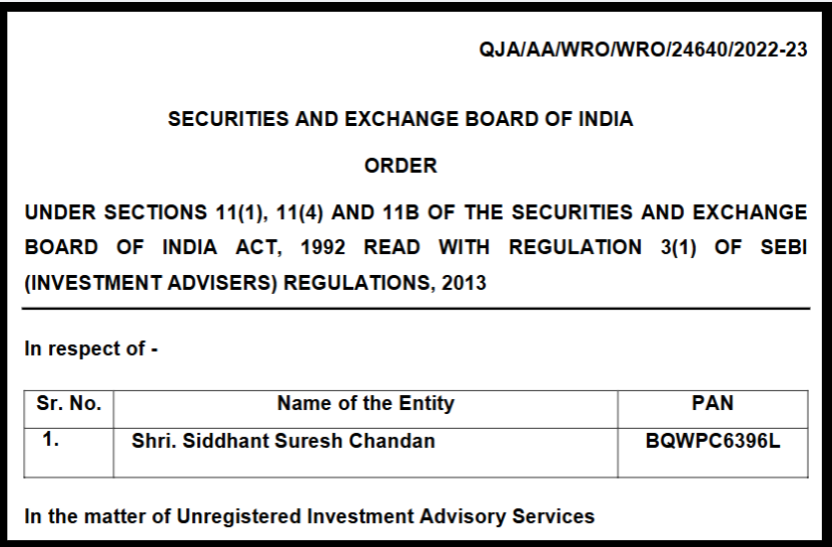
The case began with two investor complaints. Both alleged that Siddhant Suresh Chandan was running a Telegram channel named ‘NO – Bank.Nifty.Options and charging subscribers fees ranging from ₹3,000 to ₹25,000 for market tips and trading recommendations, without any SEBI registration.
SEBI issued a show-cause notice, examined his bank accounts, reviewed his submissions, and proceeded with adjudication. What emerged was a multi-layered set of violations, each serious in its own right.
Violation 1: Providing Investment Advisory Services Without SEBI Registration
The most fundamental violation in this case was operating as an investment adviser without a valid SEBI registration, which is illegal under Section 12(1) of the SEBI Act and Regulation 3(1) of the SEBI (Investment Advisers) Regulations, 2013.
Siddhant Suresh Chandan was running the Telegram channel ‘NO – Bank.Nifty.Options, through which he gave paid recommendations to subscribers on when to buy, sell, or deal in securities and investment products, primarily Bank Nifty options and related instruments.
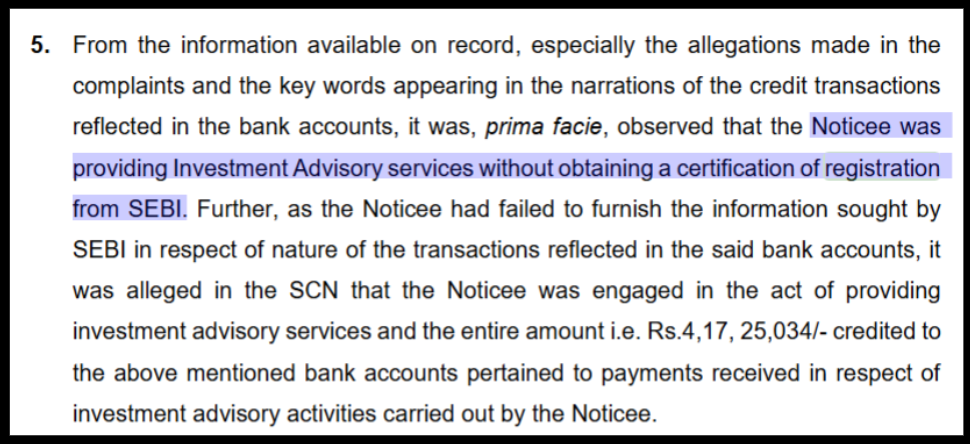
Under Indian law, anyone who charges a fee for investment advice must first register with SEBI as an Investment Adviser. There are no exceptions, whether the advice is delivered via Telegram, WhatsApp, YouTube, or any other platform.
He was not registered. He did not have SEBI’s approval to offer such services. Yet the channel operated, fees were collected, and clients acted on his calls.
When SEBI confronted him, he did not deny the activity. Instead, he argued that he was young when he started, was unaware of the registration requirement, and pointed out that others had committed similar violations.
SEBI found none of these arguments to be a valid legal defence.
Violation 2: Operating Client Demat Accounts Without Authorisation
Beyond just providing tips, Siddhant Suresh Chandan went considerably further; he actually logged into and operated the demat accounts of some of his clients.
In his own submissions before SEBI, he admitted that clients voluntarily gave him their demat account login credentials, username and password, so that he could handle trades on their behalf.
He tried to frame this as a minor matter, noting that it was only two to four clients per month and that the clients had given consent.
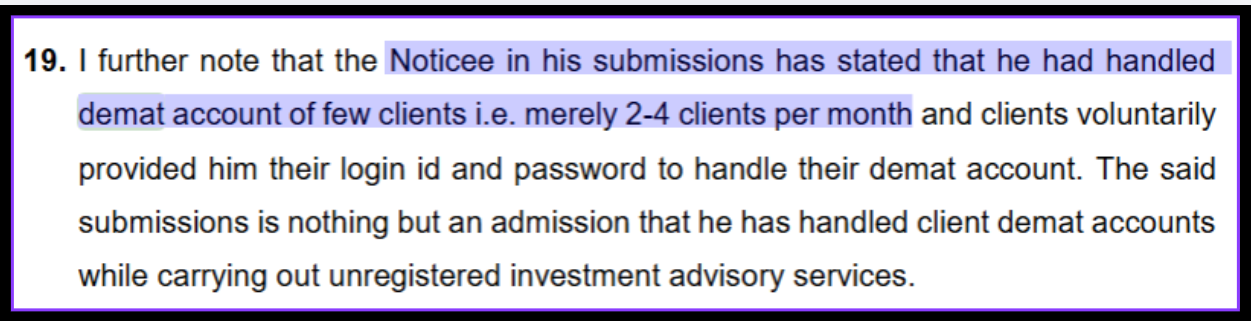
SEBI rejected this framing entirely. The CGM’s order noted clearly that his own admission confirmed he was handling client demat accounts while simultaneously running unregistered advisory services.
Managing someone’s demat account is not a small step; it gives a completely unregulated person direct control over a client’s investments.
This is far beyond the scope of what even a registered Investment Advis
er is permitted to do. A registered IA can only advise; they cannot trade on a client’s behalf without separate authorisation under portfolio management regulations.
For someone without any registration at all, this was a particularly serious overreach.
Violation 3: Promising Guaranteed Returns of Up to 200%
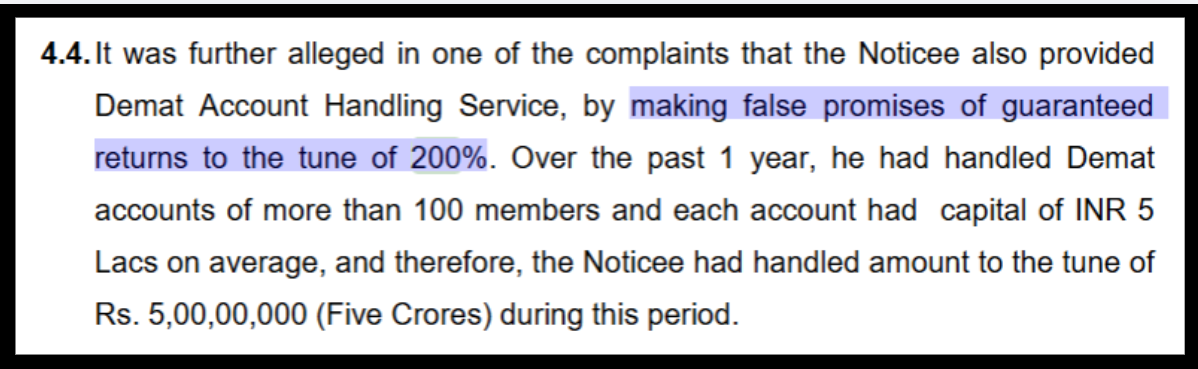
One of the complaints received by SEBI also alleged that Siddhant Suresh Chandan made promises of guaranteed returns, reportedly claiming returns of up to 200% to attract and retain subscribers.
Promising assured or guaranteed returns is illegal in the securities market. No market outcome can be guaranteed, and representing otherwise is both misleading and manipulative.
Under SEBI regulations, this kind of conduct falls squarely within the definition of fraud.
SEBI’s examination of his bank account records further revealed a large number of credit entries bearing descriptions related to stocks and the securities market, providing documentary evidence consistent with receiving advisory fees from multiple clients over a sustained period.
His bank accounts showed balances of approximately ₹4.09 crore and ₹7 lakh across two accounts. He claimed in his response that this money came from a personal loan from his father, and from friends, relatives, and clients of a drop-shipping business he claimed to run.
SEBI did not find these explanations consistent with the nature and pattern of the credits found.
Violation 4: Fraudulent and Deceptive Conduct Under PFUTP Regulations
The combination of running an unregistered advisory channel, making guarantee-of-returns claims, and operating client demat accounts without authorisation amounted to more than a technical regulatory lapse.
SEBI held that Siddhant Suresh Chandan’s conduct constituted fraud within the meaning of the SEBI (Prohibition of Fraudulent and Unfair Trade Practices) Regulations, 2003, specifically Regulation 2(1)(c) of the PFUTP Regulations, read with Sections 12A(a), 12A(b), and 12A(c) of the SEBI Act.
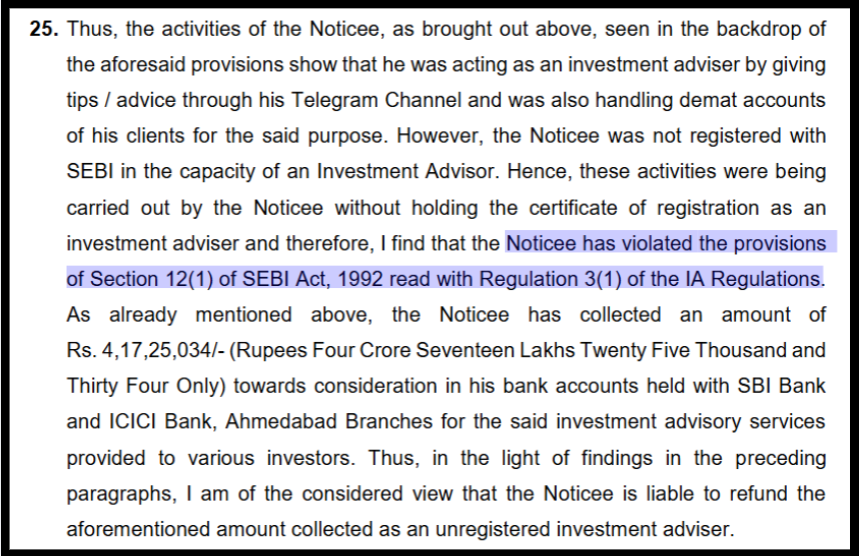
The PFUTP Regulations define fraud broadly. Any conduct, even without explicit deception, that induces another person to deal in securities qualifies.
Charging fees for unregistered advice while promising guaranteed returns, and then actually operating client trading accounts, clearly met this standard.
This finding elevated the case from a simple registration violation to a fraud finding, one that carries heavier legal consequences and reflects a more serious breach of investor trust.
Many traders who come across this case have already asked themselves: can you trust Siddhant Suresh Chandan with your money or your demat account?
Four violations later, SEBI answered that question through a formal enforcement order.
Penalty Imposed by SEBI on Siddhant Suresh Chandan
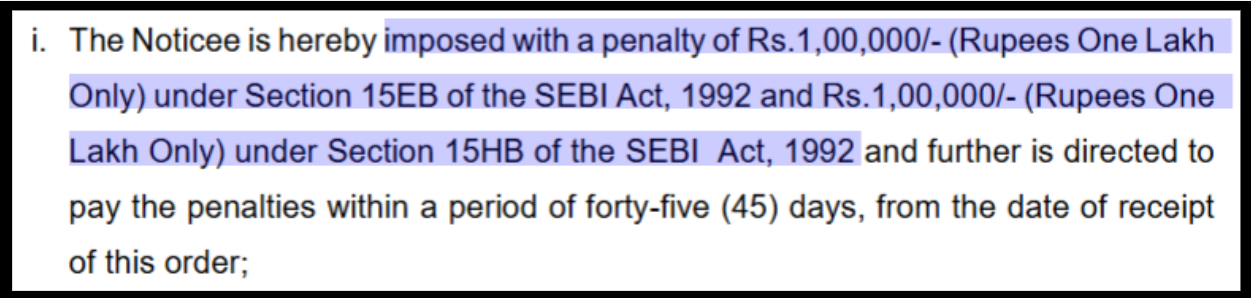
After examining all the evidence and considering his submissions, SEBI passed the following directions in its March 15, 2023, order:
- A monetary penalty of ₹2 lakh was imposed under Section 15EB of the SEBI Act for providing unregistered investment advisory services.
- He was directed to refund the entire amount collected as fees from clients within 45 days.
- He was barred from the securities market for two years, meaning he could not buy, sell, or deal in securities directly or indirectly during this period.
The penalty, refund obligation, and market ban together formed a significant set of consequences, and as subsequent proceedings showed, enforcement did not stop there.
Siddhant Suresh Chandan Recovery Proceedings
The March 2023 order was not the end of SEBI’s action.
When a person fails to comply with SEBI’s monetary directions, the regulator has statutory powers to initiate formal recovery proceedings, and that is precisely what happened here.
SEBI issued two recovery certificates against Siddhant Suresh Chandan in 2024:
- Recovery Certificate No. 7807 of 2024
- Recovery Certificate No. 7808 of 2024
Both were issued in the matter of unregistered investment advisory services, meaning compliance with the 2023 order’s monetary directions had not been completed voluntarily, prompting SEBI to escalate to formal recovery action.
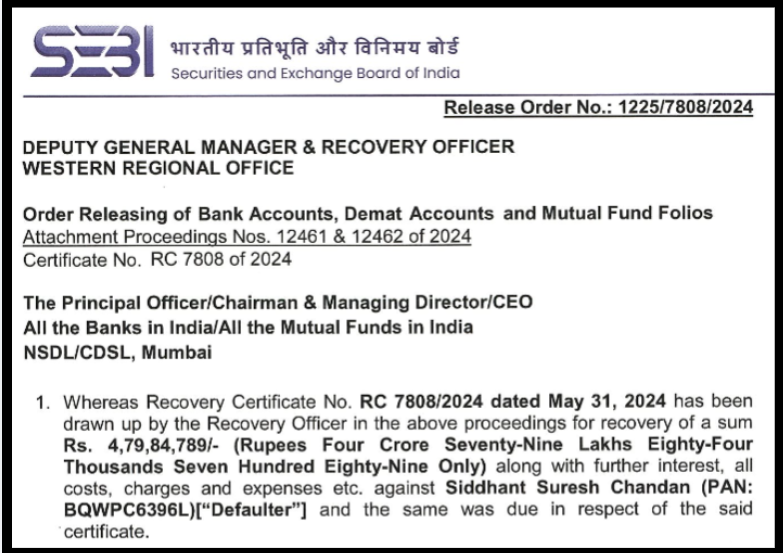
Recovery certificates are a serious step. They are issued under SEBI’s statutory recovery powers and allow the regulator to pursue the recovery of dues in the same manner as arrears of land revenue, a powerful enforcement mechanism.
In a notable development, SEBI issued a Release Order for Recovery Certificate No. 7808 of 2024 on April 10, 2026, signalling that the obligations under that specific certificate had been fulfilled.
Shortly thereafter, SEBI issued a Compliance Completion Order for Recovery Certificate No. 7807 of 2024 in May 2026, confirming that the remaining directions had also been complied with.
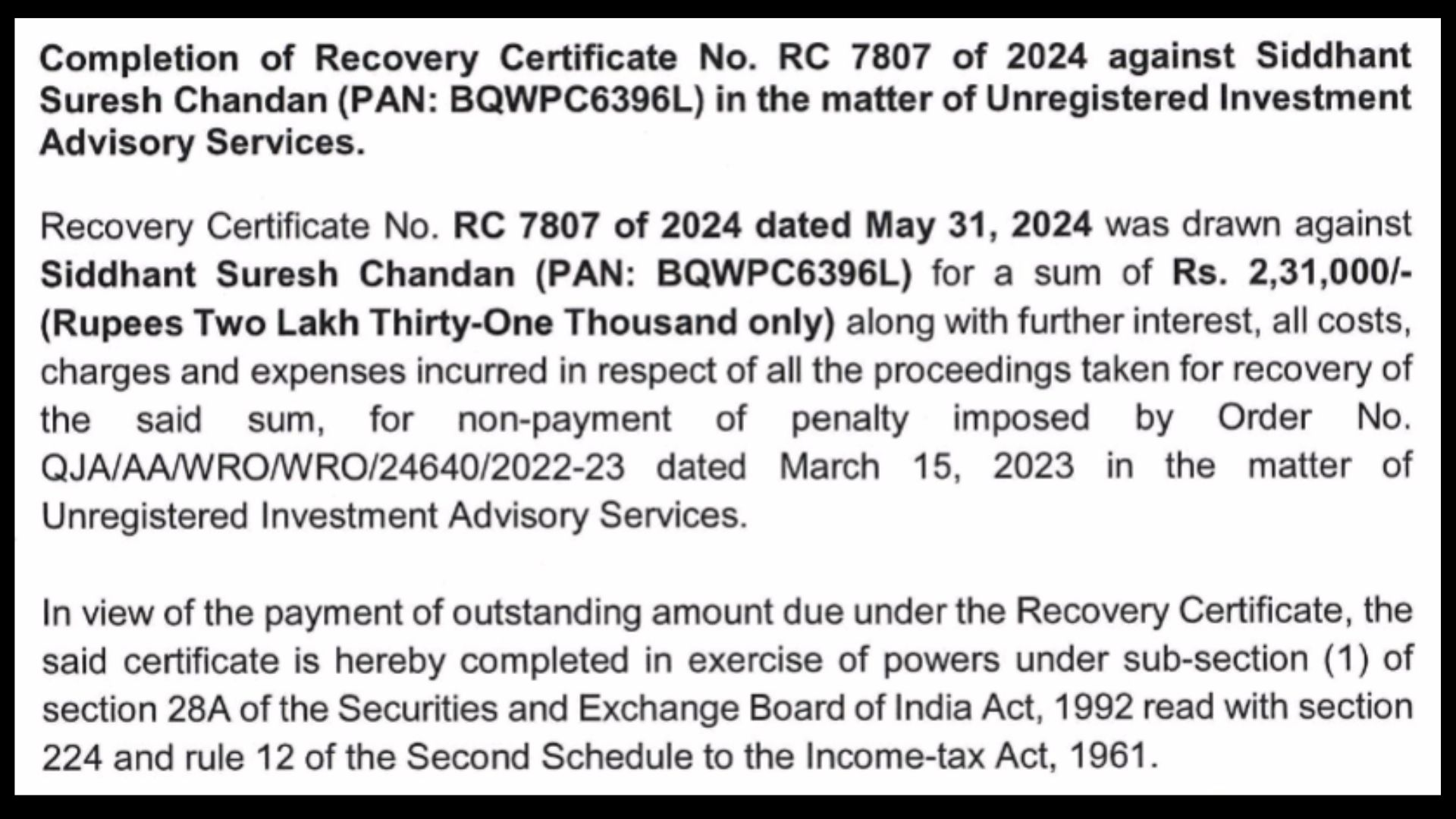
This three-year enforcement arc, from the 2023 adjudication order through 2024 recovery certificates to 2026 compliance completions, shows just how seriously SEBI pursued this case to its conclusion.
Additionally, records from the Securities Appellate Tribunal (SAT) confirm that Siddhant Suresh Chandan also filed an appeal (Case No. SEBI/0150/2025, filed on February 26, 2025) before the SAT in Mumbai, with the case listed as pending as of the last update available.
What Retail Investors Can Learn From This?
The Siddhant Suresh Chandan case is not about a sophisticated financial operator with a complex scheme.
It is the story of a Telegram channel, paid trading tips, a few thousand rupees per subscriber, and zero regulatory authorisation, a setup that thousands of retail traders encounter every single day.
That is exactly what makes it important to understand.
- A Telegram channel is not a credential: Any person can start a Telegram channel, post trade calls, and charge a subscription fee. None of that means they are legally authorised to advise you on investments.
- Verify SEBI registration before paying a rupee: Every registered Investment Adviser appears on the SEBI website at www.sebi.gov.in. It takes under two minutes to check. Make it a habit before joining any paid channel.
- Giving someone your demat login is never safe: No legitimate, registered adviser will ask for your demat account credentials. Anyone who does is operating outside the law, and your funds are entirely at risk.
- Guaranteed returns are a red flag, not a selling point: The securities market cannot guarantee outcomes. Anyone promising fixed or high-assured returns is violating SEBI regulations, and that promise itself is a signal to walk away.
- Bank account size is not evidence of legitimacy: Large inflows in a bank account can reflect advisory fees collected from many clients, not business success or market expertise.
How To File A Complaint Against Siddhant Suresh Chandan?
Conclusion
The Siddhant Suresh Chandan SEBI order is a clear reminder that the securities market has rules, and SEBI enforces them, even against individual operators running small Telegram channels.
Charging ₹3,000 to ₹25,000 per subscriber for Bank Nifty tips without registration, operating client demat accounts without authorisation, and making guarantees of 200% returns are not minor oversights.
They are serious regulatory violations that SEBI pursued through adjudication in 2023, recovery certificates in 2024, and compliance completion orders all the way into 2026.
For you as a trader, the takeaway is this: before you follow any paid tip channel or advisory service, spend two minutes on the SEBI website and verify whether they are registered.
That one check is the most powerful protection available to any retail investor.
No registration. No trust.





 Add us as a preferred source on Google »

