

Quick Summary
Meeshika Vishwakarma operated Sai Proficient Research Investment Advisory, holding SEBI Investment Adviser registration INA000002674 since December 2014. SEBI’s February 2026 order found five violations related to misleading marketing and investor protection failures. SEBI suspended her registration for one year and separately imposed a ₹19,77,000 monetary penalty. This page covers the registration, the business, and where to find the complete violation breakdown, user complaints, and complaint filing process.
You saw an accuracy claim online. Maybe 90%. Maybe 95%. It sounded too good to check twice.
That’s exactly how thousands of retail traders ended up trusting Meeshika Vishwakarma and Sai Proficient Research Investment Advisory, right up until SEBI’s own investigation revealed what was actually happening behind those numbers.
Beginners are drawn in by promises of high accuracy and profit screenshots, rarely pausing to ask what’s missing from the picture.
And this case proves something worth remembering: even a genuine, SEBI-registered adviser can still face the regulator’s strictest action.
Sai Proficient Proprietor
Meeshika Vishwakarma is the proprietor behind Sai Proficient Research Investment Advisory, which operated through its own website.
The business positioned itself as a stock market advisory service offering trading recommendations, investment guidance, and premium subscription plans.
The company relied heavily on online marketing: performance-based promotional content, accuracy claims, and aggressive client acquisition funnels.
For many beginners, the platform appeared professional and trustworthy.
Unlike a large brokerage or corporate advisory house, this operated as an individual proprietorship.
That structure matters because there is no separate board, no independent compliance function, and no layer of internal oversight between the owner and the client-facing sales operation.
When the same individual owns the business, sets its marketing tone, and approves the fee structure, the accountability for every claim made to a client ultimately traces back to one person.
This is exactly why SEBI’s final order named Meeshika Vishwakarma personally rather than referring only to a company.
Is Sai Proficient SEBI Registered?
Meeshika Vishwakarma was registered with SEBI as an Investment Adviser under registration number INA000002674, originally granted in December 2014.
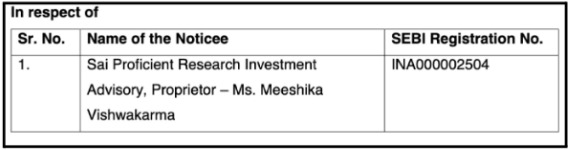
That registration is no longer active today. SEBI’s own order following the February 2026 enquiry suspended it, meaning she is not currently authorised to provide investment advisory services under this licence.
A SEBI registration is simply permission to operate within a regulated framework. It does not guarantee profits, high accuracy, or fair business practices.
When those rules are violated, SEBI can suspend or cancel the registration entirely, exactly what happened in this case.
Always verify the current status directly on sebi.gov.in rather than assuming a registration is still valid just because it was granted at some point in the past.
An Investment Adviser (IA) registration is one of several distinct categories under SEBI’s framework, and it comes with specific obligations that differ from a Research Analyst or a Portfolio Manager licence
Understanding exactly what this registration allows and prohibits helps explain why SEBI’s order against Sai Proficient was so serious, since nearly every obligation below was found breached.
A registered IA is permitted to:
- Assess a client’s financial situation and risk appetite before giving any advice.
- Recommend specific investment products suited to that individual profile.
- Charge a fee for this personalised advice.
A registered IA is not permitted to:
- Guarantee any return outcome, however it is phrased.
- Route client payments through an entity that itself holds no SEBI registration.
- Skip mandatory risk profiling and KYC documentation for any client.
Every one of these prohibited actions is exactly what SEBI’s order against Sai Proficient found had occurred.
Why Did SEBI Take Action Against Sai Proficient?
SEBI’s February 2026 enquiry order found five violations, covering misleading accuracy claims, payments routed through an unregistered entity, aggressive fee escalation, missing compliance records, and unresolved investor complaints.
The registration was suspended for one year, and a separate ₹19,77,000 monetary penalty was imposed.
The full violation-by-violation breakdown, including the exact language SEBI cited and the complete penalty reasoning, is covered on the SEBI action against Sai Proficient page on this site.
Sai Proficient Complaints
Multiple investors have shared negative experiences online about Sai Proficient Research Investment Advisory.
These accounts are taken from public Google Reviews and reflect personal experiences shared by real users, not verified or independently audited claims.
1. “Profit Sharing” Plan Changed Later
One user claimed the sales team convinced him to join a 45-day “profit sharing” package for Rs 3,000 in registration fees, promising a 70:30 profit-sharing model.

Losses started from the first day.
Executives kept saying future trades would recover the losses. After around 9 days, the service suddenly stopped, and the company asked for another Rs 3,000 to restart.
The company later allegedly denied selling any “profit sharing” package at all.
2. User Claimed Loss of Nearly Rs 3 Lakh
Another reviewer posted a very angry complaint against Sai Proficient and called the service misleading.
The user claimed:
- They lost almost Rs 3 lakh after following the company’s calls.
- The firm charged another Rs 35,000 for something called “data calls”.
- The recommendations did not work as promised.
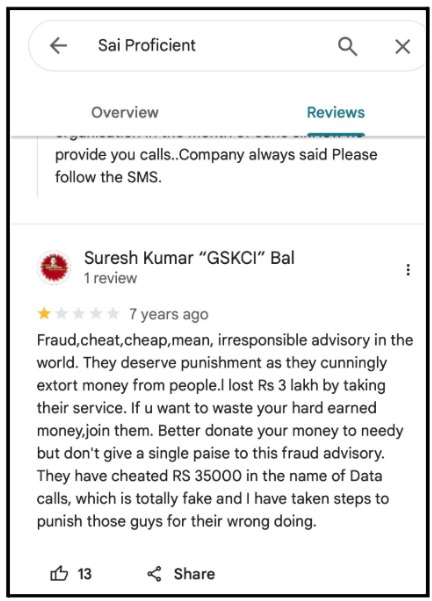
The reviewer also said the company made big claims while selling the service, but failed to deliver results later.
The complaint mainly shows how frustrated the user became after facing heavy losses and paying large fees.
3. Back-to-Back Losing Calls
Another investor shared an experience after taking a trial call from the company.
According to the review, the first trade caused a loss of around Rs 5,000. The second call resulted in another loss of nearly Rs 4,000. After that, executives reportedly upgraded the user to a “prime” category and promised better performance.
But the user claimed the third call also went wrong.
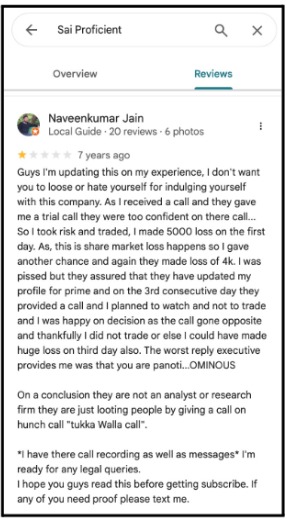
The reviewer further alleged that when they complained, an executive behaved unprofessionally and blamed the client instead of addressing the issue properly.
The user described the recommendations as random “tukka calls” instead of proper research-based calls.
The reviewer also claimed to have call recordings and chat messages saved as proof.
4. Company Kept Asking for More Money
One reviewer claimed the company first sold a package for Rs 7,500. After the service failed, an executive convinced him to upgrade to a Rs 21,000 package, then later to a “Platinum” package.
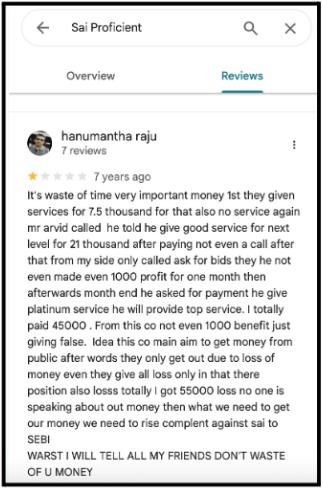
The user ended up paying nearly Rs 45,000 in total, while overall trading losses reached around Rs 55,000.
5. Fraudulent Company Allegation, Rs 34,000 Lost
Another trader described Sai Proficient as a fraudulent company and claimed to have lost around Rs 34,000 within just two trading days.
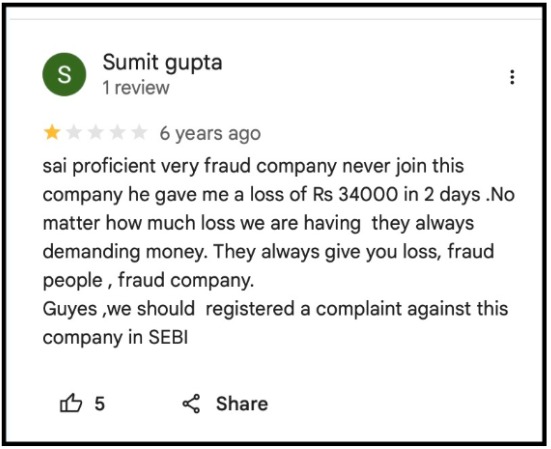
The reviewer alleged that despite continuous losses, company representatives kept demanding more money for services. The user claimed the recommendations only resulted in losses while executives continued asking for additional payments.
The reviewer also urged other investors to file complaints against the company with SEBI.
6. Rs 1.5 Lakh Lost in a Few Sessions
Another complaint came from a trader who claimed to have known the company for more than two years.
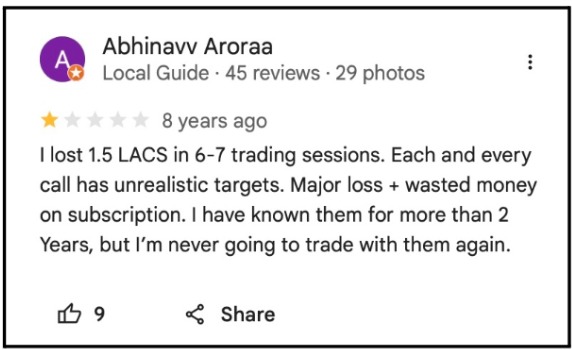
According to the review, the user lost around Rs 1.5 lakh within 6–7 trading sessions. The reviewer claimed the company provided calls with unrealistic targets, and the subscription fees became an additional burden on top of trading losses.
The user finally stated they would never trade with the company again.
7. Almost Every Call Hit Stop Loss
One reviewer claimed to have suffered losses of nearly Rs 5 lakh within a week after following Sai Proficient’s recommendations.
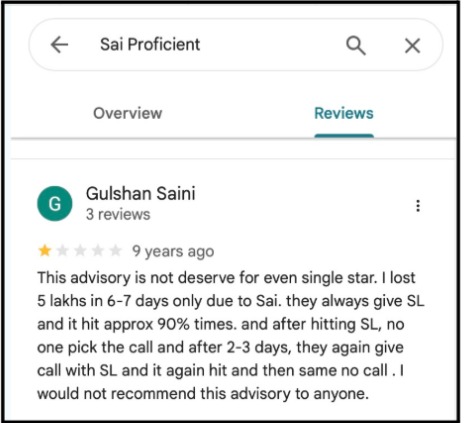
According to the complaint, almost every trade ended in a stop loss. The user further alleged that after the losses happened, company representatives stopped answering calls for several days.
The reviewer claimed the same cycle repeated again later with fresh calls and fresh stop losses.
The user strongly advised others not to subscribe to the advisory service.
8. Abusive Behaviour From Executives
Another serious complaint involved allegations of abusive behaviour from company representatives.
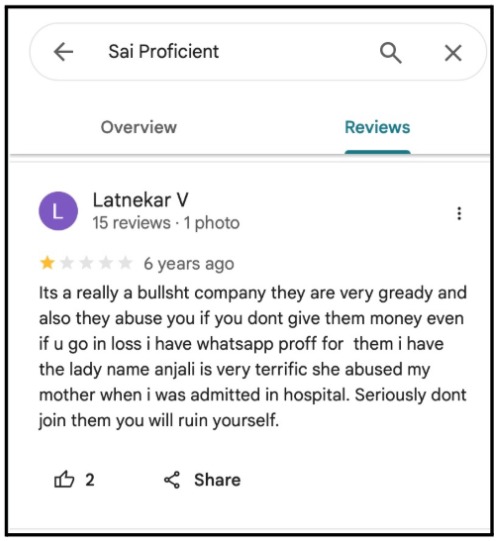
The reviewer claimed executives continued demanding money even after losses. The user also alleged that one employee behaved abusively and used offensive language during communication.
According to the complaint, this behaviour happened while the reviewer was admitted to a hospital.
The user further claimed to have WhatsApp chats saved as proof of the conversation.
Misleading Investment Claims by Sai Proficient
Beyond public reviews, SEBI’s own order cites two specific named client cases involving large fee payments tied to promised profit figures.
1. The Sameer Mahawar Case
According to SEBI’s findings, this client allegedly paid around ₹14.25 lakh in service fees.
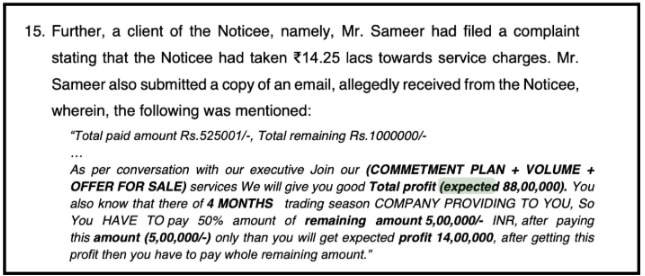
An email reportedly promised expected profits of ₹88 lakh, along with additional profit potential after further payments and structured payment demands tied to projected gains.
2. The Shyam Sunder Viramani Case
According to the order, this client was allegedly induced to pay around ₹5 lakh after receiving emails claiming 90-95% accuracy and expected profits of around ₹8 lakh.
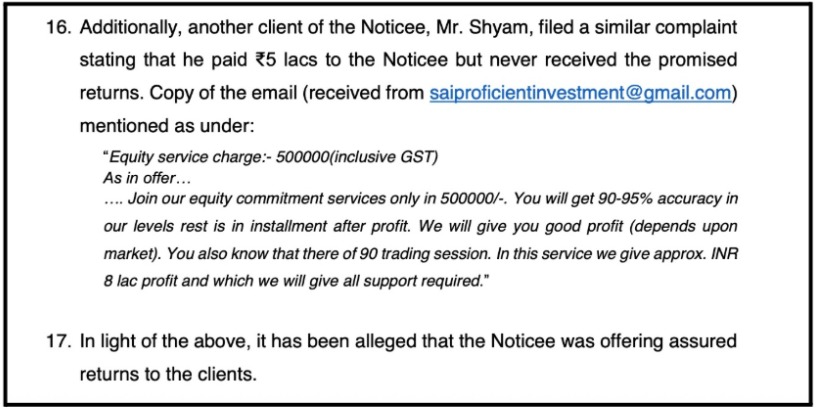
Once large profit numbers are repeatedly shown alongside high-accuracy language, many traders begin believing the profits are almost certain.
That is exactly where the risk becomes dangerous.
Total Money Routed Through the Unregistered Entity
According to SEBI, investor money was routed through an entity called Shree Sai Proficient Financial Services, which was not registered with SEBI.
Total receipts through this arrangement crossed more than ₹3.31 crore.
From an investor’s perspective, this creates major transparency concerns about who is actually receiving the money and who is legally accountable.
What to Verify Before Trusting Any Investment Adviser?
A few checks, done before you pay anything, can save you from repeating the exact pattern seen in this case.
- Be cautious the moment you see phrases like “guaranteed returns,” “sure-shot profits,” or “high-accuracy trading.” No adviser can predict the stock market consistently.
- Watch for continuous upgrade pressure. If an adviser constantly asks for more money to unlock advanced services or recover losses, slow down.
- Ask for the registration number directly and check it yourself on sebi.gov.in, rather than relying on what the firm’s own marketing states.
- Confirm the current status shows “Active,” not merely that a number exists. A registration that appears in search results could still be suspended or cancelled at the time you check.
- Ask for the risk profiling document before paying anything. A genuine adviser assesses your financial situation first; if this step is skipped or rushed, treat that as a warning sign on its own.
Did the accuracy claims or profit projections you were shown before paying not match what you actually experienced?
Our team will review your documents, identifies every applicable violation, and prepares your case for formal escalation.
Where Does Your Complaint Actually Go?
The right complaint channel depends on one thing: whether the entity you paid still holds an active SEBI registration at the time you file.
Sai Proficient’s registration is currently suspended, not cancelled outright, which puts this case in a slightly different position than a fully unregistered operator.
Both paths are worth knowing, since a suspension can end and the same channels may apply differently depending on when your issue arose.
While the Registration Was Active
Begin with a written complaint to the firm directly, stating the service purchased, the amount paid, and the resolution you’re seeking.
If there’s no response, a SEBI SCORES complaint places your grievance on the regulator’s formal record.
When SCORES doesn’t bring resolution, the SMART ODR portal offers a structured mediation route as the next step.
For losses that remain unsettled after mediation, share market arbitration delivers a formal, binding outcome.
The complete process, including document checklists and timelines, is on the complaint against SEBI registered investment advisor page.
If the Registration Is Suspended or No Longer Valid
Since Sai Proficient’s licence is currently suspended, filing through SCORES against an inactive registration may not carry the same weight it would against an active one.
A cyber crime complaint becomes the more reliable route for reporting financial fraud tied to this period, with your acknowledgement number serving as your official case reference.
Filing an FIR at your local police station remains available too. Under Section 154 CrPC, they’re required to accept your complaint regardless of whether a dedicated cyber cell exists nearby.
Notifying your bank promptly improves the odds of tracing or freezing any traceable payment.
Separately, sending a written email directly to SEBI flagging the individual and the registration number helps ensure the matter stays on record, even outside the formal complaint portals, and supports scrutiny of any future registration attempt under the same name.
Conclusion
Meeshika Vishwakarma’s suspended SEBI registration is a clear reminder that even a genuine licence doesn’t guarantee ethical conduct.
The pattern here: misleading accuracy claims, unregistered payment routing, and unresolved complaints, is exactly what investors should learn to spot early.
A registration number confirms permission to operate, nothing more.
Protecting your capital starts with independent verification, not trust built on confident marketing or promises that sound too good to be true.
Report. Recover. Stay Fraud Free.
Frequently Asked Questions
Her registration under INA000002674 was suspended for one year following SEBI's February 2026 order. Verify current status directly at sebi.gov.in under Investment Adviser.
A ₹19,77,000 monetary penalty alongside the one-year registration suspension. The full breakdown of every violation is on the SEBI action against Sai Proficient page on this site.
Yes, multiple accounts including two named cases cited directly in SEBI's own order. Every account is covered in full above on this page.
Collect all payment records and communication history. File a written complaint with the firm first, then escalate through SEBI SCORES, SMART ODR, and arbitration if unresolved.





 Add us as a preferred source on Google »

