

Quick Summary
Choice Broking account handling has drawn regulatory attention twice: a ₹10 lakh SEBI penalty in 2019 for misusing client funds, and a ₹2 lakh penalty in 2023 after unauthorised individuals were found operating trading terminals. Three arbitration cases followed a similar pattern, fabricated profit reports and missing call recordings, with awards ranging from ₹4.2 lakh to ₹21.08 lakh. In every case, one question decided the outcome: could the broker prove the client actually said yes. This blog covers both orders and all three cases in full, plus exactly what to document if your own account shows anything similar.
Imagine logging into your Choice Broking account out of pure habit, the way you check your phone first thing in the morning, and spotting a trade sitting in your history that you have no memory of placing.
That’s not a hypothetical.
Choice Broking account handling has produced two separate SEBI orders and three arbitration awards, one of them crossing ₹21 lakh, all built around the same failure: staff acting in a client’s account without real proof of consent.
When you hand your money to a stockbroker, you’re trusting them to act only when you actually tell them to.
This blog walks through what happened when that trust broke, in the regulator’s own findings and in three tribunal decisions, and what to check in your own account before you become case number four.
What Does Account Handling Actually Mean?
Choice Equity Broking Private Limited, known simply as Choice Broking, has been operating for over a decade, headquartered in Mumbai with a network across the country.
It holds a real SEBI registration, INZ000160131, and sits as a member of BSE, NSE, MCX, and NCDEX. On paper, every box is checked.
But here’s a question worth asking before you hand any broker your money. What does “account handling” actually mean, day to day?
Stripped of jargon, it’s simple.
Your broker trades when you say so, manages your funds properly, keeps accurate records, settles your account on time, and makes sure nobody touches your account without your say-so.
Done right, it’s invisible. You never even notice it’s working.
The moment it breaks, you get unauthorised trading, a transaction traced back to the broker or their staff, not to you. No instruction. No warning.
Just a trade that shows up. If that’s happened to you, you’re not imagining it, and the rules are genuinely on your side.
SEBI Orders Against Choice Broking
Two orders exist here, years apart, and they’re worth reading as two completely different stories, not one broker making the same mistake twice.
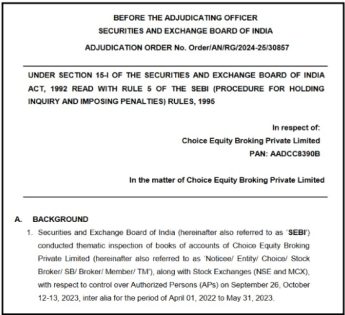
The first is about money that wasn’t supposed to move.
The second is about people who weren’t supposed to be there at all.
Order 1: Misuse of Client Funds (2019)
What happened: SEBI found that Choice Broking had used one client’s credit balance to cover another client’s debit shortfall, moving money between accounts without the authorisation to do it.
Why it matters: think about what that means practically. Your money, potentially propping up someone else’s obligation, without you ever being told.
That’s not a clerical slip; it’s treating client funds as one shared pool instead of money held separately, in trust, for the person who deposited it.
Penalty imposed: ₹10,00,000.
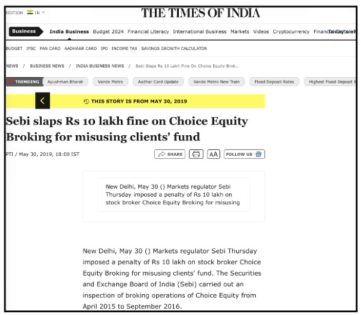
Order 2: Unauthorised Persons Operating Trading Terminals (2023)
What happened: a joint SEBI, NSE, and MCX inspection uncovered a pattern, not a single slip:
- People with no authorisation operating trading terminals at Authorized Persons, including Stockology Securities and Maloo Commodities
- A separate AP, Grow Capital, transferring client funds, brokerage refunds included, in ways that broke NSE’s own rules
- Missing complaint registers and incorrect addresses on file
- Under-reporting of how many clients its APs were actually managing
Why it matters: Choice tried to explain it away. SEBI rejected the explanations outright, calling out a plain lack of due diligence.
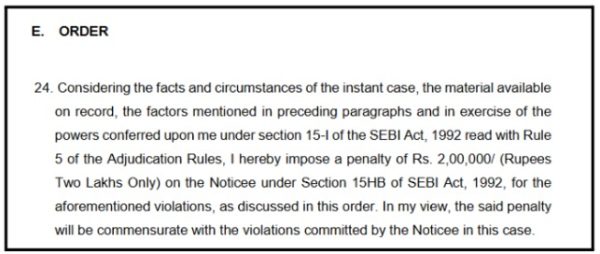
Penalty imposed: ₹2,00,000 under Section 15HB of the SEBI Act, due within 45 days.
What this means for you: before opening an account anywhere, check who’s actually authorised to touch your funds and terminal access.
Route money through the main broker directly where possible, not through an AP. And search the broker’s name on SEBI’s own website first; it takes five minutes and would have flagged both orders above instantly.
For the broader picture of what else investors are reporting against this broker, our page on Choice Broking complaints covers the full exchange data and a separate ₹33.73 lakh case.
Also Read: account handling by Nirmal Bang, six straight years of data. Every single one shows the same category present.
Choice Broking Arbitration Cases for Unauthorised Trading
Arbitration is what happens once a complaint hasn’t gone anywhere and an investor wants an actual, binding decision instead of another round of emails.
Three people took Choice Broking that far, and no two of their stories look the same.
Case 1: Santosh Kumar Banerjee, Shared Credentials, Split Liability
This is the case that should make you wince a little, because the mistake at the center of it is one almost anyone could make.
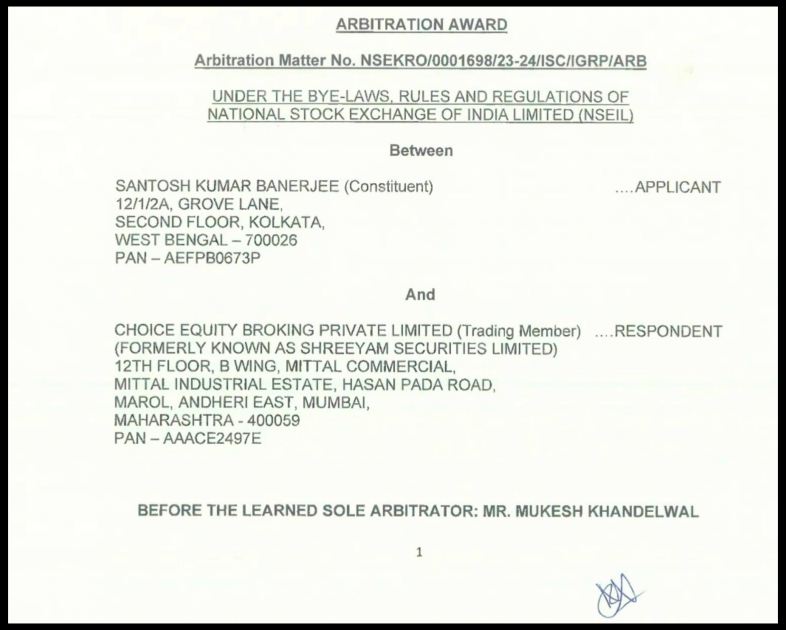
What was the case?
Banerjee deposited ₹14.25 lakh with clear instructions on which shares to buy. Along the way, he’d also shared his login password and OTP with someone at the brokerage, believing it was just part of how account handling worked.
Trades he never asked for showed up anyway, placed by the broker’s own staff.
The complication: because Banerjee had voluntarily handed over those credentials, proving the trades were fully unauthorised got a lot harder to argue.
The service failure was real, but the shared access muddied the picture.
It’s worth noting this is a different kind of dispute entirely from a trade you did approve but got charged more for than expected, which has its own real case on our Choice Broking excess charges page.
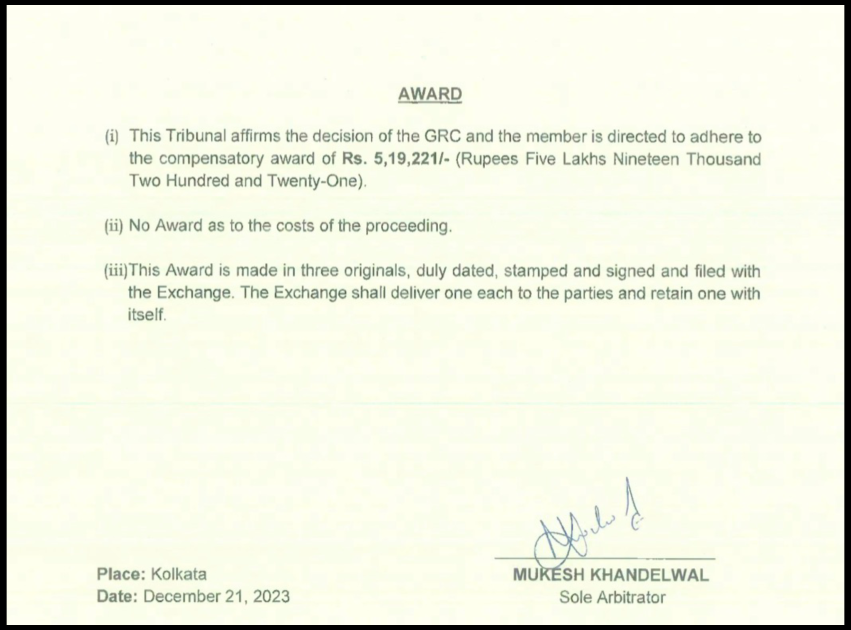
Penalty imposed: the arbitrator upheld an earlier grievance redressal decision, ordering the broker to pay ₹5,19,221, mostly a refund of the brokerage generated off the disputed trades, not the full underlying loss.
Key learning for investors:
- Never share your OTP or password with anyone at your brokerage; sharing credentials is treated as a form of implied consent, and once that’s in the picture, proving a trade was truly unauthorised becomes an uphill fight.
- Put every trade instruction in writing, email or SMS, something with a timestamp, never just a phone call nobody recorded.
Case 2: Pawan Bajaj, When the Cover-Up Became the Case
What was the case?
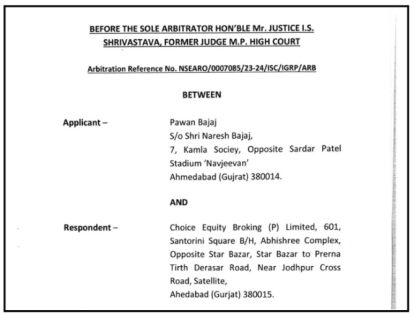
Bajaj’s F&O account was losing money on trades he never authorised. His relationship manager hid it by sending fabricated account statements, real-looking numbers showing profits, while the actual account bled money underneath.
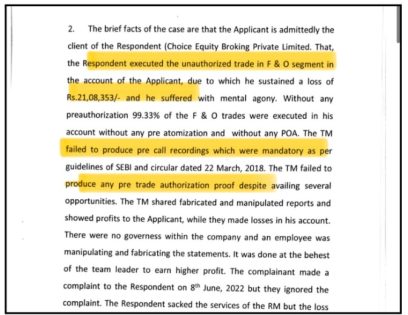
Why it went the way it did: when Bajaj demanded proof that any of this was legitimate, the broker had nothing. No order logs. No recorded instructions. Nothing at all.
Penalty imposed: the arbitrator ruled that a broker has no authority to trade without explicit orders, holding the company fully responsible for its own employee’s conduct.
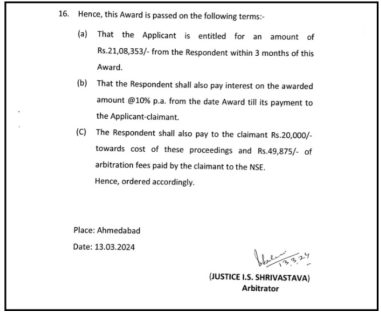
The order came to ₹21,08,353, the full loss, payable within three months, plus 10% annual interest, ₹20,000 in litigation costs, and ₹49,875 in arbitration fees.
Key learning for investors:
- Verify official records directly; never trust a private email or message showing profits at face value.
- Brokers cannot legally trade in your account without verifiable proof of your consent, and the cost awards here show tribunals will penalise bad faith, not just refund the loss.
Case 3: Vineet Vaibhav, Winning the Trade Fight, Then Fighting for the Fee
What was the case?
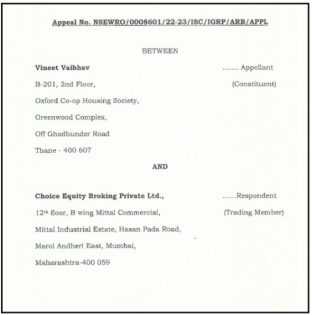
By the time this specific appeal reached the tribunal, the hard question was already settled.
A lower court had already found Vaibhav’s F&O trades unauthorised, same fingerprints as the other two, fabricated reports, no voice recordings to back the broker’s version of events.
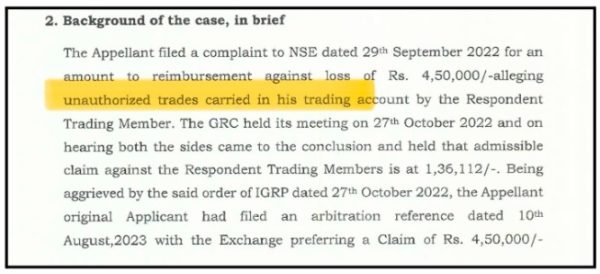
What was actually being fought over: the brokerage itself. Choice Broking had kept every rupee it earned off trades already ruled illegal, and Vaibhav wanted that back too, not just his original loss.
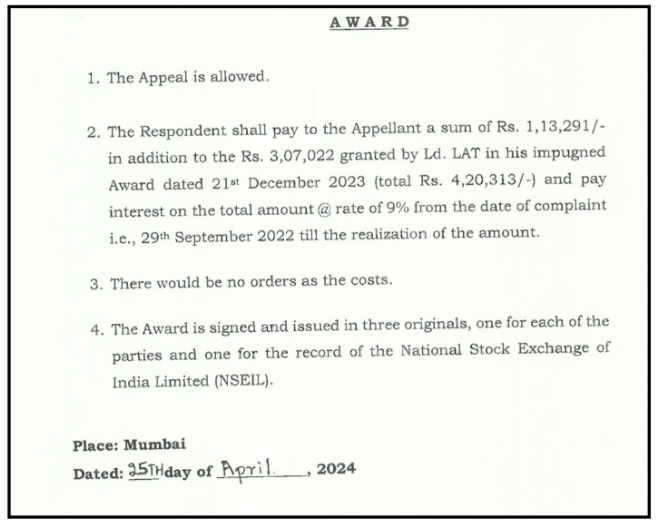
Penalty imposed: the Appellate Tribunal agreed with him.
If the trades were illegal, the broker had no claim to profit from them either. The final order totalled ₹4,20,313, the loss plus ₹1,13,291 specifically in brokerage that had to be returned.
Key learning for investors:
- If your trades are proven unauthorised, you’re entitled to the brokerage back too, not just the underlying loss.
- Official, verifiable proof, a call recording, an order log, is what a broker needs to justify any transaction. Its absence decided all three cases above.
Found trades in your Choice Broking account you never authorised, or staff with access you never realised you’d given?
Our team will review your account records against exactly the kind of evidence that decided these three cases, and helps you build a complaint that actually holds up.
How Do You Document a Choice Broking Account Handling Complaint?
Before you file anything, be honest with yourself about what you can actually prove, because that’s really what all three cases above came down to in the end.
Start with your own written instructions, whatever form they took: an email, a text, an app confirmation. If a disputed trade has nothing behind it from you in writing, that gap is itself your strongest evidence.
Be equally honest about what you may have shared along the way.
If a password or OTP changed hands, as it did for Banerjee, that complicates a “fully unauthorised” claim, even though it doesn’t excuse the broker’s own service failure.
Pull your account statements and lay them next to anything the broker itself sent you.
Both Bajaj’s and Vaibhav’s cases turned entirely on statements that didn’t match reality, and that mismatch only becomes visible once you put the two side by side.
And track every time you’ve asked for a call recording or order log, and whether you actually got one. In all three cases, that single missing piece decided everything.
Once you have this together, raise it with Choice Broking directly first, they’re required to acknowledge and respond within a reasonable window.
- If that goes nowhere, a SEBI SCORES complaint brings the regulator in directly and puts the broker’s response on record.
- Still stuck? An NSE complaint against broker puts your case in front of the exchange itself, carrying different weight than an internal complaint sitting in someone’s inbox.
- If it’s still unresolved, SMART ODR registration moves things into structured, time-bound conciliation, often faster than people expect going in.
If conciliation doesn’t get you anywhere, arbitration is the final stop, the exact process behind all three awards above. Don’t sit on it, the limitation period generally runs three years from the date of the disputed transaction.
For the complete process laid out end to end, our guide on complaint against stock broker SEBI walks through every stage.
Conclusion
Your money is yours. No broker gets to treat it as fair game just because they’re a member of every exchange in the country.
Two SEBI orders and three arbitration cases against Choice Broking all trace back to the same root problem: staff acting without real authorisation, and internal systems that didn’t catch it until an investor pushed back hard enough.
Whatever happened in your account, an unauthorised trade, a fund misuse concern, someone having access you never fully understood you’d given, you now know exactly how three real investors handled it, and what it actually took to win.
The framework works when you use it properly. Don’t sit on a feeling that something’s off.
Report. Recover. Stay Fraud Free.
Frequently Asked Questions
Two. A ₹10 lakh penalty in 2019 for misusing client credit balances, and a ₹2 lakh penalty in 2023 for unauthorised persons operating trading terminals.
It can weaken a claim that trades were fully unauthorised, since shared credentials are treated as a form of implied consent, as Banerjee's case showed, though it doesn't erase the broker's own service failure.
No. Vaibhav's appeal settled that clearly, if the trades are unauthorised, the broker must hand back both the loss and any brokerage charged on those same trades.
₹21,08,353, awarded to Pawan Bajaj, plus 10% annual interest, ₹20,000 in litigation costs, and ₹49,875 in arbitration fees, after the broker couldn't produce any proof the trades were authorised.
Generally three years from the date of the disputed transaction, so don't wait around once you notice something's off.


 Add us as a preferred source on Google »

