

Most investors discover a financial services problem only after the damage is done, a missing SIP, a deduction nobody authorised, a customer care number that rings out indefinitely.
At that point, the question becomes unavoidable: Can a stock broker steal your money, or are these issues simply operational failures that went unchecked?
NJ India Invest is one of India’s largest SEBI-registered stock brokers. It offers trading, depository, and mutual fund services to lakhs of retail investors.
However, the volume of NJ India Invest complaints across these verticals tells a story that the company’s impressive figures do not.
Furthermore, the pattern emerging from exchange data and real user reviews raises questions that every current and prospective investor deserves honest answers to.
NJ India Invest Complaints Overview
NJ India Invest Private Limited is a SEBI-registered stock broker (Registration No. INZ000213137), holding active memberships on NSE and BSE.

Beyond stock broking, the company is a depository participant with CDSL and NSDL. It is also an AMFI-registered mutual fund distributor (ARN 0155) and a Point of Presence for NPS services.
Founded in Surat, the company has scaled to a network of over 27,000 partners managing assets worth more than ₹1,30,000 crore.
Retail investors use the NJ E-Wealth Account app for trading and investments. The app is available on both Android and iOS.
The platform is designed to handle mutual fund transactions, SIP management, stock trading, portfolio tracking, and account statements, all from a single interface.
However, this app has become one of the most consistent sources of NJ India Invest complaints, with users reporting that basic functions either fail on mobile or require switching to a desktop browser to complete.
Common NJ India Invest Complaints Reported by Investors
Since NJ India Invest holds active memberships on both NSE and BSE as a registered stock broker, investor complaints related to trading and demat operations fall directly under exchange jurisdiction.
Official categories handled by NSE and BSE include:
- Non-receipt of funds or securities after settlement.
- Unauthorised debit of funds or securities from client accounts.
- Disputes regarding margin collection and forced square-off of positions.
- Issues with contract notes, trade confirmations, and account statements.
- Non-resolution of investor grievances by the broker within stipulated timelines.
- Demat account discrepancies, including wrong holdings or transfer failures.
Formal exchange complaint systems already exist. Therefore, investors must escalate quickly. Delays weaken both evidence and eligibility.
NJ India Invest Exchange Complaint Data
The following data reflects NJ India Invest’s complaint record as disclosed on the NSE member complaint data portal:
| Financial Year | Active Clients | Complaints Filed | % of Complaints | Resolved | Unresolved | % Resolved | Arbitration Cases |
| 2025–26 | 74,771 | 17 | 0.023% | 14 | 3 | 82.35% | 0 |
| 2024–25 | 86,220 | 13 | 0.02% | 13 | 0 | 100% | 0 |
| 2023–24 | 78,447 | 11 | 0.01% | 10 | 1 | 90.9% | 0 |
| 2022–23 | 78,447 | 13 | 0.01% | 9 | 4 | 69.23% | 0 |
Complaints are rising while the client base is shrinking. Active clients fell from 86,220 in 2024–25 to 74,771 in 2025–26, a drop of over 11,000. Yet complaints jumped from 13 to 17 in the same period.
Therefore, NJ India is generating more complaints per remaining client even as its client base contracts, which is a meaningful warning signal.
Notably, the resolution rate has dropped sharply in 2025–26. After achieving 100% resolution in 2024–25, NJ India’s resolution rate has fallen to 82.35% in the current financial year.
Consequently, roughly one in six complaints filed this year has received no resolution, and the year is still ongoing.
More importantly, three are already unresolved in an active financial year. With 2025–26 still running, three complaints already sit unresolved.
Meanwhile, these are only the complaints that formally reached the exchange; investors who gave up after receiving no response from the broker are not counted here at all.
NJ India Invest User Reviews
These are real reviews from the Google Play store on the NJ E-Wealth Account app.
The issues they describe have been consistent across multiple years.
1. Unauthorised Deductions Even After No Subscription
An investor who claims to have only filled out an enquiry form, never formally subscribing to any paid service.
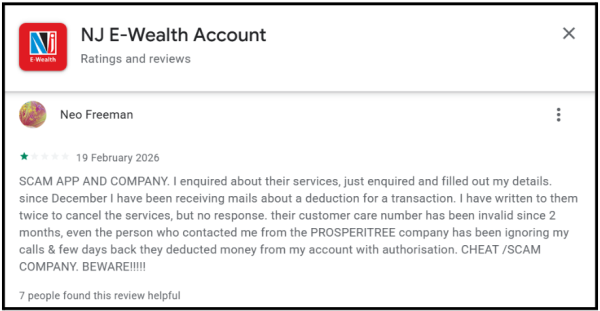
Despite this, the reviewer alleges receiving emails about deductions since December 2025, writing twice to NJ India to cancel, with zero response, and finding the customer care number invalid for two consecutive months.
For a SEBI-registered stock broker, an allegation of money being debited without client authorisation is not a minor service complaint; it is a potential regulatory violation that investors have every right to formally escalate.
2. Agent’s Incomplete Guidance Directly Causes Financial Loss
A December 2025 review describes an investor who claims to have lost over ₹4,000 due to inadequate guidance from an NJ agent.
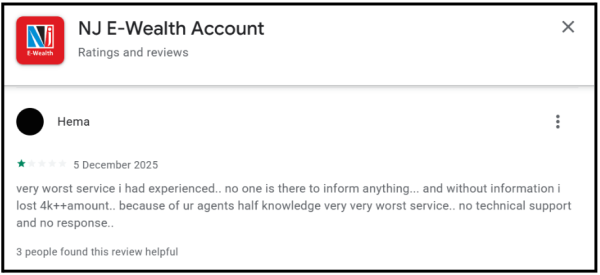
The reviewer states there was no prior information provided about risks or charges, no technical support available after the fact, and no response when the issue was raised with the company.
3. Login Delays While Trading
The user describes an app so slow and buggy that the user’s target bid price moves before the login process completes.
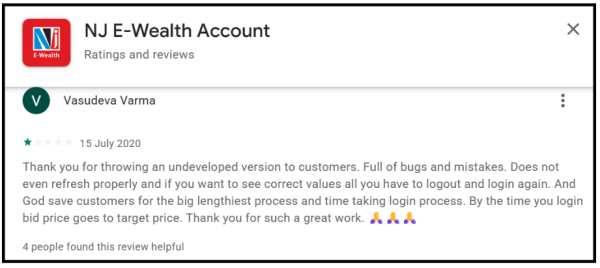
The reviewer notes the app does not refresh properly and requires a full logout-login cycle just to display correct portfolio values.
4. SIP Portfolio Shows Zero, Tax Statements Inaccessible
A January 2019 review describes the app displaying zero amounts against all SIPs, with the portfolio section failing.
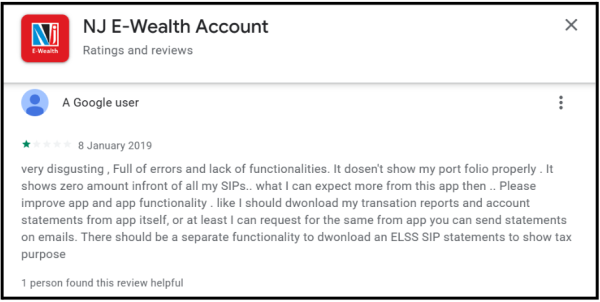
The investor asked for features every broker should offer, including downloading transaction reports, account statements, and ELSS SIP statements for income tax purposes.
For a SEBI-registered broker, inaccessible statements are not just a UX issue. Instead, they indicate a failure to provide legally required access to financial records.
When to Take Action Against a Broker?
Most investors act too late. By the time most investors decide to act, timelines for formal escalation have shortened significantly.
Here are the situations that demand immediate action:
- Money Debited Without Your Explicit Consent: If any amount has left your account without a transaction you directly authorised, document it the same day and file a formal complaint immediately.
- Customer Care Unreachable for More Than 7 Days: A SEBI-registered broker that cannot be contacted for a week or more is likely in breach of mandatory grievance infrastructure requirements.
- Agent or Partner Becomes Unreachable After Sale: If the NJ partner who onboarded you has stopped responding and the company provides no alternative support contact, your investment is effectively unsupervised.
- Cancellation Request Ignored Beyond 30 Days: If you have a written cancellation request on record and deductions are continuing, you have grounds for a formal complaint and a refund demand backed by your documentary evidence.
- Portfolio or Statement Data Is Incorrect or Inaccessible: As a SEBI-registered depository participant, NJ India is legally required to provide accurate and accessible records of your securities and investments.
Acting on the first warning sign, not the fifth, is what separates investors who recover their money from those who do not.
SEBI’s Code of Conduct for Stock Brokers under Schedule II of the SEBI (Stock Brokers) Regulations, 1992 mandates that registered brokers must act in clients’ best interests, maintain transparency in charges, resolve grievances promptly, and refrain from any form of unauthorised transaction in client accounts.
Where to Lodge a Complaint Against a Broker?
If you are facing issues with NJ Invest India, follow these steps to protect your funds and file your complaint against stock broker effectively.
Step 1: Raise a Written Complaint With NJ India Directly
Send a formal written complaint to NJ India’s official grievance email.
State the issue clearly with dates, transaction references, amounts involved, and the financial impact.
Request a written acknowledgement. SEBI mandates that registered brokers acknowledge and resolve investor complaints within 30 days.
Step 2: File a Complaint in SCORES
If your issue is not resolved at the broker level, the next step is to escalate it through the Securities and Exchange Board of India’s official grievance platform, known as SCORES (SEBI Complaints Redress System).
This platform allows investors to formally raise concerns against brokers and other market intermediaries in a structured manner.
Once you register on SCORES, you can:
- Submit a detailed complaint explaining your issue.
- Upload all relevant supporting documents, such as contract notes, statements, or communication records.
- Track the status of your SEBI complaint in real time.
After submission, SEBI reviews the complaint and forwards it to the concerned broker, ensuring that a response is provided within a specified timeframe. The regulator actively monitors the process to ensure fair handling.
Step 3: Lodge a Complaint in SMART ODR
If the issue remains unresolved even after approaching SCORES, you can escalate the matter further through the SMART ODR (Online Dispute Resolution) platform.
This system, supported by stock exchanges, is designed to resolve disputes efficiently through a digital and structured process without the need for physical hearings.
At this stage:
- You formally submit your complaint on the ODR platform.
- Both you and the broker may present your respective sides of the case online.
- A neutral mechanism is used to facilitate discussions and reach a resolution within a defined timeline.
Step 4: Arbitration in the Share Market
If all previous steps fail to deliver a satisfactory resolution, the final course of action is to proceed with arbitration.
In this stage, the dispute is reviewed by an independent arbitrator appointed under the rules of the stock exchanges.
Both parties, the investor and the broker, are required to present their arguments along with supporting evidence and documentation.
After carefully evaluating all the facts and records, the arbitrator passes a final decision, which is binding on both sides. Arbitration serves as a formal legal remedy and is often the last step in resolving investor grievances in the stock market.
Need Help?
Navigating a complaint against a large broker-distributor network like NJ India Invest while simultaneously trying to protect your own investment is genuinely difficult.
Many investors miss critical deadlines, file on the wrong platform, or do not realise that formal escalation pathways even exist until it is too late.
Register with us if you are facing issues with NJ India Invest or any other broker. We will help you take the right steps at the right time.
Conclusion
NJ India Invest Private Limited is a SEBI-registered stock broker, depository participant, and India’s largest mutual fund distributor, a company with a long operational track record and significant market presence.
Exchange data shows that complaint volume is rising against a shrinking client base, with the resolution rate falling to 82.35% in 2025–26, the lowest since the 100% resolution achieved just one year earlier.
User reviews spanning 2019 to 2026 describe identical problems: unauthorised deductions, non-functional customer care, agent misconduct, app failures, and inaccessible account statements.
For investors: these NJ India Invest complaints, along with exchange data and user reviews, should be weighed carefully against the company’s marketing claims before making any investment decision.





 Add us as a preferred source on Google »

