
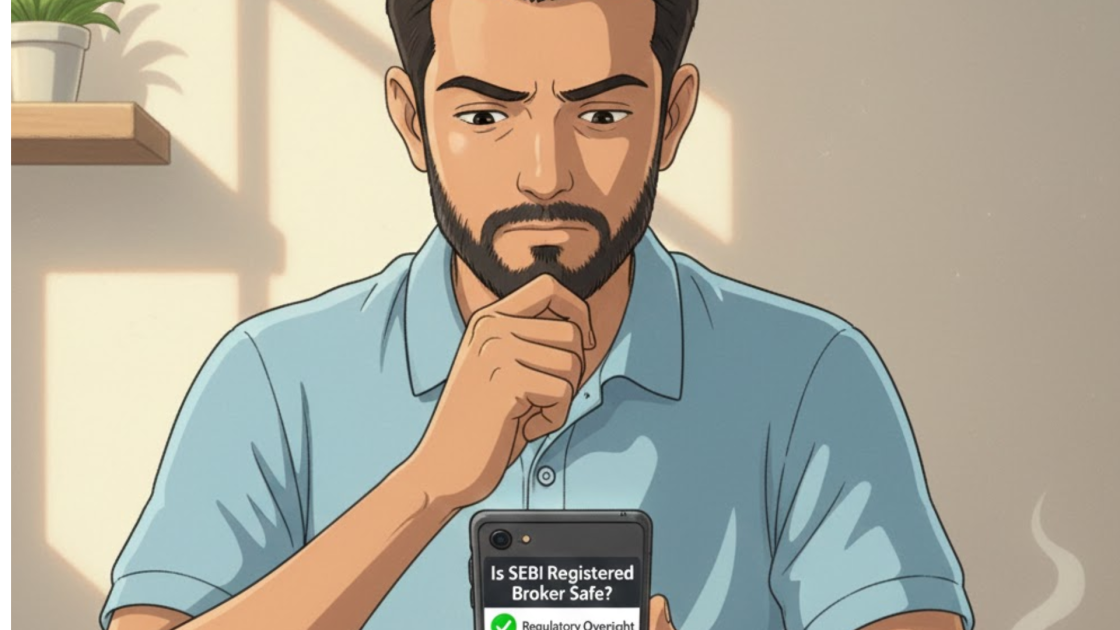
Quick Summary
SEBI registration is the baseline requirement for legitimacy, not a guarantee against fraud. Registered brokers are required to segregate client funds, meet capital adequacy norms, and submit regular reports, and SEBI actively inspects and penalises those who fail. Yet some of India’s biggest financial frauds, Karvy’s ₹2,300 crore pledge of client securities, Globe Capital’s ₹35 crore family portfolio scam, have come from registered brokers. Below are real cases covering outright fraud, guaranteed-return promises, churning against clients, and outright theft of funds, along with what protects you and how to act if something already went wrong.
The honest answer to whether a SEBI-registered broker is safe is more nuanced than yes or no.
Registration means the broker operates under regulatory oversight, must segregate your funds, and faces consequences for breaking the rules. It does not mean every transaction is automatically safe.
The cases below show exactly where that gap has cost real investors real money, and what protected the ones who recovered it.
What SEBI Registration Actually Requires
Think of SEBI registration as the basic license every legitimate stockbroker must hold to operate in India. When a broker is SEBI registered, it means they have gone through an approval process and are monitored regularly through inspections and complaint tracking.
Registration requires brokers to maintain client fund segregation, keeping your money in a bank account completely separate from the broker’s own funds, so that if the broker runs into financial trouble, your funds cannot be seized.
It also requires capital adequacy, meaning the broker must hold enough reserve to handle market volatility and client withdrawals, and strict record-keeping and reporting, including weekly cash balance reports submitted to the exchanges.
SEBI does not simply hand out certificates and walk away. It actively monitors brokers through surprise inspections and investor complaint tracking, and when a broker breaks the rules, the consequences range from heavy penalties to suspension or full cancellation of the license.
Every exchange also maintains an Investor Protection Fund that can compensate clients if a broker defaults or is expelled. None of this means brokers never commit fraud.
The framework minimises harm and provides recovery mechanisms, but it cannot prevent every case of dishonesty, and that is exactly what the cases below show.
Real Scams Committed by SEBI-Registered Brokers
Some of the biggest financial frauds in India have come from brokers who were fully SEBI registered at the time, which made the betrayal worse precisely because people trusted them more for it.
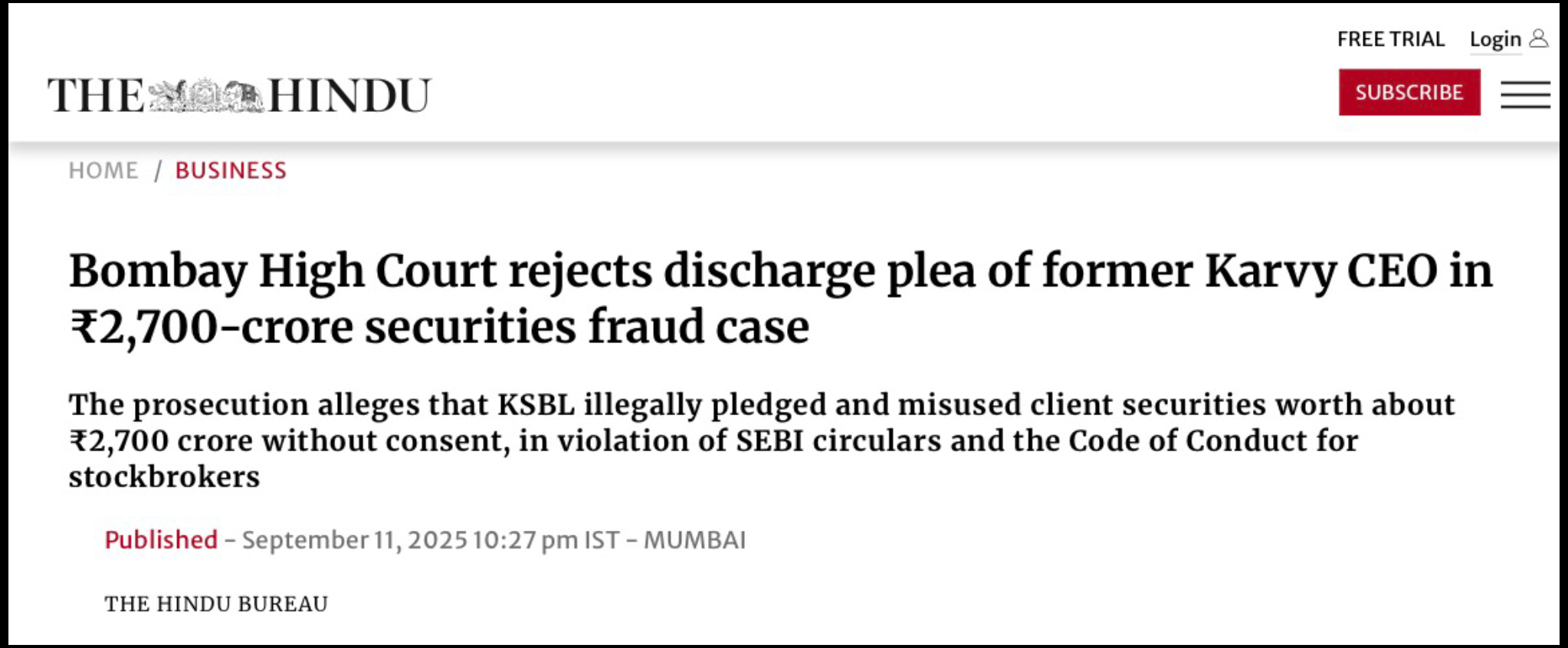
1. Karvy Stock Broking 2,700 Crore Securities Fraud
Karvy Stock Broking illegally pledged the securities of nearly 95,000 clients to banks in 2019, raising about ₹2,300 crore in loans using those shares as collateral, without the clients knowing anything about it.
When this was exposed, SEBI banned Karvy from the market for seven years and imposed a penalty of ₹21 crore. SEBI did manage to recover ₹2,013 crore and return it to about 83,000 affected investors, but thousands still lost significant amounts, and the emotional and financial stress was immense.
2. Globe Capital Financial Fraud
The ₹35 crore Globe Capital scam is a chilling reminder that even registered brokers can turn into fraud factories behind a polished facade. A 72-year-old investor, Bharat Shah, and his wife trusted Globe Capital Market with their inherited share portfolio.
For four years, they received glossy reports promising up to 18% returns that were pure fiction, while high-frequency traders misused their demat accounts, pledged the family’s shares to banks without consent, and even replied to NSE queries using forged emails in Bharat’s name.
The nightmare surfaced in July 2024 when Globe’s Risk Management Department suddenly demanded ₹35 crore for a “negative balance.” Mumbai Police’s Economic Offences Wing filed an FIR in November 2025, and Globe Capital emerged as one of the most complained-against brokers in SEBI’s records.

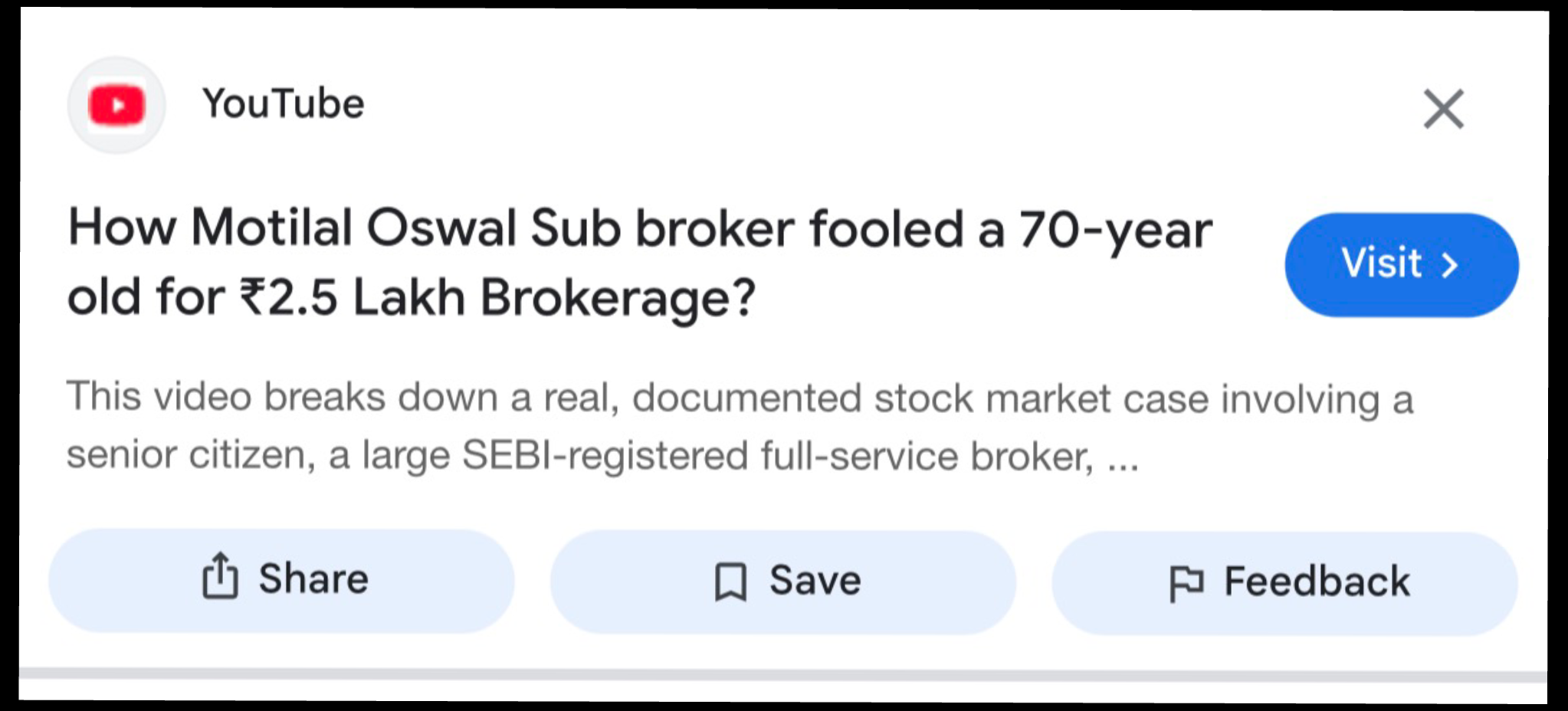
3. Brokerage Churning by Motilal Oswal Sub-Broker
The Motilal Oswal Sub-Broker case shows the same pattern at a smaller, more relatable scale. A 70-year-old senior citizen with limited market understanding was approached at home by representatives promising to manage her retirement investments.
Over just a few months, her account suffered losses of ₹4.5 lakh while the broker made ₹2.5 lakh in brokerage commissions, essentially profiting from her losses.
The account manager initiated trades without proper consent, and when she questioned the losses, she was fed stories about “positions running” and “recovery coming soon.” By the time she visited the branch to complain, the manager had already resigned.
Motilal Oswal faced separate SEBI penalties of ₹7 lakh for maintaining 334 pending complaints on the SCORES portal and providing incorrect cash balance reporting to regulators.
These are not isolated incidents. In December 2024 alone, SEBI handled over 5,600 fraud complaints, and throughout 2024-2025, it initiated enforcement actions against more than 886 entities for fraudulent trading practices.
More Registered Brokers, More SEBI Enforcement Orders
Beyond the headline cases, SEBI’s routine inspection process has repeatedly caught well-established, long-running brokers failing basic client-protection requirements.
SEBI barred Prabhudas Lilladher Private Limited from accepting new clients for seven days starting December 15, 2025, following a joint inspection with NSE, BSE, and the Multi-Commodity Exchange covering April 2021 to October 2022.
The inspection found a client fund shortfall of about ₹2.70 crore on certain dates, delays in settling client accounts, incorrect margin and client balance reporting to exchanges, and brokerage charged beyond the regulatory cap.
SEBI dismissed the firm’s defence that these were technical or software issues, holding that they directly affected investor protection rules.
Motilal Oswal Financial Services Limited was separately penalised ₹11 lakh in August 2025 after an inspection revealed delays in settling inactive clients’ funds within the required timeline, incorrect reporting of end-of-day and peak client ledger balances involving large amounts, and gaps in required technical and system safeguards.
SEBI made clear that even unintentional lapses do not excuse a broker from strict regulatory compliance, and investors should never rely purely on a broker’s brand name.
Anand Rathi Share and Stock Brokers was fined ₹5 lakh following a cybersecurity-focused inspection that found three separate instances of unauthorised trades, attributed to dealer “punching errors.”
SEBI emphasised that such explanations do not absolve brokers of responsibility, since accurate order recording and client authorisation are core regulatory requirements regardless of intent.
Can Brokers Guarantee Your Profits?
No. Under Indian securities law, it is illegal for a broker, or any of their agents, sub-brokers, or authorised persons, to give any assurance of return to a client, whether that means “we guarantee 20% returns,” “don’t worry, we will recover your losses,” a profit-sharing arrangement, or a claimed success rate without SEBI-verified data. This is not a grey area.
Both the 1992 framework and the newer SEBI (Stock Brokers) Regulations, 2026 explicitly prohibit any promise of guaranteed, indicative, or assured returns in any form, and the prohibition extends to every sub-broker and authorised person operating under a brokerage’s name.
Ramesh (name changed), who works at a hospital and earns between ₹10,000 and ₹15,000 a month, kept fending off relentless calls, four times a day, from representatives of a SEBI-registered broker.
Their answer to his objections was to remove effort entirely: “we will appoint a dealer for you, we will give you the profit,” and then the number designed to break his resistance, a guaranteed ₹15,000 a day, more in a single day than he earned in an entire month.
The offer was built to remove every objection. No charges, they said, and no need to learn to trade because a dealer would be appointed.
An OTP would arrive and the trade would go through on that OTP, and to make it feel real they sent him fake trading profit screenshots. He was told the minimum deposit was ₹50,000, and he put it in cautiously, starting with just a couple hundred rupees at a time.
The first day showed a tidy ₹1,000 to ₹2,000 profit, belief purchased cheaply. The very next day the script turned, as it always does: his capital was “short,” and for proper position sizing he would need ₹1.5 to ₹2 lakh, at which point the guaranteed ₹15,000 a day would begin.
The trading sat on a separate app run by their “trading firm,” with money moving through Google Pay and PhonePe into personal accounts rather than any regulated broking account. He never got call recordings, but he kept the WhatsApp chats and the transaction and OTP records.
A guaranteed daily figure is a promise no registered intermediary is permitted to make, because in a market nobody controls, a guarantee is always false, and the cruelty is in the sizing, the number is always set just above the target’s income.
“We will appoint a dealer so you don’t have to trade” is account handling, not brokerage, and no genuine broker needs a client’s OTP to operate. When yesterday’s deposit is suddenly “too little” and today’s demand doubles or triples, the deposit was always the product, not the trading.
And funding a private app through a personal payment handle means the money has left the regulated system entirely, which is exactly what makes it hard to recover unless it is documented, and in this case it was.
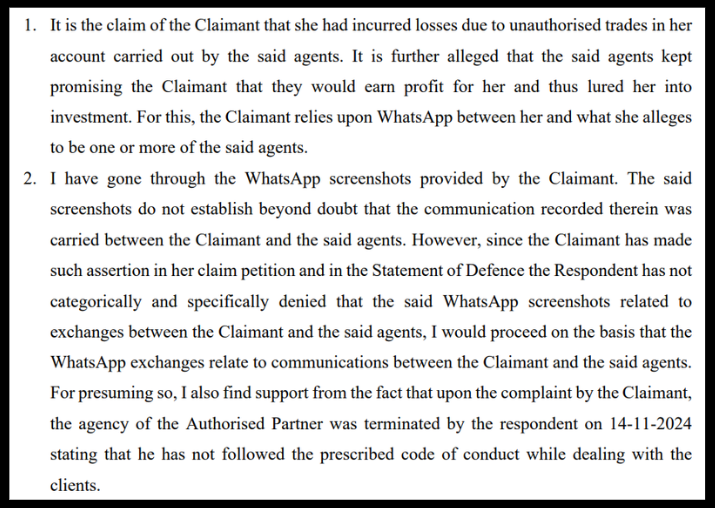
The Renu vs Angel One arbitral award (NSE-SB-2024-12-518604) shows how this plays out in real arbitration. Renu, from Delhi, opened her account with Angel One in November 2023 after being introduced by authorised persons who proposed a 70:30 profit-sharing model and offered to handle her trading entirely.
She invested ₹20 lakh and shared her login credentials and OTP, believing her account would be professionally managed. Trades were executed by a sub-broker without her direct consent, and when losses mounted, the reassurance was always the same: “Don’t worry, we will recover the losses.”
By the time she filed a formal complaint in October 2024, her claimed loss stood at ₹19,82,893, with ₹99,775 charged in brokerage. Angel One had already terminated the authorised person’s contract in November 2024 for violating its code of conduct.
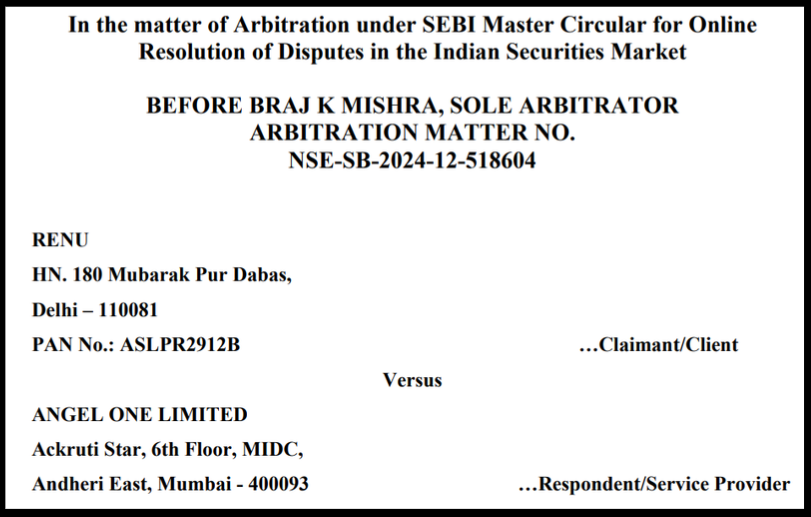
The arbitrator, hearing the case in May 2025, found that since Renu had personally provided her OTP to the agents, she had effectively authorised them to trade, meaning her trading losses could not be fully attributed to Angel One as the broker.
But the arbitrator separately found that WhatsApp exchanges clearly showed profit assurances being made, and awarded her ₹2,00,000 in compensation for the unfair trade practices, even while rejecting her full trading-loss claim.
The lesson sits in that split outcome: never share login credentials or OTPs no matter how trustworthy someone seems, but documented profit assurances can still produce compensation even when the trading loss claim itself does not succeed.
SEBI’s crackdown on Mohd Nasiruddin Ansari, “Baap of Chart,” shows the same pattern operating at scale. His website claimed a proprietary algorithm with 95% profit accuracy and promised profits “day after day, eliminating any chance of overall loss.”
What SEBI actually found was that Ansari had personally incurred trading losses of ₹2.89 crore between January 2021 and July 2023, the exact same period he was marketing guaranteed returns to investors.
SEBI banned him and seven associates for one year and directed a refund of ₹17.2 crore to affected investors.
In a separate 2022 enforcement sweep, SEBI issued show cause notices to over 120 stockbrokers connected to the algorithmic trading platform Tradetron, after finding the platform advertised strategies promising guaranteed profits, a practice explicitly prohibited by a SEBI circular.
The action made clear that even indirect association with a platform promising guaranteed returns is itself a violation, with no grey area for brokers claiming they merely provided infrastructure.
Do Brokers Trade Against You?
Every investor needs to understand the difference between what is legal and what is not when it comes to how a broker handles their account.
Authorised trading is when your broker executes trades strictly based on your knowledge and prior approval, whether you instructed the trade directly, approved a recommendation, or signed a limited Power of Attorney for specific predefined actions.
Unauthorised trading is when a broker places trades without your knowledge or instruction, trades appear that you never discussed, or you discover positions you had no idea existed.
Churning is when a broker repeatedly buys and sells securities in your account purely to earn commission, silently eating into your capital without improving your portfolio.
Mis-selling is when a broker recommends products that suit their own commission rather than your financial needs, advice that sounds genuine but is driven by the broker’s benefit.
Anant had been investing for years and trusted his broker completely, until he noticed several unfamiliar trades sitting quietly in his account that he had never instructed. When he confronted his broker, the responses were vague.
Digging deeper, he found his account had been churned repeatedly with trades that made no logical sense for his financial goals, each one generating brokerage for the broker while burning through his own capital, not negligence, but a deliberate attempt to profit at his expense.
He collected his trade statements, contract notes, and written communication, filed a formal complaint, and escalated it through the proper regulatory channels, a process that took time and emotional energy but ultimately proved that retail investors do have power when they choose to use it.
SEBI has clear rules on this: a broker cannot execute any trade in your account without your explicit consent, the only exception being a signed Power of Attorney giving specific, limited authority, and even that authority has firm boundaries that cannot be misused freely.
Many investors sign documents without reading them carefully, and brokers sometimes misuse this to gain wider control over client accounts than intended.
Can a Stock Broker Actually Steal Your Money?
Outright theft by a registered stockbroker is genuinely rare given SEBI’s safeguards like fund segregation and real-time exchange monitoring, but misuse of client funds or securities can still happen through several indirect routes worth knowing about.
- Unauthorised trading executes trades without your explicit consent, often to generate excessive brokerage regardless of whether the trades match your goals.
- Misuse of Power of Attorney or account access can let a broker or sub-broker transfer securities without proper authorisation, pledge shares for purposes unrelated to you, or execute off-market transfers you never approved.
- Misappropriation of client funds or securities, even though client funds are legally required to sit in segregated accounts, can still show up as delayed payouts, temporarily diverted funds, or client securities used for unauthorised margin activity.
- Misrepresentation and mis-selling involves promising “safe” or “guaranteed” returns, hiding risks, or steering clients toward products that primarily benefit the broker through commission.
- Forgery or unauthorised account changes, while rarer thanks to e-KYC and OTP verification, can still occur through forged authorisations or tampered account credentials.
And a significant share of what gets called “broker fraud” actually involves unregistered advisors or sub-brokers impersonating SEBI-registered entities running investment scams under the borrowed credibility of the stock market’s name.
To protect yourself, never wire money to a broker’s personal bank account, always confirm payments go to the official corporate account, watch for missing weekly or monthly contract notes or statements, regularly check SMS and email alerts from the exchanges for trades you did not authorise, and be wary of anyone promising guaranteed returns or pressuring an immediate decision without documentation.
Choosing a SEBI-registered broker with strong compliance, periodically verifying your account details directly on the NSE or BSE website, and keeping your mobile number and email linked to your demat account for real-time transaction alerts are the practical habits that catch problems early.
Two Smaller Cases Worth Knowing
Anurag (name changed) opened an account with a sub-broker of a renowned full-service broker who charged him ₹50 per trade against the broker’s usual ₹20, justified as covering “add-on” research and advisory services.
A sub-broker’s research analyst provided multiple tips on different stocks and options in a single call, then instructed him to close the positions after just minutes.
The early exits capped his profit while he still ended up paying ₹22,000 in brokerage fees, raising the obvious question of whether the tips were meant to help him or to hit the sub-broker’s own brokerage targets for incentive purposes.
Vikrant (name changed), an experienced trader using a broker charging flat brokerage fees, bought the maximum permitted 60 lots of Bank Nifty on an expiry day and was sitting on a profit.
When he tried to exit, the app would not let him place an order for all 60 lots together, forcing him to exit in smaller chunks of 20 lots at a time despite the rules technically allowing the full 60-lot exit as one order.
The reduced execution flexibility cut into his overall profit percentage, leaving him to wonder whether it was a genuine glitch or a structural choice that happened to generate more brokerage through split orders.
Is Your Money Stuck? Get It Back
Whether the issue is a fund misuse case like Karvy or Globe Capital, a guaranteed-return promise like Ramesh’s or Renu’s, unauthorised trading and churning like Anant’s, or a smaller brokerage dispute, the underlying escalation path is the same: a written complaint to the broker’s compliance officer, followed by SEBI SCORES if unresolved, then SMART ODR, then exchange arbitration where several of the outcomes above were decided.
The complete step-by-step process, required documents, and realistic timelines at each stage are covered in our full guide: file a complaint against your stock broker.
Not sure whether what happened to you is a registered broker’s misconduct or something more serious?
We check the broker’s actual registration status, map your situation against the exact SEBI violation it falls under, and build your complaint around the evidence that has already won similar cases.
Register with us to get our assistance.
Frequently Asked Questions
No. Registration confirms the broker operates under regulatory oversight and must follow specific rules around fund segregation, reporting, and conduct, but it does not eliminate the risk of individual misconduct, as the Karvy and Globe Capital cases show even at a very large scale.
Check the registration number, usually formatted as INZ000XXXXXX, in the broker's website footer, and cross-check it against SEBI's official intermediary registry, making sure the entity name matches exactly and that the broker also appears in the NSE or BSE member directory for the segment it trades in.
It is illegal, not just an aggressive sales tactic. SEBI regulations explicitly prohibit any broker, sub-broker, or authorised person from assuring guaranteed, indicative, or assured returns in any form, and this prohibition applies regardless of how casually or confidently the promise is phrased.
It weakens a pure unauthorised-trading claim, since sharing your OTP can be read as authorising the trades, as seen in the Renu vs Angel One case. But it does not eliminate your ability to claim compensation for unfair practices like documented profit assurances, which can succeed independently of the trading-loss claim.
Churning involves excessive, unnecessary trading purely to generate commission, regardless of what products are involved. Mis-selling involves recommending specific products, such as certain funds or schemes, that primarily benefit the broker's own incentives rather than your suitability. Both are separate violations and can appear together in the same account.





 Add us as a preferred source on Google »

