

Quick Summary
Brokerage churning happens when a broker runs up trades in your account not to grow your money, but to generate commission on every buy and sell. Across four real cases below, brokerage ate anywhere from 65% to nearly the entire loss amount, sometimes more than the market loss itself. One case saw ₹3 lakh turn into ₹3 crore of turnover in a single month. Another recovered 76.4% of a claim once the brokerage-to-loss ratio was laid out against the broker’s own contract notes. The pattern repeats every time: the arithmetic in the broker’s own records is what wins these cases, not anyone’s memory of a phone call.
Churning does not always look like a scam while it is happening.
It looks like a helpful broker who keeps calling with fresh ideas, keeps you trading, and keeps the account moving.
The four cases below show exactly how that pattern reveals itself once you look at the numbers instead of the phone calls.
The Listed Broker Whose Agents Called 25 Times a Day
Kavita (name changed) was new to investing, someone who had worked in people’s homes and was putting money into the market as a careful, hopeful step.
What pulled her in was not greed, it was sheer persistence.
Agents from a listed, registered broker, the kind that looks completely legitimate, called her as many as 25 times a day for months, messaging even after she set her phone to Do Not Disturb, until she finally gave in.
Within a day or two of starting, about ₹26,000 of her money was gone, not to the market, but to brokerage, on a total loss of around ₹28,000. Read that again. The commission was very nearly the entire loss. The trading was not the business they were running on her. The brokerage was.
The agents who onboarded her behaved nothing like the reputable brand they represented. They did not train her even when she asked plainly. It was just do this, buy that, take this quantity, and the account was opened through their own referral code, the detail that explains everything that followed.
They had her trade crude oil, and the next day she opened the account to find roughly ₹24,000 to ₹26,000 of brokerage deducted.
When she questioned it, they told her she had “changed 180 lots,” something a careful near-beginner simply does not do and which she says she never did.
They had also told her that if she was ever in a no-network area, she could just let them place trades from their own terminal.
Put those pieces together and a clear picture emerges: trades run on her account from their end that she never instructed, each one spinning the brokerage meter. When commission eats almost the entire loss, the trades were never about her gains.
A ₹28,000 loss cannot honestly carry ₹26,000 of brokerage unless the account was being traded specifically to manufacture commission, and the agents’ referral code, which earns them a cut of every rupee of brokerage, is the motive sitting in plain sight.
The “180 lots” she says she never changed, very possibly placed from their terminal, are not her decisions, and a broker must act on your instructions, full stop.
Hounding a first-time, vulnerable person into trading while refusing the training she asked for is the opposite of dealing fairly, and it is worth remembering that a reputable, listed brand name does not shield what its branch agents actually did inside her account.
Her proof sits in records she can get hold of: the contract notes and ledger showing the brokerage against her capital, the account history showing the 180-lot trades against what she actually placed, the referral link tying it to their code, and her screenshots of the relentless calls and messages.
From ₹3 Lakh to ₹3 Crore Turnover in a Single Month
He had seen the advertisement in a newspaper and, a month later, walked in to meet them in person. It looked real, a rented office, confident men, a line that stuck in his head: “Hum stock mein kaam karte hain, index nahi karte.” They told him the safe game was stocks, that they would build his account up patiently. He hesitated, then deposited ₹3 lakh.
From the second morning, something felt off. The trades came in bursts, “dhana dhan, dhana dhan,” buy, sell, buy, sell, from the moment the market opened until it closed. He asked them to slow down once or twice. They brushed it off. By the time he stopped to count, on a capital of ₹3 lakh, they had run a turnover of nearly ₹3 crore in a single month.
His capital was wiped, and so were the LIC savings he had kept for ten years and quietly poured in, a loss he had not even told his family about.
A genuine investor trading ₹3 lakh does not generate ₹3 crore of turnover in a month. That is a 100x churn of the capital base, and it has nothing to do with making the client money. A healthy investing account rarely exceeds a 1x to 2x ratio per month.
Every buy and every sell triggers a commission, and trading the same money back and forth all day stacks brokerage into lakhs while the account bleeds out.
The brokerage burned in an account like this can run higher than the actual loss itself, meaning the “loss” an investor sees is partly market, but a large slice of it is simply commission manufactured by volume.
When the account got wiped, he remembered something buried in the account-opening paperwork, a line to the effect of “loss hua to hum zimmedaar nahi.”
Many investors believe a signature like that closes the door. It does not. A privately drafted disclaimer cannot override SEBI’s regulations, and a signed “I accept my losses” line does not authorise a firm to handle your account, place trades without instruction, or manufacture turnover for commission.
Three problems were visible in his case within minutes: churning for brokerage on a 100x turnover, no pre- or post-trade confirmation on a single trade, and a disclaimer being leaned on precisely because the underlying conduct could not stand on its own.
Because the account was operated through the firm’s own authorised person, the registered firm is accountable for what its representative did.
A word of caution worth carrying forward for anyone in this position: when a complaint lands, the firm may call directly offering a quiet settlement, “hum ek lakh de dete hain, complaint wapas le lo.” Do not negotiate alone, and do not accept a lowball figure just to make it stop.
The Shopkeeper Who Trusted a Face He Saw on TV
Mukul (name changed) runs a small shop in Odisha, careful with money the way shopkeepers are. He kept ignoring a woman’s calls asking him to open a trading account. What finally changed his mind was not her persistence, it was a face.
The broker’s founder was someone he had seen on television. “Achha aadmi hoga, tabhi to TV mein aata hai,” he must be a good man, otherwise why would he be on TV. So he opened the account.
By the end, roughly ₹3.5 lakh was gone, and the strangest part is that there was no great market crash behind it. The brokerage took it.
Mukul funded the account, starting around ₹50,000 and adding more over time, while a “team leader” made a soothing offer: “Hum aapka account handle karenge, hum trade karenge, aapko kuch karna nahi hai, aap bas seekhte rahiye,” we’ll handle your account, you don’t need to do anything, just keep learning. So he stepped back.
There was no dramatic single fee he could point to, which is exactly what made it hard to see. The money left in a thousand small pieces, one buy and one sell at a time, each trade taking its cut of brokerage until the account was hollow.
He tried more than once to shut it down and asked them to stop. The trading, and the brokerage, carried on regardless.
When a broker runs an account and generates enough trading that the commissions themselves consume the capital, that is churning in its textbook form, and here the loss was not a market view gone wrong, the loss was the brokerage itself.
A broker’s role is to execute client instructions, not take control of an account and trade independently, and “we’ll handle everything” resembles discretionary portfolio management, which requires a completely separate licence and regulatory framework that brokers are not authorised to operate under on their own.
The pattern began with persistent cold-calling and escalated into a hand-over pitch asking him to give up access entirely, and sharing passwords or transaction PINs with a relationship manager is strictly prohibited under SEBI regulations regardless of how the request is framed.
A well-known public profile built on media appearances creates no immunity from regulatory obligations, and regulators examine actions and records, not how trustworthy someone appears on television.
Comparing the brokerage generated against the capital invested and the overall trading outcome tells the real story, and when brokerage consumes a significant share of the capital, the numbers speak for themselves without needing anyone’s assumptions.
The “No-Fee” Broker Whose Fee Was the Brokerage Itself
Sonu (name changed), a simple man in Gorakhpur, put in around ₹5 lakh after his broker told him plainly: we will not charge you anything, we make our money from your brokerage. That sounded like a firm whose interests were lined up with his own.
A month later, the brokerage alone on that account had come to about ₹3,25,000. The “no fee” was never generosity, it was the entire scheme, stated out loud at the very start. Roughly two out of every three rupees he put in went to commission.
This was a registered broker, which is what makes the case clean, but it did not behave like one. A broker’s job is to execute the orders a client decides on, and this one gave him the calls instead, telling him which lot to take, what quantity, and that a particular premium would go higher.
He followed the instructions trade after trade, each one spinning the meter, until the brokerage stacked up to ₹3.25 lakh of his ₹5 lakh.
The moment a broker starts telling you exactly what to buy and how much to trade, they cross a line no broker is licensed to cross, since their role is strictly to execute the trades a client decides on, not to push specific, high-volume recommendations directly.
“We earn from your brokerage” is the churning motive admitted in advance rather than hidden, since when a broker’s income depends on how much a client trades rather than how well the client does, every “take more quantity” call works for the broker, not the client.
Brokerage running to roughly 65 percent of capital is proof, not suspicion, because when commission eats two-thirds of what someone put in, the trading was never about their gains, and none of this rested on Sonu’s word alone since the contract notes and ledger, produced by the broker itself, listed every trade and every rupee of brokerage against the ₹5 lakh he had put in.
When the Brokerage Number and the Contract Note Tell the Real Story
Two settled refund cases show exactly how the arithmetic decides these disputes, and how differently two similar-looking losses can actually resolve.
In the first, a client’s realised trading loss over ten weeks was just ₹8,068, while his brokerage over the same period was ₹4,17,699, close to 280 percent of his working capital every month. No trading strategy needs that many trades, the volume existed because the volume itself paid someone.
The firm in this case had three separate ways to earn from the account: a direct fee of ₹30,000, a referral commission because the client had been told to open his account through a specific referral link, and the brokerage itself, rising with every trade the firm instructed.
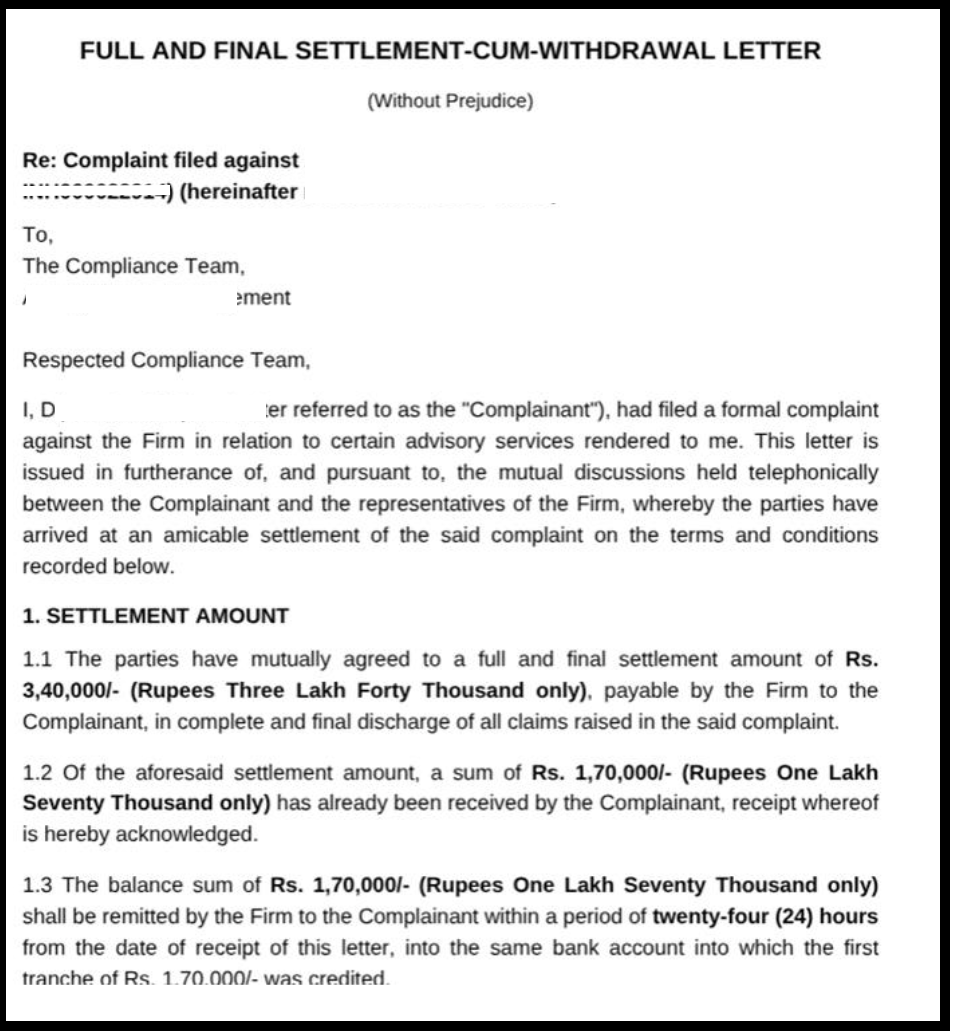
The more he traded, the more the firm made, whatever happened to his balance. Using this brokerage evidence, the case recovered ₹3,40,000 against a ₹4,45,000 claim, a 76.4 percent recovery.
The second case turned on a completely different kind of proof. This client had been shown a screenshot putting a SENSEX trade’s loss at about ₹4,800, while the contract note for the very same trade showed a loss of about ₹95,000, with the account separately charged ₹95,879 in brokerage and wiped out.
A screenshot that does not match the contract note is not a small discrepancy, the contract note is the official exchange record, and when what a client is shown differs from what the exchange recorded by a factor of twenty, that gap is documented and does not depend on anyone’s account of what was said.
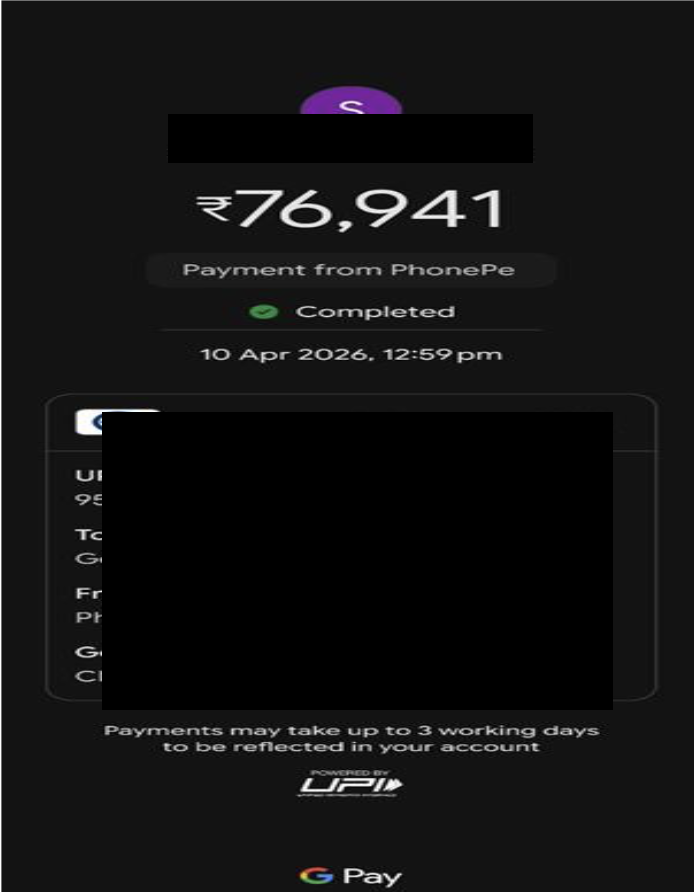
This client recovered the full amount claimed, ₹76,941, because a disputed charge behaves like a fee rather than a market loss, and it recovers the way a fee does.
One warning worth carrying into any brokerage claim: a referral link used to open an account often carries a code that earns the referring party a commission tied directly to trading volume, and if that arrangement was never disclosed, it is an undisclosed conflict of interest sitting underneath advice that was presented as being in the client’s interest.
Checking how an account was opened, and whether that link carried a code, is worth doing before assuming a loss was simply bad luck in the market.
Want Your Money Back? Follow This
Every case above followed the same underlying path once the brokerage-to-loss arithmetic was clear: a written complaint to the broker’s compliance officer naming the specific pattern (excessive brokerage, unauthorised trades, undisclosed referral conflicts, or a contract-note mismatch), followed by SEBI SCORES if unresolved, then SMART ODR, then exchange arbitration where several of the recoveries above were finalised.
The complete step-by-step process, what to attach, and realistic timelines at each stage are covered in our full guide: file a complaint against your stock broker.
Is your brokerage bill running far larger than your actual trading loss?
We total your brokerage against your account size and trading loss, isolate the churning pattern in your own contract notes, and build the complaint around records the broker cannot dispute.
Register with us to let our team help you with your case.
Frequently Asked Questions
Add up the total brokerage from your contract notes and compare it against your account size and your actual realised loss. If brokerage makes up a large share of either figure, especially a share that runs close to or exceeds the market loss itself, that points to trade volume manufactured for commission rather than a genuine market outcome.
The contract note is the official exchange record and is what counts in a dispute. A significant gap between what you were shown on a screenshot or call and what the contract note states is documented, verifiable evidence, and it was the deciding factor in one of the full recoveries described above.
It can matter significantly. A referral link usually carries a code that earns the referring party a commission tied to your trading activity. If that arrangement was never disclosed to you, it is an undisclosed conflict of interest, and your account-opening record will show whether that code was used.
No. A privately drafted disclaimer, including lines stating you accept full responsibility for losses, cannot override SEBI's regulations. It does not authorise a broker to handle your account without consent, place trades without confirmation, or generate turnover purely to earn commission.
High brokerage relative to your capital and loss is strong evidence on its own, but a complaint is considerably stronger when paired with proof of who was actually giving the trade instructions, such as WhatsApp messages, call logs, or an account-opening record showing a referral arrangement.





 Add us as a preferred source on Google »

