
Quick Summary
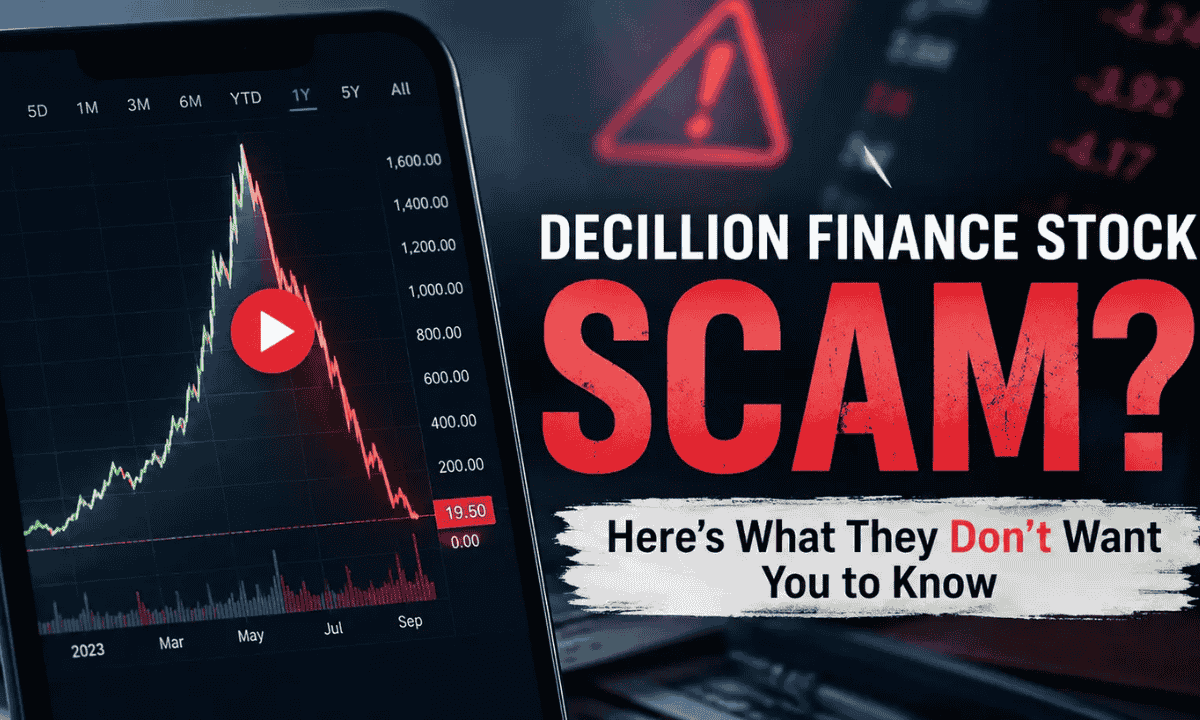
Two YouTube videos in January 2023 promised Decillion Finance Limited would rocket from ₹55 to ₹2,000 within a year, citing a fake joint venture with Bajaj Finance and fake mutual fund buying. The stock actually jumped 322% in 12 trading days before crashing back down. SEBI traced the videos to a family and friends network built around Manish Mishra, who bought heavily before the videos went up and sold almost everything while the price was inflated. On August 3, 2026, SEBI fined the group over ₹2 crore combined.
A YouTube channel promised a stock would multiply 36 times over, and someone walked away with ₹1.27 crore before it crashed.
SEBI took over three years to trace the videos behind it. Know the whole thing here.
The Videos That Promised a 36x Return
In January 2023, a YouTube channel called Stock Yatra posted two videos about Decillion Finance Limited, a company listed on BSE under code 539190.
The first video, uploaded on January 1, told viewers the stock was at ₹55 and would hit ₹500 in three months and ₹2,000 within a year.
It claimed mutual funds and foreign institutional investors had already bought in, and that Decillion Finance was about to enter a joint venture with Bajaj Finance.
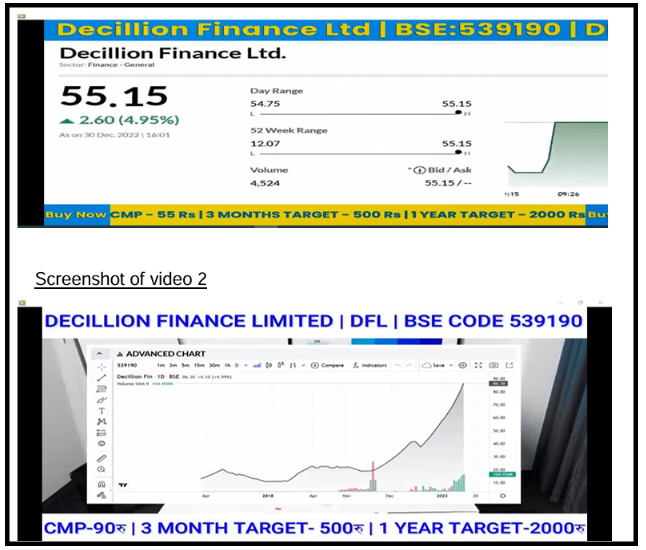
The second video, uploaded on January 14, doubled down. It said the channel had called this trade 12 days earlier, that the price had already climbed from ₹50 to ₹90, and repeated the same ₹500 and ₹2,000 targets. It also claimed promoter holding had increased and that HNIs and PMS funds were buying.
Together, the two videos were viewed more than 23 lakh times.
How the Stock Actually Moved While the Videos Spread
Decillion Finance’s share price opened at ₹22.55 in October 2022. By December 30, 2022, right before the videos went up, it had already climbed to ₹55.15.
Once the videos started circulating, the price kept climbing. It hit ₹95.10 on January 17, 2023, a 322% jump from where it started three months earlier. Daily trading volume during this window jumped from an average of 16,173 shares to 57,535 shares.
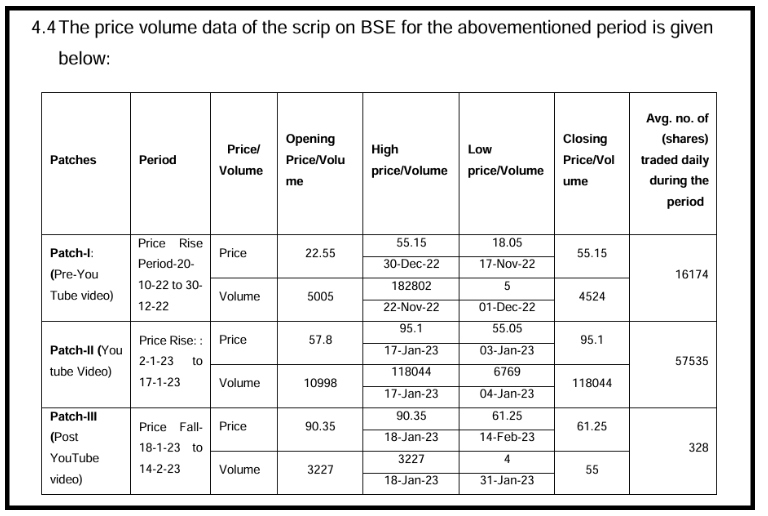
Then it reversed. By February 14, 2023, the price had fallen back to ₹61.25, and daily volume had collapsed to just 328 shares. No positive business announcement from the company explains any of this movement.
Tracing an Anonymous Channel Back to a Family
SEBI summoned Google for details on both videos. Google’s records showed both were signed up and uploaded from the same account, using an email address tied to the channel name itself.
Investigators then traced the upload IP addresses. The first video’s IP was linked, through the internet provider’s records, to a mobile number registered to Abhay Dwivedi.
The second video’s IP had been shared among eight users during a narrow two-minute window, one of whom was Anshu Mishra.
Anshu Mishra turned out to be the wife of Manish Mishra, the person SEBI identified as the one who organised the entire scheme. Abhay Dwivedi, meanwhile, is the younger brother of another noticee who was already a known associate of Manish Mishra’s.
From there, SEBI mapped out a wider web: brothers, sisters, brothers-in-law, an old friend, a company director, all linked through phone records, shared addresses, and joint bank transactions.
Decillion Finance Publicly Disowned the Videos
When SEBI asked the company to clarify, Decillion Finance wrote to BSE stating that the claims in the videos were false and misleading, and that unknown persons were misusing the company’s name without its knowledge or involvement.
The company also said it had filed police complaints over the matter, including with the local cybercrime department.
That statement matters because it rules out the possibility that this was some kind of company-backed promotion. The people profiting from the fake hype had no official connection to Decillion Finance at all.
The Buy-High-Sell-Higher Pattern SEBI Found in the Trades
Before the videos went up, Manish Mishra’s group had already bought roughly 2.3 lakh shares of Decillion Finance during the run-up in price.
Once the videos pushed the price even higher, the group sold almost all of those same shares, netting what SEBI calculated as wrongful gains of around ₹1.27 crore.
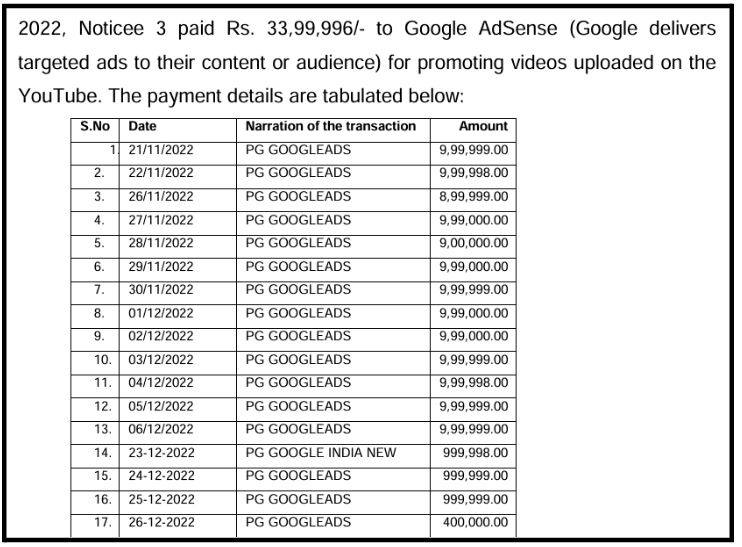
To make sure the videos reached as many people as possible, Manish Mishra paid nearly ₹34 lakh to Google AdSense in a single month to promote them, and a connected entity paid several lakh more.
This isn’t the first time this particular network has shown up in a SEBI order either.
The same group was previously connected to SEBI’s March 2023 order on Sadhna Broadcast and Sharpline Broadcast, the widely reported case that also barred actor Arshad Warsi and his wife for a similar YouTube-driven scheme.
A Second, Unrelated Manipulator Working the Same Stock
Separately, SEBI found that one individual investor, Gaurav Jaiswal, was doing something different but equally deliberate in the same stock.
Jaiswal placed a series of very small buy orders, often just a single share, at moments when much larger sell orders were sitting in the market. Each of these tiny trades nudged the last traded price up slightly.
SEBI found that 24 such trades, spread across 12 different trading days, accounted for as much as 22% of the stock’s entire positive price movement during certain periods. That’s a lot of influence from very small trades.
Regulators concluded Jaiswal had no genuine intention of building a real position. The small orders existed purely to mark the price higher.
Who Got Penalized and How Much
SEBI ultimately let several noticees off the hook, finding no solid evidence connecting them to the scheme. But for the core group, the penalties were substantial.
Abhay Dwivedi and Anshu Mishra, who uploaded the videos, were fined ₹2 crore jointly.
Manish Mishra and six connected associates were fined the same ₹2 crore jointly for the manipulation itself, plus a separate ₹5 lakh jointly for failing to disclose their shareholding changes as required.
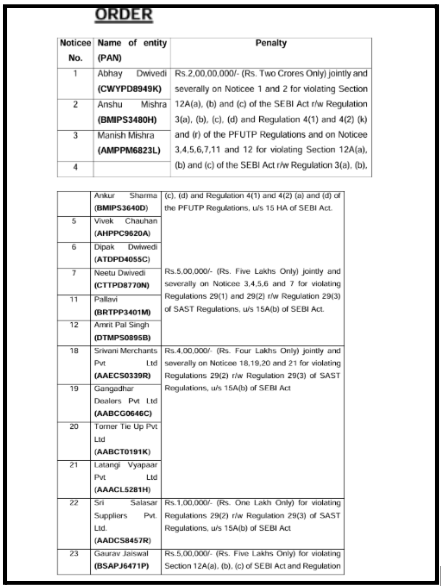
Four connected shareholder companies were fined ₹4 lakh jointly for similar disclosure failures, and one more company was fined ₹1 lakh separately.
Gaurav Jaiswal, for his small-order manipulation, was fined ₹5 lakh on his own.
If you’ve ever bought a stock because a YouTube video promised it would multiply, this case is a reminder of what’s usually happening behind the scenes. Before you act on a stock tip, it helps to understand how a pump and dump scheme actually plays out.
It’s also worth learning the specific warning signs that separate a genuine stock call from a manipulation setup.
Did you buy a stock based on a social media tip that turned out to be manipulated?
Our team helps investors document losses from pump-and-dump schemes and escalate them through SEBI SCORES and other channels.
Register with us for a free case review.
Report. Recover. Stay Fraud Free.
Frequently Asked Questions
They claimed the stock would go from ₹55 to ₹500 in three months and ₹2,000 within a year, backed by fake claims of a Bajaj Finance joint venture and mutual fund buying.
Yes. It rose 322% from ₹22.55 to ₹95.10 over about 12 weeks, then crashed back down to ₹61.25 within a month, with no real business reason behind either move.
No. The company told BSE in writing that the videos were false and that unknown persons were misusing its name, and it filed police complaints over the misuse.
Yes. The order notes the same network was previously linked to SEBI's 2023 case on Sadhna Broadcast and Sharpline Broadcast, the case that also barred actor Arshad Warsi and his wife.
Be skeptical of any stock tip promising a specific multi-bagger target price, verify claims like joint ventures or institutional buying directly from the company's official filings, and never buy purely because a video or channel says a stock recently spiked.


 Add us as a preferred source on Google »

