Have you recently come across DSJ Exchange through a Telegram group or a crypto trading invite?
The platform promotes structured trading signals and daily return projections that look systematic and easy to follow.
On the surface, it appears simple; follow the signals, compound your profits, and grow your capital.
But before you invest, one important question comes first:
Is DSJ Exchange actually legal?
A professional-looking presentation does not automatically mean regulatory approval.
In this article, we examine DSJ Exchange’s legal status, its return claims, and what regulators have said, so you can decide based on facts, not promises.
What is DSJ Exchange?
DSJ Exchange presents itself as a crypto trading platform that operates through signal-based trading.
The DSJ exchange login and registration process typically begins through an invitation link shared via Telegram or WhatsApp groups.
Users receive fixed trading codes, execute them inside their accounts, and follow a structured return model that projects daily compounding growth.

The platform promotes simplified trading, where investors do not need deep market knowledge.
Instead, they copy and confirm trade instructions, and the system calculates projected profits based on daily percentages.
It also positions itself as globally compliant and professionally managed. But understanding what a platform claims is only the first step.
The more important question is whether those claims stand up to regulatory verification.
Is DSJ Exchange Legal or Illegal in India?
To answer this properly, we need to examine what the platform promotes in its own business material.
In a presentation shared inside one of its Telegram business channels, DSJ Exchange-linked content highlights trading accuracy and structured profit projections.

This slide promotes:
- 99.6% accurate trading signals
- Guaranteed fund safety
- Guaranteed profit
In regulated financial markets, no authorised exchange guarantees profits. Markets move unpredictably.
Even licensed investment firms avoid using terms like “guaranteed safety” when discussing returns.
Now look at how the return model is explained.
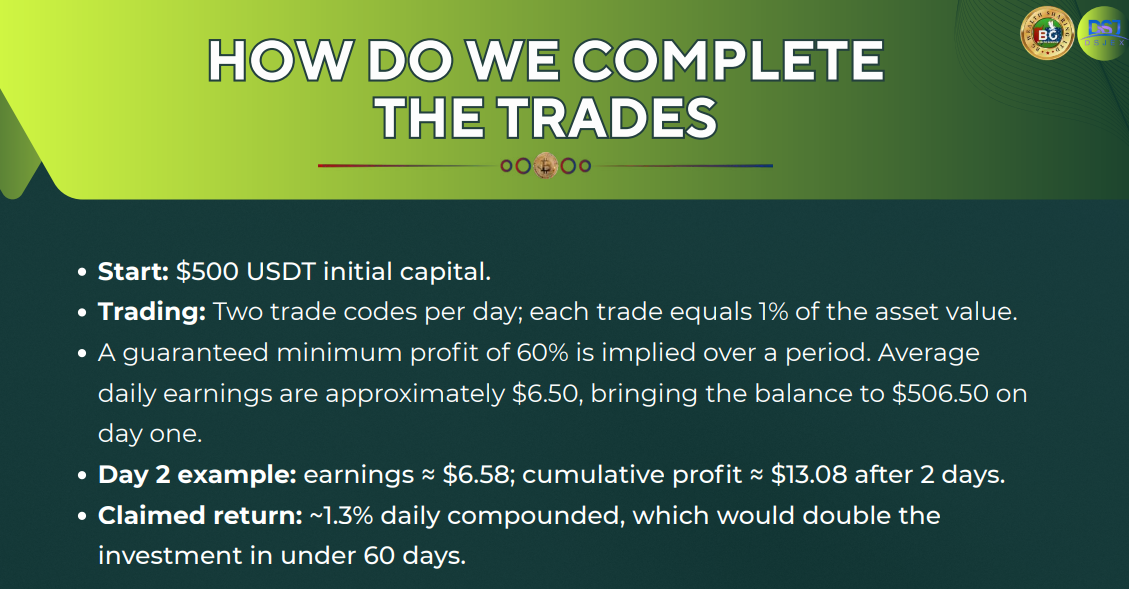
The presentation calculates a 1.3% daily compounded return, suggesting that capital could double in under 60 days.
When a platform projects fixed daily compounding returns, it moves beyond simple trading facilitation and enters the territory of structured investment promises.
This raises an important legal question:
If DSJ Exchange promotes guaranteed safety and fixed daily returns, but does not demonstrate clear regulatory authorisation in India, can it legally offer such a structure?
For Indian investors, the primary checkpoint remains:
Does DSJ Exchange hold approval from Securities and Exchange Board of India?
Publicly available records do not show clear SEBI authorization permitting DSJ Exchange to operate as a regulated investment platform in India.
When a platform claims global compliance but does not demonstrate regulatory approval in the investor’s own jurisdiction, that gap becomes significant.
And that naturally leads to the next issue, the return structure being promoted on the platform.
Is DSJ Exchange Registered?
While reviewing DSJ Exchange, we came across a business presentation PDF shared inside one of its Telegram business channels BG Wealth Sharing Plan presentation.
This document is a critical piece of the puzzle for anyone trying to determine if DSJ exchange is real or fake, as it outlines the platform’s bold claims regarding global compliance.
In that presentation, DSJ Exchange describes itself as “Compliant and Legal” and lists multiple international registrations.
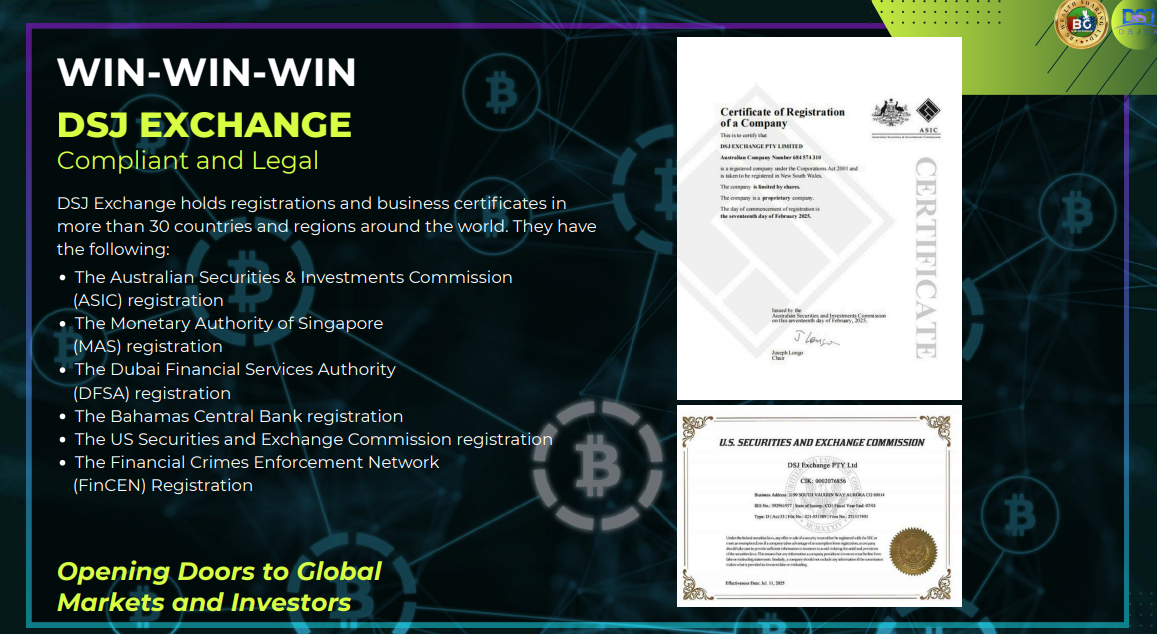
The slide mentions:
- ASIC registration
- MAS registration
- SEC registration
- FinCEN registration
- Registrations in multiple countries
At first glance, this creates a strong sense of global legitimacy.
It is vital for investors to understand a key distinction in the financial world: Registration is not the same as Authorization.
A company can register a basic business entity in a country, but that does not give it the legal license to manage trading funds, offer “guaranteed” returns, or operate a crypto exchange.
Before answering that, we must examine another critical factor: how the platform handles withdrawals.
Is DSJ Exchange Safe?
Safety depends on more than projected returns. It depends on regulation, transparency, and how a platform handles investor funds.
Earlier, we saw that the platform promotes daily compounding returns and applies conditional withdrawal rules. Now let’s examine whether regulators have raised any concerns.
Has Any Regulator Issued a Warning Against DSJ Exchange?
Safety also depends on regulatory status. Independent regulator action provides stronger insight than internal marketing claims.
Several international regulators have issued public warnings connected to DSJ Exchange–related activity.
1. FCA Warning
Before investing in any global platform, investors should verify its status with major financial regulators.
The UK’s financial regulator has already addressed this.
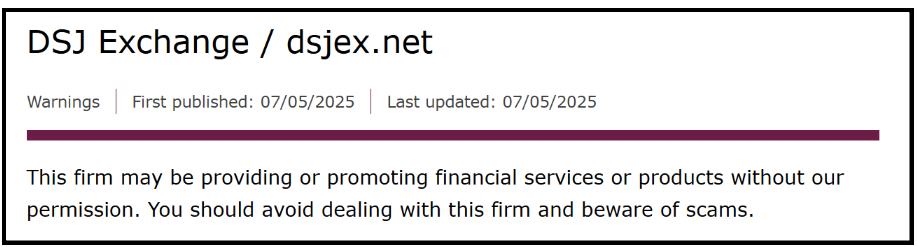
The Financial Conduct Authority has published a warning stating that the firm linked to dsjex-related operations is not authorised to provide financial services in the UK.
When a regulator classifies a firm as unauthorised, it means the entity does not hold recognised permission to offer regulated financial services in that jurisdiction.
2. Alberta Securities Commission Alert
Regulatory concern is not limited to one country.
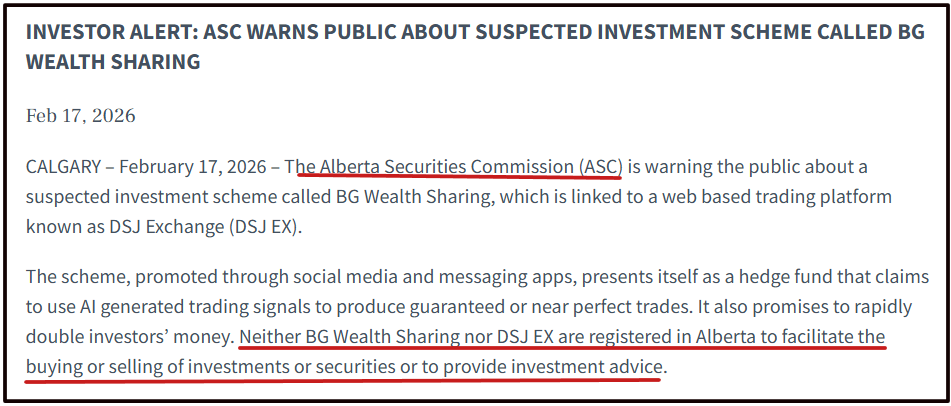
The Alberta Securities Commission has issued an investor alert stating that the related entity is not registered to trade or advise in securities.
This confirms that authorities in multiple jurisdictions have raised concerns.
3. Financial Markets Authority Warning
Another regulator has also issued a public warning.
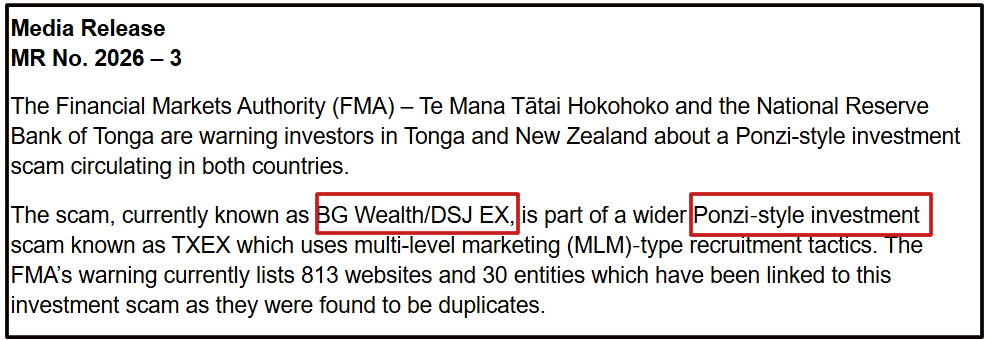
The Financial Markets Authority has released a caution regarding similar operations.
When regulators across different countries issue warnings, investors should treat the situation seriously.
Safety depends on:
- Clear regulatory authorisation
- Transparent operational structure
- Unrestricted access to investor funds
- Absence of official warnings
These regulators have explicitly warned that the platform may be targeting investors without legal permission.
For anyone still on the fence, the question: Is DSJ Exchange a scam, becomes increasingly urgent.
The ASC specifically noted that DSJ EX is linked to the “BG Wealth Sharing” scheme, a high-risk operation that promises unrealistic returns through AI signals while trapping user funds with high withdrawal fees and “management approval” delays.
These are the classic hallmarks of a financial trap designed to move money through crypto bridges where it can never be recovered.
Now let’s look at how investors can report concerns if they have already interacted with DSJ Exchange.
How to File Cryptocurrency Complaints in India?
If you have deposited funds, faced DSJ Exchange withdrawal issues, or suspect misleading activity, you should act quickly.
Early reporting increases the chances of documentation, investigation, and possible recovery.
Here are the practical steps Indian investors can take:
1. Report Cybercrime
File a complaint on the official National Cyber Crime Reporting Portal.
Select the option related to online financial fraud or cryptocurrency fraud. Upload:
- Transaction screenshots
- Wallet addresses
- Telegram chats
- Deposit proof
- Withdrawal requests
This ensures your complaint enters the official cybercrime system.
2. File a Complaint with SEBI
If the platform promoted structured returns, guaranteed profits, or investment-style services, you can report the matter to Securities and Exchange Board of India.
Use the SCORES (SEBI Complaints Redress System) platform to file details of:
- Return promises
- Regulatory claims
- Marketing material
- Any misrepresentation
3. Approach the Economic Offences Wing (EOW)
You can also approach your state’s Economic Offences Wing.
The EOW handles complex financial fraud and investment-related cases. File a written complaint with supporting evidence.
4. File an FIR at the Local Cyber Crime Cell
Visit your nearest Cyber Crime Cell and register an FIR. Carry printed copies of:
- Transaction history
- Wallet transfer records
- Communication screenshots
- Platform screenshots
An FIR formally initiates investigation at the local level.
Need Help?
Dealing with a platform like DSJ Exchange or similar crypto scams can feel confusing and overwhelming, especially when money is involved.
Many investors are unsure about what to do next. Should you wait?
Should you send more money to “unlock” withdrawals? Or ignore it and move on?
The most important step is to stop further transactions and document everything.
If you need guidance, we can help you understand the process clearly. We assist investors in:
- Organising transaction records and screenshots
- Structuring complaints properly
- Identifying the right authorities to approach
- Avoiding common mistakes that weaken a case
If you’re unsure about your next move, start with our fraud response plan and take the right action before it’s too late.
Conclusion
DSJ Exchange presents itself as a structured crypto trading platform with global compliance claims and systematic return projections.
Its business material highlights registrations, high signal accuracy, and daily compounding returns.
However, when we examine the details more closely, several important questions emerge.
The platform promotes guaranteed safety and fixed daily return projections.
It applies conditional withdrawal rules that restrict access to capital unless specific performance thresholds are met.
At the same time, multiple international regulators have issued public warnings related to DSJ Exchange–linked activity.
Public records also do not show clear regulatory authorisation in India under the Securities and Exchange Board of India.
Legality is not determined by marketing claims. It depends on regulatory approval, transparency, and compliance with financial laws.
Before investing in any platform especially one that projects fixed daily returns, investors should independently verify its regulatory status and fully understand how withdrawals and capital protection work.
In financial markets, protecting your capital is always more important than chasing projected returns.