
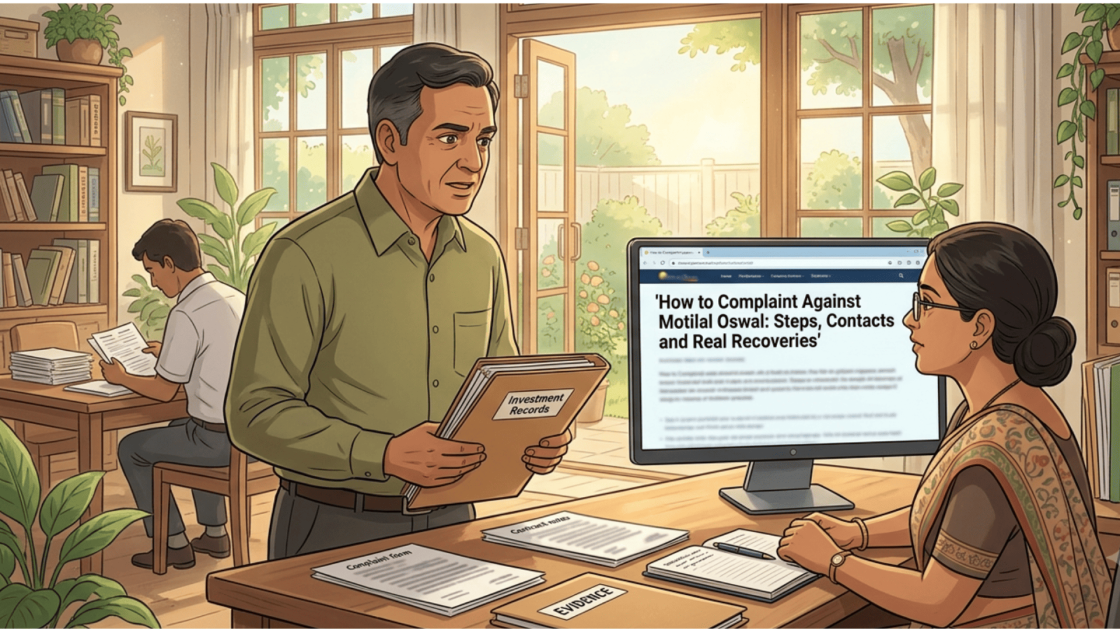
Quick Summary
If Motilal Oswal has charged you more than agreed, run trades you never approved, delayed your withdrawal, or stopped responding, a formal complaint route exists, and it works in four stages: the broker’s own grievance desk, SEBI SCORES, the exchange, and arbitration. The broker’s own disclosure shows 872 complaints in FY 2025-26, with the resolution rate slipping to 86.81 percent. This page carries every filing route with the exact emails and phone numbers, what the complaint data reveals, what users report, and a real case where our team recovered ₹28,320 for a first time investor who had lost everything.
You do not think about complaints when everything works fine.
You log in, place your trades, check your portfolio, and move on. But the moment something feels off, your entire perspective changes.
A trade appears that you did not place. Your charges do not add up. Your withdrawal takes longer than expected. You reach out for help, and you do not get a clear answer.
That is when you start asking the right question, what do you do now?
This guide answers it completely, from the first email to the final recovery.
When Should You File a Complaint Against Motilal Oswal?
Not every small glitch needs escalation. But some problems directly touch your money or your control over your account, and those should never be waited out.
The commonly reported issues cluster into a clear set, from charges to conduct.
If you find yours below, you are within your rights to raise a formal complaint:
- Trades placed without your clear consent, a situation covered in full on our page on Motilal Oswal unauthorised trading.
- Charges that feel higher than agreed or never quite add up, examined on our page on Motilal Oswal excess charges.
- Relationship managers pushing frequent trades, PMS, or mutual fund products.
- Brokerage churning, where trading activity exists to generate charges rather than returns.
- Withdrawals delayed without a clear reason.
- Account deactivated, suspended, or restricted without prior notice.
- Constant pressure to add funds or take trades.
- Complaints raised but never properly answered.
These issues do not automatically mean something illegal is happening.
But problems grow when communication lacks clarity and when you give up too much control over your account, and many investors wait hoping things fix themselves.
Delays only make cases weaker, so if your money is involved, act early and keep records of everything.
What Does Motilal Oswal Complaint Data Show?
Numbers give you a clearer picture than opinions, and the exchange publishes them for every broker.
Read the table year by year, and watch what happens between the second and third rows:
| Financial Year | Total Clients | Complaints | % of Clients | Resolved | Resolution Rate | Arbitration |
|---|---|---|---|---|---|---|
| 2022-23 | 879,629 | 516 | 0.05% | 504 | 99.61% | 19 |
| 2023-24 | 879,629 | 498 | 0.05% | 492 | 100% | 9 |
| 2024-25 | 1,014,875 | 1,078 | 0.106% | 1,078 | 100% | 2 |
| 2025-26 | 901,619 | 872 | 0.097% | 757 | 86.81% | 0 |
At first glance the percentages look small. Do not stop there.
In 2024-25, complaints more than doubled, and client growth did not rise at the same pace. That raises a simple question, are more users facing issues, or are more users now choosing to report them?
The resolution numbers look strong in the middle years, but read them carefully, because a complaint gets marked resolved once the broker responds, which does not always mean the issue was settled from the investor’s side.
And in 2025-26, the resolution rate dropped to 86.81 percent, meaning a portion of complaints stayed unresolved within the reporting period. If you already struggle to get timely responses, that number matters.
Arbitration cases have reduced over time, but fewer cases do not automatically mean fewer serious disputes, since many investors avoid that step because the process feels lengthy.
The broker’s regulatory record adds its own context too, covered on our page: SEBI penalty against Motilal Oswal.
How to File Complaint Against Motilal Oswal Online?
At this point you know your issue qualifies, your screenshots are saved, and the only thing standing between you and action is knowing where to knock first.
Most investors get this part wrong in one specific way. They jump straight to SEBI or the exchange in anger, get told to complete the earlier step first, and lose weeks coming back to the start.
The road has four stops, the broker’s own grievance desk, then the regulator, then the exchange, and finally arbitration for money disputes, and each stop only opens after the one before it closes without resolution.
So walk them in order, keep every reference number the road hands you, and treat each stage below as one more layer of pressure the previous stage could not apply.
Step 1: Complain to Motilal Oswal Directly
Your first stop is always the broker’s own grievance desk, and written beats verbal every time, because emails create the record everything later stands on.
Always mention your Client Code, registered mobile number, the nature of the complaint, and attach your supporting documents, whether you write or call.
Motilal Oswal Complaint Email
The broker runs dedicated grievance inboxes, and using the right one speeds everything up.
For broking related complaints, write to [email protected], and for demat and DP related issues, [email protected].
General account queries go to [email protected] first.
Send the email from your registered email ID, and you receive an auto acknowledgement carrying a complaint reference number, which becomes your tracking ID for every future correspondence.
Motilal Oswal Customer Care Number
Prefer speaking to someone first?
The customer service desk runs on 022-40548000 and 022-67490600, with 022-71881000 also serving client support.
Keep your Client Code ready before dialling, and whatever gets discussed on the call, follow it up with an email, because a call without a written record is a complaint that never happened.
Step 2: Escalate to SEBI SCORES
If no satisfactory resolution comes within 30 days, the regulator’s platform takes over.
Filing a SCORES complaint online puts SEBI’s own record behind your dispute.
The filing runs simply: register with your PAN, email, and mobile, select New Complaint, choose Intermediary and then Stock Broker, pick Motilal Oswal Financial Services Ltd, describe your issue, and upload your screenshots, statements, and email trail.
The broker must respond within 30 days, and this time the response goes on the regulator’s record.
Step 3: Move the Complaint to the Stock Exchange, NSE or BSE
If the response still disappoints, the exchange’s own grievance and dispute machinery opens, running through the official SMART ODR portal for conciliation.
Keep your SCORES reference number ready before approaching this stage, because the record travels with the case.
And if your trades ran on the BSE side, the exchange’s own filing route, from the portal and email ID to tracking your case, sits on our guide on the BSE complaint portal.
Step 4: File Arbitration
When your issue involves real money, unauthorised trades, hidden charges, blocked funds, and it remains unresolved, the final stage of share market arbitration disputes delivers a legally binding decision, usually within 3 to 6 months.
And this stage produces real results against this broker.
Tribunals have directed Motilal Oswal to pay ₹6,40,392.65 in a wrongful liquidation dispute and ₹1,12,48,910 with 12 percent interest in an unauthorised F&O case, and how those investors built their cases, what the arbitrators examined, and what each recovered is covered on our page on Motilal Oswal arbitration.
What Do Motilal Oswal User Reviews Report?
Before you choose a broker, and especially before you fight one, you should look beyond features and promises to how the platform performs when real users start using it.
User reviews show you that ground reality.
They reflect what people actually experience when things do not go as expected, and these come from the Google Play Store, highlighting different experiences over time.
While every review tells one side of the story, repeated concerns help you spot the patterns where users face issues, and three patterns repeat here.
1. Account Access and Withdrawal Issues
Some users raise concerns around account handling and withdrawal processes, where delays, lack of clarity, and sudden restrictions create the most frustration.
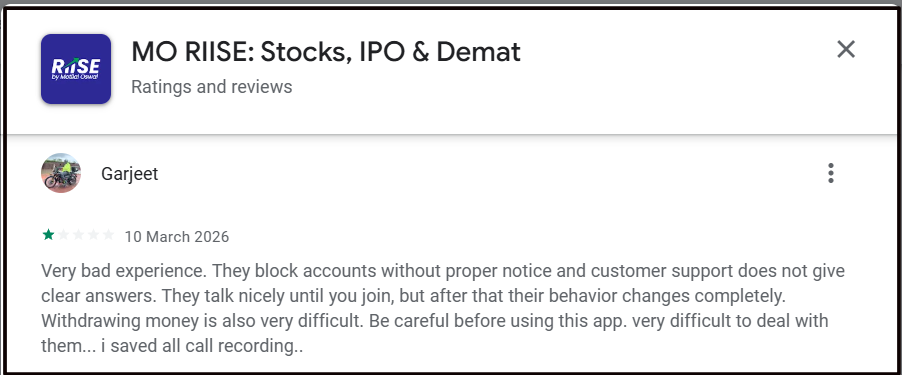
In this review, the user describes a situation where their account was blocked without clear communication.
They also mention difficulty in withdrawing funds and a lack of proper support response, which points toward a gap in communication and post onboarding support, exactly the situation where a written complaint trail becomes your protection.
2. Order Execution and Support Response
Technical issues during trading directly impact decisions, especially when timing matters, and in such moments users expect clear communication and quick resolution from support.
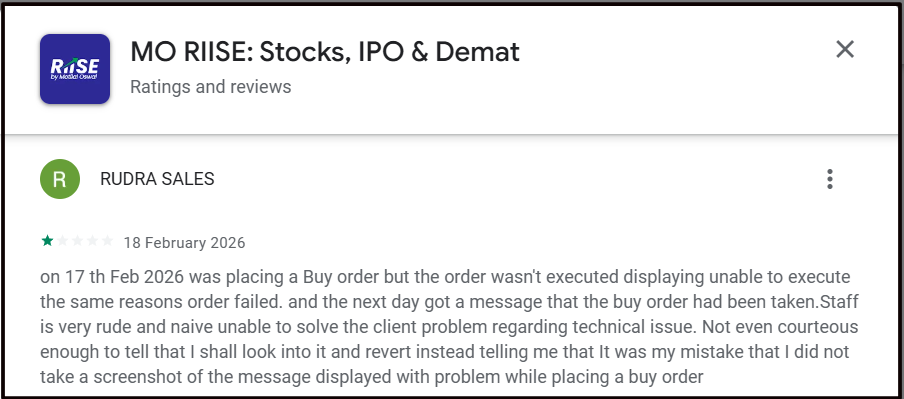
Here, the user highlights a failed order execution, and points out that support did not handle the issue properly afterward.
That raises concerns on two fronts at once, system reliability and customer support responsiveness, and if a failed execution cost you money, that loss belongs in a formal complaint, not just an app review.
3. Advisory Pressure and Investment Losses
Advisory services influence trading decisions significantly, and when expectations are not set clearly, dissatisfaction and losses follow.
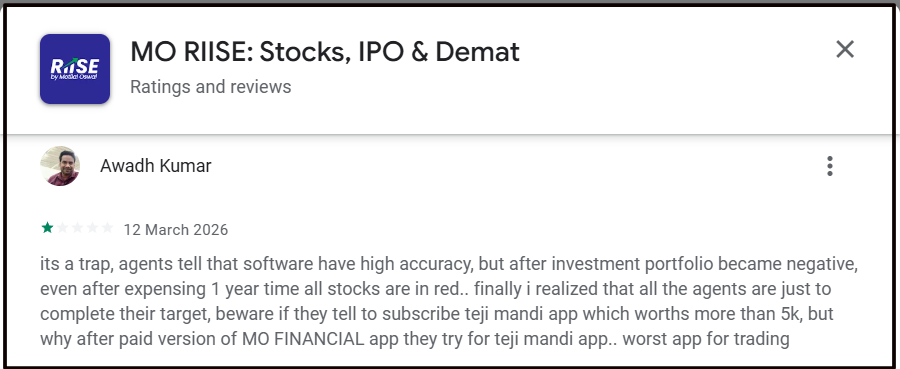
In this case, the user shares their experience with recommendations that did not perform as described, alongside being pushed toward additional paid services.
That reflects concerns about how advisory and sales approaches are handled, and where the pushing came through a local representative rather than the head office, the accountability route runs through our page on the Motilal Oswal authorised person complaint.
These reviews reflect individual experiences, and they may not represent every user.
But when similar concerns appear repeatedly, the pattern is the message, and once you lose clarity or control over your account, problems grow quickly.
Stay alert, question anything unusual, and act early, because every pattern above maps to a filing route in the steps you just read.
Real Recovery: How We Got ₹28,320 Back for a First Time Investor?
Now the proof that the process above actually pays, told exactly as it happened.
Rahul (name changed) had never traded before. Not once. A confident broker representative called him, promised guided profits, and pushed him to deposit ₹50,000.
The trading started immediately, and it started fast. Specific trade calls came through WhatsApp daily, buy this scrip, sell that, average this position, add more lots.
Lot sizes ran from 50 to 375 lots on a ₹50,000 capital base, dangerously aggressive for any investor, let alone a complete beginner.
When losses mounted and Rahul raised concerns, the response was smooth and rehearsed. “Main recover karwa dunga. Tension mat lo, sir.” And when losses worsened, “Aur amount lao. Sab market mein recover ho jayega.”
What came instead was a brokerage bill of ₹37,000 on a ₹50,000 account, nearly 74 percent of his capital eaten by charges, with the rest gone to the trades.
What we found when he came to us: fake profit screenshots of other clients sent to build trust, unsolicited personalised trade calls to a self declared non investor, churning through excessive switching and averaging, undisclosed brokerage no one would explain, assured return promises explicitly prohibited under SEBI rules, and a scripted push to fund exactly ₹50,000 with same day trading.
How the recovery ran: we mapped every piece of evidence to a specific violation, filed a regulation citing complaint with the broker’s compliance officer, escalated to SCORES with a point by point breakdown when no resolution came, and pursued the case through arbitration with full documentation.
| Amount | |
|---|---|
| Capital invested and lost | ₹50,000 |
| Amount recovered | ₹28,320 |
| Recovery rate | Around 57% |
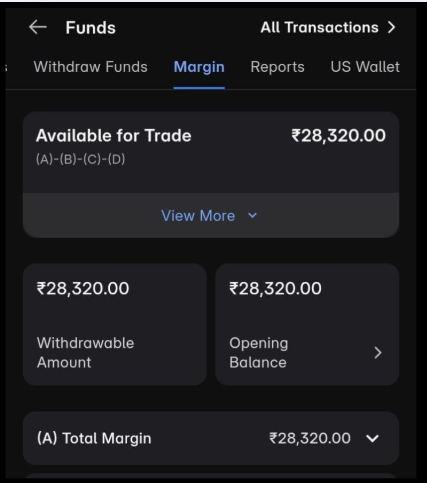
Was it the full amount?
No. But for a first time investor repeatedly told recovery was impossible, ₹28,320 back meant everything, and the screenshot above is the proof.
Check yourself against the pattern that trapped him: an unsolicited call promising guided trading, WhatsApp screenshots of other clients’ profits, exact scrips and lot sizes you never asked for, pressure to fund quickly, a promised recovery after losses, pushes to add more money, heavy account activity you never fully approved, and evasive answers about charges.
First time investors carry the highest risk here, not from carelessness, but because they have no reference point, and that gap is exactly what gets exploited.
Reading Rahul’s story and recognising the same WhatsApp messages sitting in your own phone?
We will review your transactions, map every irregularity to the violation it breaches, draft the complaint that gets attention, and carry your case from the compliance officer through SCORES to arbitration, end to end.
Conclusion
Brokers like Motilal Oswal have a responsibility to act in their clients’ best interests, from fair handling of funds to transparent communication and uninterrupted account access.
If you feel your rights as an investor were violated, do not hesitate.
Start with the written complaint to the broker, escalate through SCORES and the exchange when needed, and remember what the numbers on this page prove, 872 investors complained last year alone, tribunals have ordered this broker to pay over a crore in a single case, and recovery is real when the case is built right.
You are not alone, and you are not powerless.
Report. Recover. Stay Fraud Free.
Frequently Asked Questions
Start with a written email to [email protected] carrying your Client Code, the issue, and your documents. If 30 days pass without resolution, escalate to SEBI SCORES selecting Stock Broker as the intermediary, then to the exchange and arbitration if the dispute continues.
[email protected] handles broking related complaints, [email protected] handles demat and DP issues, and [email protected] takes general account concerns. Write from your registered email ID to receive the auto acknowledged complaint reference number.
The customer service desk runs on 022 40548000 and 022 67490600, with 022 71881000 also available. Keep your Client Code ready before calling, and always follow up any call with an email so the complaint exists on written record.
The broker's window is 30 days at the internal stage and 30 days again once SCORES forwards the complaint. Exchange data shows 86.81 percent of FY 2025-26 complaints resolved within the reporting period, so escalate the moment a window closes without resolution.



 Add us as a preferred source on Google »

