

Quick Summary
On July 28, 2026, SEBI cancelled the registration of Firstcapital Alternate Investment Trust, a fund holding registration number IN/AIF2/15-16/0181. The reason was simple: the fund did not file the reports it was supposed to file with SEBI every three months. It said it had no business going on, and later said the website was giving errors when it tried to file. SEBI did not accept either excuse. There is no fraud in this order, but there is a lesson for every investor: when a fund stops doing its basic paperwork, that is a warning sign, and the regulator treats it as one.
Most SEBI orders that make the news involve fraud, manipulation, or money that vanished. The Firstcapital Alternate Investment Trust SEBI order has none of that, and that is exactly why it deserves five minutes of your time.
A registered fund just lost its licence entirely, without a single rupee being stolen, because it treated a routine report as optional.
This page explains what happened, why SEBI rejected both of the fund’s excuses, and what the order quietly teaches anyone who puts money into a regulated fund.
What Is an Alternative Investment Fund (AIF)?
Let us start with the basics, because most people have never dealt with one of these.
An Alternative Investment Fund, or AIF, is a fund that collects money from a small group of rich investors and big institutions.
It does not take money from the general public as a mutual fund does.
It invests that money in things like private companies, startups, or other special assets, following a plan it has fixed in advance.
Because it handles other people’s money, SEBI keeps an eye on it.
One of the simplest things SEBI asks of every AIF is a short report, four times a year.
That report is exactly what Firstcapital did not send.
What Is a Quarterly Activity Report (QAR)?
Every AIF has to tell SEBI, once every three months, what it has been doing. This is called a Quarterly Activity Report, or QAR. It is filed online, on SEBI’s portal.
Think of it as a regular update. It tells SEBI what the fund is holding, where it is putting investor money, and whether it is sticking to its plan.
If these updates stop coming, SEBI has no way of knowing what the fund is doing with the money people gave it.
That is why sending this report is not a choice. A fund cannot skip it just because things are slow.
Firstcapital skipped it anyway, and that is how this whole matter began.
Why Did SEBI Cancel Firstcapital’s Registration?
SEBI found that the fund had simply not filed its quarterly reports for the periods in question.
The reports were due. They were not sent.
When SEBI sent a notice asking the fund to explain, the fund gave two reasons, and both are worth reading, because SEBI’s answers to them are the heart of this order.
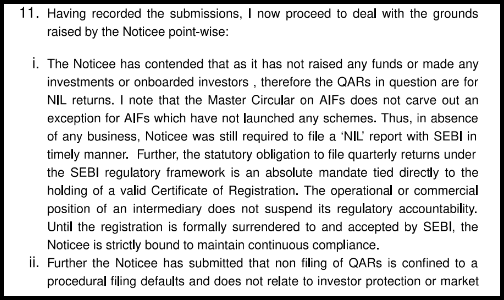
1. “We Had No Business Activity”
The first reason was that the fund had nothing going on, so there was nothing to report.
SEBI rejected this plainly.
The rule does not say file only if you are busy.
Even a fund with no activity has to file a report that says exactly that: a nil report. SEBI needs that confirmation.
Silence is not the same as saying nothing happened this quarter.
A quiet quarter still has to be reported as a quiet quarter.
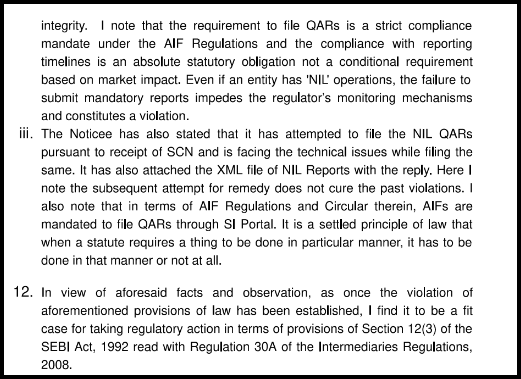
2. “The Website Was Giving Errors”
The second reason was that the fund did try to file, but only after getting the notice, and the portal was showing technical errors.
SEBI did not accept this either.
Trying to fix the problem after being caught does not undo the months when the reports were simply not filed. The reports were due long before.
They were not sent on time. A late attempt does not turn back the clock.
SEBI summed it up in one clear line: when the law says a thing must be done in a certain way, it has to be done that way, or not at all.
What Does the SEBI Order Mean for Firstcapital?
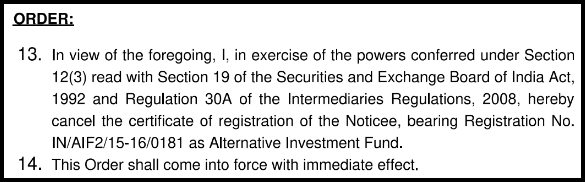
Once the violation was proved, SEBI used its power to cancel the fund’s registration.
The registration number IN/AIF2/15-16/0181 was cancelled, with immediate effect.
In plain words, Firstcapital Alternate Investment Trust can no longer work as a registered fund at all.
This is the harshest action SEBI can take against a fund like this.
It does not just fine the fund. It takes away its licence to do business.
How Does the Firstcapital SEBI Order Impact Retail Investors?
First, be clear on one thing.
No one was found to have been cheated here. This is about missed paperwork, not stolen money.
But it still teaches you something useful.
The safety you get from a regulated fund comes from the fund actually doing its duties. The reports it files are what let SEBI watch over your money.
When a fund stops filing, that watch switches off, and you lose the very protection you were counting on.
So a fund that is careless about simple, required paperwork is telling you something, even if nothing worse is ever proved.
If the people running it cannot manage a report they are legally bound to send, it is fair to wonder what else they are ignoring.
Two simple habits come out of this, one for before you invest and one for after.
Make both of them routine:
- Before you put money into any fund, check that its SEBI registration is active and in good standing. This is public information.
- After you invest, if the fund becomes hard to reach, stops sending you statements, or dodges questions about its filings, treat that as a reason to dig deeper early, not later.
Key Takeaway From the Firstcapital SEBI Order
The order is short, and its message is simple.
A fund does not have to steal to lose its licence. It can lose it just by failing, again and again, to do the basic reporting the law requires, and by treating that reporting as unimportant.
SEBI made it clear: having no business does not switch off the duty to report, and rushing to file after a notice arrives does not fix the silence that came before.
For you as an investor, the thing to watch is not only fraud. It is neglect.
A registered fund that cannot keep up with its filings is one to look at more closely, before its problems become yours.
Report. Recover. Stay Fraud Free.
SEBI cancelled its registration as an Alternative Investment Fund on July 28, 2026, with immediate effect. The action came because the fund repeatedly failed to file its quarterly activity reports with SEBI. No. This order is about a paperwork failure, not filing the required quarterly reports, and not about fraud, theft of money, or investor loss. The action was purely for missing a compliance duty. It is a short update every Alternative Investment Fund must send SEBI once every three months, through SEBI's online portal. It tells SEBI what the fund is doing with investor money, and it must be filed even in a quarter with no activity, as a nil report. Because the duty to file does not depend on being busy. SEBI needs a confirmation each quarter, even if that confirmation is that nothing happened. A fund cannot stay silent and treat silence as a report, so a nil report was still required and was not filed. That a fund's compliance record matters. The protection of a regulated fund depends on it actually meeting its duties to SEBI, so a fund that stops filing, becomes hard to reach, or avoids disclosure questions is showing a warning sign worth acting on early.Frequently Asked Questions




 Add us as a preferred source on Google »

