Imagine waking up on the day of your long-awaited trip. Your bags are packed, and your family is ready to go.
Suddenly, you realise the agent who took your money has vanished into thin air.
This is a heartbreaking situation that is becoming far too common in India today.
Scammers no longer just send suspicious emails. They set up professional digital stores and use friendly customer service to win your trust.
When we plan a vacation, we are looking for joy and relaxation. This makes it easier for us to believe a special offer that seems perfect.
This blog is not just about spotting a fake website. It is about understanding the tricks fraudsters use to steal your hard-earned savings.
By learning their patterns, you can make sure your holiday is remembered for the right reasons.
What are Holiday Scams?
In recent years, the surge in online bookings has given rise to sophisticated travel package scams.
To stay safe, you must realize these are not just bad agents. They are organized groups using a specific script to take your money.
They know exactly how to make you feel like you are getting a once-in-a-lifetime deal.
Common types of holiday scams include:
- The Fake Luxury Package: Scammers offer high-end trips at reduced prices but never book the rooms or flights. Some even create brochures with AI, including fake hotel pictures.
- The Religious Yatra Scam: These targets pilgrims by using spiritual trust to sell fake visas and travel plans.
- The VIP and Helicopter Scam: Fraudsters sell fake VIP passes or helicopter tickets for crowded festivals.
- The Clone Website Scam: Criminals build a site that looks exactly like a famous booking platform to steal your bank details.
- The Lucky Winner Scam: You get a message saying you won a free trip, but must pay fees to claim it.
How Do These Scams Operate?
The trap usually begins on your social media feed. You will see an ad with stunning photos of a villa or an international tour.
The price will feel like a total steal. Once you message them, a travel manager will call you.
These people are trained to be incredibly polite and helpful. They often spend days answering your questions to build a real bond.
They will send professional PDFs, fake invoices, and happy customer photos via WhatsApp. This makes everything feel official.
When they feel you are ready to book, the tone changes. They will create a fake emergency. They might say the last room is being held by someone else.
They might say the discount ends in 30 minutes, and the pressure stops you from thinking clearly. They will push for a quick UPI payment to a personal number.
Once they have the money, they block you and disappear.
How Can You Avoid Holiday Scams in India?
Protecting yourself from these scams is possible. You need to have a “verify first” mindset. Taking just one extra day to check the facts can save you from a massive financial headache.
1. Verify the Business Registration
Every real travel company in India must have a GST number. They should also be registered with the Ministry of Tourism.
You can use the NIDHI portal or the GST website to check these details.
If an agent makes excuses about these papers, do not send them any money.
A legitimate business is always happy to show its legal credentials. It proves they are the real deal.
2. Conduct a Digital Background Check
Do not trust the glowing reviews on an agent’s own website. Those are very easy to fake.
Instead, search for the company on independent sites like Google Maps or TripAdvisor.
Look for red flags like a burst of perfect reviews all posted on the same day.
Check for a physical office address as well. If a company has no online history older than a few months, stay away.
3. Look Closely at the Payment Methods
This is the most important safety check you can do. A real agency will always ask you to pay into a Current Account.
This account must be in the formal name of the company.
If the agent asks for a UPI payment to a personal number, stop immediately.
Scammers prefer personal accounts because they can withdraw the cash instantly. This leaves almost no trail for the police to follow.
4. Double-Check with the Actual Provider
If an agent sends you a flight ticket or hotel voucher, do not trust the PDF alone. Find the official customer care number for the airline or hotel online.
Call them directly and give them your booking reference.
Ask if it is valid and fully paid for. Scammers often book rooms on hold just to show you a screenshot.
They then cancel them as soon as your money hits their account.
Holiday Scams Real Cases in India
These real-life cases highlight how convincing these scams can be and why it is important to verify every detail before making any payment.
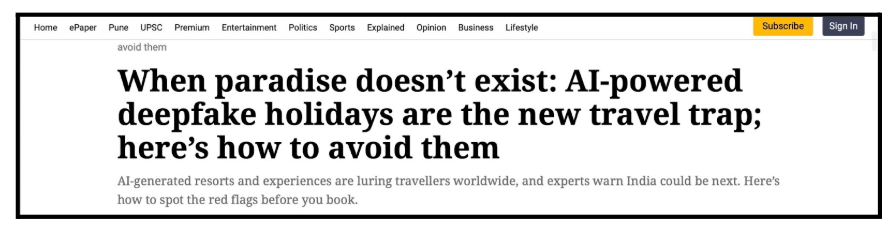
1. The Paradise That Doesn’t Exist Deepfake Scam
There is a new Deepfake scam where AI is used to create holiday spots that do not exist in the real world.
Scammers use advanced tools to make fake videos that look better than real life.
Actor Archana Puran Singh recently shared that her family lost a lot of money in Dubai this way.
They booked an indoor skydiving session through a professional-looking website that turned out to be a total fraud.
These fake sites often use AI-generated voices of travel vloggers to praise resorts that were never even built.
By the time you reach the destination, you find out the paradise was just a computer-generated trick.
Always cross-check a new resort on a real map before you pay a single rupee.
2. The Cancelled Bangkok Honeymoon
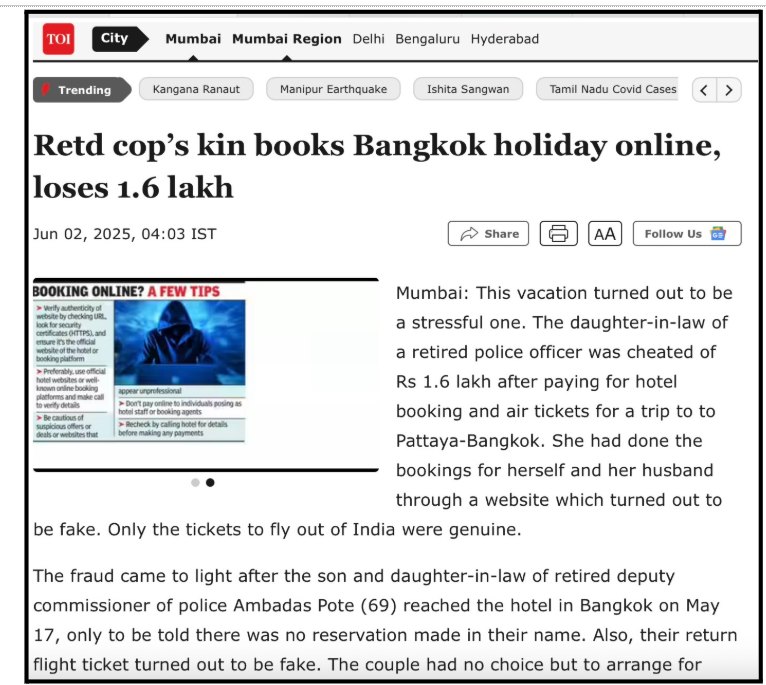
A retired police officer’s daughter-in-law in Mumbai lost ₹1.6 lakh while booking a Pattaya-Bangkok package online.
The scammer, operating under a fake agency name, sent genuine-looking flight tickets and hotel vouchers for the Pullman Pattaya Hotel.
However, when the couple landed in Bangkok, the hotel told them that the booking had been made and then cancelled just minutes later.
Their return flight tickets also turned out to be fake.
The agent switched off his phone as soon as the couple landed. This left them stranded in a foreign country with no accommodation or return travel.
3. The Chennai Package Tour Fraud
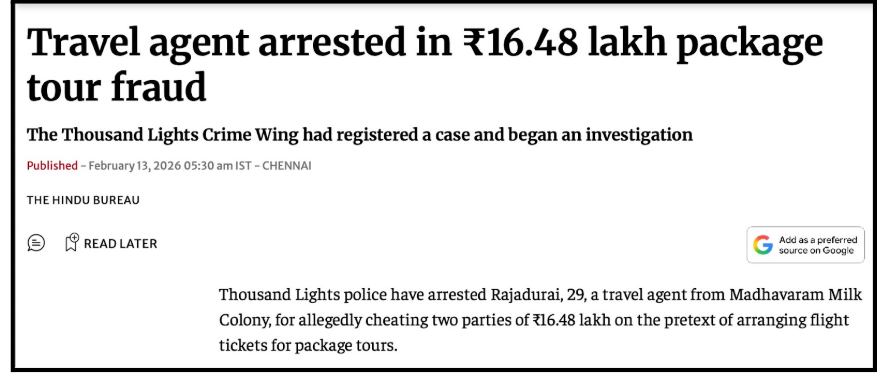
A travel agent in Chennai was recently arrested for cheating several groups out of ₹16.48 lakh.
In one instance, a group of 12 friends planned a trip to Thailand after seeing an ad on Instagram.
The agent promised a full package for ₹7.5 lakh and sent them flight tickets for a January 28 departure.
When the group reached Chennai airport, the agent stopped answering his phone and never showed up.
Another group was cheated of ₹8.8 lakh for a Kashmir tour in the same way.
Ways To Protect Yourself From The Travel Scam
To protect yourself from holiday scams, you need to take the following steps:
- Verify before you book or pay: Always research travel deals, websites, or sellers to ensure they are genuine and have real reviews.
- Avoid suspicious payment methods: Never pay using gift cards, wire transfers, or cryptocurrency, as these are commonly used in scams and are hard to trace.
- Be cautious of “too good to be true” offers: Extremely cheap holiday packages or free vacation deals often turn out to be fraudulent.
- Use secure and trusted platforms: Always book through official websites or reputable apps to reduce the risk of fake listings or phishing scams.
- Don’t rush decisions: Scammers often create urgency to pressure you into quick payments; take your time to evaluate offers carefully.
What To Do In Such Cases?
If you realise you have been cheated, you must move fast. In cybercrime, the first two hours are your best chance to get your money back.
1. Save All Digital Evidence Immediately
Take clear screenshots of the original ad and your WhatsApp chats. Save the bank transaction receipts and any fake vouchers they sent.
Do not delete messages or block the scammer yet. This digital trail is the only way the police can track them.
Organise these files into a folder so you are ready to show them to the authorities.
2. Call the Cybercrime Helpline Right Away
The national cybercrime helpline is the most important number to call. If you report the fraud quickly, the police can work with banks to freeze the money.
This stops the scammer from withdrawing it. This is very time-sensitive, so make the call the second you suspect something is wrong.
3. Report Online Fraud
Visit the official cybercrime portal and register your complaint under the Financial Fraud section.
Provide every detail you have, including phone numbers and UPI IDs.
This ensures your case is part of the national database. It will then be assigned to a specific officer for investigation.
4. Visit Your Bank Branch in Person
Go to your bank as soon as possible.
Submit a written letter about the fraud and include a copy of your cybercrime complaint. Ask the manager to flag the recipient’s account.
See if a chargeback or a reversal of funds is possible. This also helps the bank shut down accounts that scammers use to cheat others.
5. File an FIR at Your Nearest Police Station
Visit your local police station to file a physical FIR against the fraudster. Bring a printed copy of your online cybercrime complaint and all your evidence.
This includes bank statements and chat logs.
An FIR is a powerful legal document that officially starts a criminal investigation and is often required if you need to pursue the case in court or claim insurance.
Need Help?
If you have lost money in a holiday scam, it is normal to feel confused. We are here to help you look at your situation clearly.
If you are unsure about how to proceed or need guidance in filing your complaint, you can check the complaint process in our online fraud response plan.
This can also help you organise the confusing details into a clear list that the police and banks can actually use.
You do not have to handle this alone.
We provide the help you need to protect yourself and alert the right authorities.
Conclusion
The takeaway is that holiday scams work because they target our emotions, our excitement for a break, and our fear of losing a good deal.
Most victims are not careless; they are simply tricked because scammers put a lot of effort into looking real.
The best defence you have is to take your time and never feel pressured to pay. A real travel agent will always give you time to verify the facts.
But a scammer will always try to rush you. By staying alert and checking the details, you can keep your vacation memories and your money safe.