

Quick Summary
Global Vision Research is a SEBI registered Research Analyst run by Aneela Killedar out of Indore, holding registration number INH000015853 since 2024. It sends recommendations by SMS only, across plans like Smart Cash, HNI Future, and Money Club. Seven of its nine pricing plans work out to more than SEBI’s yearly fee cap once you do the maths. Its homepage uses return promises SEBI does not allow and shows logos from brands like Airbnb and Stripe that have nothing to do with the firm. Its own compliance pages disagree with each other on refunds and on whether its analysts hold positions in the stocks they recommend. This page walks through each finding in plain terms.
A Global Vision Research review has to start with the price list, because the numbers there set the tone for everything else on this page.
One single plan on this SEBI registered firm’s website costs ten times what SEBI allows a research analyst to charge in a year.
That is not a small rounding issue. It is the biggest problem on a site that has more than one.
This page checks the registration, breaks down every plan against the legal fee limit, and looks at where the firm’s own pages disagree with each other.
Global Vision Research Indore
Global Vision Research operates out of Indore, Madhya Pradesh, and its own website claims it has served more than 150 clients since receiving its SEBI licence in 2024.
The firm is structured as an individual Research Analyst registration held by Aneela Killedar, rather than a company with multiple directors or officers.
It runs from an office in Vijay Nagar, Indore, and delivers its recommendations to clients almost entirely through SMS, a detail worth keeping in mind before you look at what those recommendations actually cost.
Is Global Vision Research SEBI Registered?
Yes. Global Vision Research holds an active SEBI Research Analyst registration under number INH000015853, held by Aneela Killedar, active since 2024.
| Detail | Information |
|---|---|
| Registered Name | Global Vision Research |
| SEBI Registration Number | INH000015853 |
| Contact Person | Aneela Killedar |
| Registered Address | 316, Shagun Arcade, Above Apna Sweets, Vijay Nagar, Indore, Madhya Pradesh, 452010 |
| Contact Number | +91 9993 800 838 |
| Validity | 2024, Perpetual |
A SEBI registration is a real, checkable fact. It does not mean everything else is accurate.
Registration confirms the firm cleared SEBI’s basic eligibility rules. It says nothing about pricing, marketing claims, or how well the firm actually treats its clients, which is exactly what the rest of this page looks at.
What Services Does Global Vision Research Offer?
Global Vision Research sends its recommendations through SMS only, across seven main plans: Smart Cash, Stock Future, Stock Option, HNI Cash, HNI Future, HNI Option, and Index Option, along with a Money Club plan and a BTST Option plan billed quarterly.
SMS is a limited way to deliver research for the prices charged here. Investors who pay for the higher tier plans usually expect proper written reports and clear reasoning behind each call, not a short text message.
Whether an SMS only service justifies the fees charged is a fair question to ask before you pay, and the next section shows exactly how large some of those fees actually are.
Also Read: Rishav Kasera has 8 services, all priced identically, with no explanation for why the fee doesn’t vary.
Is Global Vision Research’s Pricing Above SEBI’s Fee Cap?
SEBI caps what a Research Analyst can charge an individual or HUF client at ₹1,51,000 a year. Checking Global Vision Research’s own pricing page against that limit tells its own story.
| Plan | Monthly or Quarterly Price | Cost for a Full Year | Within SEBI’s Cap? |
|---|---|---|---|
| Smart Cash | ₹11,000/month | ₹1,32,000 | Yes |
| Stock Future | ₹21,000/month | ₹2,52,000 | No |
| Stock Option | ₹21,000/month | ₹2,52,000 | No |
| HNI Cash | ₹65,000/month | ₹7,80,000 | No |
| HNI Future | ₹65,000/month | ₹7,80,000 | No |
| Index Option | ₹21,000/month | ₹2,52,000 | No |
| HNI Option | ₹65,000/month | ₹7,80,000 | No |
| BTST Option | ₹1,10,000/quarter | ₹4,40,000 | No |
| Money Club | ₹1,25,000/month | ₹15,00,000 | No |
Seven of nine plans exceed the yearly limit once added up. Money Club plan costs ₹1,25,000 a month. That works out to ₹15,00,000 a year.
The Money Club plan alone comes to nearly ten times the cap.

These prices also exclude 18 percent GST, so the real cost to a client is even higher than what the table above shows.

None of this is explained on the pricing page itself.
The homepage also lists separate HNI plans without describing any suitability check before a client signs up for one. SEBI rules require an assessment of whether a plan fits a client’s risk profile.
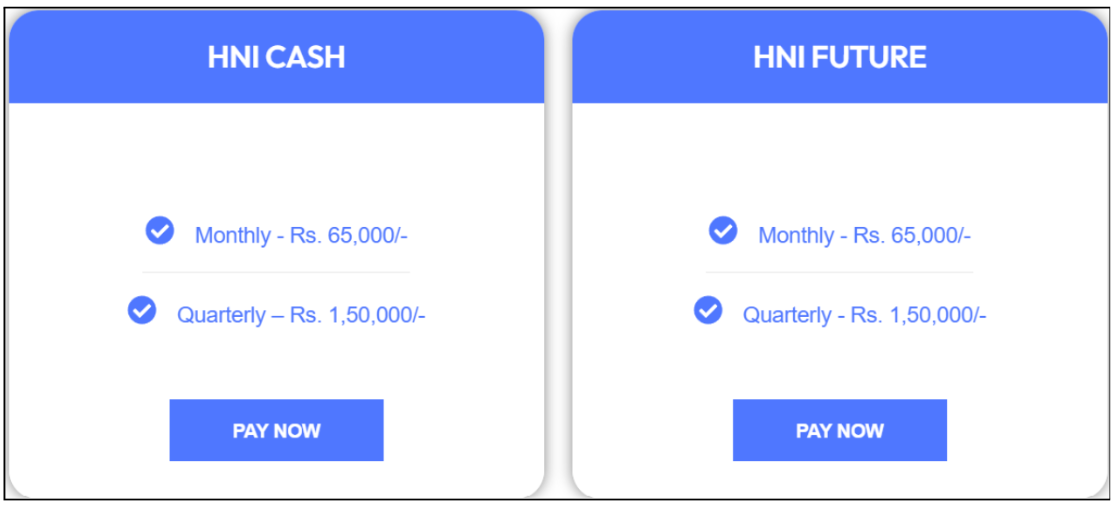
No note tells a visitor that a plan sits above the legal limit, and nothing checks whether a client’s risk profile actually suits a plan this expensive before they are allowed to pay for it.
Does Global Vision Research’s Marketing Cross a Line?
Beyond the pricing, a few things on the website make claims a Research Analyst is not supposed to make, or show things that are not really true.
Two plans promise “high returns” directly. The Option Infinity plan and the Index Master plan are both described as built to give high returns with low investment.
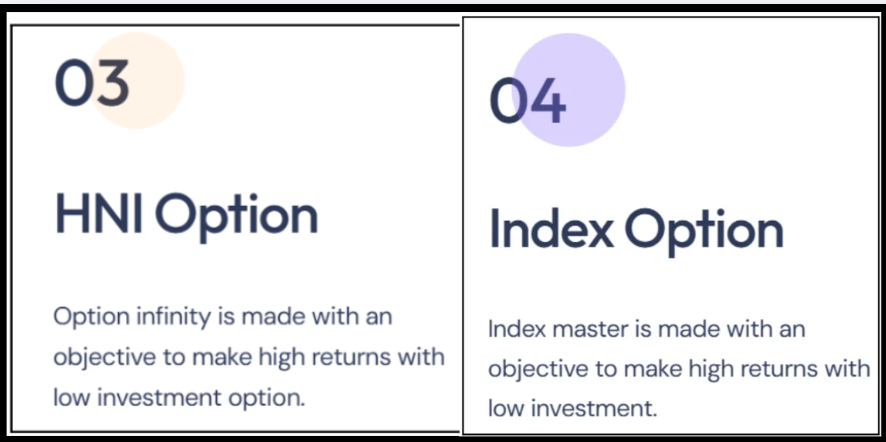
SEBI’s rules for research analysts do not allow this kind of language. A research analyst can share analysis and recommendations. It cannot promise a specific outcome, and “high returns with low investment” is exactly that kind of promise.
The homepage also shows unrelated brand logos. Brand logos from Airbnb, Stripe, Solana, Mailchimp, Sentry, and Pollock appear under a section called “How It Works.”
None of these companies work with Global Vision Research in any way. Showing well-known global logos next to a financial services homepage can make a visitor assume a partnership or endorsement that simply does not exist.
The website’s social media icons do not lead anywhere either.
Clicking them does not open any live profile. Icons that look like real links but go nowhere are a small thing on their own, but they add to a wider pattern of a site that looks more finished than it actually is.
Also Read: Research Samrat Insights shows a “100% Trusted Platform” banner sitting on a pricing page that breaks fee cap when annualised.
What Does Global Vision Research’s Complaint Data Show?
Global Vision Research’s own complaint disclosure has a math problem worth flagging here.
A recent monthly entry shows zero complaints received from SEBI SCORES, yet the same row marks one complaint as resolved in that same period.
A complaint cannot be resolved in a month where none were received or carried forward from before. The numbers as published simply do not add up.
The full tables are covered in detail on the Global Vision Research reviews page, alongside what actual Google reviewers say.
Do Global Vision Research’s Own Policies Contradict Each Other?
Several of the firm’s compliance pages disagree with each other, sometimes on basic points a client would rely on.
1. Two Pages Give Opposite Answers on Analyst Positions
The Disclosure page states that the firm and its staff do not trade in the securities they recommend.

The Disclaimer page says the opposite, stating that analysts or related people might be holding positions in those same securities.

One page says this never happens. The other says it might. A client reading both has no way to know which one is actually true.
2. The Refund Policy and the Terms Do Not Match
The Refund Policy page describes a pro rata refund after deducting charges already used, including an unnamed administrative fee.

The Terms and Conditions page separately states that fees once paid are not refundable at all.

These are two different answers to the same question, published on two pages of the same website. A client trying to get money back would not know which policy actually applies.
3. Clients Are Told to Trade Every Single Call
The Terms and Conditions instruct clients to trade on every recommendation given, for better results.

A research analyst’s job is to share research, not to control how a client trades.
Telling clients to act on every single call takes away their own judgement entirely, and pushes the relationship closer to the kind of service that needs a completely different SEBI registration, one Global Vision Research does not hold.
4. A Private Arbitrator Instead of SCORES or SMART ODR
Both the Terms and Conditions and the Disclaimer name a sole arbitrator chosen by Global Vision Research itself as the way to settle disputes.

SEBI’s actual dispute process for a research analyst’s clients runs through SCORES, SMART ODR, and exchange arbitration, not a private arbitrator picked by one side of the dispute.
A clause like this, if a client relied on it, could steer them away from the process they are actually entitled to use.
Also Read: Prabhat Mittal has a complaint disclosure that only begins in 2021, six years after the registration itself started.
What Gaps Appear on Global Vision Research’s Grievance Page?
The grievance page is supposed to be the clearest path to getting a problem fixed. On this site, it has some of the same gaps found elsewhere.
1. Customer Care and Compliance Are the Same Person
Jitendra Shukla is listed as both Head of Customer Care and Compliance Officer, using the same phone number and email for both roles.
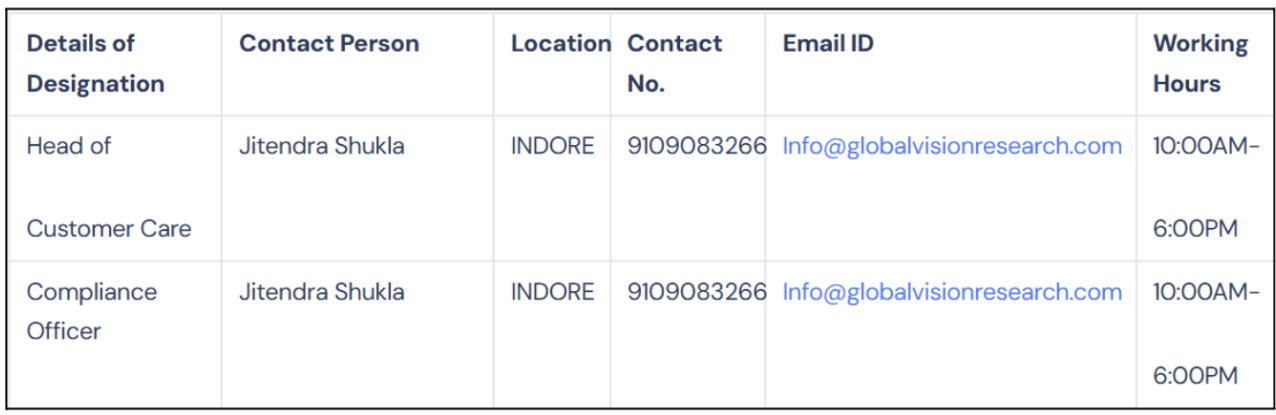
A compliance officer is meant to act as an independent check on the business, separate from day to day client support. Merging both roles into one person removes that independence completely.
2. SCORES and SMART ODR Are Never Mentioned
The grievance page only describes an internal process. SEBI requires every registered firm to tell clients that SCORES exists as an outside option.
A client who only reads this page would have no idea that a regulatory escalation path even exists.
3. A Response Time Sentence Cuts Off Mid Way
The page says a reply is expected “within 7 business,” with nothing after it.
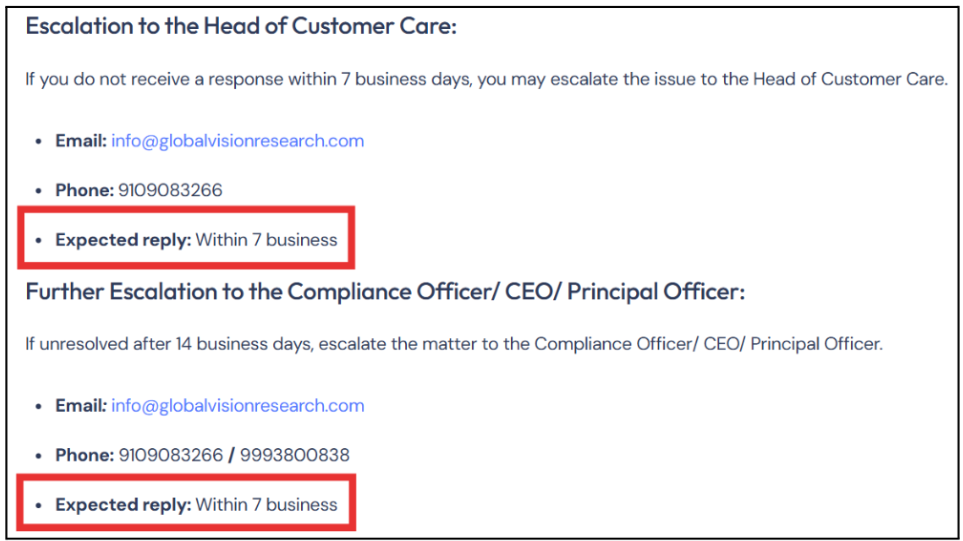
Whether this means 7 business days or something else is left unclear, which leaves a client unsure what timeline they can actually hold the firm to.
4. A Few Smaller Gaps Round Out the Picture
The About page never actually names the registered analyst behind the recommendations. The grievance page is the only place Aneela Killedar’s name shows up at all.
The Anti Money Laundering page contains only a generic explanation of what money laundering is, with no named Principal Officer and no policy written specifically for this firm.
What Can Global Vision Research Legally Do?
A research analyst is allowed to share research-based recommendations, publish reports and analysis, and offer advisory services through proper channels, always with risks disclosed clearly.
It cannot guarantee profits, charge fees beyond SEBI’s limit, mislead investors with incomplete data, or hide its complaint record.
The full breakdown of these rules, and how they apply to any registered analyst, is on the what can a SEBI registered research analyst do page on this site.
Where Can You Report a Problem With Global Vision Research?
If your own experience matches anything on this page, a few genuine channels exist to put it on record.
- SEBI SCORES complaint for a formal regulatory complaint
- SMART ODR portal for online mediation if SCORES does not resolve things
- Share market arbitration as the final, binding step
The full process, with timelines, is covered on the how to complaint against Global Vision Research page on this site.
Paid for a plan that turned out to breach SEBI’s fee cap?
We check your payment against the cap, confirm whether it qualifies as a valid complaint, and prepare your SCORES filing from start to finish.
Disclaimer: This review is based on publicly available information, including Global Vision Research’s own website, as of the date of publication and does not constitute investment advice. It is not a SEBI finding, and any conclusion drawn from it should be independently verified.
Conclusion
Global Vision Research holds a real SEBI registration, and that part checks out.
What sits alongside it does not hold up as well: pricing above the cap, banned promises, borrowed logos, and contradicting pages.
None of this proves wrongdoing by itself, but together it is more than enough reason to slow down before you pay.
Read the pricing table against the cap for whichever plan you are considering, and check both linked pages above for the full reviews and the full complaint process before you decide.
Report. Recover. Stay FraudFree.





 Add us as a preferred source on Google »

